Ultralight Flight Mirage

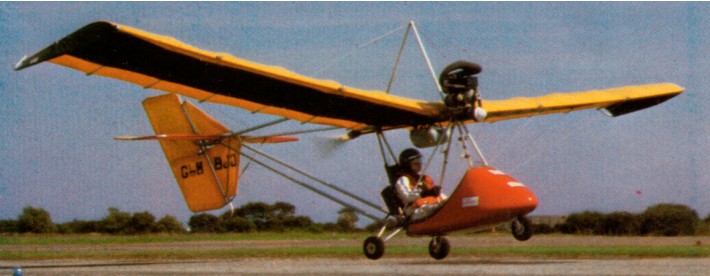
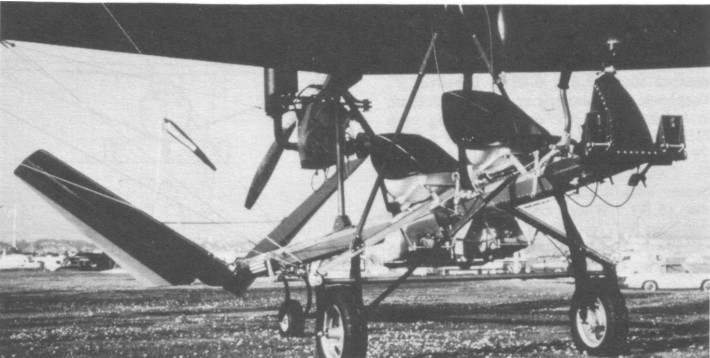
Designed by John Dempsey, the Mirage is another microlight, which holds the distinction of having been an outstanding new design at Oshkosh. Similar in appearance to the Quicksilver, it has a wing with both upper and lower surfaces. Three-axis controls and double-surface wings with droop tips, which are kingpost and cable braced. POWERPLANT: Two-cylinder Cuyuna has 2.0 reduction and is mounted in front below the wing. Drive shaft runs 58×27-inch pusher prop. LANDING GEAR: Tricycle gear has tail skid and 10-inch wheels.

Ultralight Flight Mirage Article
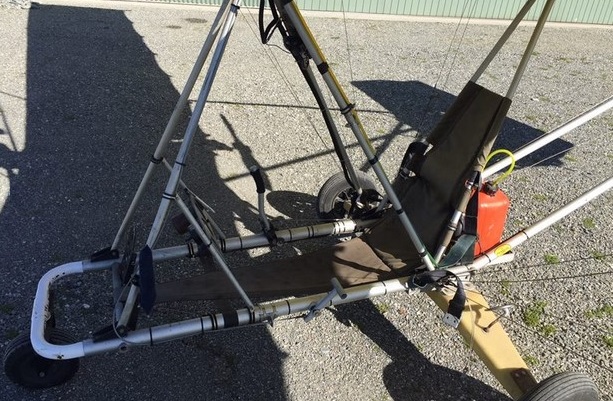
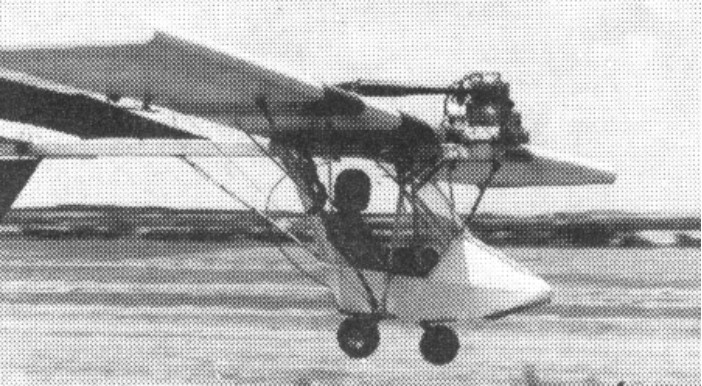
The Ultralight Flight Mirage Mk.II is a single seat single engined high wing monoplane with conventional three axis control. Wing has unswept leading and trailing edges, and constant chord; cruciform tail. Pitch control by elevator on tail; yaw control by fin mounted rudder; roll control by spoilers; control inputs through stick for pitch/roll and pedals for yaw. Wing braced from above by kingpost and cables, from below by cables; wing profile; double surface. Undercarrige has three wheels in tricycle formation, with additional tailskid; suspension on nosewheel and bungee suspension on main wheels. No ground steering (Optional: Push right go right nosewheel steering connected to yaw control). No brakes. Aluminium tube framework, with optional pod. Engine mounted above wing driving tractor propeller. Only certified aircraft grade materials and fittings.
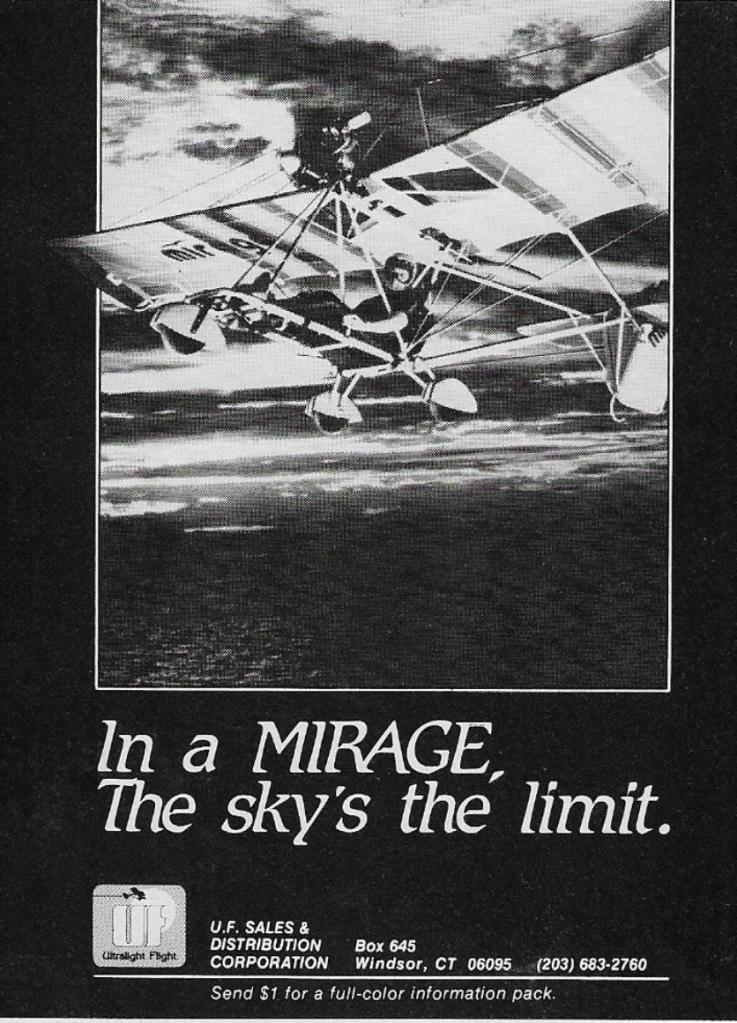
Inspired by the Humbug from Klaus Hill and with a very similar structure to the Vector 600 (on which Franklyn J Riley of Ultralight Flight worked) the Mirage has enjoyed considerable success since its first public presentation at Sun ‘n’ Fun in 1981 at Lakeland, Florida, where it won the prize for the most outstanding design.

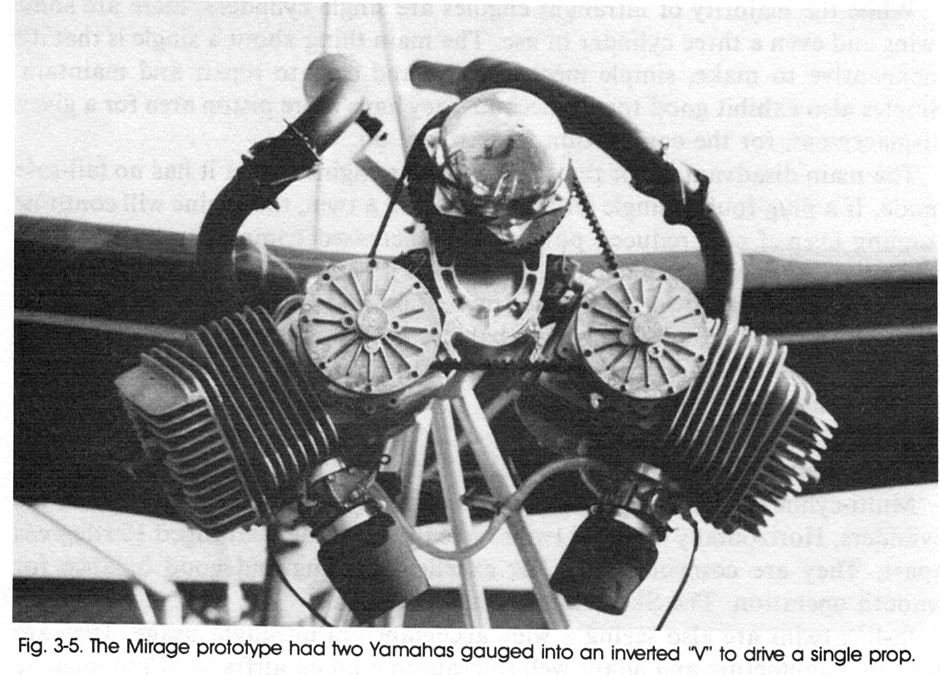
The first Mirage was fitted with two Yamaha KT100S engines of 15 hp each, with their belts forming an inverse V to drive a single twin blade propeller. The aircraft was next fitted as standard with a Cuyuna 430R 30 hp engine, which was replaced on the Mirage MkII, appearing in 1982, by the Kawasaki TA440 of 38.5hp, the Cuyuna 430RL becoming an option. On the MkII, the reduction drive connects to an enclosed drive shaft and the cable controls for the elevators are replaced by Teleflex. Ultralight Flight insists that Mirage uses only certified aircraft grade materials and fittings.
September 1982

The MkII was sold as a kit requiring 40 h for completion, according to Ultralight Flight, at a price of $4795 in 1983. The options include principally, an instrument panel, floats (Sealord $1095, Spaulding $1295), wheel fairings $117, steerable nosewheel $165, and a pod.

Gallery

Mk. I
Wingspan, 34 ft
Wing area, 140 sq.ft
Overall length, 17 ft
Empty weight, 219 lbs
Wing loading, 2.5 Ibs/sq.ft
L/D power-off glide ratio, 9:1
Cruise speed, 45-50 mph
Stall speed, 20 mph
Fuel capacity, 4 USG
Engine displacement, 429cc
Rated HP, 30 hp

Mk.II
Engine: Kawasaki TA440A engine
Max power 35 hp at 5600 rpm
Prop¬eller diameter and pitch 58 x 27 inch, 1.47×0.69m
V belt reduction, ratio 2.0/1
Max static thrust 215 lb, 98 kg
Power per unit area 0.24 hp/sq.ft, 2.6hp/sq.m
Fuel capacity 4.0 US gal, 3.3 Imp gal, 15.1 litre
Length overall 19.5 ft, 5.94 m
Height overall 8.6ft, 2.61m
Wing span 32.0ft, 9.75m
Constant chord 4.5ft, 1.37m
Dihedral 8 deg
Sweepback 0 deg
Tailplane span 8.0ft, 2.44 m
Fin height 4.7ft, 1.43m
Total wing area 144 sq.ft, 13.4 sq.m
Total spoiler area 2.3 sq.ft, 0.21 sq.m
Fin area 4.1 sq.ft, 0.38 sq.m
Rudder area 9.5 sq.ft, 0.88 sq.m
Tailplane area 11.7 sq.ft, 1.09 sq.m
Total elevator area 11.7 sq.ft, 1.09 sq.m
Wing aspect ratio 7.1/1
Wheel track 4.0ft, 1.22m
Wheelbase 5.6ft, 1.70m
Nosewheel diameter overall 10 inch, 25 cm
Main wheels diameter overall 10 inch, 25 cm
Empty weight 246 lb, 112kg
Max take off weight 500 lb, 227 kg
Payload 254 lb, 115 kg
Max wing loading 3.47 lb/sq.ft, 16.9 kg/sq.m
Max power loading 14.3 lb/hp, 6.5 kg/hp
Load factors; +5.6, 2.8 ultimate
Max level speed 65 mph, 105 kph
Never exceed speed 70 mph, 113 kph
Max cruising speed 50 mph, 80 kph
Economic cruising speed 45 mph, 72 kph
Stalling speed 25 mph, 40 kph
Max climb rate at sea level 1000 ft/min, 5.1 m/s
Min sink rate 430 ft/min at 29 mph, 2.2 m/s at 46 kph
Best glide ratio with power off 8/1 at 26 mph, 42kph
Take off distance 100ft, 30 m
Land¬ing distance 100ft, 30m
Service ceiling 14,500 ft, 4420 m
Range at average cruising speed 105 mile, 169 km

Engine: Rotax 429cc
Rated hp 30
2.0 reduction
Mmounted in front below the wing
58’ x27” pusher prop
Wingspan 34’
Wing area 140 sq.ft
Overall length 17’
Empty weight 219 lbs
Wing loading 2.5 lbs/sq.ft
L/D power-off glide ratio 9:1
Cruise speed 45-50 mph
Stall speed 20 mph
Fuel capacity 4 USG
Ultralight Aircraft Industries Wombat / Bunyip

The Wombat, which is available in two basic versions comes with a tricycle undercarriage, but in its Bunyip form is a tail dragger aircraft. Construction is Dacron covered aluminium structure. Development work is continuing and a powerplant change to the English Huntington Field engine is currently being planned.

Bunyip
Engine: Fuji Robin 440
Prop: 144cm x 96cm pitch
Wingspan: 8.41 m
Length: 4.7m
Weight: 150kg
Fuel capacity: 23 ltr
Econ cruise speed: 50 kts
Stall: 27kts

ULAC X-99

Tandem two seat single engined high wing monoplane with conventional three axis con¬trol. Wing has unswept leading and trailing edges, and constant chord; V tail. Pitch/yaw control by elevon; roll control by one third-span spoilers; control inputs through stick for pitch/roll and pedals for yaw. Wing braced from above by kingpost and cables, from below by cables; wing profile 100% double surface. Undercarriage has three wheels in tail dragger formation; steel spring suspension on tailwheel and suspension on main wheels. Push right go right tailwheel steering connected to yaw control. Brakes on main wheels. Aluminium tube framework, with optional pod. Engine mounted below wing driving pusher propeller.

Georges Borgeaud, the president of ULAC, acquired on the 14 August 1981 the rights to sell in Europe and Africa the Maxair Hummer. Starting with the basic single seater model designed by the late Klaus Hill, ULAC has developed its own tandem two seater, the X 99. The transformation principally in¬volved raising and reinforcing the wing, increasing the track of the undercarriage, the addition of spoilers to change the machine into a conventional three axis control aircraft and finally the adoption of the Hirth motor.

The prototype made its first flights at the beginning of 1982 above the Californian desert near to Salton Sea. For the distribution of this aircraft, George Borgeaud built a factory at Monthey in the Vallais area in Switzerland. Shown at the first European Salon of Microlights at Lyon Bron in Septem¬ber 1982, and later at the microlight assembly at Blois in France, this machine met with considerable success amongst the established pilots at whom it is aimed. Georges has consistently followed an intelligent sales policy, hinged on safety, and will only sell this aircraft in Europe to qualified private pilot’s licence holders.

Ready to fly X 99s cost US$8650 in 1983 ex works for the standard version, trailer included. Standard are compass, ASI, altimeter, rev counter and CHTG. As an option, it can have climb, turn and slip gauges. Its spoilers can be used together as air brakes and the machine can be flown solo (from the front seat) without any modification. The rear seat can be replaced by a large supplementary fuel tank and other options include skis, floats, pod, main wheel fairings, dual controls, a second instrument panel for the rear seat and a three blade propeller.

Georges was working on a new wing design which can be rigged in two different spans 32.8 ft or 45.9 ft (10.00 or 14.00 m), and the larger span would bring the X 99 comfortably within British ultralight law.

Length overall 17.1 ft, 5.75 m]
Height overall 8.8 ft, 2.65 m
Wing span 34.1 ft, 10.40 m
Constant chord 4.4ft, 1.32 m
Sweepback 0 deg
Tailplane span 8.2 ft, 2.50 m
Fin height 2.1ft, 0.90m
Total wing area 147 sq.ft, 13.7 sq.m
Total spoiler area 1.9 sq.ft, 0.18 sq.m
Tailplane area 19.4 sq.ft, 1.8 sq.m
Total elevon area 13.6 sq.ft, 1.3 sq.m
Wing aspect ratio 7.9/1
Wheel track 4.1 ft, 1.24 m
Wheelbase 7.5 ft, 2.25 m
Tailwheel diameter overall 10 inch, 26 cm
Main wheels diameter overall 14 inch, 35 cm
Floats, dimensions 10. 1 x 2.0 ft, 3.30 x 0.59 m
Skis, dimensions 2.1 x 0.6 ft, 0.87 x 0.14 m
Engine: Hirth 272R 438 cc, 40 hp at 7000 rpm
Prop¬eller diameter and pitch 54 x 30 inch, 1.37×0.76m
Toothed belt reduction, ratio 2.2/1
Max static thrust 252 lb, 114 kg
Power per unit area 0.27 hp/sq.ft, 2.9 hp/sq.m
Fuel capacity 3.2 US gal, 2.7 Imp gal, 12.0 litre in main tank
Fuel capacity 21.7 US gal, 18.1 Imp gal, 82.0 litre in reserve
Empty weight 320 lb, 145kg
Max take off weight 662 lb, 300kg
Payload 3421b, 155 kg
Max wing loading 4.501b/sq.ft, 21.9kg/sq.m
Max power loading 16.6 lb/hp, 7.5kg/hp
Load factors; +5.0, 3.0 ultimate
Max level speed 62 mph, 100 kph
Never exceed speed 71 mph, 115 kph
Max cruising speed 53 mph, 85 kph
Economic cruising speed 44 mph, 70 kph
Stalling speed 24 mph, 38 kph
Max climb rate at sea level 350 ft/min, 1.8 m/s
Min sink rate 680 ft/min at 28 mph, 3.5 m/s at 45 kph
Best glide ratio with power off 7/1 at 37 mph, 60 kph
Take off distance 180 ft, 55 m
Land¬ing distance 80ft, 24m
Service ceiling 13,100ft, 4000 m
Range at average cruising speed 75 mile, 120 km

Ultraleicht Wildente

Single seat single engined high wing monoplane with conventional three axis control. Wing has unswept leading and trailing edges, and constant chord; cruciform tail. Pitch control by elevator on tail; yaw control by fin mounted rudder; roll control by half span ailerons; control inputs through stick for pitch/roll and pedals for yaw. Wing braced from below by struts; wing profile Ga 549; double surface. Undercarriage has three wheels in tricycle formation; steel spring suspension on nosewheel and glass fibre suspension on main wheels. Push right go right nosewheel steering connected to yaw control. Brakes on main wheels. Aluminium tube framework, with pod. Engine mounted below wing driving pusher propeller.

Two prototype examples of this machine were on show at Friedrichshafen in March 1983, but the Wildente did not fly for the first time until 16 April. This machine has a welded tubular framework, which appears to have great rigidity and is also claimed to allow derigging and rigging in less than 10 min. It is sold built and ready to fly. Options include wheel fairings and a three blade propeller.

Length overall 19.4ft, 5.90m
Wing span 34.4ft, 10.50m
Constant chord 4.9ft, 1.50 m
Total wing area 166 sq.ft, 15.4 sq.m
Wing aspect ratio 7.2/1
Wheel track 5.1 ft, 1.55 m
Engine: Hirth F263, 22hp at 4000rpm
Propeller diameter 51 inch, 1.30 m
Belt reduction, ratio 1.8/1
Max static thrust 172 lb, 78 kg
Power per unit area 0.13 hp/sq.ft, 1.4 hp/sq.m
Fuel capacity 5.3 US gal, 4.4 Imp gal, 20.0 litre
Empty weight 221 lb, 100kg
Max take off weight 464 lb, 210kg
Payload 243 lb, 110kg
Max wing loading 2.79 lb/sq.ft, 13.6kg/sq.m
Max power loading 21.1 lb/hp, 9.5kg/hp
Load factors; +6.0, 3.0 ultimate
Never exceed speed 62mph, 100kph
Economic cruising speed 47 mph, 75 kph
Stalling speed 26 mph, 42 kph
Max climb rate at sea level 240 ft/min, 1.2m/s
Min sink rate 310ft/min, 1.6m/s
Best glide ratio with power off 9.5/1
Take off distance 130 ft, 40 m
Range at average cruising speed 124 mile, 200 km

Ultraflight Manufacturing Sparrowhawk / Aero-Dynamics Sparrow Hawk

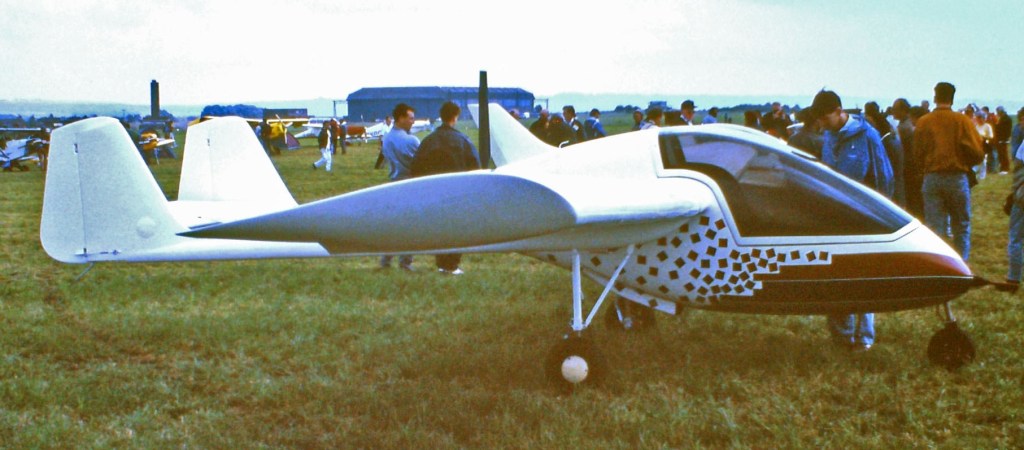
Aero-Dynamics Sparrow Hawk N5832M

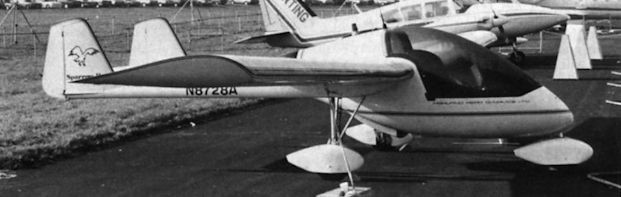
The Sparrow Hawk is a twin boom, twin fin, ultralight aircraft built with mixed construction including Kevlar, Carbon Fiber, Polyurethane Foam, a Rotax 532 four-stroke engine in Pusher configuration, and features a cantilever shoulder wing, fixed landing gear and two seat enclosed cockpit. Former Boeing design engineer Charles “Chuck” Herbst was responsible for the original design.

The public debut of the Sparrow Hawk was at the EAA Annual Convention and Fly-In in July 1985, when two Sparrow Hawks attended, registered N5793F and N5832M. The manufacturer and model of N5793F is recorded by the Federal Aviation Administration (FAA) as an “Ultralight Aircraft Ltd Sparrow Hawk Mk II”, while N5832M is recorded as an “Aero Dynamics Ltd Sparrow Hawk MkII”.
Seven were manufactured by Aero Dynamics Limited.

Sparrow Hawk (G-BOZU, not marked, arrived by road) at a fly-in at Wroughton Airfield in July 1992

Although it did fly, the SparrowHawk was a somewhat marginal airplane that needed redesign to correct a number of problems including empennage flutter, drive design and some less than sufficient structure. It was also underpowered.

The design faltered and exchanged hands several times, being held longest by the same folks who owned the now failed NSI. During that period the project really went nowhere, and it was gathering dust in the corner of their shop.

A Sparrow Hawk (N23SH) is currently preserved at the Oakland Aviation Museum.

Sparrow Hawk II
Powerplant: 1 × Rotax 532, 64 hp (48 kW)
Wingspan: 34 ft 5 in (10.49 m)
Length: 17 ft 10 in (5.44 m)
Maximum speed: 105 mph (169 km/h; 91 kn)
Cruise speed: 95 mph (153 km/h; 83 kn)
Stall speed: 36 mph (58 km/h; 31 kn)
Crew: one
Capacity: one passenger

Sparrow Hawk IIB
Powerplant: 1 × 90hp Norton P62
Wingspan: 34’5″
Length: 17’10”
Useful load 700 lb
Maximum speed: 130 mph (09 km/h; 113 kn)
Cruise speed: 120 mph (193 km/h; 104 kn)

Ultra-Fab Sundowner Convertible

Centre mounted joy stick, rudder pedals, tail wheel steerable through rudder pedals.

Empty wt: 248 lbs
Wing span: 30’6”
Wing area: 148 sq.ft
Height: 7’
Length: 17’
Fuel cap; 4.5 USG
Construction: Aluminium, Dacron
Engine: Rotax 277 (268 cc) 28 hp
Static thrust: 230 lbs
Max wt: 500 lbs
Stall: 25 mph
Max speed: 62 mph
Vne: 75 mph
Climb rate: 800 fpm @ 35 mph
Design limit: +6, -4g
Glide ratio: 7.5-1
Wing loading: 3.42 lbs/sq.ft
Power loading: 17.86 lbs/hp

Ultra Efficient Products Invader

Invader IIIB

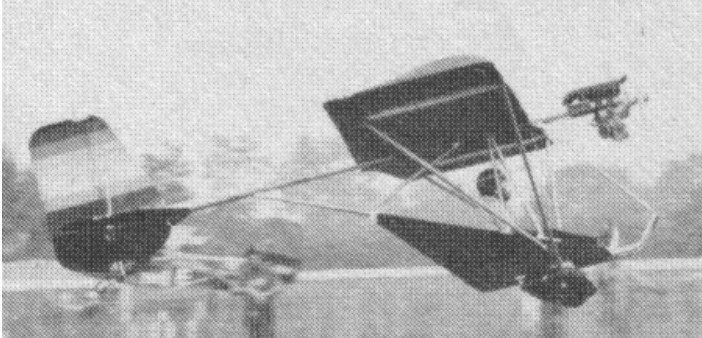
Single seat single engined mid wing mono¬plane with unconventional three axis control (conventional three axis control optional). Wing has unswept leading and trailing edges, and constant chord; V tail. Pitch/yaw control by elevon; roll control by one third span ailerons; control inputs through stick for pitch/yaw/roll (optional: stick for pitch/roll and pedals for yaw). Cantilever wing; wing profile; double surface. Undercarriage has three wheels in tricycle formation (MkIII and MkIII B), tail dragger formation (MkII); suspension on all wheels. Nosewheel steering independent from yaw control. Wood/foam/steel tube fuselage, partially enclosed (totally enclosed optional). Engine mounted above wing driving pusher propeller. Mylar wing covering.

Ultra Efficient Products Invader Article

Conceived by Nick Leighty, the prototype Invader was seen for the first time at Sun ‘n’ Fun in 1982 where it won the outstanding aircraft award, which ensured considerable success every time the aircraft appeared in public. The aircraft is covered in transparent plastic which allows the whole structure of the aircraft to be seen and is proving to be a real marketing asset.

The Invader is controlled purely through a stick in the standard version, a mixer transmitting the stick movements to the ailerons and the elevons on the V tail. It is possible, however, to build this single seater to give conventional control using the rudder bar, which is fitted anyway to control the steering. On the MkIII type (with tricycle undercarriage) it controls the nosewheel, while on the MkII (with tail dragger under-carriage) it steers the tailwheel, the undercar¬riage being the principal difference between the two versions. The wing is made up of a central section to which are joined the wings and the aileron controls and these are demountable for easy transport and garaging.

Offered as a set of plans for $60 in 1983, the cost of building an aircraft being reckoned at $1500 for material and 300 400h labour. Ribs are made of white block styr¬ofoam, hot wire cut to shape and reinforced with spruce cap strips to tie them to the spar. The geodesic structure ensures excellent rigidity and the fuselage structure is made up of 4130 chrome molybdenum steel, welded. However, the rib structure has not been well received by the European homebuilders, where there are still few people used to the idea of a ‘consumable’ aircraft, as these ribs have an expected life of around four years if the aircraft is garaged or covered when not in use.

At Sun ‘n’ Fun in March 1983 Ultra Efficient Products confirmed its intention to sell the Invader as kits during this year. At that time the machine was expected to have a Yamaha engine with reduction drive or a Zenoah G25B of 20 to 22 hp using direct drive. However, since then a MkIII B version has appeared, similar in all respects to the MkIII but with Rotax 277 power. The undercarriage configuration does not make a significant difference to the weight or per¬formance of the aircraft.

Engine: Yamaha, 14hp rpm
Power per unit area 0.10hp/sq.ft, 1.1 hp/sq.m
Fuel capacity 2.5 US gal, 2.1 Imp gal, 9.5 litre
Length overall 18.0 ft, 5.49 m
Height overall 4.0ft, 1.22m
Wing span 31.0ft, 9.44m
Constant chord 4.5 ft, 1.37 m
Sweepback 0 deg
Total wing area 140 sq.ft, 13.0 sq.m
Wing aspect ratio 6.9/1
Empty weight 165 lb, 75kg
Max take off weight 380 lb, 172kg
Payload 215 lb, 98 kg
Max wing loading 2.71 lb/sq.ft, 13.2 kg/sq.m
Max power loading 27.1 lb/hp, 12.3 kg/hp
Load factors +4, 4 design
Max level speed 55mph, 88kph
Never exceed speed 60 mph, 97 kph
Max cruising speed 40 mph, 64 kph
Stalling speed 20 mph, 32 kph
Max climb rate at sea level 500 ft/min, 2.5 m/s
Min sink rate 250 ft/min at 40 mph, 13 m/s at 64 kph
Best glide ratio with power off 14/1 at 40 mph, 64 kph
Take off distance 150 ft, 45 m
Landing dis¬tance 175 ft, 53 m
Service ceiling 4000 ft, 1220 m
Range at average cruising speed 100 mile, 161 km

Engine: Rotax 277, 28hp at 6500 rpm
Propeller diameter and pitch 44 x 15 inch, 1.12 x 0.38 m
Power per unit area 0.20hp/sq.ft, 2.2 hp/sq.m
Fuel capacity 2.5 US gal, 2.1 Imp gal, 9.5 litre
Length overall 18.0 ft, 5.49 m
Height overall 4.0ft, 1.22m
Wing span 31.0ft, 9.44m
Constant chord 4.5 ft, 1.37 m
Sweepback 0 deg
Total wing area 140 sq.ft, 13.0 sq.m
Wing aspect ratio 6.9/1
Empty weight 185 lb, 84kg
Max take off weight 400 lb, 181kg
Payload 215 lb, 98 kg
Max wing loading 2.86 lb/sq.ft, 13.9 kg/sq.m
Max power loading 20.0 lb/hp, 6.5 kg/hp
Load factors +3.5 design
Max level speed 60mph, 97kph
Never exceed speed 70 mph, 113 kph
Max cruising speed 45 mph, 72 kph
Economic cruising speed 40mph, 64kph
Stalling speed 22 mph, 35 kph
Max climb rate at sea level 500 ft/min, 2.5 m/s

Invader Mk.IIIB
Engine: Rotax 277, 28 hp
Empty wt.: 245 lbs
Max wt.: 475 lbs
Wing span: 31 ft
Wing area: 144 sq.ft.
Length: 5.49m
Aspect ratio 7:1
Length 18’
Wing loading: 3.2 lbs/sq.ft
Power loading: 16.9 lbs/hp
L/D 14:1
Max speed mph: 60 mph
Cruise: 50 mph
Stall: 27 mph
Vne: 80 mph
Seats: 1
Takeoff roll 150 ft
Climb rate 500 fpm
Fuel capacity 1.25 USG

Invader Mk.IV Sport
Engine: Rotax 277, 28 hp
Prop: 56 x 22
Wing sapn: 28 ft
Wing area: 126 sq.ft
Empty wt: 225 lbs
Max wt: 450 lbs
Cruise: 50 mph
Stall: 27 mph
Vmax: 60 mph
ROC: 600 fpm
TO run: 150 ft
Ldg roll: 100 ft

Invader Mk.IV Sail
Engine: Rotax 277, 28 hp
Prop: 56 x 22
Wingspan: 36 ft
Wing area: 135 sq.ft
Empty wt: 225 lbs
Max wt: 450 lbs
Cruise: 40 mph
Stall: 27 mph
Vmax: 60 mph
ROC: 600 fpm
TO run: 150 ft
Ldg roll: 100 ft