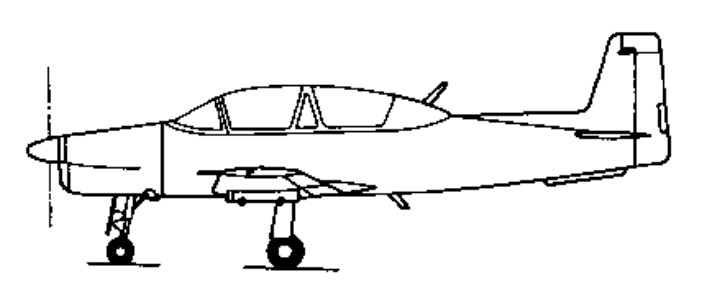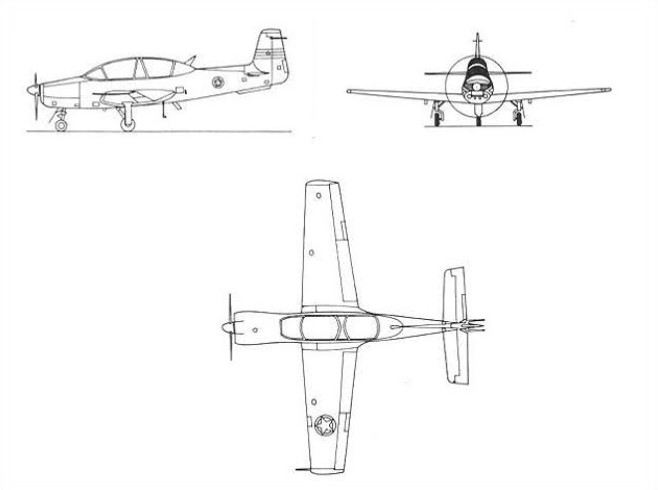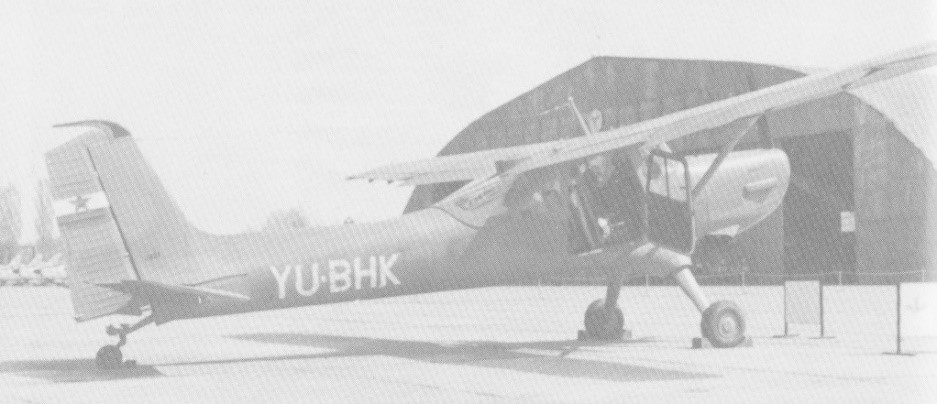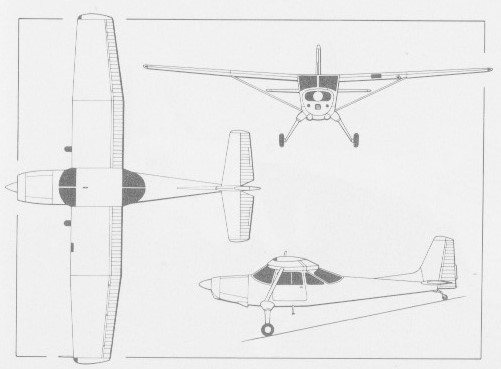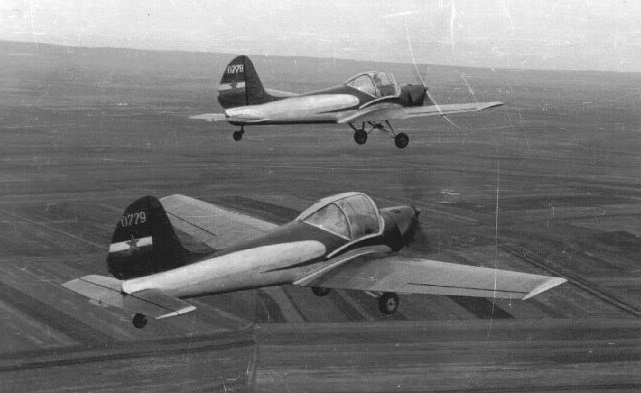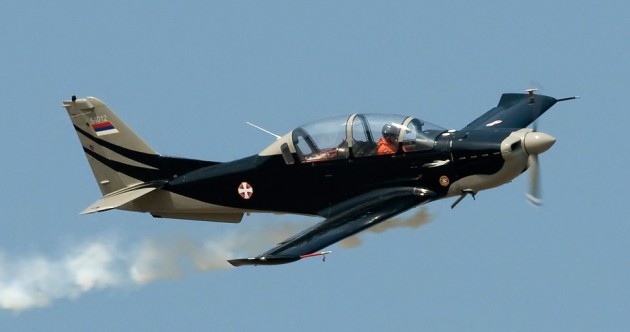
The Lasta was originally designed by VTI – Military Technical Institute Belgrade, and developed to be a replacement of the Utva 75, which had been the most commonly used trainer aircraft of the Yugoslav Air Force up until 1991. Designed as a lead-in trainer to the Super Galeb, the Lasta is a low-wing tandem-seat aircraft with a 224kW Lycoming AEIO-540-Z1B5D piston engine driving a three-blade propeller. Two underwing hard-points are provided. The first prototype Lasta 1 first flew on 2 September 1985.
Substantial changes were made to the prototype and in January 1989 a modified version – the Lasta 2, was completed. It is a lighter aircraft, with shorter fuselage and a new electronic systems including fire control Ferranti ISIS D-282. By early 1990s Utva, and her partner, have produced enough parts for the completion of 10 pre-production airframes. During the 1999 NATO bombing of Yugoslavia, all 5 existing prototypes were destroyed during the bombing of UTVA (a sixth prototype survived with damage and was donated to the Aviation Museum at Belgrade Nikola Tesla Airport).
In 2006 development of the Lasta was restarted. The new version was known as the Lasta 95. First flown on 26 February 2009, the Lasta 95 (Swallow 95) series is a profile designed as a primary training aircraft. Yugoimport-SDPR, an arms export company based in Serbia, was marketing the LASTA-95.
The LASTA-95 accommodates two crew members in tandem cockpits under individual canopies. The height-adjustable pilot seat accepts a back-carried pilot parachute. The rear seat is provided with a minimum headroom of 100mm.
The hydraulically operated landing gear can be extended using mechanical actuators in case of failure of hydraulics. The mechanical system allows extension and locking of all three struts in unfolded position at speeds of up to 180km/h.
In December 2007, Iraq made an order with Yugoimport for 36 (20 firm with an option for 16 units) Lasta 95 armed variants.
The first LASTA-95/LASTA 3 prototype trainer made its first flight in February 2009. This aircraft is derived from the LASTA-1 and LASTA-2 prototypes. LASTA-95 complies with federal aviation regulations.
The first three Lasta 95s were transferred to Iraq on August 5, 2010. Last of the 20 ordered Lasta 95 aircraft arrived in February 2012.
Unit cost in 2010 was $300,000.
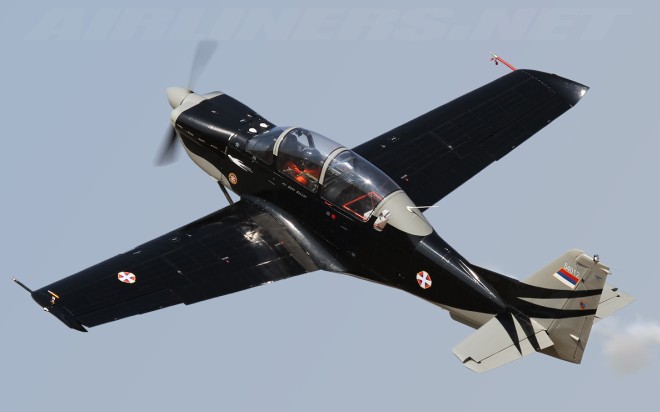
The Serbian Air Force had ordered 15 Lasta 95s. The first two aircraft were delivered in October 2011. By March 2012, two of 15 ordered Lasta 95 aircraft began service with the Serbian Air Force.
Basic version of the aircraft is built against the requirements for aerobatic category loads and the armed version of the aircraft is built against the requirements for utility category with loads of (max = 4.4, min = -1.8).
The armed variant of LASTA-95 aircraft can be installed with collimator sight to perform combat training missions using its guns, rockets and bombs. The aircraft can be optionally equipped with optoelectronic sight to employ onboard airborne ordnance.
The aircraft pods can be mounted with 7.62mm/12.7mm calibre machine guns, Honeycomb-type 57mm multiple rocket launchers and two 100kg aerial bombs.
Versions:
Lasta 95N
This light piston-propeller training aircraft is primarily intended for initial and basic training of military pilots. With in-line tandem seating, the trainer was developed in accordance with the FAR (JAR) 23 regulations for acrobatic category of airplanes and it provides an easy transition to Kobac and then to jet at higher training levels. The Lasta is equipped with a six-cylinder 224 kW (300 HP) engine of the opposed-cylinder type, and a double metal propeller Hartzell HC-C2YR-4CF/FC 8475-6, which provide maximum flight velocity (at an altitude of 3000m and a take off weight of 1085 kg) of 345 km/h. The empty weight is 888 kg, and the maximum take off weight is 1210 kg. The total aircraft length is 7.97m. The trapezoidal wings have a wingspan of 9.7 m and a surface of 12.9 m². The altitude barrier of flight is 6000 m. This propeller-driven low-wing aircraft has a tricycle retractable landing gear. Onboard GPS and Instrument Landing System (ILS) support the operations during CAT-II weather conditions. The aircraft is equipped with Mode S transponder for flight identification.Besides for training purposes, it can be used for combat fire training, rocket firing and bombing. The armed version of the LASTA 95 can be equipped with 7.62 mm or 12.7 mm machine guns, 57 mm rocket launchers or bombs weighing up to 100 kg.
Lasta 95V-54
Lasta 95V-54 designation is for Serbian Air Force and Air Defence. Differences between Lasta 95N and Lats 95V-54 are:
Engine Lycoming AEIO-580-B1A, with 315 hp (332 kW, under H = 0 and 2700 rpm)
Hartzell HC-C2YR-4CF/FC 8475-8 propeller
New propeller cap
Modified primary flight commands
Modified engine commands with less frictions
New command for propeller steeping and engine mix in both cabins
New instruments for measuring temperatures and oil pressure and temperatures of cylinder block and exhaust gases in both cabins
New radio stations Bendix/King for UHF with antennas
New gun sight AKN-09 Teleoptik Zemun who supports containers with Machine gun, bombs and unguided rocket launcher
Two under-wing carrier for weapons max allowed 120 kg
New glass cockpit with Garmin G500 avionics suites, which include primary flight display (PFD) and a multi-function display (MFD). The aircraft also integrates an instrumental flying simulation system.
Introduction of new composites materials in some parts of plane
Lasta 95P-2
It is a same version like Lasta 95V-54 designated for export customers with possibility of slight differences at customer request.
Operators:
Iraq – Iraqi Air Force – 20 delivered Lasta 95N (another 16 optional).
Serbia – Serbian Air Force – 2 prototypes and 15 serial aircraft Lasta 95V-54 ordered, 10 delivered.
Specifications:
Lasta 95N
Engine: 1 × Lycoming AEIO-540-L1.B5D, 300 hp/220kW at 2,700rpm or Lycoming AEIO-580-B1A, 315 hp
Propellers: two blade, variable pitch, constant speed Hartzell HC-C2YR-4CF/FC 8475-6
Length: 7.965 m (26 feet 1 in)
Wingspan: 9.702 m (31 ft 10 in)
Height: 2.84 m (9 ft 4 in)
Wing area: 12.9 sq.m (138.85 sq.ft)
Empty weight: 888 kg (1958 lb)
Max. takeoff weight utility category: 1210 kg (2668 lb)
Never exceed speed: 425 km/h (229 knots, 264 mph)
Maximum speed: 345 km/h (186 knots, 214 mph)
Cruise speed: 320 km/h (173 knots, 200 mph)
Stall speed: 95 km/h (51 knots, 59 mph)
Max range: 1160 km (721 miles)
Endurance: 3 hr
Service ceiling: 6000 m (20000 ft)
Rate of climb: 8.5 m/s (1,673 ft/min)
Limit load factor: +6/-3 g
Crew: Two, student and instructor
Hardpoints: 2 (one under each wing)
Lasta 95V-54
Engine: 1 × Lycoming AEIO-540-L1.B5D, 300 hp/220kW at 2,700rpm or Lycoming AEIO-580-B1A, 315 hp
Propellers: two blade, variable pitch, constant speed Hartzell HC-C2YR-4CF/FC 8475-6
Length: 7.965 m (26 feet 1 in)
Wingspan: 9.702 m (31 ft 10 in)
Height: 2.84 m (9 ft 4 in)
Wing area: 12.9 sq.m (138.85 sq.ft)
Empty weight: 888 kg (1958 lb)
Max. takeoff weight utility category: 1210 kg (2668 lb)
Never exceed speed: 425 km/h (229 knots, 264 mph)
Maximum speed: 345 km/h (186 knots, 214 mph)
Cruise speed: 320 km/h (173 knots, 200 mph)
Stall speed: 95 km/h (51 knots, 59 mph)
Endurance: 3 hr
Max range: 1160 km (721 miles)
Service ceiling: 6000 m (20000 ft)
Rate of climb: 8.5 m/s (1,673 ft/min)
Limit load factor: +6/-3 g
Crew: Two, student and instructor
Hardpoints: 2 (one under each wing)