Vancraft 2 Place

A two seat tandem partially enclosed autogyro. A high-low tandem with pilot only controls. Engine: 2180cc VW or similiar. Prop: St.Croix 56” x 60” wood or 66” Warp Drive. Rotor blades: 29’ x 9” Vancraft wood core, steel spar, aluminium skins.

Min speed: 5-10 mph
Cruise: 65-85 mph
Top speed: 120 mph
Empty wt: 500 lbs
Useful load: 400 lbs
Gross wt: 900 lbs
Width: 5’4”
Length: 13’

Vance V-S-1 Baby Lark

The 1929 Vance V-S-1 Baby Lark was a single place, open cockpit biplane powered by a 27hp Kemp-Henderson. All-wood with fabric-covered wings, it was priced at $935, oe $1,180 with a 40hp Szekely engine.

Advertisements appear for a home-builders’ Vance project as either biplane or monoplane, with a complete kit offered for $180 less motor and dope, which is most likely a version of this model. It is unknown is if any were ever built and flown, but ads like these, catering to the flying craze of the late 1920s, were common in periodicals.

Engine: 27hp Kemp-Henderson
Wingspan: (upper) 20’0″ (lower) 21’10”
Length: 14’6″
Useful load: 250 lb
Max speed: 85 mph
Cruise speed: 70 mph
Stall: 24 mph
Range: 350 mi
Seats: 1

Vance M-1 Golden Arrow / V-1 Golden Arrow

One M-1 Golden Arrow was built in 1929, priced at $895. It was a single place, open cockpit, low wing monoplane of wooden construction with fabric-covered wings.

The V-1 Golden Arrow of 1929 was a single place, open cockpit, biplane, priced at $895. All-wood with fabric-covered wings, those built include N365H c/n 5.

M-1 Golden Arrow
Engine: 27hp Kemp-Henderson
Wingspan: 24’6″
Length: 15’9″
Useful load: 225 lb
Max speed: 80 mph
Cruise speed: 70 mph
Stall: 28 mph
Range: 250 mi
Seats: 1

V-1 Golden Arrow
Engine: 27hp Kemp-Henderson
Wingspan: 20’6″
Length: 14’6″
Seats: 1

Vance Flying Wing / Viking Cargo Plane

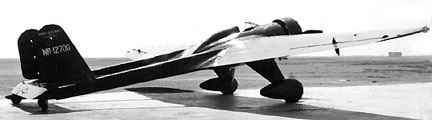
Vance Flying Wing Race NR12700

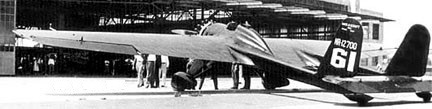
The 1932 Flying Wing, or Viking Cargo Plane, NR12700 was designed by Charles Rocheville and Clare Vance. A flying wing design with twin booms and twin tails, fuel (1200 USgallons) and cargo were carried in the wing.

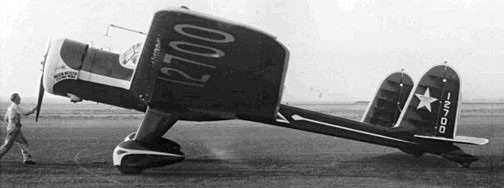
Its extent in competition is unclear, but is seen in some photos wearing race numbers. Also unresolved is the name “Mason Meteor” on its cowling in the lower picture—possibly Monty Mason was pilot, which would clear up some of the confusion with Mason Greater Meteor type.

Vance Flying Wing Mason Meteor NR12700

The Flying Wing transport was flown in the 1932 Bendix Air Race by Clare Vance from Union Air Terminal (Burbank CA). Winners were Jimmy Haizlip, Roscoe Turner and Lee Gehlback. Wings Feb 2000 shows the flying wing, but IDs it as Vance Viking (NR12700), stating Clyde Pangborn used this plane to better his 41-hour west-to-east flight (in Miss Veedol) and planned to make a global flight in it. It is possible the Flying Wing Transport was race #61 and later became the Viking. They both have the same tail number.

Vance Viking NR12700

Flying Wing / Viking Cargo Plane
Engine: P&W R-1340 Wasp, 660hp
Wingspan: 55’0″
Length: 30’0″
Useful load: 2000 lb
Max speed: 185 mph
Cruise speed: 165 mph
Range: 7200 mi
Seats: 1
No built: 1 – NR12700

Van Berkel 1919 seaplane

The 1919 Van Berkel seaplane is a twin-float seaplane, shown at the E.L.T.A. exhibition without engine, but intended for a Mercedes. The fuselage is built up of a light framework covered with three-ply wood. The ply-wood covering of the rear portion of the fuselage is continued outwards over the tail plane, which latter is built integral with the body. The fuselage is very deep at the rear, where it performs the function of a fin, no other vertical fin being fitted. The tail plane is at the top of the fuselage and the rudder has its balanced portion projecting below the stern.

The two floats, which are single step, are flat-bottomed as regards their front portion, but to the rear of the step the bottom gradually changes from flat to Vee bottom, finally corning to a point at the heel of the float. The construction is very similar to that of the fuselage, brass screws and nails being used throughout. The floats are fitted with water-tight bulkheads, detachable inspection doors being provided in the deck for examining the interior.

The wing bracing is only one pair of struts on each side. The upper plane is of slightly greater span than the bottom, and the inter-plane struts slope outwards. The lift and landing loads are taken by tubes sloping from the floats outward to the lower surface of the bottom plane at the points where occur the inter-plane struts. A speed of 155 km. per hour is estimated.
VanDellen LH-2

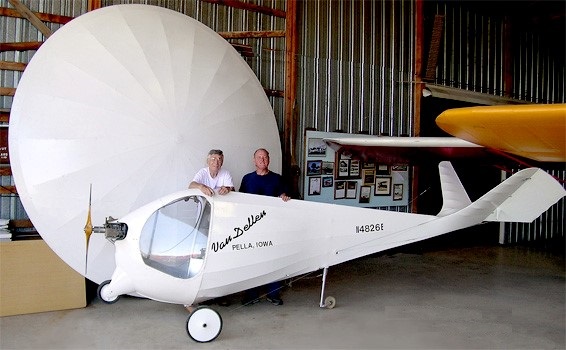
VanDellen LH-2 N4826E

Built by Lubert VanDellen in 1959, the LH-2 was two=place powered by an unknown reciprocating engine. The register classified it as a “rotocraft”—instead of a wing, it had a circular saucer-like disk which was said to rotate. A small engine with a tractor prop was located in the front end, and the opposite end sported a butterfly tail.

Registered N4826E, it was taxi-tested but never flown, donated to AAA’s Airpower Museum.

Gross wt: 900 lb
Seats: 2