1982: Piccard Balloons, Box 1902, Newport Beach, California 92663, USA.
Soon to introduce its eighth model (in 1982), Piccard has a wide selection of balloons. Envelopes range in volume from 33,000 to 90,000 cubic feet, and baskets are interchangeable. Larger models have been custom built. Basic prices of Piccard balloons range from $3,656 to $16,000 in 1982.
Balloon
Pérez Villa de Paris

Matias Pérez was a Portuguese aeronaut, tent-maker and Cuban resident who, carried away with the ever increasing popularity of aerostation, disappeared while making a gas balloon flight originating from Havana’s Plaza de Marte (now Parque Central) on June 28, 1856. A few days earlier he had made a successful first attempt, traveling several miles. His second try however, became part of Cuba’s folklore as today when someone or something vanishes into thin air, people say: “Voló como Matías Pérez” (flew away like Matias Pérez).
Payne Shoestring
Built by G.F. Payne in the UK, the Payne Shoestring G-AZRI c/n GFP.1 was a 56,000 cu.ft hot air balloon.
Parseval-Siegsfeld Drachen
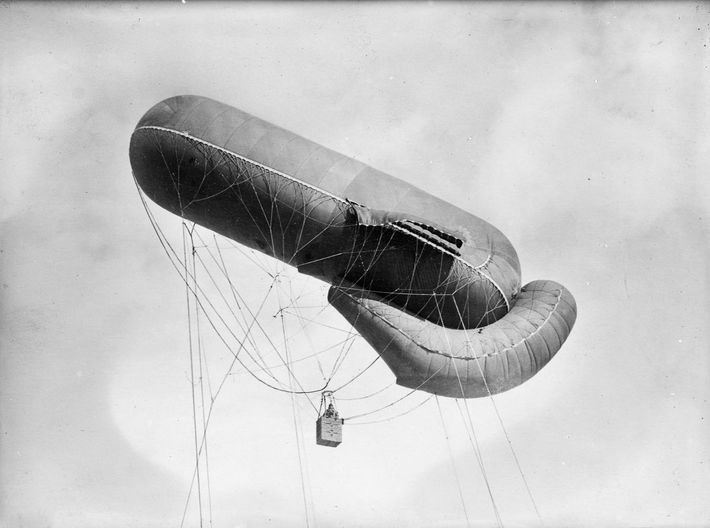
The Germans made excellent use of observation balloons in several configurations. An early variety made by Parseval-Sigsfeldand called “Drachen”, had a single fin, low centre, and was totally cylindrical, with rounded ends. The British called them sausages, for obvious reasons. The balloon’s shape gave it another nickname, “Nulle” or “Testicle”.
The drawback of military captive balloons was their unsteadiness in the air. This was remedied by two German officers, Major August von Parseval and Captain H. Bartsch von Sigsfeld, who set themselves the task of turning out an improved type of observation balloon. The outcome was the ‘Drachenballon’, or kite balloon, so called because it combines both balloon and kite principles. Theirs was not a new idea, but they improved on previous efforts. They created an oblong envelope which was partly supported by the wind when facing it at an inclined angle of 30 to 40 degrees. It was stabilised by means of a control surface, which was later replaced by a large air bag.
Beginning in 1893 they tried different combinations and various sizes of envelopes, from 600 cu.m (21,200 cu.ft) capacity to twice that size, and by 1898 von Parseval and von Sigsfeld had arrived at the type which gradually became the standard of most European armies. By now they had added a stabilising fin on the right and left sides of the envelope to prevent the captive balloon from twisting around its longitudinal axis and, like a kite, it was further provided with a long tail to which one to five parachute-like ‘umbrellas’ were attached. Combined with the stabilising bag, these devices held the balloon facing into the wind.
The August Riedinger balloon plant in Augsburg, Germany, began a regular production of this type of kite balloon, and also supplied various styles of engine-driven motor winches on which the observation balloons were raised into the air and later hauled down again to the ground. The cruisers in the navies of several countries were also equipped with kite balloons, to detect enemy submarines and protect the cruisers against their attacks. It soon became standard practice for the kite balloon to stay completely steady in the air at altitudes ranging from 1,000 to 2,000 m, even in winds of up to 65 km/hr (40 m.p.h.)
Kite balloons were used extensively in World War 1. They soon began to appear in great numbers on the western front, where the Germans employed them to direct their gunfire and report its effects. This, combined with the proclivity of the Germans for eating large quantities of sausages, explains why these kite balloon artillery observation platforms were soon nicknamed ‘sausages’ by the Allies, who in turn copied, built and used them extensively until the French came up with the improved ‘Caquot’ type balloon. Although the kite balloons were in fixed positions, the fighter pilots flying to attack them soon had driven home to them forcefully that this meant first running the gauntlet of a well-adjusted barrage of fire from anti-aircraft guns mounted to protect them. This meant that the kite balloons must be attacked very fast from above in a determined dive on them because they could be hauled down fast. The downing of a kite balloon therefore ranked on a par with a victory in any other air battle. The balloon observer was one up on the aeroplane pilot in one respect, in that he had a parachute hanging on the outside of the basket and could jump to save his life in case of an enemy air attack.
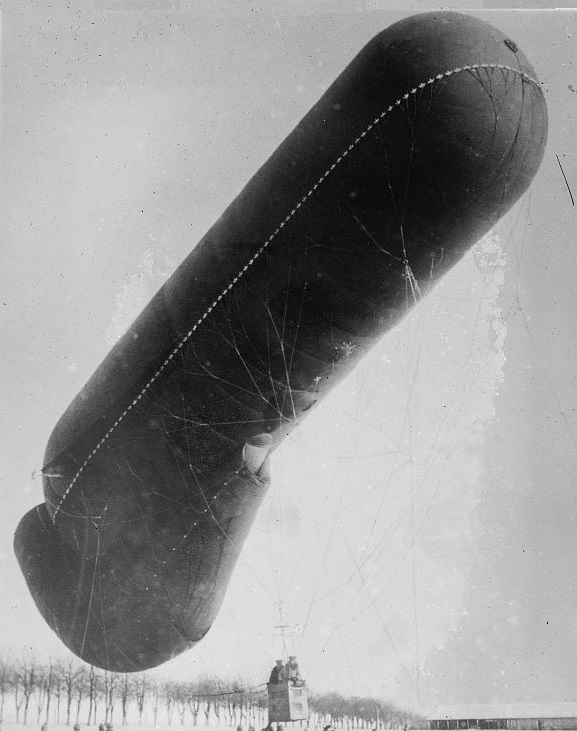
In 1896 Maj. August von Parseval and Hptm. Rudolf Hans Bartsch von Siegsfeld successfully floated the first Drachen (Dragon) balloon, an engineering advance that quickly replaced the older spherical balloon. The Drachen differed in several respects from its predecessor, with design refinements aimed at improving the stability of the observer’s platform. The most important—as well as the most visible—differences in the Drachen lay in the elongated shape of the balloon and in the addition of a stabilizing lobe to the rear of the craft. French construction of Drachen-type balloons began in October 1914 and completed balloons began arriving at the front that December. Germany had nine of the improved kite balloons in the field on the Western Front in February 1915 and by the end of the year the number of German balloon sections had increased to forty, each with two balloons.
Because the Parseval-Siegsfeld Drachen balloon had an extremely low ceiling—around 1,500 feet in an average wind—it offered limited usefulness as a reconnaissance and artillery-observation platform. German designers dealt with the low ceiling issue by making the balloon bigger, increasing its volume first to 800 cubic meters and later still to 1,000. Floating it higher in the sky did not entirely cure the Drachen’s problems. Contrary to its designer’s initial hopes, the addition of the lobe did not completely solve the stability issue and too many observers still became airsick as their craft pitched and yawed violently in moderate-to-high winds. This led to further fundamental improvement in observation balloon design, but the French engineer Albert Caquot beat the Germans to the next advance. Caquot tackled the pitch and yaw problem
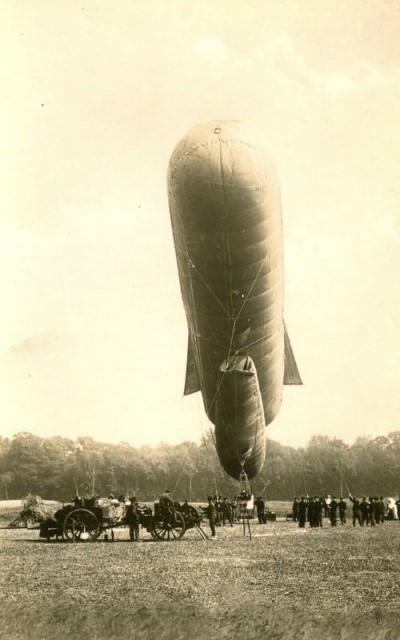
The German approach to organizing its Balloonzüge (balloon sections) illustrates the strength of the partnership achieved between observation balloonists and ground units. As part of the reorganization of Germany’s aviation program in the last months of 1916, balloons became the joint responsibility of the Kommandierende General der Luftstreitkräfte (commanding general of the Air Force, abbreviated Kogenluft) and the Inspektion der Luftschiffertruppen (inspector of Airship Troops, abbreviated Iluft). Below this overall command structure, a Staboffizier der Luftschiffertruppen (staff officer of Airship Troops, abbreviated Stoluft) provided balloon staff support at each German Army headquarters. Within each army, balloon detachments at the division level managed three to five individual Balloonzüge, each with an active and a reserve balloon working with artillery units assigned to the corps.
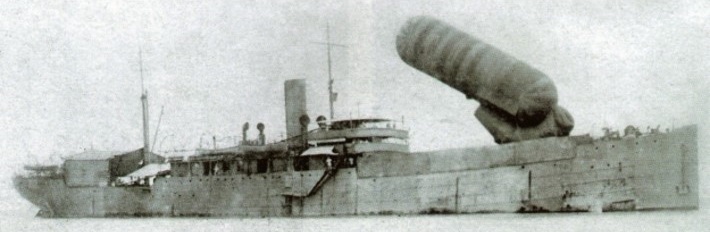
There were several sizes (going from 600 m³ to 800 m³, for man-lifting ones, between 1909 and post-WWI. The form was held by an inside air-ballonnet, into the gas-balloon of 150 m³.
One was 750 m³ with diameter 6,5 m and lenght of 27 m.
There seems to have been 2 sizes of baskets, probably following the volume of the balloon.
In Spain, one was constructed following the plan drawings from Germany of 800 m³, 7 m diameter but only 18 m length.
Orlandi Hybrid hot-air/hydrogen Balloon
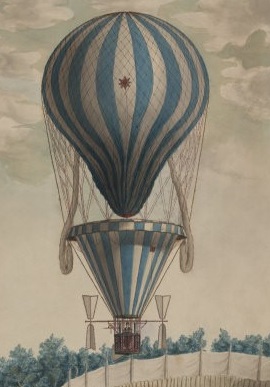
Francesco Orlandi, the most successful with hybrid hot-air/hydrogen type of aerostat, published a treatise on ballooning, suggesting this new design, in 1800. His first flight did not occur until August 30, 1825 after which he made 40 flights. Despite the death in June 1785 of Pilatre de Rozier and Jules Romain in their combination hot-air and hydrogen balloon, experimenters continued to build balloons that combined these elements. The aeronaut Francis Olivari lost his life in one on November 25, 1802, at Orleans, as did Francesco Zambeccari on September 21, 1812, near Boulogne.
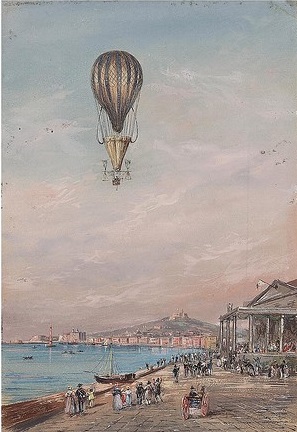
Mosment 1806 balloon
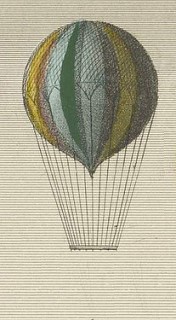
Frenchman M. Mosment did not use the customary basket on his balloon, but stood on a flat platform. He made his last ascent at Lille on 7th April, 1806. About ten minutes after takeoff a small parachute, containing some animal, was observed to be launched from the car; immediately afterwards an object which was soon ascertained to be the flag of the adventurer, slowly followed it through the sky. A rumour began to spread about that the aeronaut himself had fallen from his balloon. This was shortly after confirmed by the discovery of his body almost buried under the sand in one of the fosses (ditches) of the ramparts that surrounded the town. It was supposed that the oscillations communicated to the balloon in the act of delivering the parachute had thrown him off his balance. Some persons pretended at the time to have heard him declare the event before-hand, and from thence argue that the affair was not unpremeditated.
Morgan Cluster Balloon
On October 20, 2017, Tom Morgan of Bristol, England reached heights of 8,000 ft (2,438m) using 100 color helium balloons and has flown 25 km (15.5 miles) over South Africa.
Montgolfier La Marie-Antoinette
Rozier took part in a further flight on 23 June 1784, in a modified version of the Montgolfiers’ first balloon christened La Marie-Antoinette after the Queen, which took off in front of the King of France and King Gustav III of Sweden. Together with Joseph Proust, the balloon flew north at an altitude of approximately 3,000 metres, above the clouds. They travelled 52 km in 45 minutes before cold and turbulence forced them to descend past Luzarches, between Coye et Orry-la-Ville, near the Chantilly forest. They set records for speed, altitude and distance travelled.
Montgolfier Le Flesselles
Along with Joseph Montgolfier, he was one of six passengers on a second flight on 19 January 1784, with a huge Montgolfier balloon Le Flesselles launched from Lyon. Four French nobles paid for the trip, including a prince. Several difficulties had to be overcome. The wallpaper used to cover the balloon’s envelope became wet because of extreme weather conditions. The top of the balloon was made of sheep- or buckskin. The air was heated by wood in an iron stove: to start, the straw was set on fire with brandy. (In other tests charcoal or potatoes were used). The balloon had a volume of approximately 23,000 m³, over 10 times that of the first flight, but it only flew a short distance. The spectators kneeled down when the balloon came down too quickly. That evening the aeronauts were celebrated after listening to Gluck’s opera, Iphigénie en Tauride.
Montgolfiere Le Réveillon
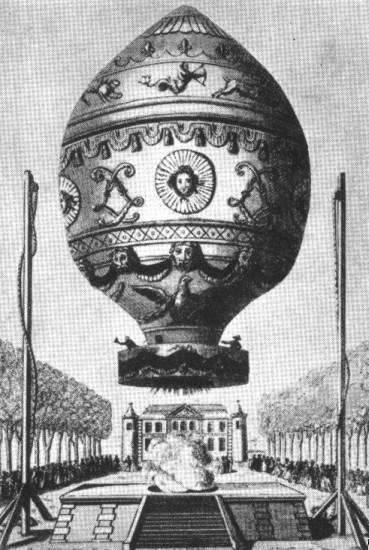
On 19th September the first living creatures ever to leave the ground in an aircraft — a sheep, a cock and a duck — travelled almost two miles in a wicker basket slung under a Montgolfière released at Versailles and it was planned to carry under the next balloon a criminal who would receive a free pardon if he alighted safely. But a young scientist named Pilâtre de Rozier, considering it unthinkable that a criminal should gain the honour of being the first airman, volunteered to make the ascent himself; and on 15th October 1783 he rose to about 80 feet in a captive balloon with a capacity of 60,000cu. ft. Pilatre de Rozier made a 4 minute 24 second tethered flight. The second ascent was done with Pilâtre de Rozier, and André Giroud de Villette, to 105m.
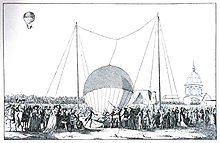
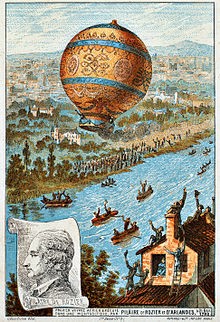
After several tethered tests to gain some experience of controlling the balloon, de Rozier and d’Arlandes made their first untethered flight in a Montgolfier hot air balloon on 21 November 1783, taking off at around 2 p.m. from the garden of the Château de la Muette in the Bois de Boulogne, in the presence of the King. Their 25-minute flight travelled slowly about 5½ miles (some 9 km) to the southeast, attaining an altitude of 3,000 feet, before returning to the ground at the Butte-aux-Cailles, then on the outskirts of Paris.
The 25-minute flight was not without hazard, for the balloon was kept inflated with hot air by means of a brazier slung under its neck, and the airman had a hectic time putting out fires on the fabric with a sponge and water which they had wisely decided to take with them.
The first woman aeronaut, Mine Tible, ascended from Lyons as passenger in a Montgolfière in June 1784.
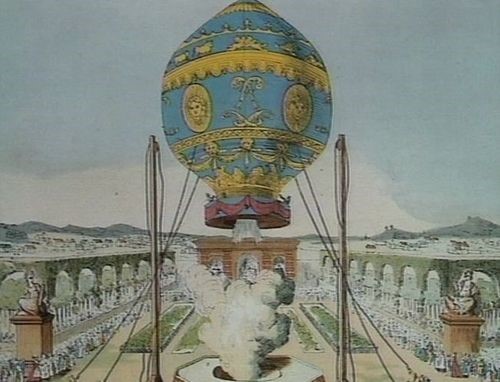
Replica: HAS Woodford Montgolfier
Capacity: approx 77,700 cu.ft / 2200 cu.m
Diameter: approx 49 ft / 14.95m
Height: approx 75 ft / 22.75m
 All Aero