Ax 6 O 56A
Ax-6 O 77
Balloon
Thunder & Colt
Colt made a name as a scrappy player in the industry, not to be underestimated. Perhaps because that image so resembled Thunder’s in the ’70s, the two companies merged in 1980. Thunder & Colt continued production of Colt balloons, bringing the marque’s ultimate output to 99 before production ceased.
Later in 1994, Airborne Group Plc (UK), and its various divisions, including Thunder & Colt Ltd., UK were placed into receivership. The hot air ballooning division, Thunder & Colt Ltd. (UK), was purchased in December 1994 by Cameron Balloons Ltd.
In 2011 T&C Balloons US, Inc. offers a complete line of sporting balloons from the one-man cloudhoppers, to the single and dual chariots, right up to the more traditional 77 and 90,000 cubic foot models. For 1995, the sport models were upgraded to include the Classic basket and the new adjustable Stratus double burners. T&C system prices are based on the following equipment: Series I (12-gore) envelope, Classic basket, adjustable double Stratus burners, two 15-gallon stainless steel tanks with jackets and straps and the Ball M55 instrument package. Our envelopes include a Nomex scoop, full Nomex protection in the throat, LongLife fabric in the parachute and top two panels and two paraclear inserts.
In 2011 T&C Balloons US, Inc. offers a complete range of ride balloons unequaled in their quality of construction and passenger comfort. The following sample system prices are based on the following equipment: A-type envelope (24 or 28-gore) with Nomex scoop and full Nomex throat, LongLife fabric in the parachute and top two panels with two paraclear inserts; double adjustable Status burners, two 15-gallon stainless steel tanks with jackets and straps, Ball M55 instruments and Classic T-partition baskets.
In 2011 Thunder & Colt offer a range of four different hot air airships. A standard two person gondola is suspended beneath either a chubby Mark 2 envelope or a slim line GD envelope. Each envelope design comes in a choice of sizes and has its own unique properties.
All T&C systems include your choice of color patterns, any full panel-any color at no extra charge. Other standard equipment includes a fire extinguisher, accessory bag and two strikers. Improvements to balloon and airship equipment are being made all the time.
Cloudhoppers are non-registered ultralight aircraft. Chariots and hot air airships are not US type-certified, but may be flown on British registration, as is the case with special shapes.
Thunder & Colt was bought by Cameron Balloons in 1995. At that time, the T&C factory in Shropshire was not profitable and production was moved to the Cameron factory in Bristol. T&C now operates as a separate division with its own sales and engineering staff, promotion, and model range. Despite the change in ownership, Thunder & Colt continues to lead a separate existence as an independent balloon manufacturer and has kept producing some of the finest hot air vehicles on the market.
Thunder & Colt was the first company to build a pressurized Hot Air Airship. From the very beginning their designs were well thought out. The four designs currently available are the AS-105 Mk II (105,000 cu. ft.), AS-120 Mk II (120,000 cu. ft.) and the AS-80 GD and AS-105 GD which were developed by GEFA-FLUG in Germany. (“GD” stands for “German Design”.) Thunder & Colt also developed the largest hot air airship in the world, the AS-261, to drop an observation platform in the canopy of tropical rainforests. In 1993 the ship was fitted with a larger replacement envelope manufactured by Lindstrand Balloons and has since been known as the AS-300. The main advantage of Thunder & Colt’s airship line is that all models feature internal catenary curtains for load suspension like real helium airships. This improves the aerodynamic shape and stability of the envelope.
At the 1996 Hot Air Airship World Championships in Aosta, Italy, the first three places were won by Thunder & Colt airships with the fourth place being held by a GEFA-FLUG AS 80 GD which features a standard T&C gondola and is also built at the T&C factory in Bristol, England.
T&C also produced the GA-42 non-rigid helium airship which was capable of carrying two people and featured state of the art fly by wire controls. The rights to the GA-42 design were acquired by the American Blimp Corporation when T&C was acquired by Cameron in 1995.
Thunder Balloons AX-6
1972 Hot Air Balloon
AX6-56
Persons: 3
Diameter: 48 ft
Height: 63 ft
Volume: 56,000 cu.ft
Weight: 425 lb
Payload: 1226 lb
Burner: 8 Million BTU/hr
Fuel capacity: 20 USG
Cost: (1972): US$ 8255
FAI AX-6
AX6-56Z
Persons: 3
Diameter: 48 ft
Height: 63 ft
Volume: 56,000 cu.ft
Weight: 425 lb
Payload: 1226 lb
Burner: 8 Million BTU/hr
Fuel capacity: 20 USG
Cost: (1972): US$ 8293
FAI AX-6
Thunder Balloons AX-5
1972 Hot Air Balloon
AX5 – 42
Persons: 2
Diameter: 44 ft
Height: 57 ft
Volume: 42,000 cu.ft
Weight: 400 lb
Payload: 919 lb
Burner: 8 Million BTU/hr
Fuel capacity: 20 USG
Cost: (1972): US$ 7013
FAI AX-5
Thunder Balloons Bolt
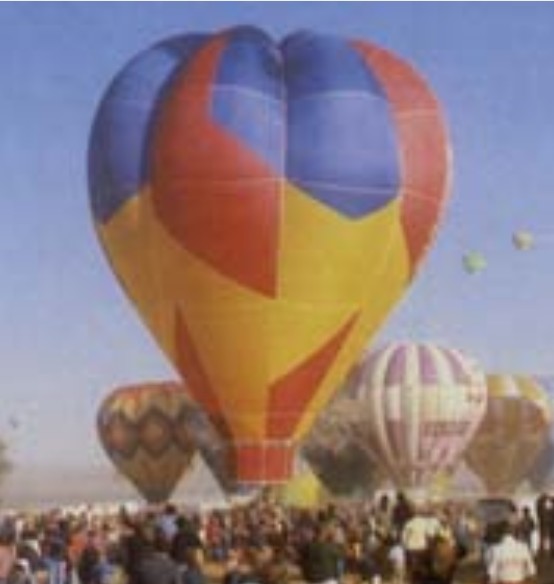
Starting in 1978, Thunder built the Bolt as an answer to Cameron’s successful Viva. Note the slim profile, which made the Bolt very stable when changing altitude.
Thunder Balloons Z-Type
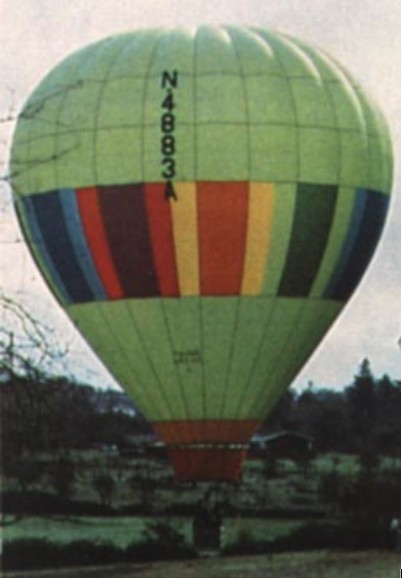
The Thunder Z-Type, introduced in 1977, won over commercial and sport pilots alike, with its favorable performance and up-to-date good looks.
Thunder Balloons A-Type

Introduced in 1974, the A-Type had a flat envelope with a parachute rip, and came in three sizes: 56, 69 and 77 (24-32 vertical-cut gores).
Thunder Balloons Jumpin’ Jack / Series One
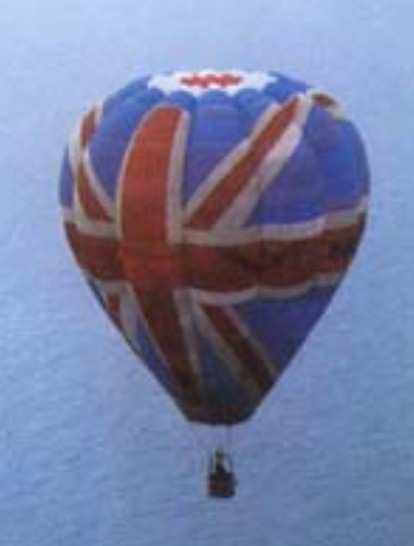
The first Thunder was Jumpin’ Jack (sometimes listed as Jumpin’ Jack Flash).
One of the early “Jack” balloons, TigerJack was built in 1973, and first flown in January 1974.
The 12-gore “Series One” envelope, patterned after Jumpin’ Jack, could be had in 5 sizes: 42, 56, 65, 77 and 84.
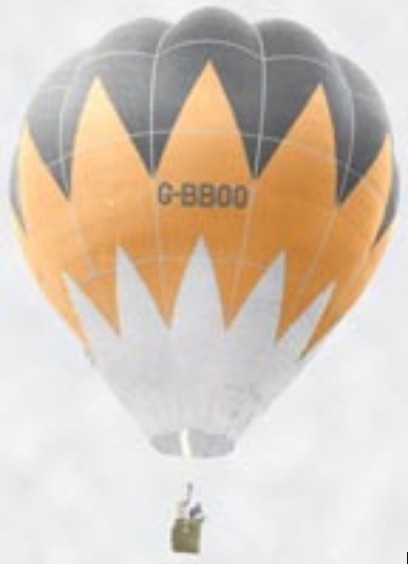
Variation:
Ruppenthal Eagle
Thunder Balloons
Dick Wirth was an architecture student when he teamed up in the early 1970s with fledgling architect Tom Donnelly, and the two recruited businessman Kenneth Simmonds to form Thunder Balloons, Ltd. David Barker recalls that production took place at 75 Leonard St, London (should be ‘long about here). “Thunders were on the first and second floors of a warehouse building and everything had to be lifted up and down using an outside hoist. Thunders production commenced in late 1972 when Jumping Jack was registered; it made its debut at the Icicle meet, January 1973.”
The firm built what grew into a line of attractive, well-performing aerostats that quickly amassed market share around the world. The early “Series One” Thunders were distinctive for their bulbous gores and sharply tapering profile. Thunder began production of the smooth-envelope A-Type in 1974, and with the introduction of the Z-Type in 1977, had a thoroughly modern aircraft – lightweight and with a narrow shape favored for its performance in turbulence and at high rates of ascent and descent (presaging the narrow “competition balloons” now all the rage on the rally circuit). Thunder innovated constantly, introducing gimbaled burners, turning vents and the (production) parachute rip to the British market. Wirth penned what is perhaps the greatest ballooning book ever, Ballooning – A Complete Guide to Riding the Winds in 1980, and died in an infamous crash in Albuquerque in 1982. With much of its soul torn out, Thunder continued, having merged with Colt in 1980. ThunderColt continued production of Colt balloons, bringing the marque’s ultimate output to 99 before production ceased, but was ultimately bought by rival Cameron. Solid as the product was in its later years, the vigor and innovation of the Dick Wirth era will surely be the company’s lasting legacy.
1982: Thunder Balloons, 114 Sandalwood Court, Santa Rosa, California 95401, USA.
Thunder offered hot air balloons ranging in size from 19,000 to 140,000 cubic feet, with a capacity of one to eight passengers. Prices start at $6,384 and continue to $16,127 in 1982. Standard equipment includes a basket, instruments, two tanks, a bag and a burner.
Thorn Eccles
The Thorn coal gas balloon, named Eccles, was registered G-ATGN constructor number 2, built by J.Thorn.
It was eventually withdrawn from use.
 All Aero