British National Antarctic (Discovery) Expedition Eva

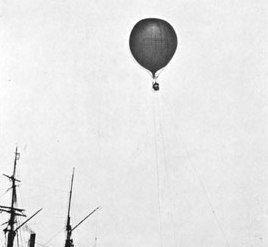
One of two observation balloons procured by Robert Falcon Scott from the the British War Office for him to use on his first polar expedition. Inflated with 8480 cubic feet (240 m³) of hydrogen and ascended with Capt. Scott on February 4, 1902, this was the first flight in Antarctica by any type of aircraft and reached a height of 244 metres – the limit of the tether. From the balloon Capt. Scott saw many parallel lines of undulation to Southward. A second ascent was then made the same day, carrying Ernest Shackleton, who took the first ever Antarctic aerial photographs, but after that the balloon developed a leak and was never flown again. The location of these flights was a small bay in the Ross Ice Barrier, near King Edward VII Land along what is now known as the Bay of Whales. The second balloon of the expedition was never flown. The name “Eva” was given to the former British Army balloon by Scott.
Bousson Auto-Aviateur

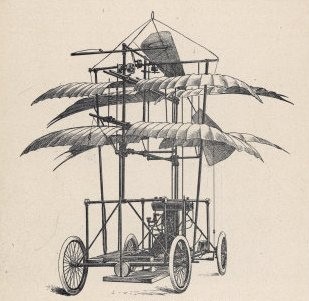
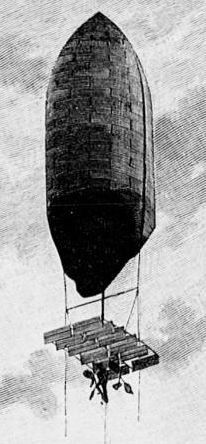
The Bousson Auto-Aviateur of 1900.

A Mr. Danilewsky hoped, thanks to a thorough study and to progressive improvements of his apparatus, to manage to do without the help of the balloon. It was also the hope of Mr. Firmin Bousson, who built and tested in 1900 an airplane suspended under an elongated cylindrical balloon, mounted on four wheels and operated by a petrol engine, is intended to roll on land like an automobile, or to fly in the air. Wheel tests were conducted at the Avron plateau in October 1900; hindered by bad weather they did not give positive and complete results.

Boland Flagship

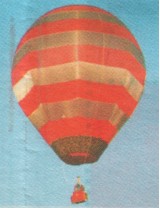
A free balloon, the envelope sown together in an Auckland, New Zealand garage by Brian Boland during the 2002 Christmas period. Flagship weighs only 34 kg and guaranteed for a life of 400 hours. The basket, envelope and accessories weigh a total of 95 kg and the whole rig fits in the back of Peter Boland’s station wagon and can be inflated and airborne in about ten minutes. Registered ZK-FAG on 10-06-2003 but during 2002 he flew his tiny craft around the Akaroa landscape.

Capacity: 40,000 cu.ft

Blanchard Dihydrogène Balloon

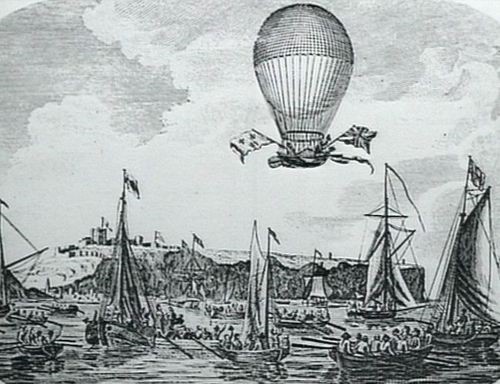
Dihydrogen Balloon Jean-Pierre Blanchard.

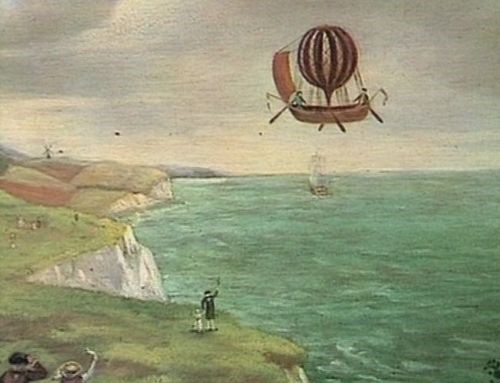
The first flight over the English Channel was on the 7th January 1785, between Dover and Guînes, in 2h25 carrying J.P.Blanchard and John Jeffries.

Aeronaut Jean-Pierre Blanchard had made 66 flights in several countries, when he died in 1809 after having been hardly injured in an accident in 1808.

Blanchard and Jeffries crossing the Channel in 1785

Berry Airship

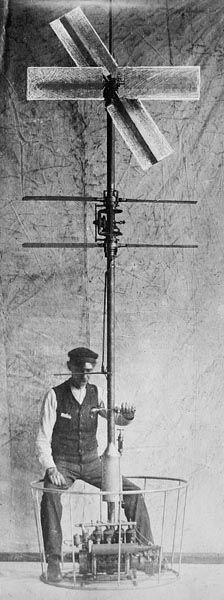
John Berry was a builder of balloons in St. Louis who in 1907 was slated to race his airship in the dirigible races held in conjunction with the Gordon Bennett balloon race. For unknown reasons it was never tried and no photos of it are known to exist. This photograph shows the patented airship mechanism without the gas bag.

Berry, John

John Berry (1849-1931) was an inventor, mechanic, car-dealer, and builder of balloons in St. Louis who in 1907 was slated to race his airship in the dirigible races held in conjunction with the Gordon Bennett balloon race.

Berry made his first balloon flight on a smoke balloon, in 1862 at the age of 13 from Rochester, N.Y., and his first gas balloon flight the following year. “The Dean of American Aeronauts”, Capt. Berry made more than 500 balloon flights during his aeronautical career which lasted sixty years; his last flight taking place in 1922.

Berends Rooster

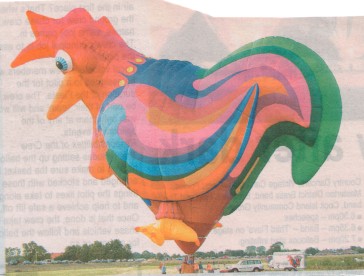
Standing 47 metres high (the height of a 16-storey building) and weighing 435 kilograms, the rooster was the biggest special shape balloon in Europe. The balloon’s creator and pilot was Alex Jan Berends, though the craft was built by Cameron Balloons in the UK in 2000.