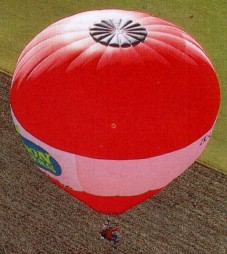
Cameron H Srs
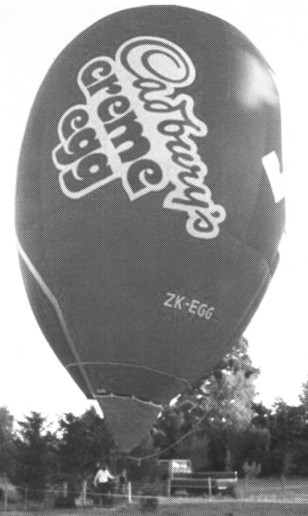
First registered to Cameron Balloons of Bristol, UK, on 11-02-2000 was the 65,000 cu.ft “EGG-65” G-OZEG. This is a two-person balloon built to order for Cadbury’s in the UK to advertise one of their products. The balloon has only three hours on it, all done in NZ before 2003. Cadbury now has no finan-cial interest in the balloon, which was cancelled from the UK register on 17-04-02. Cameron Balloons offered the unit to Andy Nicholson, the NZ dealer, and it became ZK-EGG, with Balloon Affair out of Christchurch.
Capacity: 65,000 cu.ft.
Seats: 2.

C-80
C-90
A-105
up to 4 plus pilot
A-120
up to 5 occupants plus pilot
A-140
up to 6 occupants plus pilot
A-180
up to 8 occupants plus pilot
A-210
Capacity: 210,000 cu.ft.
up to 10 occupants plus pilot
A-250
A-275
up to 12 occupants plus pilot
A-340
Crew: 1.
Pax cap: 20
A-300
up to 16 occupants plus pilot
A-500
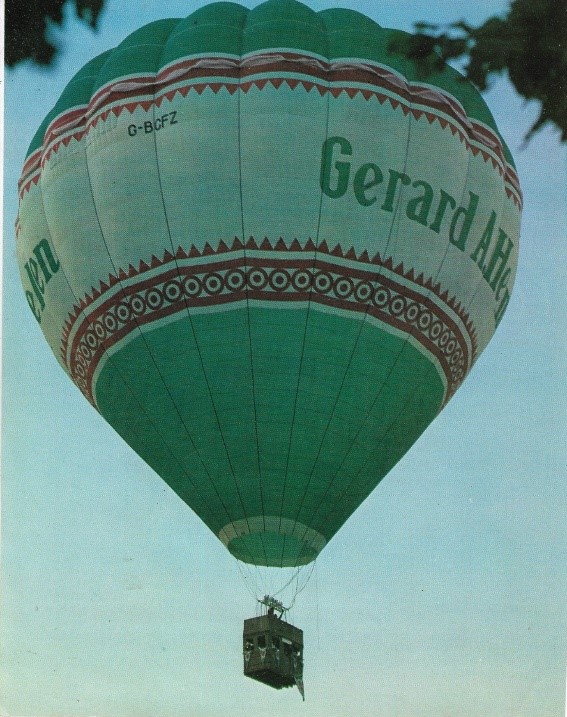
1974 Cameron Balloons A-500
Size: Pilot plus six passengers to pilot plus 28 passengers
Burners: Burners available in Double, Triple or Quad formation
Fabric: Nomex base with Nylon (Polyurethane-coated) and/or Hyperlast (Silicone-coated on both sides)
Colours: Choice of 26 + new shiny silver & gold.
Deflation System: RDS (Rapid Deflation System), Lock-top, Velcro Rip or Standard Parachute
Rotation Vents: 1 or 2 Envelope rotation vents available
Ancillary: Comprehensive range of baskets available from Standard to Safari specification
A-530
up to 28 occupants plus pilot
Cameron Balloons is a company established in 1971 in Bristol, England by Don Cameron to manufacture hot air balloons. Cameron had previously, with others, constructed ten hot air balloons under the name Omega. Production was in the basement of his house, moving in 1972 to an old church in the city. In 1983 Cameron Balloons moved into its current premises in the former Robinsons paper bag/printing factory (built in 1887 in the Bedminster area of the city). In 1989 the company received the Queen’s Award for Export.
Output has grown to around 500 balloons per year. As of December 2007[update], Cameron Balloons accounted for 1,073 of the 1,553 hot air balloons registered with the United Kingdom Civil Aviation Authority.[1] Cameron Balloons is also famous for its special shapes, the first being Robertson’s Golly, constructed in 1975. Most special shapes are made for commercial advertising, but some have been bought privately. Notable amongst these private buyers is the late Malcolm Forbes of Forbes magazine, who commissioned a number of special shapes, including Harley-Davidson motorbike, Sphinx, bust of Beethoven, French Chateau, Pagoda and Minaret.
The Bedminster factory occupies three floors. Most factory space (first and second floors) is devoted to laying out the hundreds of yards of fabric which is sewn together by machinists. If the detail on the balloon is intricate, to save cost and weight, the designs may be sprayed or painted on instead.
The company also makes airships, helium balloons and static inflatables. It has been involved in record breaking balloon flight attempts including trans-Atlantic, altitude and distance records.
1982: Cameron Balloons, 3600 Elizabeth Road, Ann Arbor, Michigan 48103, USA.
Cameron builds balloons varying in envelope size from 31,000 to 210,000 cubic feet (the company also built a 500,000 cubic foot, 32 ¬passenger monster for Heineken). Standard equipment includes an inflation scoop, instru¬ments in an oak case, appropriate number of tanks, fire extinguisher and envelope bag. Prices range from $7,285 to $24,000 in 1982.
Later in 1994, Airborne Group Plc (UK), and its various divisions, including Thunder & Colt Ltd., UK were placed into receivership. The hot air ballooning division, Thunder & Colt Ltd. (UK), was purchased in December 1994 by Cameron Balloons Ltd.
Cameron has integrated the Thunder & Colt product range, notably the AS-series hot air airships, into its own catalogue, while Sky’s products have been discontinued. Lindstrand Balloons continues to operate as an independent company with separate management and its own designs and products.
In the late-1990s, Cameron Balloons and its owner Don Cameron acquired two-thirds ownership of Lindstrand Balloons. Cameron bought the majority stake in Lindstrand Balloons from Rory McCarthy, a British industrialist associated with Richard Branson, who had invested in Lindstrand to support Branson’s series of record-setting balloon flights. The remaining third of the company is owned by its founder Per Lindstrand.
Despite Cameron’s ownership, Lindstrand Balloons continues to operate as an independent company with separate management and its own distinct designs and products. Per Lindstrand also independently operates a separate company, Lindstrand Technologies, which designs and builds gas balloons, innovative buildings, specialized aerospace equipment (including an advanced parachute for the Beagle 2 Mars-lander) and inflatable structures including aircraft hangars, plugs for fire-containment for road tunnels and flood prevention systems.
The Cambridge Hot Air Association Phlogiston hot air balloon of 42,000 cu.ft was registered G-BBGZ c/n CHARA.42.
Built by R. Burns in the UK, the Burns Contrary Mary G-AXVV c/n PRB-01 was a 77,000 cu.ft hot air balloon.
In the late 1970s there was only one balloon in Czechoslovakia and this was an import that was based in Prague. A group of local balloon enthusiasts met in Brno and determined that they would build their own balloon. Ales Kubiček was a founding member of what became the Brno Aviatik group and he took the lead in designing and building the club’s first balloon. In 1983, after a process of trial and error the first Czech hot-air balloon flew as part of the Aviatik club. The club prospered and further successes followed.
 All Aero