Crosbie, Richard

Richard Crosbie spent much of his childhood devising peculiar contraptions at his family home in Baltinglass, Co Wicklow. By 1783, he was a student at Trinity College, Dublin, listening to the tale of two Frenchmen who spent 25 minutes elevated in the sky within the basket of a hot air balloon.

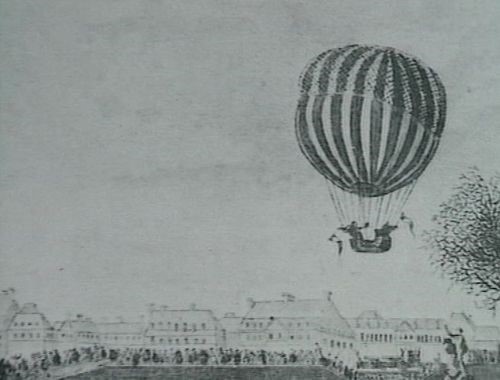
Crosbie vowed he would one day cross the Irish Sea. His vehicle of choice would be a rubberised silk-covered balloon, filled with hydrogen.

To raise funds for his adventure, Crosbie held an exhibition in Ranelagh Gardens in Dublin. For a small fee, the public was invited to examine both his balloon and the “aeronautic chariot” which would carry himself, his equipment, his scientific instruments and the ballast.
Couch Cluster Balloon

On July 7, 2007, Kent Couch, a 47-year-old American gas station owner from Bend, Oregon, reportedly flew 240 miles (390 km) in his lawn chair, landing in a field about 3 1⁄2 miles (6 km) NNW of North Powder, Oregon, about 30 miles (50 km) from the Idaho border. Traveling an average of 22 mph, Couch used plastic bags filled with 75 litres (20 US gal) of water as ballast against the 105 large helium balloons tied to his lawn chair. Like Larry Walters, Couch had a BB gun on hand to shoot the balloons in order to initiate descent. After the flight, he developed a way to release helium from the balloons, allowing for a more controlled descent. During a second flight on July 5, 2008, Couch realized his goal of interstate travel when he landed safely in western Idaho. The trip totalled 240 miles (390 km) and took 9 hours and 12 minutes.

Compagnie d’Aérostiers L’Intrépide / Hercule

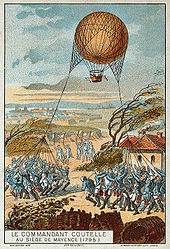
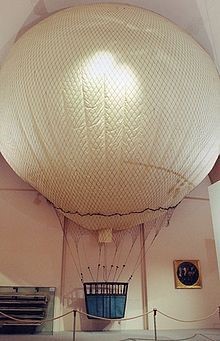
L’Intrépide or Hércule flown at the siege of Mainz (1795)

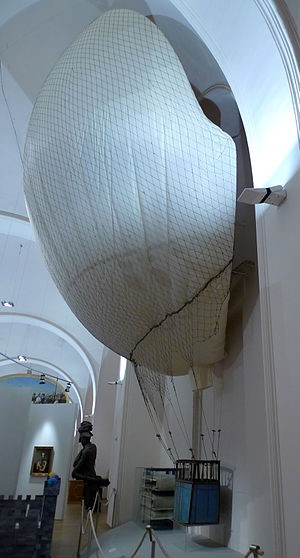
L’Intrépide was the larger of two observation balloons, the other being Hercule (“Hercules”), issued to the Aerostatic Corps in June 1795, twelve years after the pioneering hydrogen balloon flights of Professor Jacques Charles and the Robert brothers in Paris. These balloons were used by the Corps’s first company attached to General Jourdan’s Army of Sambre-et-Meuse in 1796. When that army was defeated by Austrian forces at the Battle of Würzburg on 3 September 1796, the balloon was captured and taken to Vienna, where it is now on display at the Heeresgeschichtliches Museum.

The actual preserved envelope is the sole survivor of the world’s first military air fleet – and possibly the world’s oldest surviving aircraft.

The balloon’s silk envelope is roughly spherical and has a diameter of 9.8 metres (32 ft). Its wooden gondola is very small, measuring 1.14 metres (45 in) by 0.75 metres (30 in) and its railing has a height of 1.05 metres (41 in). The hull displayed in the museum is a replica, with the original displayed in a glass box nearby.

Colt Balloons Ltd / Eire Colting Balloons Ltd

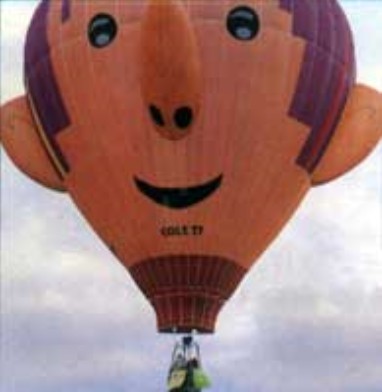
Hokan (or Hakan) Colting began building balloons in Ireland with fellow Swede Per Lindstrand in 1976, drawn, like many others, by that country’s abundance of available skilled labor (much of the company’s output went to Sweden). Production of Colt balloons by Eire Colting Balloons Ltd. continued until the company moved to London in 1978, and changed its name to Colt Balloons Ltd. The company had half the staff of a giant like Cameron, but innovated by building many challenging special shapes, and fabricating most of the components itself, Colt made a name as a scrappy player in the industry, not to be underestimated. Resembling Thunder in the ’70s, the two companies merged in 1980. ThunderColt continued production of Colt balloons, bringing the marque’s ultimate output to 99 before production ceased.

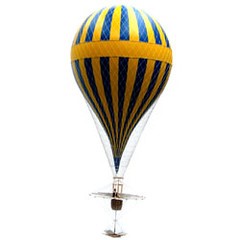
Claudius 1811 balloon

The Karl Friedrich Claudius balloon was equipped with a flat disc-like device that was located around the gondola. This was essentially a clap-valve wing which could be made to oscillate up and down, with the lift generated giving the balloon additional lift. On May 5th, 1811, Claudius made a flight from Berlin to Gartz, covering 18 miles in two hours.

Charles & Robert Charlières

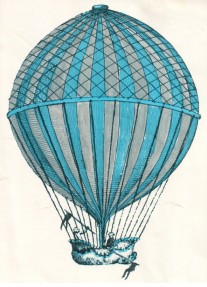
The early successes of the Montgolfiers had prompted the geologist Faujas de Saint-Fond to raise a public subscription for construction of a small silk hydrogen-filled balloon by J.-A.-C. Charles, the physicist, and two mechanics, the brothers Robert. This balloon flew 15 miles, unpiloted, on 27th August 1783; and on 1st December Charles and the elder Robert flew for more than two hours in a 26-foot-diameter hydrogen balloon, from the Tuileries Gardens in Paris, some 27 miles to Nesle. After touching down, Charles went up again by himself, but was so alarmed when the balloon shot up to over 9,000 feet that he never flew again.
More important than the flights themselves was the fact that Charles’s balloon was such a masterpiece of design and manufacture that many of its features — the valve, the net, the suspension of the basket, the provision of ballast, use of a barometer and the gas — have been retained to this day in free balloons.

Dihydrogen Balloon J. Charles