The Unikomtrans 11 four-seat light amphibian was displayed in 1995, but not known to have flown by 1998.
Amphibian
ULM Engineering Hydron
An amphibious three axis ultralight circa 1998.
ULM Engineering TRI MAR AIR
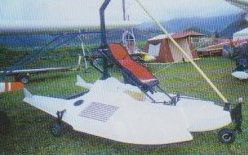
A trimaran arrangement, rather than straight-forward floats.
Empty weight: 150 kg
Wing span: 15 m
Wing area: 15 sq.m
Fuel capacity: 40 lt
Engine: Rotax 582, 64 hp
MAUW: 450 kg
Seats: 2
Max speed: 120 kph
Cruise speed: 90 kph
Minimum speed: 45 kph
Climb rate: 3 m/s
Fuel consumption: 16 lt/hr
Price (1998): 29 500 000 L
Two Wings Mariner Mono UL
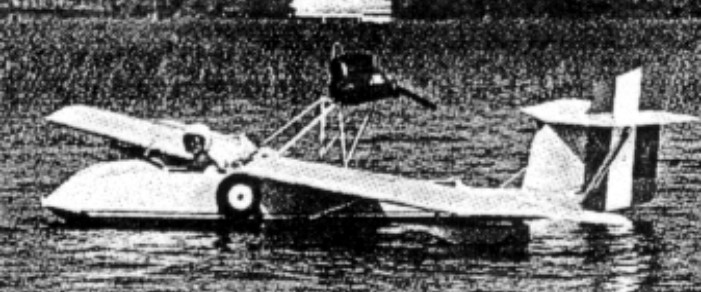
Amphibian pusher made from sheet metal, tube and fabric.
Engine: Rotax 447, 40 hp
HP range: 30-100
Height: 6 ft
Length: 18.75 ft
Weight empty: 304 lbs
Gross: 650 lbs
Fuel cap: 10 USG
Speed max: 63 mph
Cruise: 55 mph
Range: 75 sm
Stall: 27 mph
ROC: 800 fpm
Take-off dist: 200 ft
Landing dist: 250 ft
Service ceiling: 12,000 ft
Seats: 1 or 2
Landing gear: tail wheel, retractable
Two Wings Mariner High Wing

Amphibian pusher made from sheet metal, tube and fabric.
Engine: Subaru, 60 hp
HP range: 30-100
Height: 6 ft
Length: 18.75 ft
Weight empty: 300 lbs
Gross: 900 lb
Fuel cap: 10 USG
Speed max: 100 mph
Cruise: 85 mph
Range: 400 sm
Stall: 31 mph
ROC: 1000 fpm
Take-off dist: 200 ft
Landing dist: 250 ft
Service ceiling: 20,000 ft
Seats: 1 or 2
Landing gear: tail wheel, retractable
Two Wings Mariner EXP
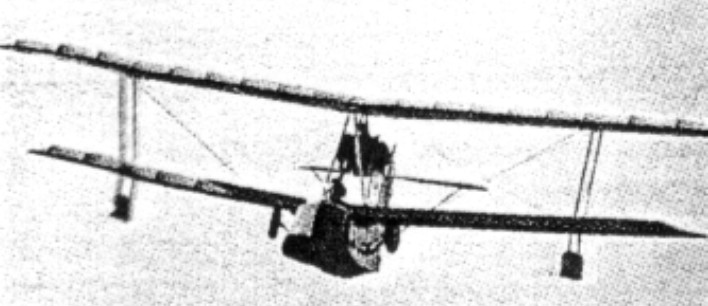
Amphibian pusher made from sheet metal, tube and fabric.
Engine: Subaru, 60 hp
HP range: 30-100
Height: 8 ft
Length: 18.75 ft
Wing span: 28.5 ft
Wing area: 204 sq.ft
Weight empty: 370 lbs
Gross: 950 lbs
Fuel cap: 10 USG
Speed max: 100 mph
Cruise: 80 mph
Range: 400 sm
Stall: 29 mph
ROC: 1500 fpm
Take-off dist: 175 ft
Landing dist: 225 ft
Service ceiling: 20,000 ft
Seats: 1 or 2
Landing gear: tail wheel, retractable
Tupolev ANT-44 / MTB-2

In December 1934, Tupolev was asked to design a naval heavy bomber (Morksoi Torpedonosets Bombardirovshik = naval torpedo bomber = MTB). With his seaplane specialist Ivan Pogosski dead, he gave the project to Aleksander Golubkov who came up with a more conventional design than the earlier ANT ‘hydroplanes’ – a single hull with a high-wing profile, made entirely from duraluminium. It was an amphibian with a retractable wheeled undercarriage, and the floats, mounted near the wingtips on struts, were load-carrying. Powerplants were four Gnome-Rhone 14Krsds, which gave 810hp each, and were mounted in the wing leading edges. The wing shape resulted in the ANT-44, as the project was designated, being called the Chaika (Seagull).
Construction of the prototype began on 4 October 1935, and the aircraft was manufactured with smooth sheets of duraluminium, which were now becoming available in place of the former corrugated ones. The work was carried out in the TsAGI-ZOK factory N156. It was completed in March 1937, and brought by road to Khodinka, from where it made its first flight on a fixed wheeled undercarriage (because the retractable mechanisation was not yet ready) on 19 April 1937. Its pilot was Timofei Riabenko. State tests were conducted with the undercarriage fixed down; maximum speed was measured at 355km/h, maximum take-off weight at 18,500kg, and range with a bomb or torpedo load of 2,500kg was 2,500km. The state tests were completed in July.

A second aircraft was completed in June 1938. By now the first had its undercarriage modified to retract, while the second aircraft had a retractable one from the start. It had 840hp Mikulin M-87As fitted and was dubbed the ANT-44bis or -44D.
By September, both aircraft were taken on service with the Soviet Navy, as the MTB-2A.
No production was ordered, and they served some operations in the Great Patriotic War from bases in the Black Sea. Led by Ivan Sukhomlin, the MTB-2As were used to bomb oil refineries in Bulgaria and Romania, both then under Nazi occupation.
Before the Soviet Union was invaded by Germany, Ivan Sukhomlin had earned four world records, with the ANT-44bis. In June 1940, he set several records lifting different loads to record altitudes for amphibians, and on 7 October he achieved a record for amphibians by carrying a two-tonne load over a 1,000km closed circuit at an average speed of 241.999km/h. Although this record was not acknowledged by the FAI until after the war, it stood unbeaten until 1957.
MTB-2A
Engine: 4 x M-87
Max take-off weight: 21500 kg / 47400 lb
Wingspan: 37.0 m / 121 ft 5 in
Length: 24.0 m / 79 ft 9 in
Height: 9.0 m / 30 ft 6 in
Wing area: 144.7 sq.m / 1557.54 sq ft
Max. speed: 350 km/h / 217 mph
Cruise speed: 250 km/h / 155 mph
Ceiling: 7200 m / 23600 ft
Range: 4500 km / 2796 miles
Range w/max.payload: 2500 km / 1553 miles
Crew: 4-5
Armament: 6 x 7.62mm machine-guns
Bombload: 2000kg

Tupolev ANT-27 / MDR-4 / MTB-1
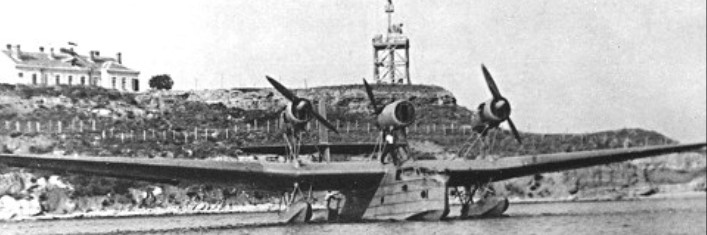
Naval, long-range, reconnaissance, heavy bomber, flying boat with three M-34RN engines. 15 April 1934 crashed at take-off during factory tests.
The ANT-27bis was a naval torpedo carrier, bomber/flying boat, in small serial production.
ANT-27bis
Engines: 3 x AM-34R, 610hp
Max take-off weight: 16250 kg / 35825 lb
Empty weight: 10521 kg / 23195 lb
Wingspan: 39.4 m / 129 ft 3 in
Length: 21.9 m / 72 ft 10 in
Height: 8.6 m / 28 ft 3 in
Wing area: 177.5 sq.m / 1910.59 sq ft
Max. speed: 225 km/h / 140 mph
Ceiling: 4470 m / 14650 ft
Range: 2000 km / 1243 miles
Crew: 5

Tupolev ANT-22 / MK-1

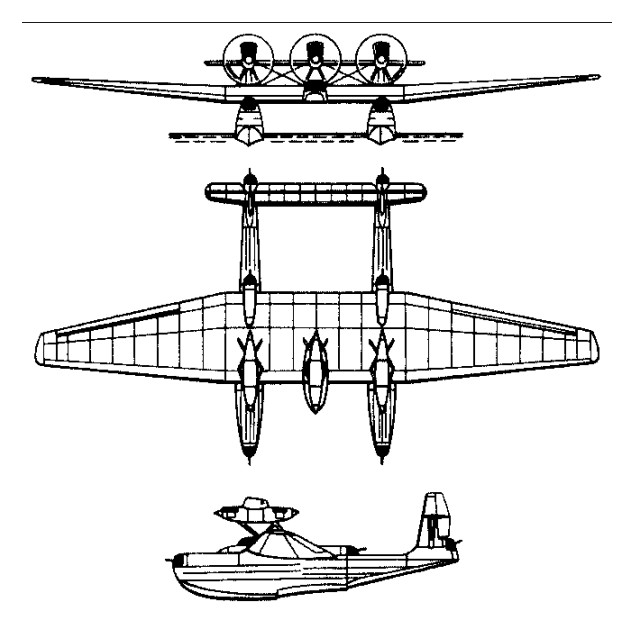
The Tupolev ANT-22 or MK-1 with six 619kW M-34R engines was a long-range bomber reconnaissance flying-boat, with a twin-hull. Test flown for the first time on 8 August 1934, it established several weight-to-height world records in December 1936, but was abandoned soon afterwards.
Armament comprised eight 7.7mm ShKAS machine-guns, one 20mm cannon and a bombload of up to 6000kg.
ANT-22
Engines: 6 x AM-34R
Max take-off weight: 33560 kg / 73988 lb
Wingspan: 51.0 m / 167 ft 4 in
Length: 24.1 m / 79 ft 1 in
Height: 6.4 m / 21 ft 0 in
Max. speed: 223 km/h
Ceiling: 3500 m / 11500 ft
Armament: 2 x 20mm cannons, 6 x 12.7mm machine-guns
Bombload: 6000kg
Crew: 3
Tupolev ANT-8 / MDR-2
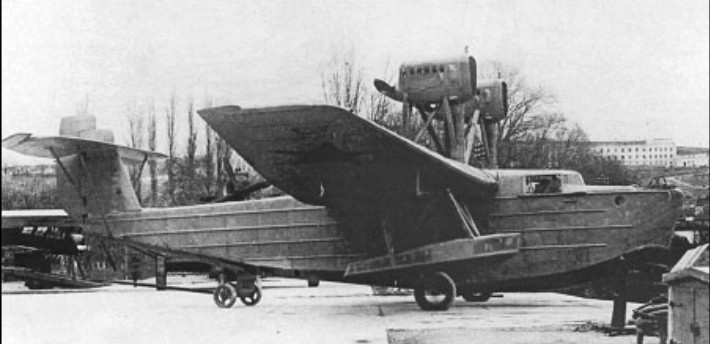
Although Tupolev and the TsAGI had been requested to construct a flying boat in 1925, higher priority had been given to his long-range bomber projects and little work was done. But in 1930, with Ivan Pogosski as head, work began in earnest on the ANT-8, which was given the military designation of MDR-2 (MDR = Morskoi Dalnii Razvedchik = Naval Long-Range Reconnaissance).
The designation ANT-8 indicated how long the TsAGI had held back this project, for shortly after its first flight, the ANT-14 flew. The flying boat’s wings and tailplane were derived from the ANT-9, and again an all-metal construction was chosen. The fuselage was given a lot of attention by the design team, and the opportunity was taken to make the floats part of the load bearing structure as well as surface balancing devices. Power was provided by two BMW-VI pusher engines mounted on struts over the wings. It was piloted by S. Riballschuk on its first flight which took place on 30 January 1931. Armament was two DA-2 machine-guns, and it could carry an underwing bomb load of 900kg.
Tupolev regarded the ANT-8 as a proof of concept machine for further development, particularly of hulls. In fact, it turned out to be a worthwhile design in its own right, although the Soviet Navy decided not to proceed with it as it considered the design already dated and unlikely to meet its developing needs.
Only the prototype ANT-8 was built; although several modifications were made to its hull, it remained essentially a one-off experimental aircraft.
Engine: 2 x BMW-VI, 500hp
Max take-off weight: 8160 kg / 17990 lb
Empty weight: 4560 kg / 10053 lb
Wingspan: 23.7 m / 78 ft 9 in
Length: 17.03 m / 56 ft 10 in
Height: 5.67 m / 19 ft 7 in
Wing area: 84.00 sq.m / 904.17 sq ft
Max. speed: 166 km/h / 103 mph
Ceiling: 3350 m / 11000 ft
Range: 1062 km / 660 miles
Crew: 5

 All Aero