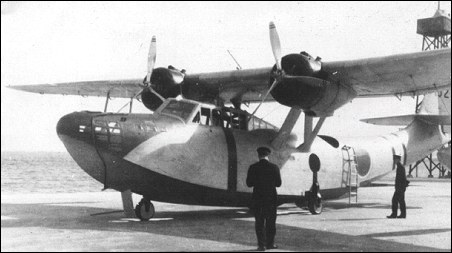
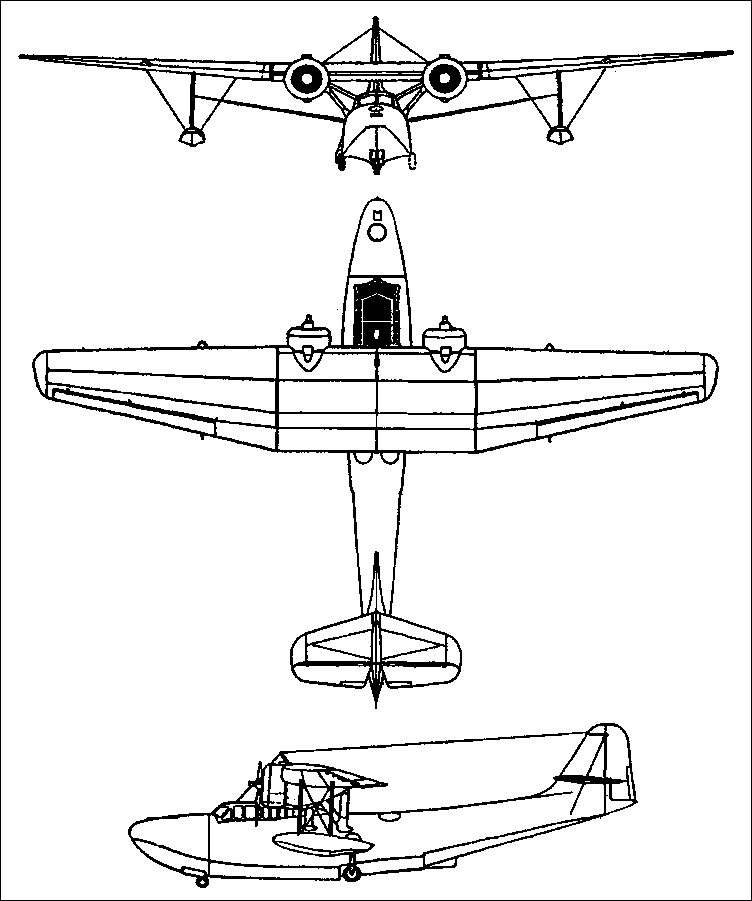
The first prototype flew in September 1940 and a total of 30 were built.
H9A1 Engine: 2 x Nakadjima Kotobuki-42, 530kW Wingspan: 24.0 m / 78 ft 9 in Length: 16.95 m / 55 ft 7 in Height: 5.25 m / 17 ft 3 in Wing area: 63.3 sq.m / 681.35 sq ft Take-off weight: 7500 kg / 16535 lb Empty weight: 4900 kg / 10803 lb Max. speed: 315 km/h / 196 mph Cruise speed: 220 km/h / 137 mph Ceiling: 6780 m / 22250 ft Crew: 5 Passengers: 3 Armament: 2 x 7.7mm machine-guns, 250kg of bombs
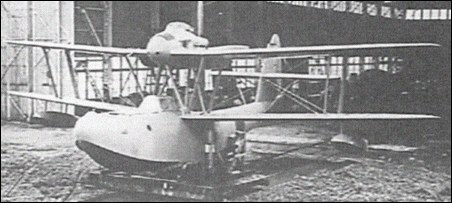
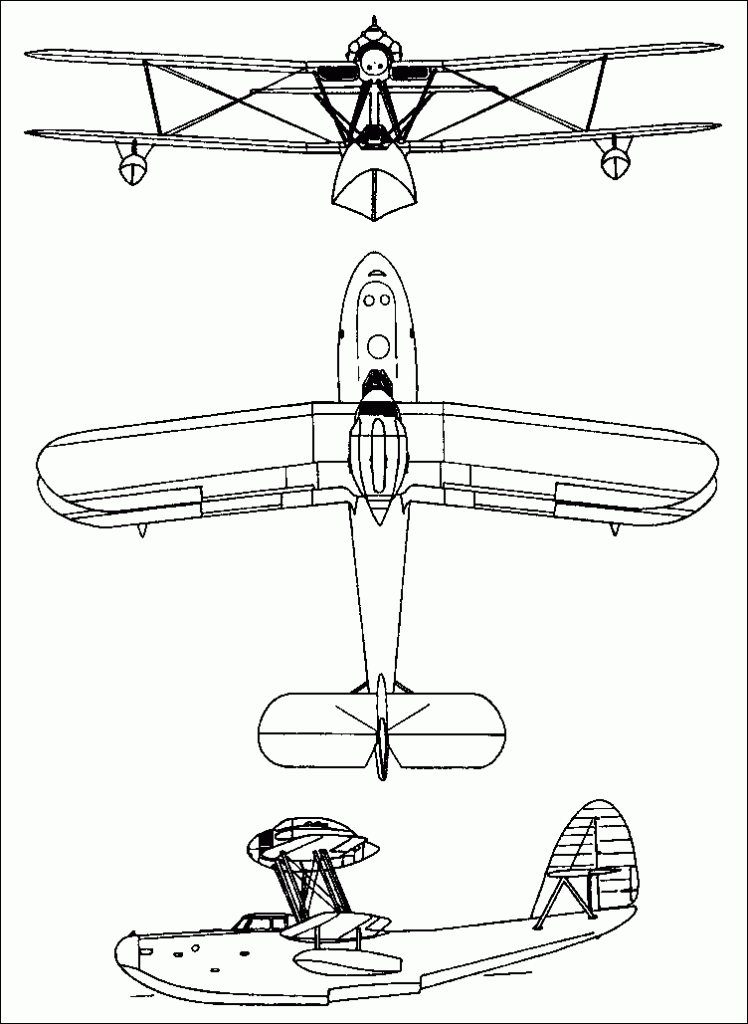
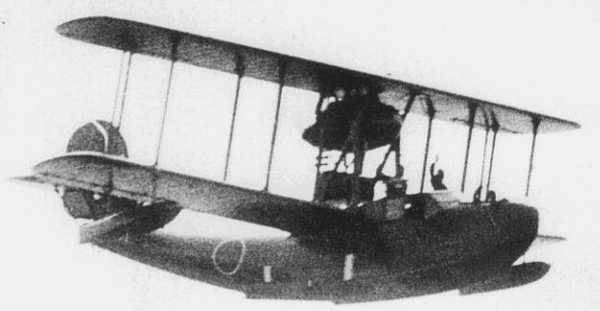
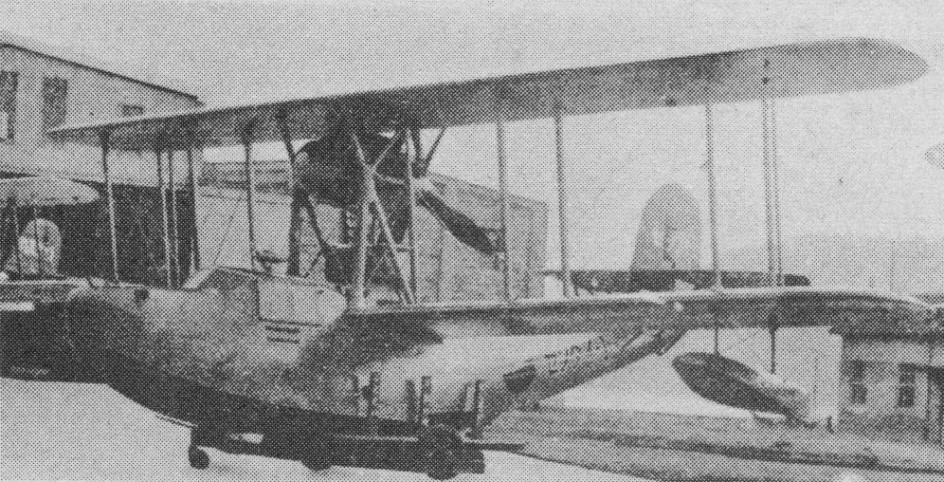
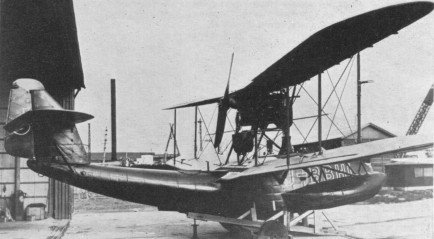
The E11A was planned to a 1936 requirement for a successor to the same company’s E10A as the noctur-nal spotter carried by Japanese battleships and cruis¬ers, and first flew in June 1937. The Aichi prototype was evaluated competitively against the Kawanishi El1K, and ordered into production during April 1938 with the full designation Navy Type 98 Night Recon¬naissance Seaplane, and the short designation E11A1 (reconnaissance seaplane, 11th in series, built by Aichi, 1st model). Including prototypes, production up to 1940 amounted to just 17 aircraft, and these saw limited operational service in the opening rounds of Japan’s Pacific campaign in the Second World War. Of biplane configuration, the two-step hull carried a braced tail unit, with the tail-plane and elevator mounted almost halfway up the fin. Accommodation was provided for a crew of three, and there was an open bow position that could be used during on-water manoeuvres, or mounting a defensive machine gun. Balancer floats were mounted beneath each lower wing, close to the wingtip. The engine was a Hiro Type 91 Model 22 inline engine, mounted at the centre-section of the upper wing, and driving a pusher propeller with spinner.
E11A1 Engine: 1 x Hiro Type 91 Model 11 inline piston, 620-hp (462-kW) Maximum speed: 135 mph (217 kph) at 7,875 ft (2,400 m) Climb to 9,845 ft (3,000 m): 18 min 32 sec Service ceiling: 14,520 ft (4,425 m) Range: 1,209 miles (1,945 km) Weight empty: 4,248 lb (1,927 kg) Maximum take-off weight: 7,275 lb (3,300 kg) Wing span: 47 ft 6.5 in (14.49 m) Length: 35 ft 1.75 in (l0.7lm) Height: 18ft 0.5 in (5.50m) Armament: one 7.7-mm (0.303-in) machine-gun
In 1934, based on experience of testing the Experimental 6-Shi Night Reconnaissance Flying boat, the Imperial Japanese Navy drew up a specification for a new night reconnaissance aircraft, intended to shadow enemy fleets during the cover of darkness, with orders being placed with Aichi and with Kawanishi.
Aichi’s design, with the company designation AB-12, was a single-engined biplane flying boat of all-metal construction. Its two-bay wings folded rearwards to save space on board ship, while its crew of three were accommodated in an enclosed cabin. It was powered by a pusher water-cooled Aichi Type 91 engine, driving a four-blade wooden propeller.
The first prototype flew in December 1934, and when tested proved to have superior stability to the competing Kawanishi E10K, and so was ordered into production.
The AB-12 entered service in August 1936 with the Japanese Navy as the Type 96 Night Reconnaissance Seaplane, with the short designation E10A. The allied code name ‘Hank’ was assigned before its appearance or manufacturer was known.
Fifteen aircraft were built for the Imperial Japanese Navy serving from 1936, remaining in service until 1941, being phased out in 1941 before the Japanese attack on Pearl Harbour.
E10A Powerplant: × Aichi Type 91 W-12, 370 kW (500 hp) to 485 kW (650 hp) Propeller: 4-bladed wooden fixed-pitch pusher Wingspan: 15.5 m (50 ft 10 in) Wing area: 52.1 m2 (561 sq ft) Length: 11.219 m (36 ft 10 in) Height: 4.5 m (14 ft 9 in) Empty weight: 2,100 kg (4,630 lb) Gross weight: 3,300 kg (7,275 lb) Wing loading: 63.2 kg/m2 (12.9 lb/sq ft) Power/mass: 0.113 kW/kg (0.069 hp/lb) Maximum speed: 206 km/h (128 mph, 111 kn) at sea level Cruise speed: 106 km/h (66 mph, 57 kn) at 1,000 m (3,281 ft) Range: 1,852 km (1,151 mi, 1,000 nmi) Service ceiling: 4,120 m (13,520 ft) Time 3,000 m (9,843 ft): 17 minutes 42 seconds Guns: 1× 7.7 mm machine gun flexibly mounted in nose Crew: 3
This 4-seat amphibian was a design of a company name Aero Wood Specialties, Inc. and work started around 1993. The aircraft had a largely all composite materials construction and the first example (a Model Avovet 1-A with a 300hp Lycoming IO-540-K1D5 engine) was under construction when the project was halted, possibly in/around 1998 and consequently the prototype was never completed.
Engine: Lycoming IO-540-K1D5, 300 hp. HP range: 240-350. Wing span: 39 ft. Wing area: 185 sq.ft. Height: 10.75 ft. Length: 26.25 ft. Weight empty: 1960 lbs. Gross: 3520 lbs. Speed max: 165 mph. Cruise: 155 mph. Range: 900 sm. Stall: 53 mph. ROC: 1200 fpm. Take-off dist: 700 ft. Landing dist: 1200 ft. Service ceiling: 16,500 ft. Fuel cap: 100 USG. Seats: 4. Landing gear: retractable nose wheel amphibian.
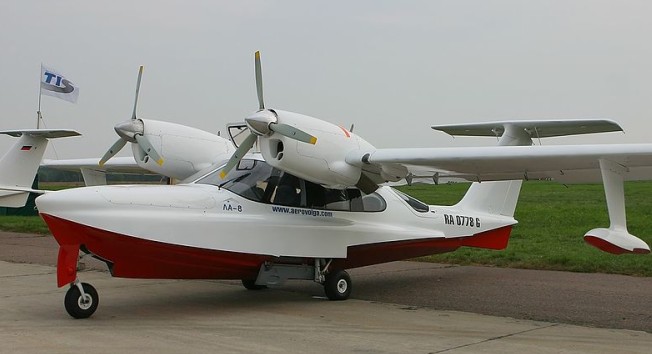
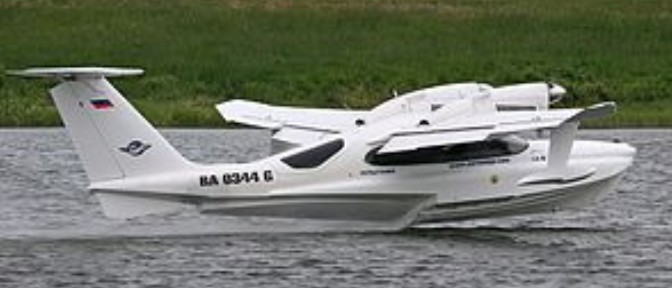
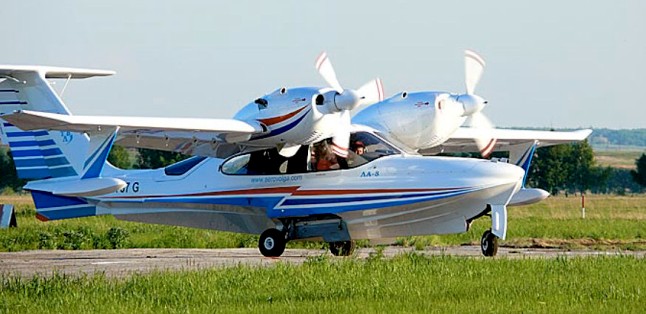
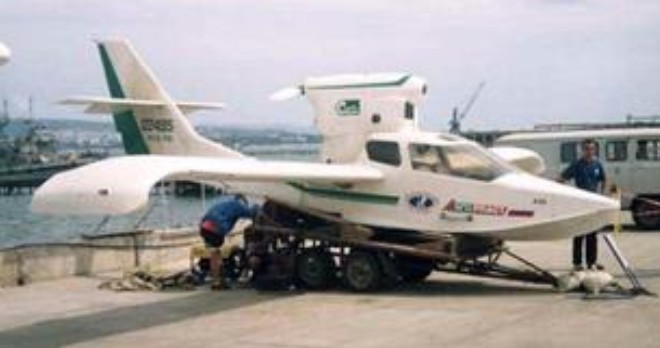
The AeroVolga LA-8 8 seat amphibious aircraft has its origin with the Chaika L-6, first flown in 2000, and its immediate successor the L-6M, promoted by AeroVolga and first flown in 2001. Both of these were twin engine, V-tailed amphibious aircraft, the latter differing in its hull design, undercarriage and maximum take-off weight. Chaika developed the L-6M into the L-4 and AeroVolga developed it into the LA-8. These are very different designs: the LA-8 has a T-tail and is some 25% longer than the L-4, with tricycle gear.
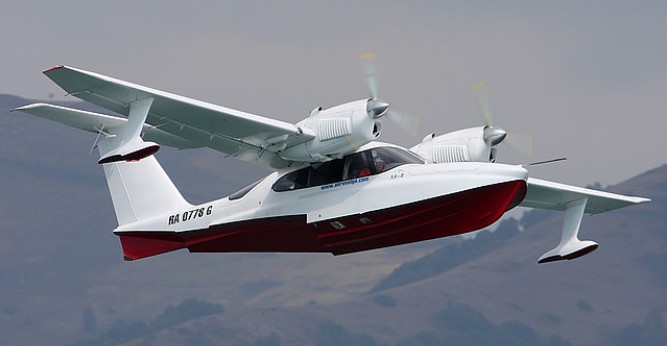
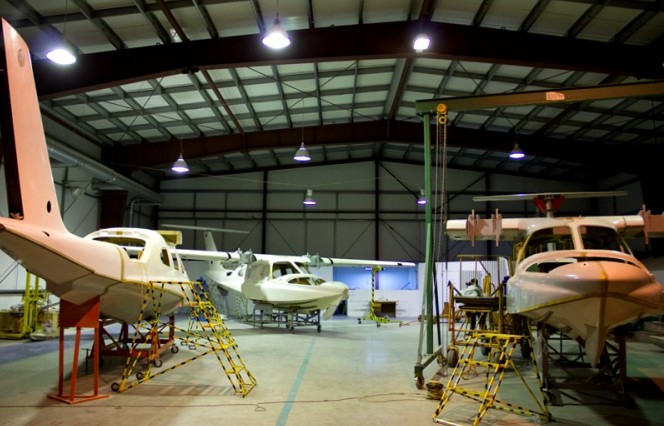
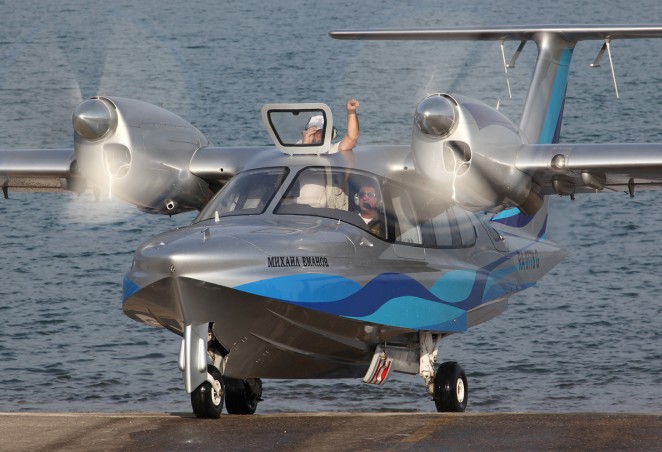
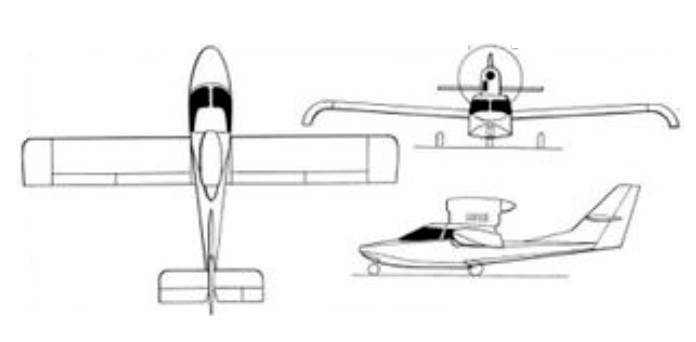
The LA-8 is largely built from plastic foam and PVC filled glass fibre sandwich. Its wing is divided into watertight compartments. The amphibian is a cantilever high wing monoplane with straight tapered wings; most of the sweep is on the trailing edge. First flown on 20 November 2004, the prototype originally had downturned wing tips but these were replaced with extended upturned tips by 2006 and by early 2011 a later aircraft had winglets which extended both above and below the tips. There is no dihedral. Its twin engines are placed above and ahead of the wing leading edge, as close to the centre-line as the clearance between propeller and fuselage allows. The prototype was powered by two LOM M337AK air-cooled six-cylinder supercharged inverted inline engines.
The basic version of the power plant (C-version) is two piston engines LOM PRAHA M337C-AV with take off power 235 HP. The engines are equipped with supercharge and timing fuel injection system. Time between scheduled maintenance of engines is 100 hours, motor oil replacing time is 200 hours.
The LA-8L variants have 175 kW (235 hp) Lycoming IO-540 air-cooled flat-sixes. Turboprop engines are TP-100 (250 HP) or АI-450 (300 HP).
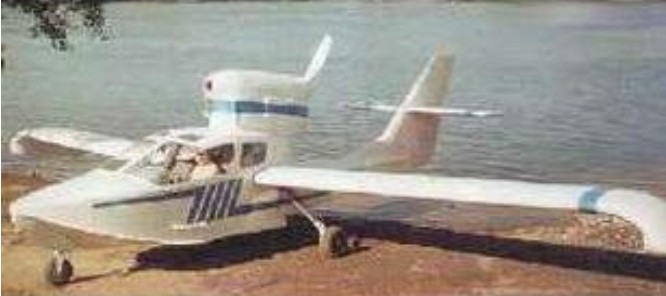
First prototype in 2008, with upturned tips
The two step hull is also subdivided into watertight compartments. Two fixed underwing stepped floats at about 75% span stabilize the aircraft on water. The cabin is under the wing, with two long continuous transparencies, one on each side plus two shorter panels in the main entry hatch in the rear roof behind the trailing edge. There is seating for eight, including one or two pilots. The LA-8’s T-tail has a slightly tapered, straight edged, swept fin with a sub-fin extension; both the rudder and the single piece, externally mass balanced elevator have electrically actuated trim tabs.
The LA-8 has a tricycle undercarriage with mainwheels retracting into the fuselage sides and the nosewheel retracting rearwards. A ballistic parachute is an option.
The aircraft has a composite high wing, with T-shaped stabilizer. The main fuel tanks with a capacity of 455 liters (for RS-version – 1 400 liters) are located in the wing of the aircraft. For C-version and L-version it is possible to install the additional fuel tanks in winglets, with total capacity 100 liters.
Two mooring rings are located on the lower surface of the wing, one – in the nose part, one – on the aft. Two cleats are located near the hatch. The cleats can be either fixed or retractable into frame.
There are four knots on the top of the aircraft, for which the aircraft can be lifted by crane onto the deck of the ship and the dock with using a standard four-point brace. The aircraft can be equipped with lifting eye bolts and two sling-adapters.
Ground power unit (GPU) is plugged to the standard onboard socket and allows starting the engines and charging on-board batteries.
The landing/taxi LED lights cluster is installed in the left wing. The quad xenon land light is installed in the right wing. The navigation lights (left and right) are located in the winglets, in the tail part of the fuselage the tail light and anti-collision light are installed, on the fin tip is located the parking light switched on in the water.
Landing gear is tricycle type, with the nose strut. Wheel suspension is wishbone, with gas-fluid absorbers. For manufacture of landing gear it is used special high-quality stainless steel and special coverings with high resistance to seawater. The specially designed landing gear allows to land on unpaved ground. The landing gear retraction/extension is performed by hydraulic drive; emergency main struts extension is performed under its own weight, the nose strut extension is performed by backup pneumosystem.
The emergency extension of all struts is performed under their own weight in RS-version. The working of hydraulic system and emergency pneumosystem is controlled by two pressure gauges mounted on the pilot’s instrument panel.
Indication of the landing gear position is designed specifically for amphibian aircraft, when landing on the water surface is performed with retracted landing gear. So the position of retracted landing gear is displayed as bright-blue color, extended – as yellow color. The additional visual control of position of the landing gear can be made by using panoramic mirrors located on the floats.
For controlling the aircraft when moving on water the different engine thrust or reverse thrust is used, for controlling the aircraft movement on land – separate braking wheels. The brakes are hydraulic, on control pedals. Both main wheels can be stopped by parking brake.
Control of the aircraft is possible from the right or left pilot’s seats which are equipped with control columns and pedals. For locking the elevators and ailerons when standing the safety pin with red marker is inserted into the control column support.
Autopilot is controlled from the central instrument panel and the button of autopilot emergency cutoff is on the control wheel. Control of engines, propellers and trimmers are located on the centre console between pilots.
Engine control levers allow operate as straight thrust as reverse thrust. In order to prevent the propellers transition to reverse mode during flight engine, control console is equipped with computer controlled reverse lever lock disabling reverse activation at speed over 100 km/h and more than 1 400 RPM.
Flaps are controlled by electric drive. The flaps position is controlled by indicator or visually. RS-version of the aircraft normally (other versions – optional) is equipped with automatic follower-up control system of the flaps, where required flap angle from 0 to 40 degrees is set by flap position selector, after that automatic equipment set the flaps into appointed position.
Pilot’s seats have a system of longitudinal movement which provides comfortable seating and adjustment for pilots which are from 160 to 200 cm in height. For convenient seat adjustment the handrail is mounted in the cabin. The design of the seat pan allows using individual anatomic cushion.
The main access door is located in the top tail part of fuselage and designed to provide boarding the aircraft as well on land as in water. The hatch opens up. The dimensions of hatch allow to load long-measuring freight and as well a patient on special stretcher. Gas jacks provide easy hatch opening and closing and locking device – fixing the hatch opened. Hatch lock mechanism provides a two-level protection against accidental opening, allowing, at the same time, almost instantaneous opening hatch, both inside and outside. To access to the cabin is used embedded folding ladder, the design of which allows, if necessary, to climb back on board for swimmers.
There are two emergency exits on left and right sides. Sliding transparent vents are embedded in windshield of hatches. At the top of the cabin there is the access hatch. The windscreen of the cabin is made from acrylic (PMMA) plastics, with improved athermical properties. The windshield is able to stand standard bird strike. The left windscreen of pilot can be equipped with electrical defrost heating for deicing and besides the left windscreen can be equipped with washer which feed water to remove salt stains.
In the cabin up to eight seats can be installed with two pilot seats included. The rear seats have fold-back and lockers under the seat pan. Each seat is equipped with a mandatory safety belt system.
Above each seat individual lighting, adjustable air ball vent and intercom are installed.
For baggage there are two storage compartments – in the nose of the aircraft and in the rear part of the cabin. For small items there are special pockets and niches. The aircraft LA-8C-RS can be equipped with lockable luggage racks.
The aircraft is equipped with two bilge pumps. De-icing system includes electric system of heating the pitot tube, the stall warning indicator, the left pilot windshield, the propeller and the leading edges of wing and tail. Using the M337C-AV engines with compressors and dispersed fuel injection allows eliminating such a dangerous effect as icing the intake system of the engine.
The aircraft is equipped with a speed computer-analyzer which prevents the reverse activation at speed exceeding 100 km/h, as well as the landing gear retraction at speed below 100 km/h. If necessary to retract or extend the landing gear at slow speed (for example on the water or at maintenance works) the lock should be turned off by special switch.
Each propeller is equipped with a centrifugal lock, making it impossible to shift the propeller blades to reverse at 1,400 RPM. Thus to prevent accidental reverse activation in flight there is backup locking system.
Basic power plant is based on the two engines LOM PRAHA M337C-AV with take-off power 235 HP and continuous power of 210 HP each. Each engine has six cylinders in line (capacity of 6 liters, 366 cubic inches). The engines are invert. Such design of the engine provides the minimum aerodynamic resistance of power plant. The engines are equipped with mechanical superchargers and keep power to altitude of 1 200 m. Also the engines are equipped with timing fuel injection which provides record low fuel consumption up to 0,195 kg (kw/h) and have automatic altitude fuel-air mixture correction
The German propeller MTV-12-D-C-F-R(M)/CFR190-53 with constant speed, hydraulic control, reverse and feathering are installed.
The aircraft can be equipped with LYCOMING 540 of 235HP to 300HP, as well as turboprop TP-100 or AI-450 engines with propellers “AVIA” or MT.
In case of using LYCOMING engines it is possible to install HOFFMAN V-123 propellers with increased starting thrust.
The aircraft can be equipped with auxiliary power unit with generator of 1 500W to increase the independency of the aircraft.
The main electrical network of the aircraft is DC 27V. Energy supply is DC generators. Basic battery of 24V/16 Ah or also the battery of 24V/20 ah can be installed.
Power supply of power-consuming devices such as de-icing devices is performed by AC 42V from the additional generators mounted on the engines. To be able to connect devices with a voltage of 12V can be installed static converter with power up to 250 W.
The main flight instrument is GARMIN G500 avionics display system certified for multiengine piston aircrafts with take off weight up to 5 700 kg and flight altitude up to 6 000 m. The display consists of two monitors.
For better maneuverability of the aircraft on the water is provided the small boat engine installation.
The design of the aircraft allows its quick (within 15 minutes) transformation from a passenger (main) version into cargo version. On the rails of the floor are installed strapping shoes for mooring cargo or cargo mash. Re-equipment of the aircraft is performed from passenger modification into air ambulance less than 30 minutes.
The design of the wing (version RS) allows to mount two underwing containers weighing up to 150 kg each.
It is possible to deliver LA-8 as hydroplane with fast mounted undercarriage (mounting and dismantling take not more 10 minutes) and removable ski set for winter operation. The useful load of LA-8H is 1180 kg (1215 kg for RS-version).
SPU “AeroVolga” offers a unique modification of the fire-monitoring aircraft LA-8 FF (2 person crew) with the possibility of taking onboard 1000 liters of water in the planing mode, water drop (foam-water mixture) during 2 sec from the altitude up to 5 m at speed of 180 km/h and duration for fire monitoring up to 5 hours.
The patrol modification of the aircraft based on LA-8C-RS with radio and video monitoring set of surrounding area can stay in the air up to 14 hours with crew of 4 people. The crew is provided by dry closet, galley and a place for rest for one person as well as multi-channel communication protected system
The first-aid modification of the aircraft based on LA-8C-RS with medical equipment weighing up to 180 kg allows two doctors to resuscitate a patient (injured) during the flight up to 5 hours (1000 km).
In 2013 the aircraft are delivered with airworthiness certificate under FAP-118 Russian Federation at the moment.
The LA-8 first prototype flew for the first time on 20 November 2004 with test pilot M.M. Emanov. The first production aircraft flew in August 2006 and the first Lycoming powered machine was completed in mid-2010.
In 2006 the aircraft was modified with series 37 engines: М-337C with power increased by 25%, and specific fuel consumption reduced by 15%. In 2008 the Lycoming 540 (235 h.p.) engine was integrated.
The first flight tests of the LA-8 were carried out successfully. Takeoff from water showed good characteristics: exit to the glideslope is 45 km/h, take-off is 90 km/h, the length of takeoff of an empty plane is 200 meters. Prototyprs 1 and 2 conducted more than 200 hours of factory flight tests.
Certification works are carried out according to Russian aviation rules (АR-23,21) correspondent to international FAR; JAR.
By mid-2012 six LA-8s had been produced for customers as well as the three prototypes. Two were with Russian operators, one flying around Lake Baikal and the other on Lake Seliger. Two went to an operator in Montenegro. Another five have been sold to Rimos Ltd for work in the Persian Gulf; by July 2012 two of these had been delivered.
Seagoing ability allows operating with wave height up to 0,6 m. Minimum length of runway is 400 m. Runway absolute altitude up to 1 500 m for piston version and 2 500 m for turboprop version.
Variants:
LA-8C Baseline version powered by 2x 175 kW (235 hp) LOM Praha M-337C-AV01.
LA-8C-RS Long range version of LA-8C, powered by 2x 175 kW (235 hp) LOM Praha M-337C-AV01.
LA-8L-RS Long range version of LA-8L, 2x 175 kW (235 hp) Lycoming IO-540B4B5 engines.
LA-8HC Flying boat / Hydroplane / skis based on the LA-8C
LA-8HL Flying boat / Hydroplane / skis based on the LA-8L
LA-8LDM High specification variant.
LA-8FF Fire-fighting variant.
Specifications:
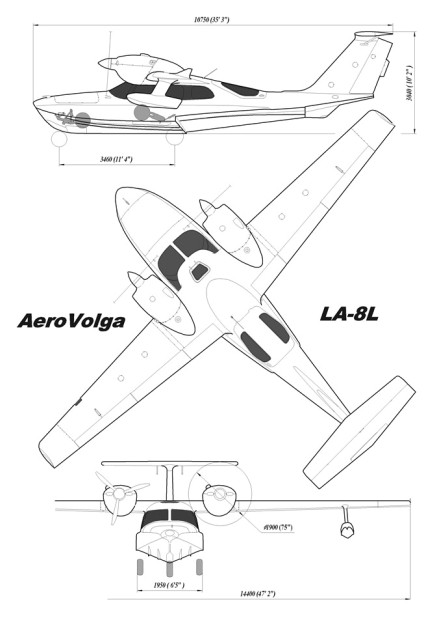
LA-8 Length: 36,42 ft Wing length: 46 ft Ramp height: 11,15 ft Maximum width of fuselage: 6,56 ft Track of landing gear: 6 ft Wheelbase of landing gear: 11,23 ft Wing area: 217,4 sq.ft Maximum takeoff weight: 5997 lb Maximum useful comercial load: 1764 lb Maximum fuel capacity (ferrying): 396,3 gal Maximum altitude: 14760 ft Maximum allowable speed: 189,5 ktas Maximum speed of horizontal flight: 170,9 ktas Cruise speed (economy): 146 ktas Range (payload 1764 lb): nm (max) Range max: 2160 nm Endurance (max tow): 5,6 hr Rate of climb: 787-1181 ft/min Runway length land (max t.o.w.): 1148 ft Runway length water level (max t.o.w.): 1476 ft Landing speed (at maximum weight): 53 ktas Maximum overload: +3,8 -1,9G Passenger Cabin length: 11,32 ft Passenger Cabin width: 5,381 ft Passenger Cabin height: 4,068 ft Cabin capacity: 130,7 cu.ft Maximum length of cargo: 14,53 ft Front upper access door: 1,47 х 1,90 ft Rear upper access door: 5,545 x 4,232 ft Emergency doors (left, right): 2,23 х 2,23 ft
LA-8C Empty weight: 1 685 kg Maximum take-off weight: 2 720 kg Maximum useful load: 1 035 kg Range 630 kg payload opt tip tanks: 1 400 km
LA-8C-RS Engines: 2x 175 kW (235 hp) LOM Praha M-337C-AV01. Empty weight: 1 650 kg Maximum take-off weight: 2 720 kg Maximum useful load: 1 070 kg Maximum range: 4 000 km
LA-8L-RS Engines: 2 × Lycoming IO-540B4B5 air-colled flat six, 175 kW (235 hp) each Propellers: 3-bladed Hoffman HO-V123K, 1.95 m (6 ft 5 in) diameter Length: 10.80 m (35 ft 5 in) Wingspan: 15.00 m (49 ft 3 in) Height: 3.14 m (10 ft 4 in) Wing area: 22.10 sq.m (237.9 sq ft) Airfoil: P-lll-15 Empty weight: 2,000 kg (4,409 lb) Gross weight: 2,720 kg (5,997 lb) Maximum speed: 259 km/h (161 mph; 140 kn) Cruising speed: 220 km/h (137 mph; 119 kn) normal Stall speed: 86 km/h (53 mph; 46 kn) power off, flaps down Service ceiling: 5,000 m (16,404 ft) g limits: +3.8/-1.9 Take-off run, land: 350 m (1,149 ft) Take-off run, water: 450 m (1,477 ft) Crew: One or two Capacity: max 7 passengers.
A four-seat amphibian first flown in November 1994.
A-25 Breeze Wing Span: 10.6 m Length: 7.9 m Height: 2.5 m MTOW: 1200 kg Fuel Capacity: 195 lt Maximum Speed: 111 kt Optimum Speed: 93 kt Absolute Ceiling: 14,000 ft Optimum Ceiling: 12,000 ft Maximum Range: 600 nm Maximum Climb Rate: 980 ft/min Take Off Distance: 420 m Seats: 4
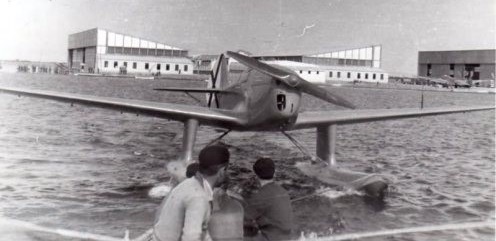
In essence a floatplane variant of the HM.1. The two HM.3’s built were tested at the end of the 1940s. Certain problems soon appeared, mainly questionable float design and lack of power. The Spanish AF didn’t show any further interest in them and that was the end of it.
 All Aero