Amphibious aircraft (long range arctic recon.)
Amphibian
Bagalini Baganfibio
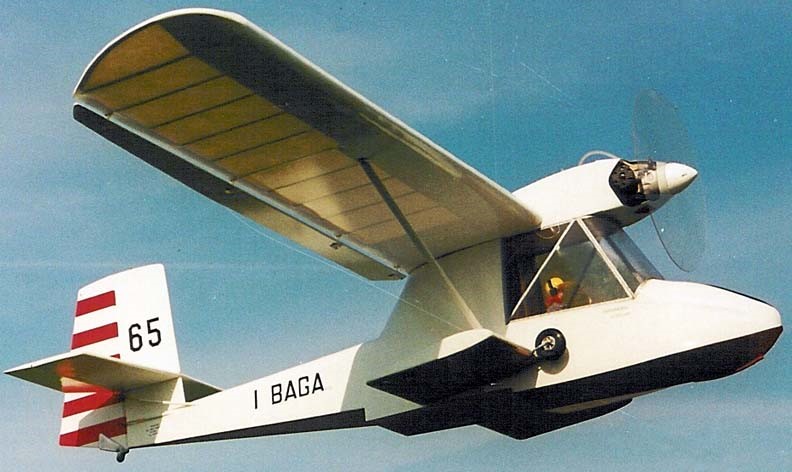
The Bagalini Baganfibio (from “Bagalini” and “Amphibian”) is an Italian homebuilt flying boat that was designed by Marino Bagalini. The two-seat tandem amphibious aircraft was supplied in the form of plans for amateur construction.
The Baganfibio features a strut-braced high-wing, a two-seats-in-tandem enclosed cockpit, retractable conventional landing gear and a single engine in tractor configuration mounted above the wing.
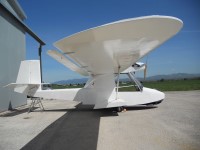
The aircraft is of all-wooden construction, with its wings covered in doped aircraft fabric. Its 10.7 m (35.1 ft) span wing employs an RSG 36 airfoil and has Junkers ailerons. The aircraft does not use tip floats, but instead relies on sponsons for balance in the water. The acceptable power range is 40 to 50 hp (30 to 37 kW).
Full fuel is 26 litres (5.7 imp gal; 6.9 US gal) and the payload is 151 kg (333 lb).
The manufacturer estimates the construction time from the supplied kit as 700 hours.
Plans were available in 1998.
Engine: Rotax 503, 50 hp / 37 kW
Wingspan: 35 ft 0 in / 10.67 m
Wing area: 167 sq. ft / 15.5 sq.m
Airfoil: RSG 36
Length: 22 ft 0 in / 6.71 m
Empty weight: 385 lb / 175 kg
MTOW: 759 lb / 344 kg
Fuel capacity: 26 litres (5.7 imp gal; 6.9 US gal)
Wing loading: 22 kg/sq.m / 4.5 lb/sq ft
ROC 600 fpm / 3.0 m/s
Cruise: 43 mph / 69 km/h / 37 kn
Max speed: 62 mph / 100 km/h / 54 kn
Range: 130 mi / 210 km / 110 nmi
Stall: 28 mi / 45 km/h / 24 kn
Seats: 2
Bachelier-Dupont-Baudrin 1913 flying-boat
The 1913 Bachelier-Dupont-Baudrin biplane flying-boat was designed and built by Bachelier, Dupont and Baudrin in France.
Span: upper 36’9″ lower 29’6″
Length: 26’3″
Weight empty: 836 lbs
Avid Amphibian / Catalina

The Catalina was formerly named Avid Amphibian. Designed by Dean Wilson, the original prototype was powered by an air-cooled engine, but was changed for the Rotax 582. The sponsons contain the main wheels as well as providing a step, and the drooped wingtip have built-in floats.


Engine: Rotax 582, 65 hp.
Speed max: 80 mph.
VNE: 80 kt / 92 mph / 148 kmh
Cruise: 75 mph.
Range: 364 sm.
Stall: 36 mph.
ROC: 900 fpm.
Take-off dist: 300 ft (750 ft water).
Landing dist: 500 ft (275 ft water).
Service ceiling: 12,500 ft.
Fuel cap: 17 USG.
Weight empty: 600 lbs.
Gross: 1200 lbs.
Height: 5.75 ft.
Length: 19.4 ft.
Wing span: 36 ft.
Wing area: 150 sq.ft.
Seats: 3.
Landing gear: retractable tail wheel.
Engine: Rotax 532.
Empty wt.: 560 lbs
Max wt. lbs: 1,200
Wing span: 36ft
Wing area: 150 sq.ft.
Wing loading: 8 lbs/sq.ft
Power loading: 18.75 lbs/hp
Max speed: 80 mph
Cruise: 75 mph
Stall: 25 mph
Vne: 80 mph
Seats: 2
Aviaspetstrans Consortium
Created 1990 to develop the Yamal multipurpose amphibian, suited to passenger (15) and cargo transportation, patrol, survey, firefighting, rescue and other roles. MAPO ‘Myasishchev’ to manufacture. Unusual powerplant; twin turboshafts driving single 6-blade pusher propeller aft of tail unit.
AVIC AG600 / TA-600 / Kunlong
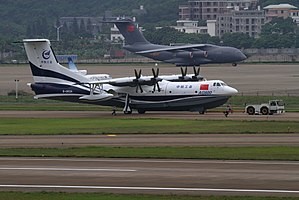
The AVIC AG600, code named Kunlong (鲲龙), also known as TA-600, is one of China’s three “big plane projects” approved by the State Council of China in 2009, along with the Xi’an Y-20 and C919. It is intended for both civil and military roles. In civil use, as an aerial firefighter it will be capable of dropping 12 tonnes of water, while in search and rescue operations it will accommodate up to 50 passengers. It is also intended to meet China’s strategic defence needs in the South China Sea area.
It was designed by the Aviation Industry Corporation of China (AVIC). The aircraft was developed by a group of 70 aircraft component manufacturers and research teams in association with more than 150 institutes across 20 provinces and municipalities in China. Over the years, its silhouette has been slowly revised by way of modified float supports, a more blended, better-contoured cockpit roofline, and a “T-style” tail unit (as opposed to the split vertical tail fins of the SH-5). On the whole, the aircraft has continued use of flying boat basics – high, shoulder-mounted wings, two engines installed at each wing, and a boat-like hull for water landings. The hold will also support seating for up to 50 passengers. The resulting aircraft has proven heavier than previously planned at approximately 107,000lb, up from the original 98,000lb. The added weight has altered the expected operational range, reduced from 3,200 miles to 3,100 miles. The AVIC AG600 is an amphibious aircraft having the hull of a flying boat for waterborne operations along with a wheeled retractable undercarriage for alighting on land. The prototype AG600, built by CAIGA, has a wingspan of 38.8 metres (127 ft) and is powered by four turboprop engines. The type of engine is WJ-6, a modified Chinese-made version of the Soviet Union’s Ivchenko AI-20 series. It is designed to have a maximum takeoff weight of 53.5 t (118,000 lb) and a maximum range of over 5,000 km (3,100 mi).
The aircraft is powered by four Chinese-made WJ-6 turboprop engines driving four six-bladed constant speed propellers. WJ-6 is a license-built copy of the Ivchenko AI-20 engine and generates a power output of 3,805kW (5,103hp).
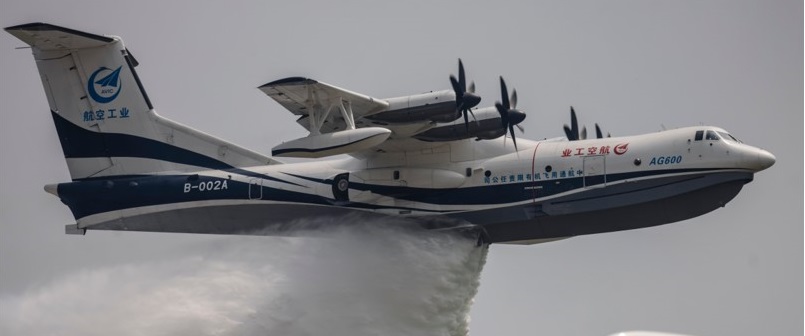
The mid and forward fuselage sections of the aircraft were completed in December 2014 and March 2015 respectively. The horizontal and vertical tail was completed by January 2016. The prototype was rolled out on 23 July 2016 at the Zhuhai AVIC factory. Its maiden flight was made from the runway of Jinwan Civil Aviation Airport in Zhuhai, Guangdong on 24 December 2017, at 09:39 China Standard Time. 17 orders had been received from Chinese customers before the flight.
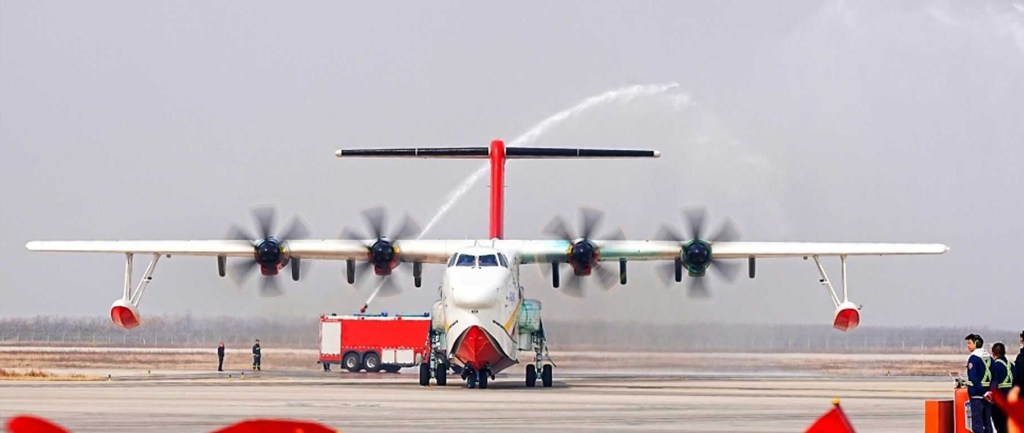
On March 2, 2025, China announced that the AG600, the country’s domestically developed large amphibious seaplane, has successfully completed its flight testing phase and is on the verge of receiving its type certificate from the Civil Aviation Administration of China (CAAC).
According to a statement from the Aviation Industry Corporation of China (AVIC), the state-owned aerospace giant overseeing the aircraft’s development, the AG600 prototype conducted its final flight test on the morning of Friday, March 1, 2025, at a civil aviation testing center in Pucheng, located in Shaanxi Province. This successful flight concludes a two-year testing program, which saw the aircraft complete a total of 2,014 flights spanning 3,560 hours.
The AG600 program was officially approved by the Chinese government in June 2009, with research and development kicking off later that year. The program saw the collaboration of tens of thousands of engineers and researchers from over 160 domestic institutes, enterprises, and universities. The first prototype of the AG600 was constructed in 2014 and completed in July 2016. After its debut flight in December 2017 at Zhuhai in Guangdong Province, the aircraft has undergone extensive testing across various regions of China.
The aircraft can take-off and land from 1,500m-long, 200m-wide and 2.5m-deep water. It has the capacity to collect 12t of water in 20 seconds and can carry up to 370t of water on a single tank of fuel. The AG600 can perform take-off and landing in severe weather conditions with a wave height of 2m. The maximum take-off weight of the aircraft is 53.5t on runways and 49t on water.
AG600 aircraft received two option orders at the 10th Airshow China held in Zhuhai in November 2014, bringing the total option orders to 17.
AG600
Engines: 4 × WJ-6 turboprops, 3,805 kW (5,103 hp) each
Propellers: 6-bladed constant speed
Wingspan: 38.8 m (127 ft 4 in)
Length: 36.9 m (121 ft 1 in)
Height: 12.1 m (39 ft 8 in)
Max takeoff weight: 53,500 kg (117,947 lb)
Maximum speed: 570 km/h (354 mph; 308 kn)
Cruise: 500 kph
Stall: 220 kph
Range: 4,500 km (3,418 mi; 2,970 nmi)
Service ceiling: 10,500 m (34,400 ft)
Capacity: 50 passengers
Atol Avion Atol
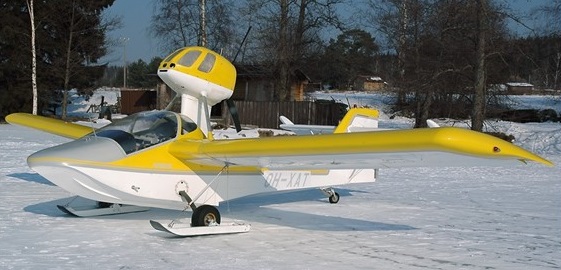
The Atol was designed by Markku Koivurova and produced by Martekno Ky and later Atol Avion Ltd. The development of Atol began in the 1970s, inspired by the American Osprey II. When the development of Atol was started, a wooden structure was selected.
The first versions of the design used the Ken Rand KR structure. Atol’s predecessors were larger and their structure recalled the traditional structure of a wooden aircraft.
Reinforced plastic basically displaced the wooden structure for manufacturing reasons, and its increasing popularity stopped the development of the wooden structure. They continued development of the wooden structure manufacturing methods and, as a result of this work, talk of a wood composite structure.
Very important safety feature is ATOL’s directed pitch trim change when changing power settings. The propeller flow has been directed to flow to the tailplane from above causing a nose-up moment higher than the nose-down moment caused by the thrust. Because the propeller flow and thrust work together, a decrease in power changes the balance towards the nose-down direction, while the speed remains relatively unchanged.
Competitors have aimed to reduce the change in trim caused by power changes by positioning the wing as close to the propeller shaft as possible. This solution reduces the phenomenon but does not eliminate it totally. Instead, this solution causes a problem with the center of gravity because the propeller and, therefore, the engine must be positioned much farther back. As a result, a balancing weight must be used in the nose or the crew must be positioned closer to the front. This reduces the balancing weight but leads to a situation where the balancing weight must be repositioned every time when one or two people fly the aircraft. There is always a potential fatal risk of forgetting the balancing weight in a wrong place.
ATOL’s wing aspect ratio allows a wide range of center of gravity (CG) and ease of loading without strict loading limitations.
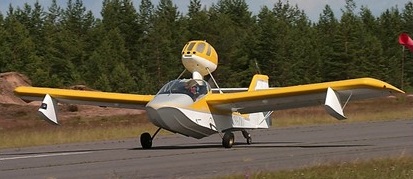
ATOL’s canopy is rear hinged providing easy entry and exit when beaching. The canopy lifts backwards together with the instrument panel. This feature enables the aircraft to be accessed/exited through the front deck. Canopy locking mechanism and emergency release enables quick exit if needed. Optional skis are for snow during winter.
Two seat composite wood ATOL has conventional landing gear. Main gear retracts for flight and water operations. Aircraft has an auxiliary nose wheel assisting in beaching to steep shores. ATOL can also be fitted with ATOL Water Taxiing System (AWTS) to help water maneuveres.
First flight of ATOL amphibious aircraft in Rovaniemi, Finland on Aug 23, 1988, and the first flight on water in Lake Norvajärvi, Rovaniemi on Oct 20, 1988. A 1988 sales tour in southern Finland with the ATOL prototype resulted with five kits sold. In 1989 the prototype was destroyed in a storm in the fall but with the insurance pay off and using prototype’s front fuselage and wings a second prototype was built. The second prototype made its first flight in Norvajärvi on October 12, 1990.
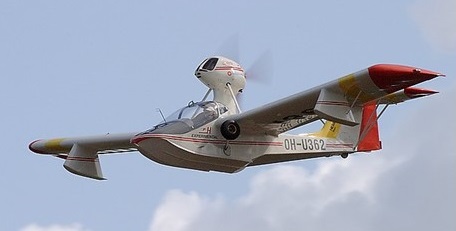
Production was launched by Martekno Finland Ltd in 1990 by building jigs and moulds and familiarizing employees. The second prototype flew off Lake Norvajärvi n Oct 12, 1990. Five kits were delivered during 1991. ATOL classified as a LSA aircraft, which maximum take-off weigh is 650 kg (1430 lbs).
With the establishment of ATOL Avion Ltd in 1991, the building of a new prototype with a longer fuselage was started. Design of the engine cowling and fuselage extension was refined. The nose, canopy and upper fuselage were redesigned for optimal aerodynamics and to reduce twirling in the tail.
Standard Equipment
Wing folding system with manual control lines connection
Dual controls
Dual Brake pedals
7-inch MGL Enigma
4,3-inch MGL XTreme Engine Monitoring System
Cockpit heater and defog
Fresh air nozzle
Emergency canopy release
Canopy locking from the outside
Four point seat belt and shoulder harness
Bilge pump
Bulkheads in the rear fuselage to prevent any bilge water from moving uncontrollably
Electric trim
Mounting for an iPad
Electrical sockets in the instrument panel and upper panel
Stern cleat and mooring posts in auxiliary float supports and tail
Four color paint scheme with decals, factory design. Special design or color subject to separate offer
Cockpit upholstery fabric/artificial leather. Luggage compartment painted.
Water rudder integrated in the tail wheel
Paddle + fasteners
Pilot Operating Handbook, service manuals and repair instructions
ATOL Service Program
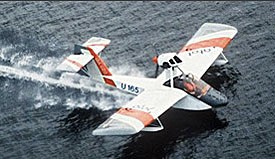
In 1993 Atol Avion Ltd acquired Martekno Finland Ltd’s bankruptcy estate.
In 2012 ATOL Avion asked an FAA team to visit its overseas factory for an audit so it can also come to market.
By 2014, five ATOL airplanes have flown. Two prototypes and three production line aircraft. The second ATOL prototype had the same registration number (OH-U165) as the first prototype but was a totally different aircraft. Two kits which were delivered by Martekno and one by ATOL Avion are under construction.
In 2014 the factory was building three aircraft one of these which had already flown was an extended fuselage number three prototype.
Third prototype is ready for full flight testing. Fuselage has been extended by one metre (3 ft 4 in) and nose is more curved than in previous version. Highest point is closer to the nose and spreaded over a longer distance.
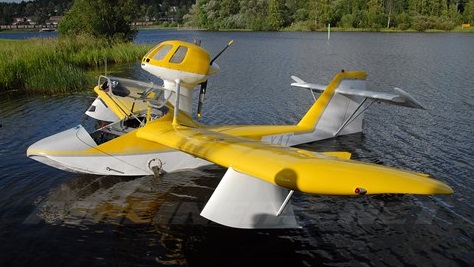
Other new features include advanced wing folding mechanism and revolutionary patent pending ATOL Water Taxiing System (AWTS). In addition, numerous pilot friendly modifications has been made.
The first water taxi tests of the new LSA version were commenced in December 2014 on the Kemijoki River, Finland, on the Arctic Circle.
The ultralight version has a lighter decoration and painting, and more limited optional equipment. The LSA version contains an auxiliary wheel in the nose (assisting in beaching when the shoreline is steep). It can also be equipped with an electronic navigation system with which beaching can be performed accurately.
A special introductory price for orders made before May 2015 was EUR 125,000.00 (VAT 0%).
Specifications:
ATOL 495 LSA
Engine: 1 × Rotax 912 iS , 75 kW (100 hp)
Propellers: 3-bladed fixed pitch propeller, 1.72 m (5 ft 8 in) diameter
Length: 7.45 m (24 ft 5 in)
Wingspan: 9 m (29 ft 6 in)
Wing area: 13.5 m2 (145 sq ft)
Empty weight: 375 kg (827 lb)
Max takeoff weight: 650 kg (1,433 lb)
Fuel capacity: 140 liters (37 gal)
Payload: 275 kg (606 lbs)
Tail plane span: 2,40m / 7 ft 11 in
Cruising speed: 170 km/h (106 mph; 92 kn)
Stall speed: 74 km/h (46 mph; 40 kn)
Range: 750 km (466 mi; 405 nmi)
Endurance: 5 hours
Take-off distance from water (50 ft): 450 m (1,476 ft) (LSA)
Crew: one
Capacity: one passenger
ATEC Omsider / Nordic Omsider
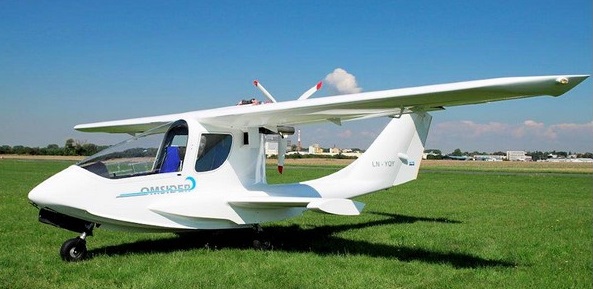
The Nordic Omsider (English: at last or finally) is a Norwegian amphibious flying boat, designed by Terje Sandvik and Jostein Eide and under development by Nordic Aircraft AS of Kinservik.
The Omsider was developed to provide an amphibious aircraft suited to Norwegian conditions. Conceived in the 1980s, development was started in 1999 and 20,000 person-hours and €600,000 have been invested in building the molds and the prototypes.
The design features a cantilever high-wing, with a stub lower wing/float, an enclosed cockpit, with two-seats-in-tandem under a forward-hinged bubble canopy, a T-tail, retractable tricycle landing gear and a single engine in pusher configuration.
The aircraft is made from composite material. Its 9.1 m (29.9 ft) span wing mounts flaps. Standard engines available are the 100 hp (75 kW) Rotax 912ULS and Rotax 912iS four-stroke powerplants.
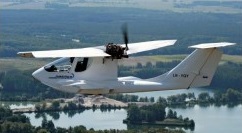
The initial prototype was built in Norway and has logged over 500 flying hours. It features outrigger floats. The second prototype was built under contract by ATEC v.o.s. in the Czech Republic. The wings and part of the tail are from the ATEC 321 Faeta and the second prototype features stub wings/floats.
It was introduced at the AERO Friedrichshafen show in 2014. The program had cost €600,000 by 2014 and the unit cost was to be €90,000 assembled in 2015. Once in production the aircraft is intended to be supplied complete and ready-to-fly.
Omsider
Engine: 1 × Rotax 912ULS, 75 kW (101 hp)
Propeller: 3-bladed composite
Wingspan: 9.1 m (29 ft 10 in)
Length: 6.9 m (22 ft 8 in)
Empty weight: 320 kg (705 lb)
Gross weight: 495 kg (1,091 lb)
Fuel capacity: 80 litres (18 imp gal; 21 US gal)
Cruise speed: 210 km/h (130 mph, 110 kn)
Stall speed: 64 km/h (40 mph, 35 kn)
Never exceed speed: 254 km/h (158 mph, 137 kn)
Range: 900 km (560 mi, 490 nmi)
Crew: one
Capacity: one passenger
Arnoldi Frenard Duck

This single-seat amphibian/flying boat N69966 was designed and built by Mr. Fred N. Arnoldi (hence Frenard) and several colleagues of the Curtiss-Wright company. The aircraft was intended as flying scale for a planned (unbuilt) 4-seat aircraft and it was completed in 1948/1949 and then powered by a 50hp Continental A50.
Many years later (in the 1970s) the aircraft was advertised for sale as the Bohmer Canard and it had been re-engined with a 65hp Continental A65.
The aircraft is still on the FAA register as the Frenard Experimental. The Duck was claimed to be easy to convert for land or water use and the wing floats and landing gear were removable.
Argonaut Pirate
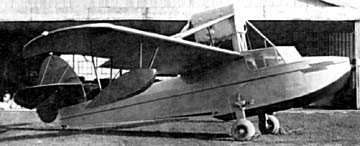
Three-seat monoplane amphibian, with Menasco Pirate engine
Donald G. White of Buffalo, New York, formed a White Aircraft Inc in 1939 to continue production, in modified form, of the Pirate amphibian designed and built previously by Argonaut Aircraft Inc.
The 1934 H-20 Pirate three seater prototype NX14760 c/n H20-100 was powered by a 120hp Curtiss Crusader, later 125hp Menasco and cost $4,975.
The one H-24 Pirate NX/NC15682 c/n H24-500 (ATC 650), designed by Howard J Heindell, was built in 1935 and cost $4,995.
H-20 Pirate
Engine: 120hp Curtiss Crusader, later 125hp Menasco C-4
Wingspan: 35’4″
Length: 26’0″
Useful load: 870 lb
Max speed: 110 mph
Cruise: 100 mph
Stall: 42 mph
Range: 490 mi
Ceiling: 12,000′
Seats: 3
H-24 Pirate
Engine: 125hp Menasco C-4
Wingspan: 42’0″
Length: 27’1″
Useful load: 650 lb
Max speed: 104 mph
Cruise: 89 mph
Stall: 45 mph
Range: 350 mi
Ceiling: 10,500′
Seats: 2
1935 Factory ad shows H-24 Pirate:
Wingspan: 35’4″
Length: 26’0″
Useful load: 680 lb
Max speed: 120 mph
Cruise: 104 mph
Stall: 40 mph
Range: 500 mi
 All Aero