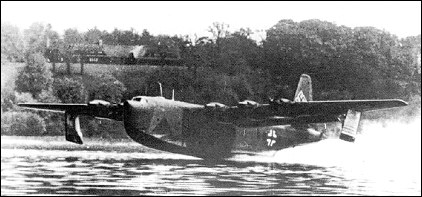
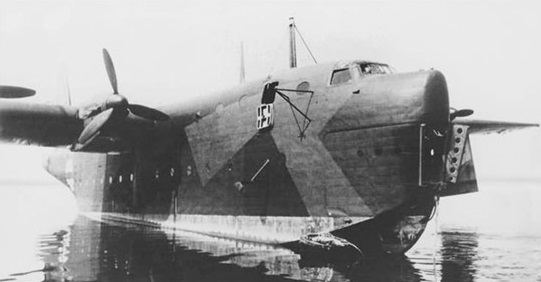
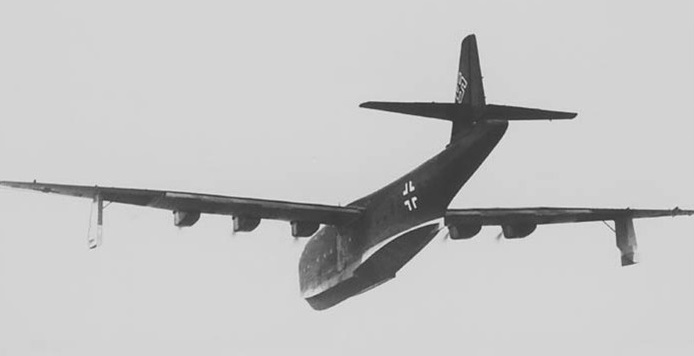
Originally designed as a passenger flying boat for the postwar Lufthansa, the BV 238 design was adapted in 1941 for military use as a maritime patrol and transport aircraft. When completed in 1944 it was the largest aircraft since the Maxim Gorkii and the heaviest built to that time.
Bv.238
A quarter-scale testbed called the FGP 227 was deemed necessary to test the aerodynamics and water handling, but it completely failed to take off when tested on wheels and was then damaged by saboteurs. All the engines seized on the FGP 227 first flight from water — months after the first full-scale BV 238 flew in April of 1944, powered by six Daimler Benz inverted V-12 engines.
Bv.238
The sole complete BV 238 was caught on a lake by P-51 Mustangs and sunk by machine-gun fire in September 1944. Although three further BV 238s and three BV 250 landplane bombers were under construction, the loss of the only flying example caused the Luftwaffe to give up on the idea.
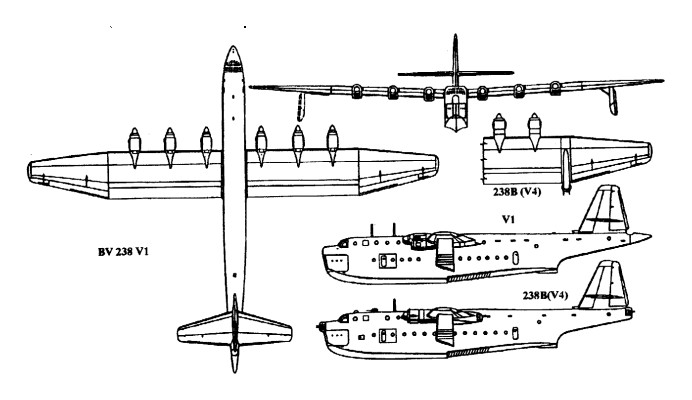
Bv 238 V-1 Engines: 6 x 1900hp Daimler-Benz DB 603G inline piston Wingspan: 60.17 m / 197 ft 5 in Length: 43.36 m / 142 ft 3 in Height: 12.80 m / 41 ft 12 in Empty Weight: 120,593lbs (54,700kg) Maximum Take-Off Weight: 187,393lbs (85,000kg) Max. speed: 425 km/h / 264 mph Maximum Range: 4,474miles (7,200km) Service Ceiling: 23,950ft (7,300m)
Germany’s foremost shipbuilder, the Blohm und Voss Schiffsweft of Hamburg, established an aircraft¬ manufacturing subsidiary on 4 July 1933. It was this youthful and relatively inexperienced concern that was selected by Deutsche Lufthansa (DLH) in preference to the immensely more experienced Dornier and Heinkel companies for the develop¬ment of a transatlantic flying boat only marginally smaller than the Dornier Do X. By 31 May 1937, when the Hamburger Flugzeugbau As the Blohm und Voss subsidiary was then known submitted its Projekt 54 transatlantic flying boat design study to DLH, the company had still to celebrate its fourth anniversary, and its practical experience with waterborne aircraft was limited to two prototypes of its first seaplane, the Ha 139. Nevertheless, on 19 September, the Hamburger Flugzeugbau was recipient of an order for three flying boats. The definitive DLH specification called for luxurious and spacious accommodation for 24 passengers by day, with an alternative arrangement for 16 sleeping berths. While this was being finalised, a thorough evaluation of the hydrodynamic characteristics of the proposed planing bottom of the new flying boat was undertaken with models by the Deutschen Schiffsbau Versuchsanstalt (DSV). This planing bottom was novel in that the length to beam ratio was 8.4 compared with the generally accepted ratio of the order of 6, this having been selected by the Hamburger Flugzeugbau team, headed by Dr Ing Richard Vogt, in order to reduce both hydrodynamic and aerodynamic drag.
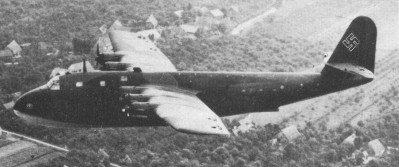
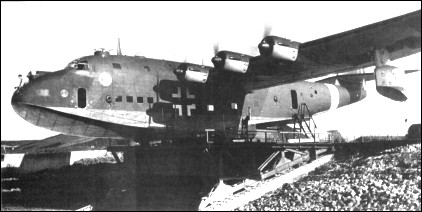
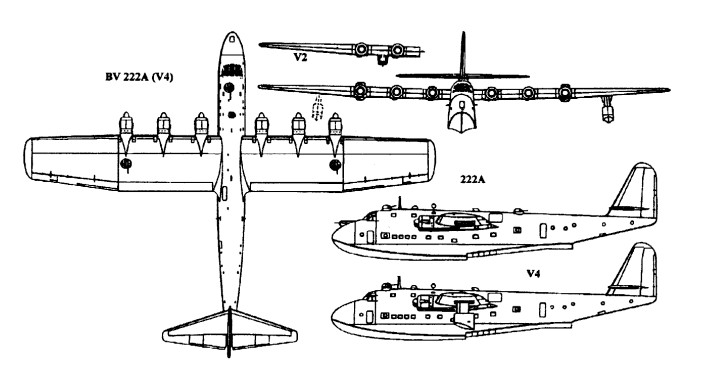
Other novelties proposed included electrically actuated retractable floats arranged to split vertically, each half rotating through a 90 deg arc to lie flush within the wing, and a part servo and part manual control system. The structural design was conventional except insofar as it incorporated the fuel carrying tubular mainspar that had been developed by Dr Ing Vogt while working in Japan, this being sub divided by bulkheads to accommodate six 759 Imp gal (3 450 1) fuel tanks, and carrying via welded steel tube extensions the six BMW 132H nine cylinder radial engines by which it was proposed that the massive flying boat was to be powered. Detail structural design began in January 1938, the designation Ha 222 initially assigned to the flying boat having meanwhile been changed to BV 222 with the change in the title of the Hamburger Flugzeugbau to that of Abteilung Flugzeugbau der Schiffswerft Blohm und Voss. The first metal was cut during the course of the year at Wenzendorf, near Hamburg, while work began on a larger, more modern facility at Finkenwerder where it was proposed that assembly should take place. Despite the commencement of hostilities in September 1939, work on this ambitious commercial flying boat continued unallayed, and on 16 July 1940, DLH representatives inspected a full scale mock up of the interior, although it was becoming obvious that the airline stood little chance of adding the BV 222 to its fleet. Dr Ing Richard Vogt, leader of the BV 222’s design team, revealed that the BV 222 was intended from the outset as the forerunner of an even larger machine (ie, the BV238) and that the servo tab control system was selected in preference to an even more sophisticated power assistance system as it was likely to give less production repeatability trouble, a lower maintenance load and a more desirable method of emergency operation. In fact, the system was not pure servo tab control, but part servo and part manual. Each aileron was divided into two unequal sections, the large inboard section being fitted with a servo tab which had a follow up ratio of 0.6, both aileron and tab being aerodynamically balanced and the balance system consisting of Blohm und Voss patented “paddles” differentially controlled wind vanes previously employed by the tri motored BV 138. The “paddle” balance permitted an adjustment of the force to apply aileron and also enabled the pilot to adjust the stick free dihedral stability as required. The smaller outboard section of the aileron was operated by servo motor through a complex gearing action, but with the linkage direct to the pilot’s control wheel, while its trim tab was operated from the cockpit through rotating rods. Thus, both aileron sections moved in unison in response to the controls under normal circumstances, and in the event of the control linkage being severed, both sections were designed to float neutral. Each elevator was divided into three sections, the outboard section being used only for trimming and operated by an electric motor, the switch for this being adjacent to the flap control to ease the trimming out of pitching movements with the application of flap. The centre portion of the elevator was also driven by an electric motor, but was not connected to the pilot’s wheel and had its tab locked central. This could be utilised as a normal power operated surface activated by the electric motor, be operated by the auto pilot, moving according to the attitude of the aeroplane, or be disconnected from the motor and allowed to float in the trailing position. The normal flight crew was intended to comprise 11 members, consisting of two pilots, two flight engineers, a navigator, a radio operator and five gunners. The structure was conventional, apart from the 4 ft 9 in (1,45 m) diameter welded steel tubular wing spar which was sub divided by bulkheads into six separate fuel compartments each with a capacity of 633.5 Imp gal (2 880 1) of Diesel K 1, the similar number of oil tanks each containing 37.4 Imp gal (170 1). The fuel tanks were pressure filled from the front wing catwalk, which also gave access to the rear of the engines, and the tanks had to be filled in staggered sequence one, six, two, five, three and four, and with 220 Imp gal (1000 1) at a time so as to avoid the risk of capsizing. The six Junkers Jumo 207C Diesel engines each offered 1,000 hp at 3,000 rpm for take off, with a maximum output of 750 hp at 2,500 rpm for 30 min at sea level for climb, and drove 10 ft 9 in (3,30 m) diam VDM Schwarz wooden bladed propellers. It appeared, however, that the Diesels developed insufficient take off power to lift the fully laden boat within a reasonable distance and therefore provision had been made for the attachment of four solid fuel take off assistance rockets beneath the wings, the modus operandi being to fire the rockets after 10 seconds full throttle to get the boat over the “hump” speed, these burning for a half minute and the cases then being jettisoned. Even in a lightly laden condition and at full power, the boat demanded a long run before it could be eased up onto the step, but once over the “hump” speed it soon lifted off smoothly at about 78 knots (145 km/h). The floats, each of which split vertically, each half folding upward to lie flat within the wing, had to be retracted as soon as the boat was airborne since the electrical process occupied some 20 seconds and had to be completed before the airspeed reached 121 knots (225 km/h). The flight deck, which was reached by a ladder from the lower deck, was spacious. The first pilot’s seat had an armour shield moulded to the shape of the body, and the first flight engineer occupied a jump seat between the two pilots, while the second engineer had a station at the rear of the flight deck. Meanwhile, the BMW 132H engines had given place to Bramo Fafnir 323Rs which it was anticipated would be able to offer 200 hp more for take off with the aid of methanol water injection, and late in August 1940, the first prototype, the BV222 V1 Werk Nr 365, was rolled out of the Finkenwerder factory, launched on the Elbe, and, on 7 September flown for the first time with Flugkapitan Helmut Rodig at the controls. Sporting the registration D ANTE, the flying boat was airborne for 20 minutes, Rodig declaring himself generally satisfied with control response, but complaining of some slight directional instability and a tendency to porpoise during taxying. Flight testing continued from the Elbe, interspersed with brief periods in the Finkenwerder factory for modifications, and the basic flight test programme was virtually complete by December, when the river iced up. Testing was resumed in February 1941, and plans were laid for a series of long distance flights to demonstrate range and endurance. At this stage, the Luftwaffe proposed that these flights should also be supply missions. Cargo doors were therefore cut in the sides of the hull and the interior rearranged to accommodate bulky items of freight. With the civil registration replaced by the radio callsign CC+ EQ, and now wearing full Luftwaffe markings and camouflage, the BV 222 V1 flew its first supply mission on 10 July 1941. The BV 222 flew from Hamburg to Kirkenes, Norway, on the Barents Sea, six more flights between Hamburg and Kirkenes being flown by 19 August, totalling some 18,600 miles (30 000 km), about 650 tonnes of freight being carried to Kirkenes and 221 casualties being transported back to Hamburg. While the first prototype was engaged in its proving flights between Hamburg and Kirkenes, the second prototype commenced its test programme from the Elbe, this, the BV 222 V2 Werk Nr 366 CC + ER, taking off on its maiden flight on 7 August 1941. The decision had meanwhile been taken to place the second and subsequent BV 222s at the disposal of the Fliegerfuhrer Atlantik, established in the previous March, additional hulls being laid down for the long range reconnaissance role in collaboration with U boats, and the V2 having been completed with full defensive armament. This armament comprised a single 7,9 mm MG 81 machine gun in the bow, fore and aft upper turrets each mounting a single 13 mm MG 131, four MG 81s firing from beam positions in the hull, and one forward and one aft firing MG 131 in each of two gondolas mounted beneath the wing and between the outer engine pairs. In the event, trials with the V2 at Travermunde revealed that the drag penalty incurred by the gondolas was greater than could be accepted by what was already tacitly admitted to be an underpowered aircraft, and these appendages were promptly removed. Other modifica¬tions directly resulting from the Travermunde test programme included the deepening of the rear hull step by the simple expedient of adding a wedge shaped auxiliary structure, the addition of five short auxiliary steps immediately aft of the first main step, and some structural strengthening. The BV 222 VI resumed its long distance flights on 10 September 1941, after overhaul at Finkenwerder, these commencing with a mission to Athens from where it was supposed to operate a shuttle service to Derna, Libya. Before this service could begin, however, the flying boat was forced to return to Finkenwerder to have a thick layer of barnacles scraped from its hull. During the period 16 October to 6 November 1941, the BV222 V1 made 17 return flights between Athens and Derna, carrying 66,140 lb (30000 kg) of freight and evacuating 515 casualties. During these flights, a maximum speed of 239 mph (385 km/h) was recorded at 14,765 ft (4500 m), and it was ascertained that up to 72 casualty stretchers or 92 fully equipped troops could be accommodated. Totally unarmed, the BV 222 VI was normally escorted by two Bf 110s, but occasionally the fighters missed the rendezvous and the flying boat had to fulfil its mission unescorted. On one such occasion, the lone BV 222 encountered two patrolling RAF Beauforts, but for some reason these did not attack the defenceless flying boat. In November 1941, the BV 222 V1 returned to Finkenwerder to have defensive armament fitted, this being similar to that already mounted by the V2 apart from the underwing gondolas. Bv 222 VI was fitted with seven single 7.92mm and 13mm machine-guns, and under each wing a gondola mounting a pair of the latter.
The BV 222 V3 Werk Nr 439 DM + SD, first flown on 28 November 1941, possessed no armament other than the MG 81 in the bow position, this third prototype being intended purely for the transport role, which, for some time, was also to be the task of the BV 222 V2. On 20 January 1942, the BV 222 flying boat was officially named Wiking (Viking) by the Reichsminister der Luftahrt, and by this time a pre production batch of five aircraft had reached advanced stages on the Finkenwerder final assembly line. It was envisaged that these boats, powered by Bramo Fafnir 323R 2 radials and considered as A series machines although allocated Versuchs numbers V4 to V8 inclusive, would serve in both transport and maritime reconnaissance roles. In the event, the fourth of the A series boats, the V7, was to be modified during construction to take Diesel engines as a C series prototype.
Ultimately, the Bv 222 V7 prototype was selected as the official production model for the military Bv 222 and appeared with the definitive “Bv 222C” model designation form. The earlier prototypes (V2, V3, V4 and V5) pressed into military service became maritime reconnaissance platforms, differing mainly in defensive armament and some mounting FuG 200 series search radar systems while flying for Fliegerfuhrer Atlantik. Bv 222B was a proposed variant to fit Junkers Jumo 208 series engines but never materialized.
On 9 December 1941, the BV 222 V3 had been officially taken on strength by the Luftwaffe and, as the entire aircraft complement of Lufttransportstaffel See 222 V3, had under¬ taken 21 supply flights between Italian bases and Tripoli in the period January March 1942. The BV 222 V3, by now coded X4 + CH, was joined on 20 April 1942, by the BV 222 V4 X4+13H, and the unit was redesignated Luftverkehrsstaffel “C”. The BV 222 V4 Werk Nr 0004 (originally DM + SE) had been completed earlier in the year at Finkenwerder, and embodied some strengthening of the rear hull and the outer wing panels, and a redesigned, longer span tailplane. On 10 May, the BV 222 VI was returned to service after modification and overhaul at Finkenwerder, being assigned to Luftverkehrsstaffel “C”, which then became Lufttransport staffel See 222, or LTS See 222, but the complement of the unit remained unchanged owing to the re assignment of the V3 to the 3Staffel of Kustenfliegergruppe 406, a BV 138 equipped unit operating from Biscarosse, for the maritime recon-naissance mission. The complement of LTS See 222 was increased in August, however, with the arrival on the 10th of the BV 222 V2 (now X4 + BH) and the BV 222 V6 Werk Nt¬ 0006 X4 + FH on the 21st. The four boats were primarily engaged on flying supply missions from Italian and Greek bases to Rommel’s Afrika Korps, alighting at Tobruk and Derna, and returning with casualties, and were joined on 26 October by the BV 222 V8 Werk Nr 0008 X4+HH, but a month later, LTS See 222 suffered its first casualty when the BV 222 V6 was intercepted and shot down by RAF fighters on 24 November when flying unescorted south of Pantelleria. This loss resulted in orders that BV 222s would subsequently fly all missions in formation at low altitude. Despite this precaution, on 10 December, the BV 222 V1, V4 and V8 were intercepted by a trio of RAF Beaufighters while flying in formation at low altitude over the Mediterranean en route to Tripoli. The BV 222 V8 was shot down and the V4 suffered heavy damage but succeeded in reaching Tripoli in company with the V1. The BV 222 VI foundered in the harbour at Athens in February 1943 when it struck a marker buoy at speed, ripping several yards of skinning from its planing bottom. LTS See 222 was therefore stood down and the surviving Wikings returned to Traverniinde for re arming and other modifications. The fact that the BV 222 was manifestly underpowered had been a matter of considerable concern to the Blohm und Voss team from an early stage in the development of the flying boat. The A series boats were not, in fact, to be equipped with the planned methanol water injection system for boosting take¬ off power until the summer of 1942, and then the maximum permissible take off weight was raised from 99,206 lb (45 000kg) to 105,820 lb (48 000 kg). The Bramo Fafnir 323R 2 engines each afforded 1,000 hp at 2,500 rpm, 800 hp at 2,250 rpm and 640 hp at 2,100 rpm, MW 50 boosting take off power to 1,200 hp. From the outset, Junkers Jumo Diesel engines had been favoured for their economy, although in service such engines were proving temperamental and demanding on skilled maintenance. The definitive model planned for DLH had been the BV 222B with six Jumo 208 Diesel engines each rated at 1,500 hp at 2,800 rpm and 1,000 hp at 2,500 rpm, but Junkers had failed to take the Jumo 208 beyond the bench testing stage. Proposals originally made to the RLM in 1939, which included Projekt 97 with six BMW 801 air cooled radials and Projekt 98 with four BMW 801s, were resurrected, but the RLM was adamant that such engines be reserved for other aircraft types. Finally, the Technische Amt of the RLM accepted Blohm und Voss’s proposals that Jumo 207C Diesels affording 1,000hp at 3,000 rpm be installed in the fourth A series flying boat, the BV 222 V7, Junkers promising a further development of this engine, the Jumo 207D with MW 50 boost which would provide the desired short term take off power, for installation in later production boats. The BV 222 V7 was intended from the outset primarily for the long range reconnaissance role. Fuel tank capacity was decreased, each of the six mainspar tanks accommodating 633.5 Imp gal (2 880 1) of Diesel K 1 as compared with the 759 Imp gal (3 450 1) of gasoline of the A¬ series aircraft tanks, the capacity of the six oil tanks each being raised to 37.4 Imp gal (170 lt) from 19 Imp gal (861 lt). Normal loaded weight was 101,390 lb (45990 kg) and maximum overload weight was 108,026 lb (49 000 kg), and at neither weight did the Jumo 207C Diesels deliver sufficient power for take off without an excessively long run. Provision was therefore made for the attachment of four solid fuel take off rockets beneath the wings, these being fired after 10 seconds at full throttle and burning for 30 seconds. The surviving BV 222 flying boats had meanwhile standardised on a revised defensive armament which now incorporated a forward dorsal turret with a 20 mm MG 151 cannon, a similar weapon in each of two turrets mounted in the wings immediately aft of the extreme outer engine nacelles, a 13 mm MG 131 machine gun firing from a forward beam position and two 7,9 mm MG 81s from aft beam positions, the aft dorsal turret and the bow gun being deleted. The BV 222 V7 reinstated the bow position, however, adding an additional forward beam MG 131 and supplanting the rear beam MG 81s with MG 131s. Furthermore, it featured repositioned wing turrets which were now situated in the rear ends of engine nacelles two and five. Search radar was fitted and additional radio aids included FuG 200 Hohentwiel, FuG 16Z VHF radio with direction and range measuring facilities, FuG 25a IFF, and an FuG 101a radio altimeter. An ETC 501 rack was fitted to carry an FuG 302c Schwan (Swan) beacon. Similar equipment was simultaneously installed in the remaining A series boats as it had become obvious that Axis resistance in North Africa was collapsing and that the BV 222s would be best employed in co-operation with the U boat fleet in the Atlantic under the control of the Fliegerfuhrer Atlantik. The Diesel engined BV 222 V7 Werk Nr 0310007 TB + QL flew for the first time on 1 April 1943 as the prototype of the C¬ series, work on several pre production examples of which had been initiated some time before the completion of the last A series aircraft, the BV 222 V8. In fact, the BV 222C 09 Werk¬ Nr 0310009 was completed only six weeks after the V7 and was actually to precede the Diesel engined prototype into service with the Fliegerfuhrer Atlantik, being taken on strength by Aufklarungsstaffel See 222 on 23 July 1943. This unit had been formed in May with the V2, the V3, the V4 and the V5 as a component part of 3./Ku.Fl.Gr.406, but had lost two of the boats, the V3 and the V5, in the following month when they were strafed and sunk at their moorings at Biscarosse. The BV 222C 09 differed from the V7, which was to join Aufklarungs¬staffel See 222 on 16 August 1943, essentially in the positioning of the defensive wing turrets, these being located slightly further forward and between the outboard engine pairs, and extended beneath the wing to provide adequate leg room for their gunners. The BV 222C-010 Werk Nr 031 0010 had been added to the Biscarosse based unit by October 1943, when the Aufklarungs¬staffel See 222 was redesignated 1.Staffel of (Fern)/See Augklarungsgruppe 129, its flying boats ranging far out over the Atlantic on U boat co operation tasks, and in October 1943, one of the BV 222s encountered and shot down a patrolling Lancaster. The BV 222C 011 and C 012 followed the C 010 from the Finkenwerder factory at short intervals, the time to build a hull in the gantry having by now been reduced to six weeks by dint of working shifts around the clock, the complete airframe being produced in an average of 350,000 manhours, the detail manufacturing and sub-assembly being mainly undertaken at the Steinwerder branch factory. The BV 222C 013 was the first airframe in which it was proposed to install the more powerful Jumo 207D Diesels as the prototype BV 222D, but as these failed to materialise, the boat had to be completed with the lower powered Jumo 207C engines. Four additional airframes had been under construction which it had been intended to complete as BV 222Ds, but, meanwhile, the RLM had ordered the cessation of further development and production of Diesel engines and, failing the availability of more suitable power plants, Blohm und Voss had no recourse but to revert to the Bramo Fafnir 323R 2s of the A series. With these radials installed it was intended to designate the four additional boats as BV 222Es, but in the event, early in 1944, it was concluded that the aircraft industry could no longer afford the large labour force demanded by the BV 222, the production programme being cancelled and the four boats under construction being scrapped. The 1.(F)/SAGr. 129 continued operations from Biscarosse, losing the BV 222C 010 to RAF night fighters early in 1944, but in July, following the D Day landings, the unit was disbanded, the four BV 222s remaining on strength being reassigned to the Stab and L(F)/SAGr.130 and 2.(F)/SAGr.131, the former being primarily BV 138 equipped and the latter operating a mix of BV 138s and Ar 196As. As the war situation progressively deteriorated, the BV 222s were increasingly relegated to transport tasks and only one other example, the BV 222C-09, was lost to enemy action before fighting terminated in Europe, this being strafed and damaged beyond repair by RAF fighters at Travermunde early in 1945. Of the boats that survived the conflict, the BV 222 V2 was blown up by British forces in Norway, the V4 was blown up by its own crew at Kiel Holtenau, the V7 was destroyed by its crew at Travemunde, the C 011 and C 013 were captured intact by US forces and taken to the USA for evaluation, and the C 012, was captured by British forces in Norway and flown to the UK.
Bv 222 A-0 Viking Engine : 4 x Bramo Fafnir 323 R-2, 1184 hp Length : 119.751 ft / 36.5 m Height : 35.761 ft / 10.9 m Wingspan : 150.919 ft / 46.0 m Max take off weight : 99749.8 lb / 45238.0 kg Weight empty : 62452.2 lb / 28323.0 kg Max. speed : 167 kts / 310 km/h Cruising speed : 139 kts / 257 km/h Initial climb rate : 492.13 ft/min / 2.5 m/s Service ceiling : 21325 ft / 6500 m Range : 4023 nm / 7450 km Armament : 1x MK108 30mm, 2x MG151 20mm, 2x MG131 13mm, 2x MG 81Z
BV222A Engines: Six Bramo Fafnir 323R 2 nine cylinder radial air cooled, 1,200 hp with MW 50 boost for take off, 1,000 hp at 2,500 rpm, 800 hp at 2,250 rpm and 640 hp at 2,100 rpm Propellers: three bladed variable pitch VDM Schwarz Prop diameter: 10 ft 9in (3,30 m) Internal fuel capacity, 759 Imp gal (3 450 1) in each of six tanks. Max speed (at 100,530 lb/45 600 kg) at sea level: 184 mph (296 km/h) Max speed (at 77,162 lb/35 000 kg): 193 mph (310 km/h) Max continuous cruise (at 100,530 lb/45 600 kg) at sea level: 158 mph (254 km/h) Max continuous cruise (at 77,162 lb/35 000 kg) at sea level: 173 mph (278 km/h) Econ cruise (at 100,530 lb/45 600 kg): 155 mph (250 km/h) Econ cruise (at 88,185 lb/40 000 kg): 160 mph (257 km/h) Max range: 4,350 mls (7 000 km) at sea level Max range: 4,630 mls (7 450 km) at 16,075 ft (4 900 m) Optimum flight endurance: 33 hrs at sea level Optimum flight endurance: 23 hrs at 16,075 ft (4 900 m) Climb to 19,685 ft (6 000 m): 49 min Service ceiling: 21,325 ft (6 500 m) Empty equipped: 62,941 lb (28 550 kg) Max loaded: 100,530 lb (45 600 kg) Span: 150 ft 11 in (46,00 m) Length: 119 ft 9 in (36,50 m) Height: 35 ft 9 in (10,90 m) Wing area, 2,744.8 sq ft (255 sq.m).
BV222C Engines: Six Junkers Jumo 207C six cylinder two stroke. Rating: 1,000 hp at 3,000 rpm for take off, 750 hp at 2,500 rpm (for 30min) and 680 hp at 2,400 rpm Propellers: three bladed variable¬ pitch VDM Schwarz Prop diameter: 10 ft 97 in (3,30 m) Internal fuel capacity, 633.5 Imp gal (2 880 1) in each of seven tanks Max speed (at 101,390 lb / 45990 kg): 205 mph (330km/h) at sea level Max speed (at 101,390 lb / 45990 kg): 242 mph (389 km/h) at 16,405 ft (5 000 m) Max continuous econ cruise: 189 mph (304 km/h) at sea level Max continuous econ cruise: 214 mph (344 km/h) at 18,210 ft (5 550 m) Optimum endurance: 28 hrs at 152 mph (245 km/h) at sea level Max range: 3,790 mls (6 100 km) Initial climb (at 101,390 lb / 45990 kg): 473 ft/min (2,4 m/sec) Time to 19,685 ft (6 000 m): 52 min Service ceiling: 23,950 ft (7 300m) Empty equipped weight: 67,572 lb (30 650 kg) Normal loaded weight: 101,390 lb (45 990 kg) Max overload weight: 108,026 lb (49 000 kg) Wing span: 150 ft 11 in (46,00 m) Length: 121 ft 4.66 in (37,00 m) Height, 35 ft 9 in (10,90 m) Wing area: 2,744.8 sq ft (255 sq.m) Crew: 11 Armament: 3 x 20mm cannon, 5 x 13mm machine guns
Bv 222C-0 Engines: 6 x Junkers Jumo 207C 12-cylinder diesel, 1,000hp each. Length: 121.39ft (37m) Wingspan: 151 ft (46.00m) Wing area: 2,744.8 sq.ft Height: 35.76ft (10.90m) Empty Weight: 67,638lbs (30,680kg) Maximum Take-Off Weight: 110,231lbs (50,000kg) Maximum Speed 16,400 ft: 242mph (390kmh; 211kts) Max speed: SL: 189 mph Maximum Range: 3,790miles (6,100km) Rate-of-Climb: 472ft/min (144m/min) Service Ceiling: 23,950ft (7,300m) Armament: 5 x 13mm machine gun, 3 x 20mm cannon Crew: 11-14 Passenger capacity: 92
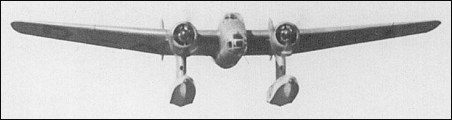
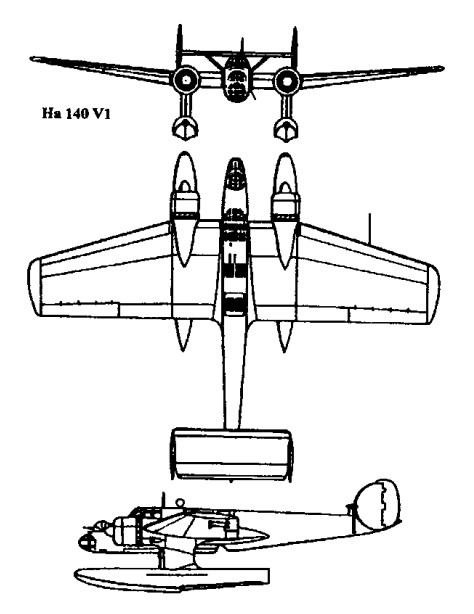
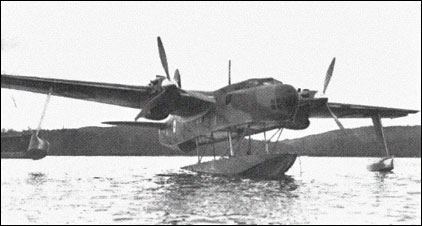
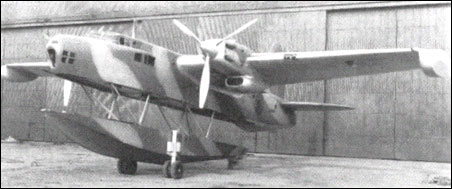
A twin-engined torpedo-bomber floatplane, based on the Ha.139 long-range mailplane, the Ha.140 was first flown on 30 September1937, and competed with the He-115. According to some sources the Luftwaffe actually preferred the Ha 140, but Blohm & Voss did not have the production capacity to meet the orders. Others claim that the aircraft had unacceptable handling. Only four were built.
Engines: 2 x BMW 132K, 830 hp Propellers: 3 blade metal variable pitch Wing span: 22,00 m Length: 16,74 m Height: 3,50 m Empty weight: 6300 kg MTOW: 9227 kg Power loading: 5,558 Kg/hp Max speed: 333 Kmh Range: 2000 km
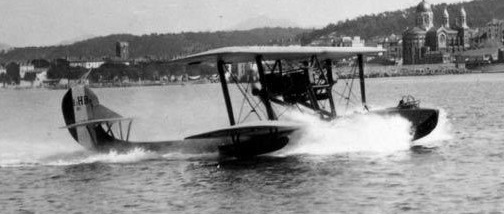
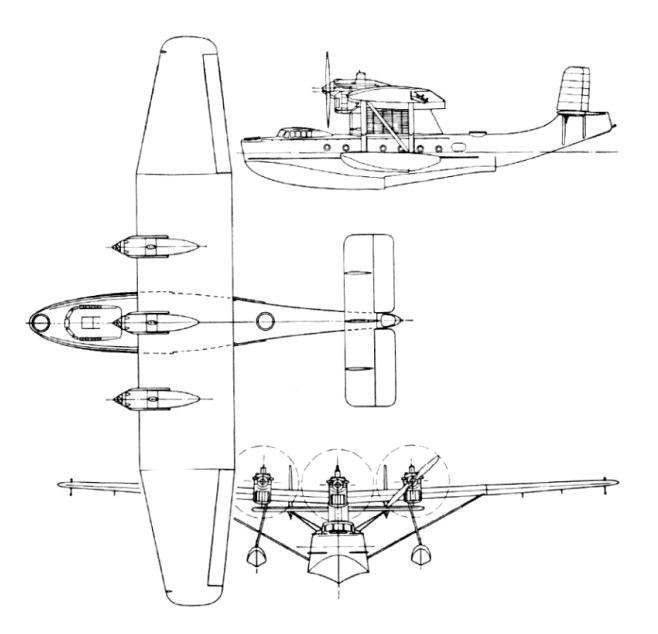
The Blanchard Brd.1 was a French reconnaissance flying boat used by the French navy in the 1920s. It was a large biplane with two engines mounted in the gap between the wings, each engine driving a pusher propeller.
First flown in 1922, twenty-four were built, primarily operated by the French Navy Aéronautique Maritime Escadrille 5R1 from 1923. They were retired in 1926.
In 1924, one Brd.1 was used to set several world altitude records for seaplanes.
Engines: 2 × Hispano-Suiza 8Fe, 205 kW (275 hp) Wingspan: 19.00 m (62 ft 4 in) Wing area: 85.0 m2 (914 ft2) Length: 13.85 m (45 ft 5 in) Height: 5.00 m (16 ft 5 in) Empty weight: 2,465 kg (5,434 lb) Gross weight: 3,930 kg (8,664 lb) Maximum speed: 170 km/h (106 mph) Service ceiling: 3,500 m (11,480 ft) Crew: three, pilot, navigator, and gunner Armament: 1 × 7.7 mm machine gun in flexible mount in bow 1 × 7.7 mm machine gun in flexible mount in rear fuselage Bombload: 290 kg (640 lb)
Founded in January 1923 by M. Blanchard, a designer who had worked for the Farman brothers and Georges Levy. Specialized in the construction of flying-boats. A single-seat racing monoplane was designed to take part in the 1924 Schneider Trophy Contest, which was canceled because there were not sufficient aircraft ready to compete.
The Blackburn R.B.3A Perth development of the Iris was to replace the earlier flying-boat in service with No. 209 Squadron at Plymouth. The Perth differed from the Iris V primarily in having an, enclosed cockpit, and a hull covered with corrosion-resistant material. An improvement in armament was the installation of a 37mm gun in the bow position for anti-shipping work, but there was also an alternative rail-mounted 7.7mm machine-gun, as on the Iris. The Perth’s service introduction came in January 1934 when the second aircraft was delivered to Plymouth. At that time the first was still under test at Felixstowe, but by 31 May 1934 all three from the first contract had been delivered. A fourth Perth had been ordered subsequently and flew in April 1934, but this was retained at the MA&EE Felixstowe for experimental work. Problems with the tail unit required the flying-boats to be modified at Brough, keeping them out of service for several months. The first Perth was lost in heavy seas during September 1935, and two of the remaining three were eventually struck off charge in 1936. The last aircraft survived a further two years at Felixstowe.
Engine: 3 x RR Buzzard IIMS, 615kW Take-off weight: 14740 kg / 32496 lb Empty weight: 9500 kg / 20944 lb Wingspan: 29.6 m / 97 ft 1 in Length: 21.3 m / 69 ft 11 in Height: 8.1 m / 26 ft 7 in Wing area: 233.3 sq.m / 2511.22 sq ft Max. speed: 213 km/h / 132 mph Cruise speed: 175 km/h / 109 mph Ceiling: 3500 m / 11500 ft Range w/max.fuel: 2780 km / 1727 miles Range w/max.payload: 1600 km / 994 miles Crew: 6
Robert Blackburn announced in March 1923 that his company, the Blackburn Aeroplane and Motor Co Ltd of Leeds, was to build an entry for the 1923 Schneider Trophy Contest, and the event was set for 28 September, with Cowes, on the Isle of Wight, as the starting and finishing point. The aircraft was to be a single-seat flying boat and the company had only worked on one flying boat – before, the NAB single-seat fleet escort bomber of 1918 and that had never been completed. Blackburn’s chief test pilot, Reginald W. Kenthworthy, wanted the aircraft to be ready for test flying in August, a month before the race, so that any problems could be resolved and he could gain some handling experience on an untried prototype.
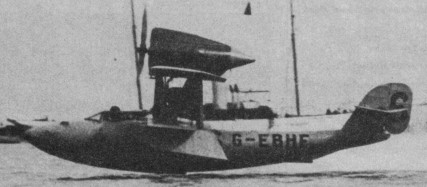
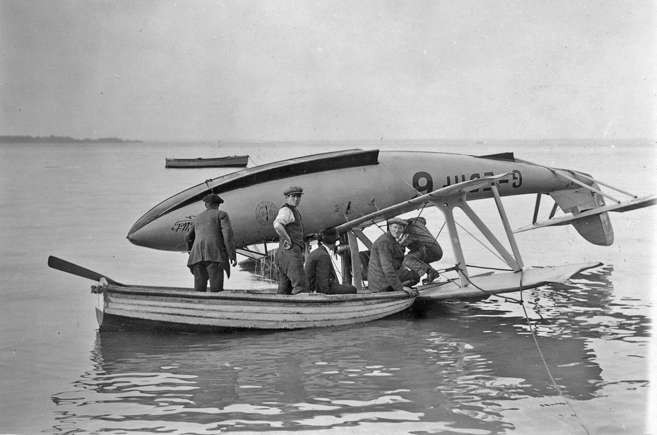
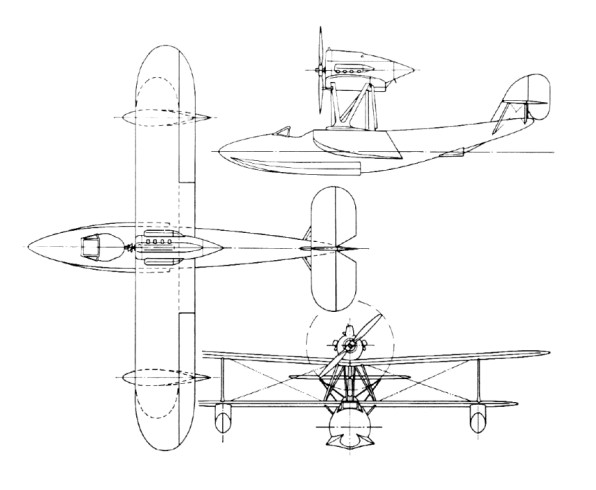
The design of the aircraft was largely determined by the use of the hull of the NAB, a streamlined structure which comprised circular wooden formers separated by stringers and planked with diagonal mahogany strips in two layers crossing each other at right angles. The Pellet’s hull, adapted from the abandoned N.1B fleet escort bomber, featured Linton Hope’s smooth, two-step mahogany construction. The aircraft had a compact biplane layout with a Napier Lion engine perched above the top wing. Flush radiators cooled it, and the pilot sat ahead of the propeller. To this hull was added, a biplane wing structure, comprising single-bay sesquiplane wings, the lower wing being of less span and chord than the upper and having no ailerons. The wing structure was attached to the top of the hull and on the top centre section, supported by N struts, was mounted a 450 hp Napier Lion, in a close fitting, streamlined nacelle. It was the engine from the Gloster Bantel, which had won that year’s Aerial Derby. Wooden wingtip floats were fitted beneath the outboard N struts of the narrow-gap wings. The open cockpit had a well raked windscreen and there was a streamlined fairing behind the he pilot’s head. A strut-braced tailplane was Positioned half-way up to the fin. The flying boat was eventually named the Pellet and the civil registration G-EBHF was allotted to it on 23 July. Despite efforts to complete the Pellet on time, its engine was not available until August and it was not finished until the first week of September. After some engine runs it was launched down the Brough shipway with Kenworthy in the cockpit. Unfortunately, it was caught by the Humber tide and the crosswind, dipped its starboard wingtip float and turned turtle and sank, ejecting Kenworthy into the river. It was only three weeks before the contest, but Robert Blackburn was undeterred. The Pellet was stripped, repaired and given larger wingtip floats and the engine was returned to Napiers for cleaning. Five days before the event, the Pellet was again ready, but, as there was no time to fly it at Brough, it was sent by rail to Fairey’s yard at Hamble, Southampton, for assembly and testing. On 26 September, only two days before the contest and the day before the preliminary tests, the Pellet was relaunched, now displaying the racing number 6 on its fuselage and rudder. During the take-off run it shipped a lot of water, but took off successfully. Kenworthy then found that he needed all of his strength on the control column to prevent the Pellet diving, as it was extremely nose-heavy. To complicate matters, the wing-mounted recessed radiators proved inadequate and the cooling water boiled. With no choice but to alight, Kenworthy put the troublesome machine down on the sea just past the RAF seaplane base at Calshot and was eventually retrieved by a motor boat from S.E. Saunders Lid, which towed it to Cowes. Working through the night, Saunders’ staff fitted a large Lamblin ‘crab-pot’ radiator beneath the engine nacelle and bypassed the wing radiators. The original two-bladed wooden aircrew had been damaged by spray so a two-bladed metal unit was, installed. The fin chines were reinforced and adjustments were also made in an attempt to settle the problem with the centre of gravity. By 11.48 next morning, just before the final launching time for the navigability and watertightness tests, the Pellet was ready, However, as Kenworthy began his takeoff run down the River Medina, a heavy swell turned the machine slightly to the right so that it was heading straight for two rowing boats. Kenworthy tried to change direction: ‘the machine, travelling at about 140 mph jumped and jumped’, Kenworthy told a Daily Graphic reporter. It then left the water in a stalled attitude, coming down twice with great force before it tipped over to starboard. The wingtip float touched the water and the Pellet made a final leap before diving nose down and turning right over.
Kenworthy was picked up unharmed by Lord Montagu of Beaulieu in his motor boat, fainted and was revived by artificial respiration. He had been under the hull for 61 seconds. The Saunders works manager, Mr Newman, recovered the Pellet that night, but this time it was beyond repair. Robert Blackburn never built another Schneider Trophy racer.
Engine: One 450 hp Napier Lion W-12 Upper span: 34 ft Lower span: 29 ft 6 in Length: 28 ft 7 in Height: 10 ft 8 in Maximum speed (estimated): 122 mph
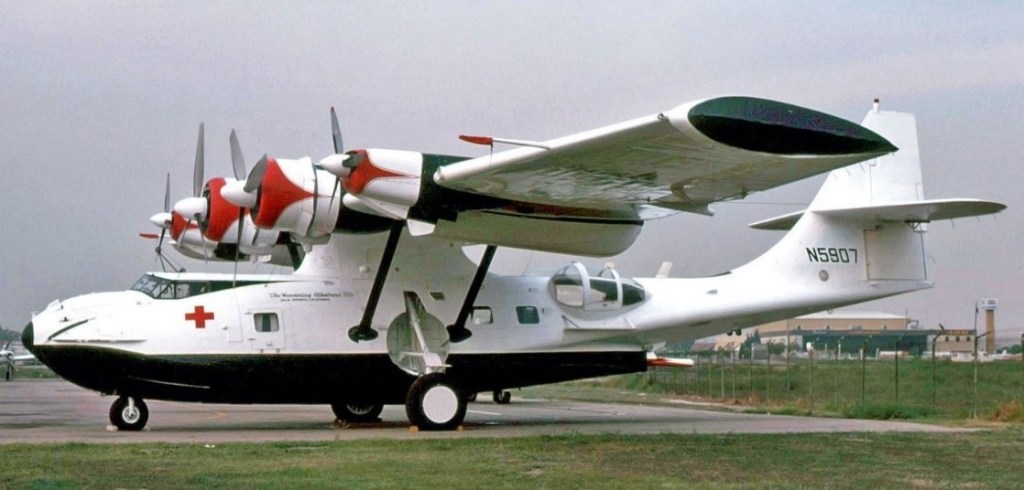
During the late 1960s Forrest Bird designed, and his Bird Corporation developed a conversion for the PBY Catalina to improve performance.
The Catalina was modified by adding two 340 hp (254 kW) Lycoming GSO-480-B2D6 engines positioned outboard of the original Pratt & Whitney radials to increase range and performance. (These engines and cowlings had originally been installed on the McKinnon four engine Grumman Goose. When they were removed by McKinnon to convert the Goose to twin turboprop power, they were purchased by Bird for his PBY Innovator conversion. Engineering for the Innovator conversion was performed by Spectro engineering of Los Angeles).
The wing attach fittings were strengthened and fuel capacity increased by adding fuel bladders to the outer wing panels. The engineer’s controls were previously moved to the cockpit by Southern California Air Service during their “Landseaair” conversion to allow operation without a Flight Engineer. Propeller control for the two Lycomings was electrical. The Lycoming’s propellers were fully reversible, distinctly improving the handling dexterity on the water. The main engine propellers were controlled by the standard mechanical linkage. The larger “Super Cat” rudder and increased power main engines (1830–94) had been installed at an earlier time. The angle of incidence of the wing and horizontal surfaces were not modified during the conversion.
First flying in 1967, the effect of the extra engines exceeded expectations, such that it was capable of a cruising speed of 152 mph (244 km/h) on four engines, and of maintaining 124 mph with one of the main engines feathered. The original PBY cruised at about 125 mph. The downside of the Innovator conversion was the gross weight of the aircraft increased to over 29,000 lbs. This exceeded the 27,000 lbs maximum that the US Military considered safe for water operations.
Only one Innovator was converted, a 28-5AMC Canso A (This was a Consolidated built aircraft. Built in November 1941 (under a contract for Canada), registration N5907, formerly RCAF serial number 9746, which was already used by Dr. Bird as a flying classroom/salesroom for medical equipment. Bird Corporation registered it as N81RD, and sold it in 1976, when its registration reverted to N5907. In the late 1970s, Pyramid Corporation purchased the Innovator and converted it to a camera platform to count whales along the west coast of the Americas. A plastic bubble with camera was installed in the nose and cameras were installed in the right blister and air stair door.
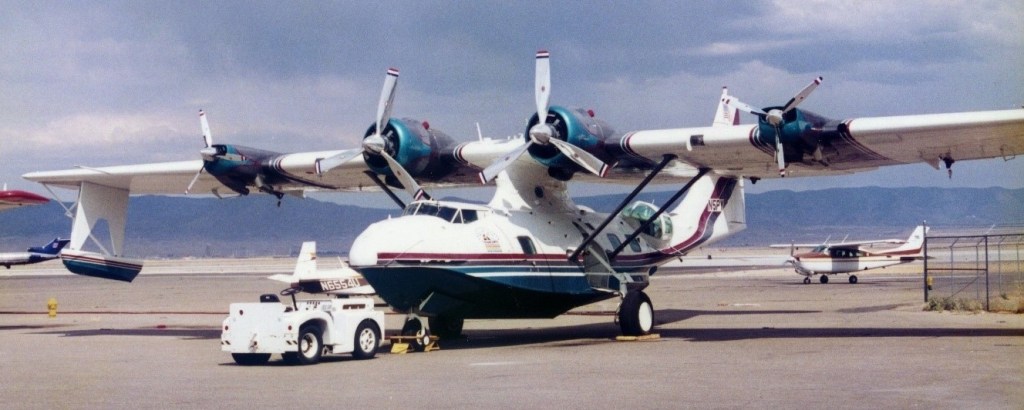
The Innovator was stored in Titusville, Florida at the end of this contract. While in storage a local law enforcement official decided that, since it was a large seaplane, it must have been used for illegal purposes and the aircraft was confiscated. Many years of lawsuits later, the Innovator was exonerated but time and the Florida sun had taken its toll. In the early 1990s, a New Mexico aircraft salesmen bought the Innovator, registered it as N5PY and spent the better part of a year restoring the aircraft to flying status. In 1997, during inspection, the new owners found an improper repair to the main keel truss from an earlier gear-up landing in the 1960s.
The extent of the damage, the previous attempt at repair and corrosion issues showed the need for a major IRAN (Inspect and repair as necessary) of the aircraft. At this time it was decided that, due to the extreme weight gain and aging complexity of the Innovator conversion, returning the aircraft to its original twin engine “Landseaire” condition was the safest and best option for the future preservation of the aircraft. As of 2013, restoration continues with the bow, pylon, and tail sections completely restored and a complete new keel truss, keelson, stringers, and bottom skins currently being installed; currently registered as N5PY.
Innovator Engines: 2 × Pratt & Whitney R-1830-94 Twin Wasp, 1,350 hp (1,010 kW) with 3-bladed Hamilton Standard constant-speed propellers & 2 × Lycoming GSO-480-B2D6, 340 hp (250 kW) with 3-bladed Hartzell 83XF-3A fully-feathering reversible-pitch propellers Wingspan: 104 ft 0 in (31.7 m) Wing area: 1,400 sq ft (130 m2) Aspect ratio: 7.73 Length: 63 ft 10 in (19.46 m) Height: 20 ft 2 in (6.15 m) Gross weight: 29,000 lb (13,154 kg) + Fuel capacity: 1,750 US gal (1,457 imp gal; 6,624 l) main tank + 375 US gal (312 imp gal; 1,420 l) in 3x additional bladder wing tanks Cruise speed: 174 kn (200 mph, 322 km/h) maximum 137 kn (158 mph; 254 km/h) at 34,000 lb (15,422 kg) gross weight and 5,000 ft (1,524 m) 132 kn (152 mph; 244 km/h) at 64% power and 11,000 ft (3,353 m) 125 kn (144 mph; 232 km/h) starboard auxiliary engine feathered 124 kn (143 mph; 230 km/h) port auxiliary engine feathered 112 kn (129 mph; 207 km/h) both auxiliary engines feathered 110 kn (127 mph; 204 km/h) starboard main engine feathered 108 kn (124 mph; 200 km/h) port main engine feathered Service ceiling: 15,000 ft (4,600 m) one main engine inoperative Service ceiling: 10,000 ft (3,048 m) with both port engines inoperative Rate of climb: 750 ft/min (3.8 m/s) at 75% power at sea level Take-off run: 1,000 ft (305 m) at 34,000 lb (15,422 kg) Take-off at 85% power: < 2,000 ft (610 m) at 34,000 lb (15,422 kg) Crew: 2



 All Aero