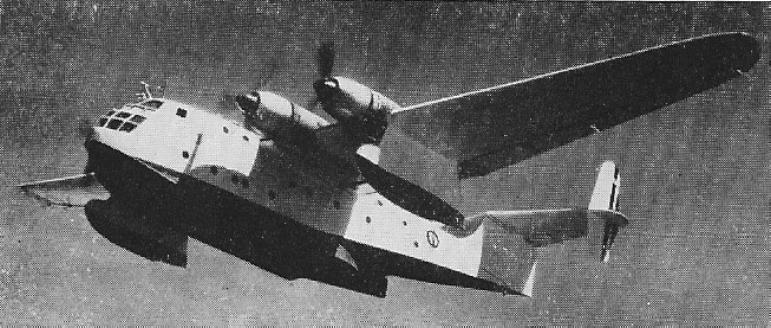
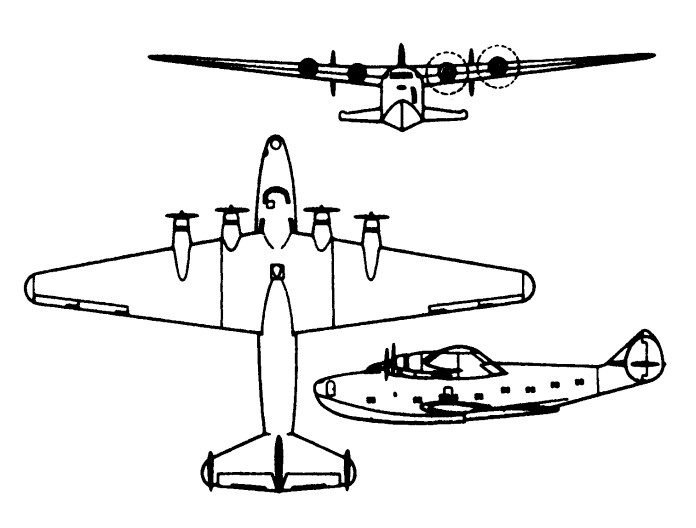
Designed before the war as a military patrol flying boat, the Type 731 Bellatrix was test flown at the Berre naval air base in unoccupied France in 1942, the prototype Type 730 having been flown just before World War 2.
The Type 731 differed from the pre-war Type 730 in having re-designed crew accommodation, modified floats, and a strengthened hull. The Type 731 escaped destruction and, after the war, it was re-engined with four 1480 hp Gnome-Rhone 14R radials and was used by the French Naval Air Service.
Only one Type 731 Bellatrix was completed.
Engines: our 1480 hp Gnome-Rhone 14R Wingspan: 132 ft 5 in Wing area: 1851 sq.ft Length: 79 ft 11 in Height: 26 ft 10 in Empty weight: 41,226 lb Loaded weight: 77,161 lb Max speed: 239 mph at 8,530 ft Cruise: 186 mph
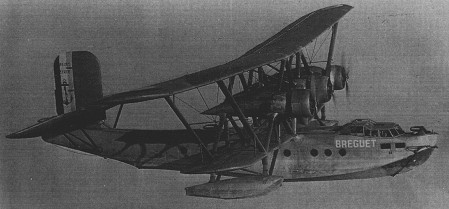
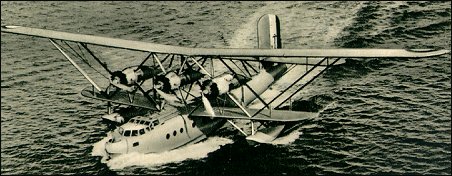
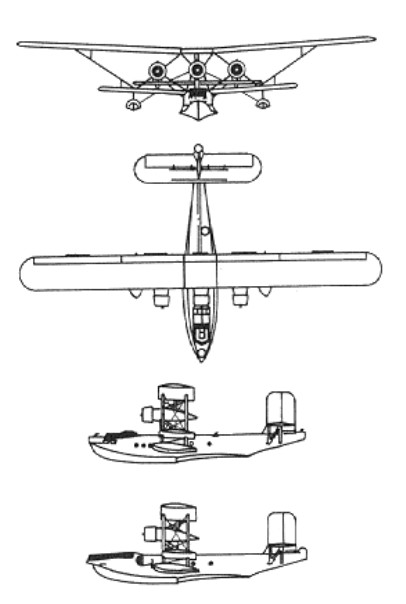
In 1931 Breguet secured a licence to build the Short Calcutta, and this was used as the basis for the company’s Bre.521 submission to meet a 1932 French Navy requirement for a long-range reconnaissance flying-boat. The Bre.521 was of all-metal construction with stabilising floats strut-mounted under the lower wings, a strut-braced empennage and three tractor engines located between the biplane wings. The Bre.521.01 prototype flew on 11 September 1933 with 630-kW (845-hp) Gnome-Rhóne l4Kdrs radials, and was followed by three pre¬production boats. The second of these introduced refinements intended for the production variant, includng an improved cockpit enclosure and more potent defensive armament. Armament comprised five 7.5mm Darne machine-guns: one in the cupolas each side at the rear of the cabin, one under each of two sliding hatches (with retractable windscreens) staggered to port and starboard amidships, and one in the extreme tail cockpit aft of the tail unit. Thirty were built up to 1940, powered by three 671kW Gnome-Rhone 14 Kirs radial engines. These served with “Exploration” escadrilles of the French Aeronavale from 1935 until the end of World War II, latterly being used as maritime reconnaissance and anti-submarine aircraft. Of these, nine were captured by the Germans and were used during 1943-45 for air-sea rescue.
One ‘boat became the sole Bre.522 when re-engined with 746-kW (1,000-hp Hispano-Suiza l4Aa radial engines.
In 1935 a civilian version – the Breguet Br.530 Saigon – was produced.
Bre.521 Bizerte Engines: 3 x Gnome-Rhône l4Kirs or 14N-11, 671 kW (900 hp). Wingspan: 35.1-18.9 m / 115 ft 2 in-62 ft 0 in Wing area: 169.8 sq.m / 1827.71 sq ft Length: 20.5m (67 ft 3in). Height: 7.5 m / 24 ft 7 in Max T/O weight: 16600 kg (36,597 lb). Empty weight: 8855 kg / 19522 lb Max speed: 243 km/h / 152 mph at 3,280ft. Cruise speed: 200 km/h / 124 mph Ceiling: 6600 m / 21650 ft Range w/max.fuel: 3000 km / 1864 miles Range w/max.payload: 2000 km / 1243 miles Seats: 8 Crew: 5 Armament: 5 x 7.5-mm (0.295-in) Darne mg plus up to 300 kg (661 lb) of bombs.
Bre.522 Engines: 3 x Hispano-Suiza 14Aa, 1000 hp, (746 kW). Span: 35.15m / 115ft 4in. Length: 20.5m / 67 ft 3in. Armament: 5 x 7.5-mm (0.295-in) Darne mg.
Signor Enea Bossi was the Italian representative of the Curtiss Co. and had arranged with the Zari Bros. of Bovisia, Italy, to build the Curtiss type boat from plans sent from Hammondsport. On September 22, 1914, Lanny made a demonstration flight in the first Italian built flying boat on Lake Como before naval officials. The Dai-Dai boat was purchased and an order placed for several more. The Italians were convinced that naval aviation was an excellent way to patrol their long and exposed coastlines.
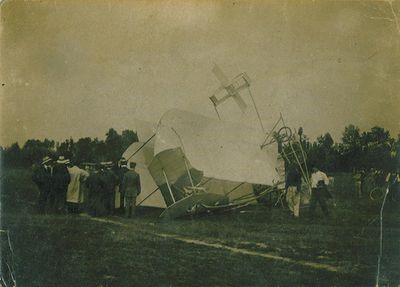
Frank and Joesph Boland built and tested several aircraft that featured canard layouts. The 1913 flying boat appeared with a raised plane wing which tied into spanwise braces that also served as outriggers for the stabalising floats. A single fin and rudder were mounted between the wing and float on the port side. The forward canard, rigged as an all flying stabaliser, was large enough to function as a tandem wing. The engine appears to have been a pusher water cooled V-8. The flat bottom hull had two traverse steps approximately at the centre of gravity.
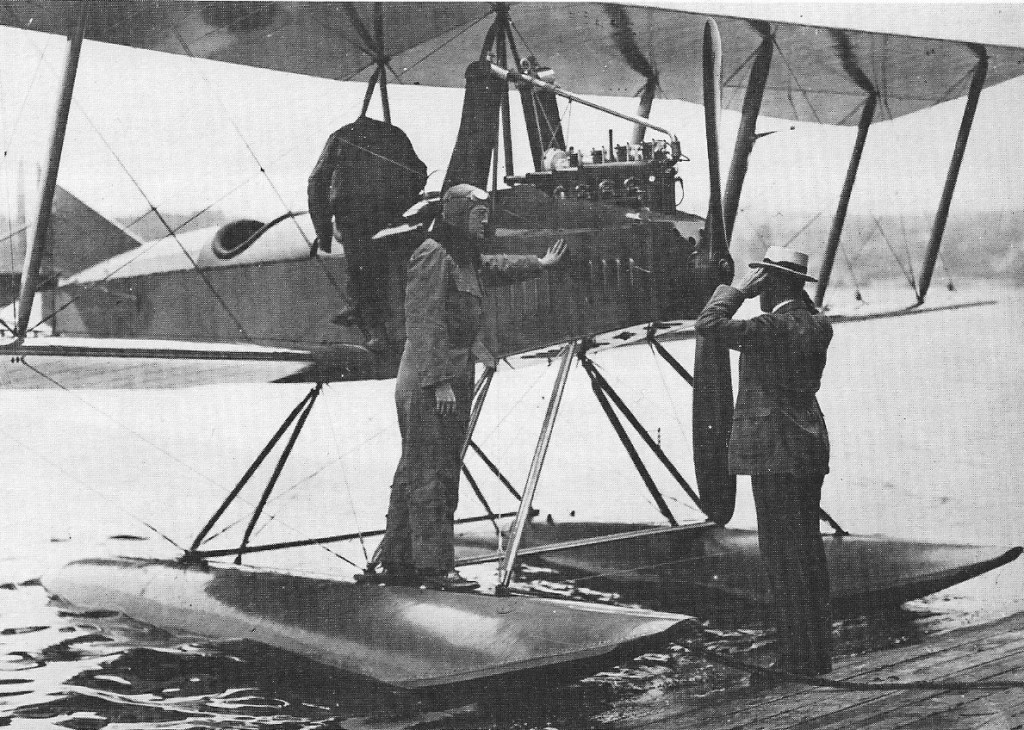
The Boeing C-700 was a development of the Model 5. Boeing (on the float) and Edward Hubbard put this aircraft to work in 1919 carrying mail between Seattle and Victoria B.C. and to ships at sea.
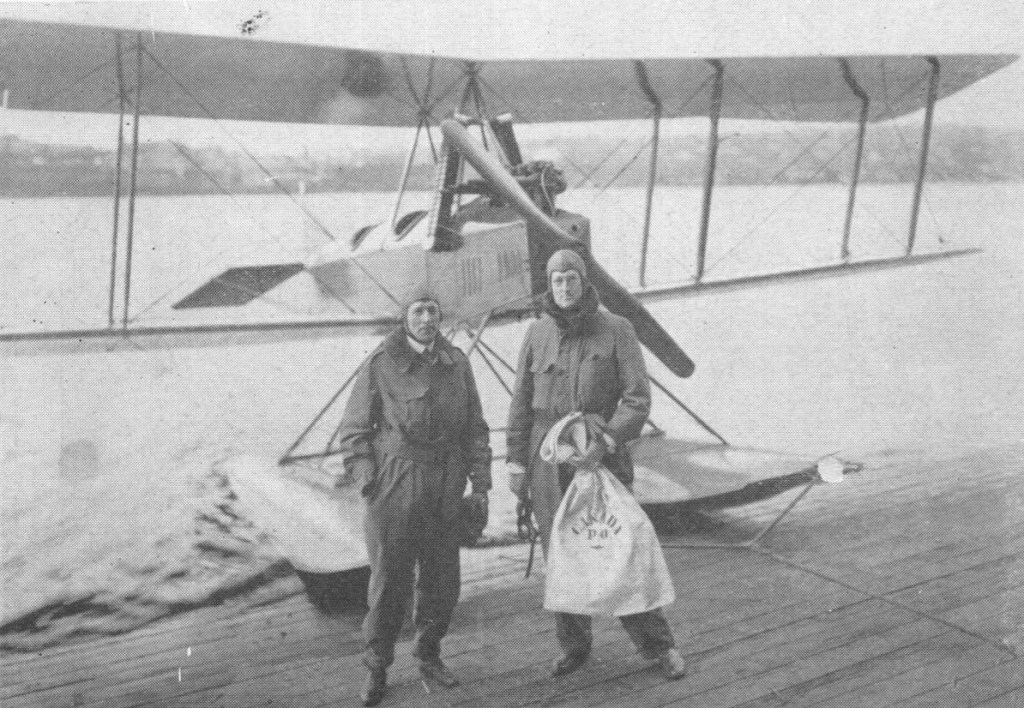
The first internation airmail flight was made from Vancouver to Seattle on 3 May 1919 by Eddie Hubbard and Bill Boeing. A pouch of 60 letters was carried in the C-700.
First international airmail
Powered by a Hall-Scott water-cooled four-cylinder of 100 hp, the cruise was 60 mph.
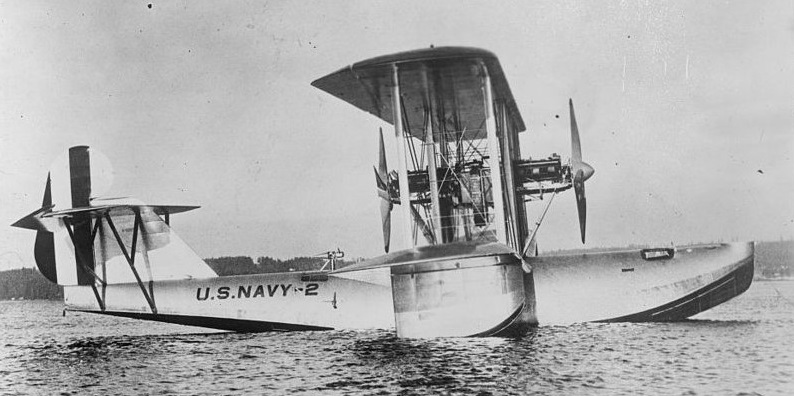
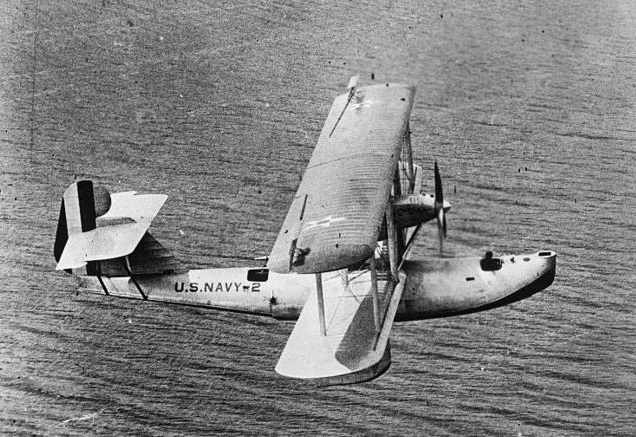
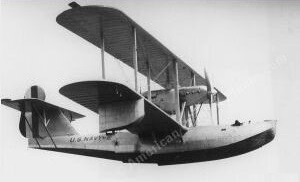
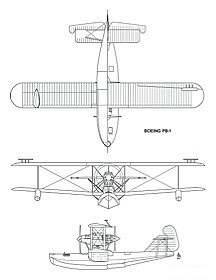
In September 1924, the Naval Aircraft Factory was tasked with designing a long-range twin-engined flying boat, capable of flying the 2,400 mi (3,860 km) between San Francisco and Hawaii. The initial design was carried out by Isaac Laddon, an employee of Consolidated Aircraft, and then passed to Boeing for detailed design and construction. The new flying boat, the Boeing Model 50, was a two-bay biplane of very streamlined design for flying boats of the time. The wings were of metal construction, with wooden wingtips and leading edges. The fuselage had a metal lower part, with the upper half made of laminated wooden frames with a wood veneer covering. Two 800 hp (600 kW) Packard 2A-2500 V12 engines driving four-bladed propellers were mounted in tandem between the wings above the fuselage.
The Boeing Model 50, designated PB-1 by the US Navy, made its maiden flight in August 1925 as A6881. It was intended to use it to lead a pair of Naval Aircraft Factory PN-9s in an attempt to fly to Hawaii on 31 August 1925, but engine trouble led to its participation in the flight being cancelled.
PB-1
In 1928, the aircraft was modified by the Naval Aircraft Factory, its Packard engines were replaced by two 500 hp (370 kW) geared Pratt & Whitney R-1690 Hornet radial engines, leading to the new designation PB-2.
Although the aircraft was a prototype the U. S. Navy did not distinguish between experimental and operational aircraft at that time so the aircraft was never designated XPB-1 or XPB-2.
XPB-1 Engines: 2 × Packard 2A-2500, 800 hp (600 kW) each Length: 59 ft 4.5 in (18.098 m) Wingspan: 87 ft 6 in (26.67 m) Wing area: 1,801 sq ft (167.3 m2) Airfoil: Clark Y Height: 20 ft 10 in (6.35 m) Empty weight: 11,551 lb (5,239 kg) Gross weight: 26,882 lb (12,193 kg) Maximum speed: 97 kn; 180 km/h (112 mph) Cruise speed: 82 kn; 151 km/h (94 mph) Service ceiling: 9,000 ft (2,700 m) Range: 2,172 nmi; 4,023 km (2,500 mi) Rate of climb: 4,000 ft/min (20 m/s) Armament: none fitted Crew: 5
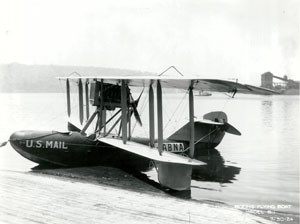
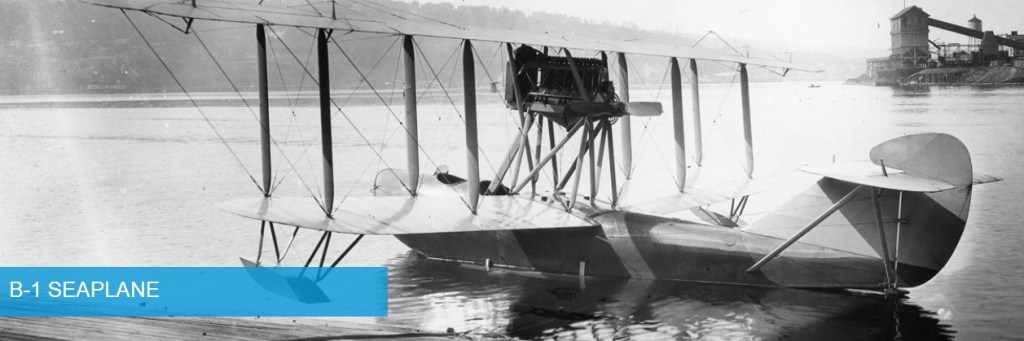
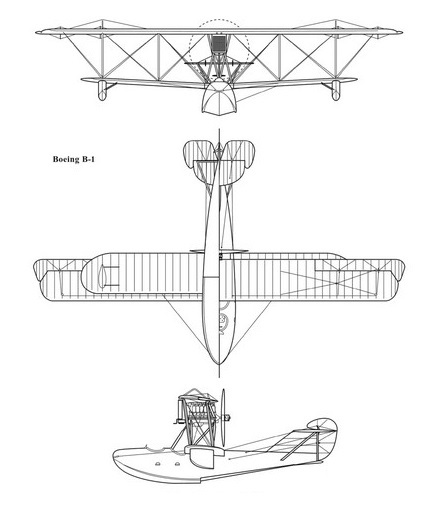
The Boeing Model 6, also known as the B-1 was a small biplane flying boat designed by William Boeing shortly after World War I. The Model 6 was the first commercial design for Boeing (as opposed to military or experimental designs), hence the B-1 designation. Its layout was conventional for its day, with a Hall-Scott engine driving a pusher propeller mounted amongst the cabane struts. The pilot sat in an open cockpit at the bow, and up to two passengers could be carried in a second open cockpit behind the first. The hull was laminated wood veneer, and the wing frames were spruce and plywood. The design was reminiscent of the Curtiss HS-2L that Boeing had been building under license during the war.
Only a single aircraft was built, first flying on 27 December 1919, as Boeing had trouble selling it in a market flooded with war-surplus aircraft. In 1920, it was purchased by Edward Hubbard, who used it to carry air mail between Seattle, Washington and Victoria, British Columbia. Air mail service began on 27 December 1919, and continued for eight years. The B-1 mail flights took off from Lake Union in Seattle. It outlasted six engines in eight years of international airmail runs between Seattle, Wash., and Victoria, British Columbia. Flown by Eddie Hubbard, the B-1 covered 350,000 miles (563,000 kilometers).
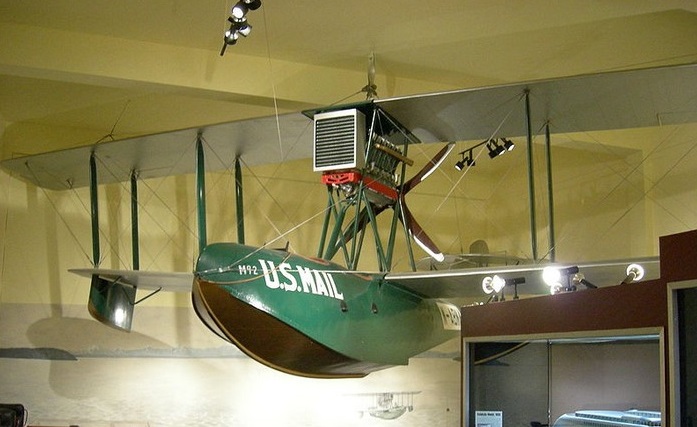
The plane flew until 1930 before being preserved and put on display at Seattle’s Museum of History and Industry in 1954.
Model 6 on display at the Museum of History and Industry in Seattle
Engine: 1 × Hall-Scott L-6, 200 hp (149 kW) 6 or 400-hp Liberty Prop: 4 blade wooden fixed pitch Wingspan: 50 ft 3 in (15.32 m) Wing area: 492 sq.ft (45.7 sq.m) Length: 31 ft 3 in (9.53 m) Height: 13 ft 4 in (4.06 m) Empty weight: 2,400 lb (1,089 kg) Gross weight: 3,850 lb (1,746 kg) Maximum speed: 90 mph (145 km/h) Cruise speed: 80 mph (128 km/h) Range: 400 miles (640 km) Service ceiling: 13,300 ft (4,050 m) Crew: one pilot Capacity: 2 passengers
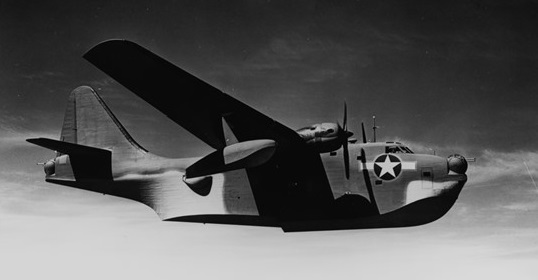
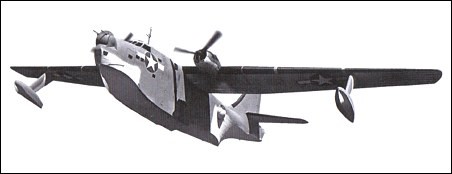
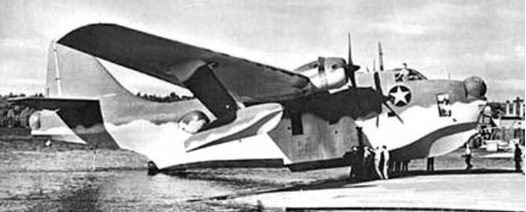
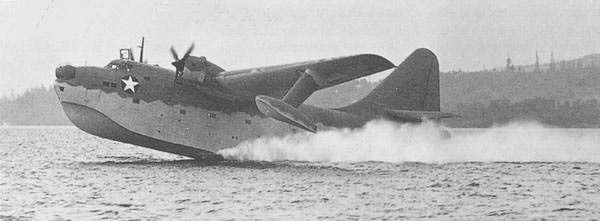
Well before the United States entered World War II, the Navy started a program to develop a long-range flying boat, able to cover the vast expanse of the Pacific Ocean. The Model 344 design offered by Boeing was chosen, and a contract for 57 aircraft was awarded on 29 June 1940.
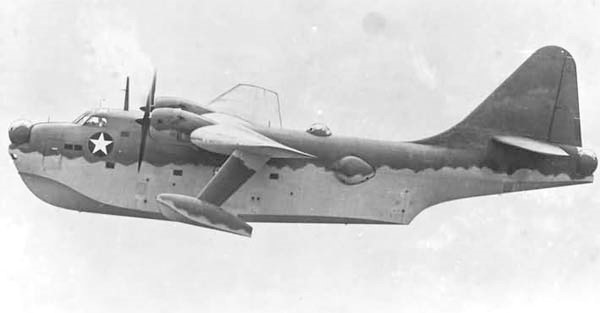
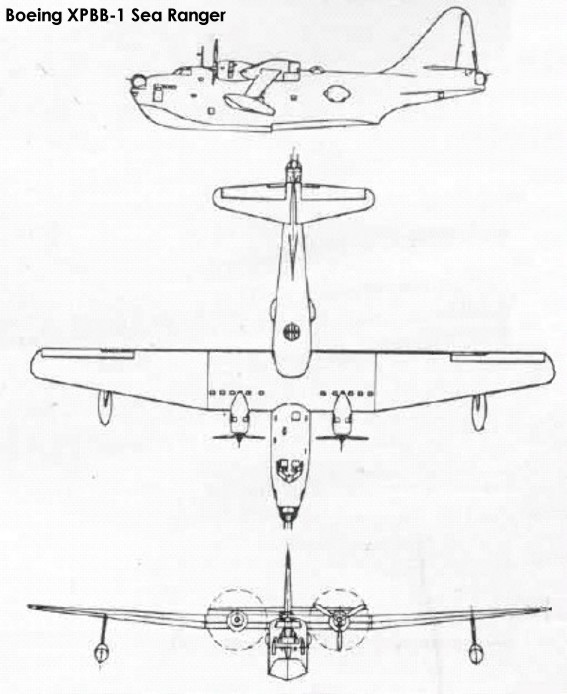
To build the large twin-engined XPBB-1 Sea Ranger (Boeing 344) flying boat Patrol Bomber prototype, Boeing started construction of a new lakeside factory in Renton, Washington, that was owned by the US Navy. The Navy owned 95 acres (38 hectares) on the south shore of Lake Washington in Renton, Wash. The waterfront site provided natural protection from prevailing winds, so it was easier to launch seaplanes directly from the plant. However, the prototype was constructed mostly in Seattle, and was moved to Renton only to be completed.
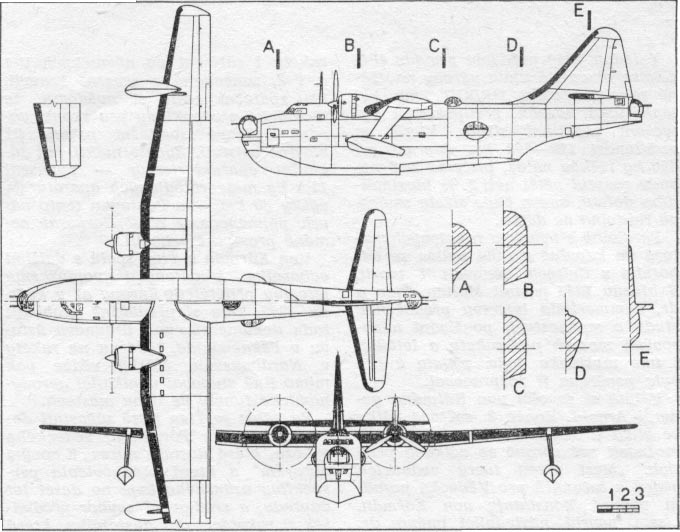
To achieve the desired long range, the PBB became a large aircraft, with a wing span of 139 feet 8½ inches (42.59 m) and a crew of 10. Despite this size, it was powered by just two Wright R-3350 Duplex Cyclone radial engines, driving three-bladed Curtiss Electric propellers. It was the largest twin-engined flying boat flown during World War II. For a flying boat, the PBB was aerodynamically clean, with a cantilever wing set high on the fuselage. The planing bottom had a single step, and the non-retractable outrigger floats were attached to streamlined, cantilever struts. The lower hull was divided in seven watertight compartments, and a short upper deck provided seating for the cockpit crew. The wing of the PBB was constructed in a centre section and two outer panels. The centre section carried the engine nacelles and contained the internal bomb bays, as well as fuel and oil tanks. The outer wing panels contained main and auxiliary, integral fuel tanks.
The defensive armament of the PBB consisted of five powered turrets equipped with Browning .50 M2 machine guns. They were installed in the nose, in the tail, on the upper fuselage just aft of the trailing edge of the wing, and in two waist positions on the rear fuselage. Except for the waist guns, the turrets had two guns each. Offensive armament could consist of up to 20,000 lb of bombs in internal bomb bays in the wing centre section (five bays on each side) or of two Mk.13 or Mk.15 torpedoes slung under the wing centre section.
The 1710 US gallon auxiliary outer and 1565 US gallon inner fuel tanks were intended to be used only in an overload condition, in which the PBB would use catapult-assisted take off to achieve a theoretical range of 11000 miles (17700 km). Normal range using the main fuel tanks was 4245 miles (6830 km).
The PBB was the first aircraft of the Patrol Bomber category built by Boeing for the Navy.
In March 1941 the Navy’s Bureau of Aeronautics asked the Naval Aircraft Factory for a catapult able to launch a PBB-1. The NAF duly prepared a design for a Mark VII catapult that would be able to launch a fifty-ton PBB-1 at a speed of 130 miles per hour. The catapult would be installed on a lighter, so that the flying boat could be lifted onto it with a large crane or hydraulic jacks. However, in the summer of 1942, while development of the Mk.VII catapult was still ongoing, the Navy cancelled the project because it considered JATO assistance at take-off more practical.
The prototype, designated XPBB-1 (hull number 3144), made its first flight on 9 July 1942 from Lake Washington. The aircraft handled very well and was considered technically successful.
The Boeing 25-year tradition of building seaplanes came to an end when the Lone Ranger flew out of Renton for the last time on Oct. 25, 1943, heading for the Navy base in San Diego, Calif.
However, already in 1942 the PBB programme had been cancelled: The need for a long-range flying boat had been reduced by the ability of land planes such as the Consolidated PB4Y to fly long-range missions over the ocean, and construction of a small number of PBB-1s would have a negative impact on the production rate of the B-29. The Navy allowed the Army to use the Renton factory for the production of B-29 bombers, in return for the use of another factory in Kansas.
The single XPBB-1 was handed over to US Navy in 1943, and was used in trials programmes at the naval base in San Diego until 1947, when it was finally retired to the Norfolk Naval Air Station in Virginia. It remained the single example of the type, and was accordingly nicknamed “Lone Ranger”.
The Navy traded the Renton site with the U.S. Army for a plant in Kansas City, Mo., and the Army took over the Renton plant, where Boeing workers subsequently produced 1,119 B-29 bombers. After the war, the Renton plant eventually became a manufacturing facility for Boeing commercial jet transports.
XPBB-1 Sea Ranger Engines: 2 × Wright R-3350-8 Double Cyclone, 2,300 hp (1,716 kW) Wingspan: 139 ft 8½ in (42.59 m) Wing area: 1,826 ft² (169.7 m²) Length: 94 ft 9 in (28.89 m) Height: 34 ft 2 in (10.42 m) Empty weight: 41,531 lb (18,878 kg) Loaded weight: 62,006 lb (28,185 kg) Max. takeoff weight: 101,130 lb (45,968 kg) Maximum speed: 186 knots (214 mph, 345 km/h) at sea level Cruising speed: 158 mph / 254 km / h Range: 6,300 mi (5,500 nm, 10,000 km) (maximum) Normal range: 3,691 NM, (4,245 mi, 6,834 km) Service ceiling: 22,400 ft (6,830 m) Rate of climb: 980 ft/min (4.98 m/s) Endurance: 72 hr Wing loading: 34.0 lb/ft² (166 kg/m²) Power/mass: 0.15 hp/lb (0.24 kW/kg) Armament: 8 × .50 in (12.7 mm) machine guns in bow and tail turrets and waist positions Bombload: 20,000 lb (9,100 kg) Crew: 10
As early as January 1935, Pan American Airways had signified to the US Bureau of Air Commerce its wish to establish a transatlantic service and, the airline wanted a new aircraft for the route.
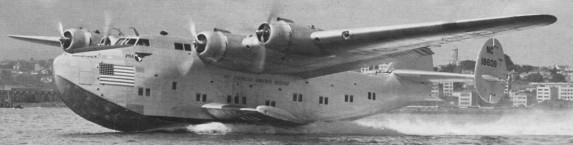
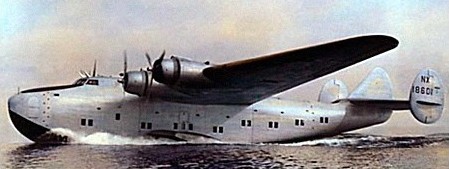
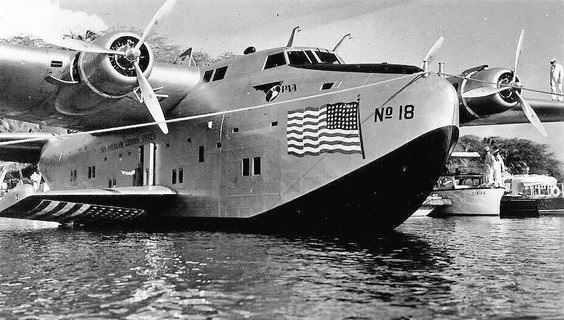
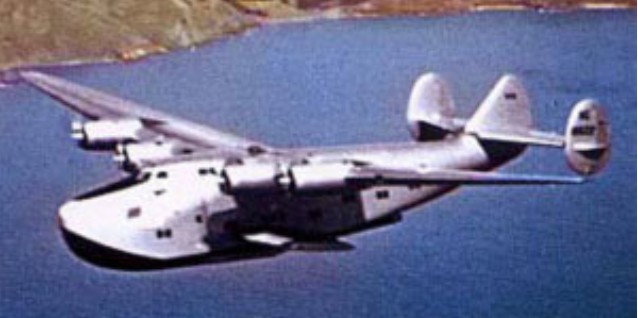
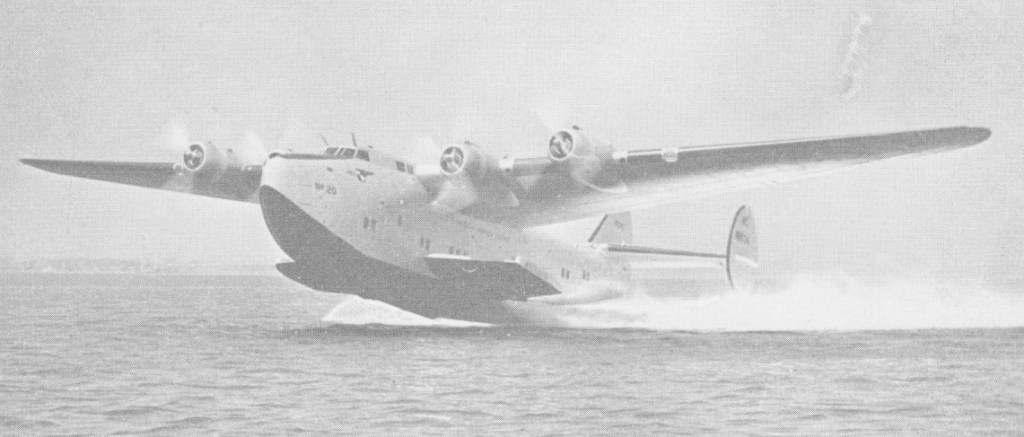
Boeing submitted a successful tender to the Pan American specification and a contract for six Boeing Model 314 flying-boats was signed on 21 July 1936. They used features of the XB-15 heavy bomber, adapting the wing and horizontal tail surfaces for its 37421kg gross weight flying-boat, which could accommodate a crew of 8 and up to 74 passengers in four separate cabins. The engines 1119kW Wright GR-2600 Double Cyclones which gave the machine a maximum speed of 311km/h. The fuel capacity of 15898 litres giving a maximum range of 5633km. Some of the fuel was stored in the stabilising sponsons, which also served as loading platforms. The first Boeing 314 made its maiden flight on 7 June 1939, this original version having a single fin and rudder, later replaced by twin tail surfaces to improve directional stability. These proved to be inadequate, and the original centreline fin was restored, without a movable rudder.
The aircraft was awarded Approved Type Certificate No. 704 and entered transatlantic airmail service on 20 May 1939. PAA Boeing 314 ‘Yankee Clipper’ flew by way of the Azores to Spain and then on to Southampton. On June 17 ‘Atlantic Clipper’ made first passenger crossing, carrying reporters and airline officials. Regular passenger service commenced on 28 June 1939, when ‘Dixie Clipper’ carried twenty-two paying passengers. One passenger having booked his seat in 1931. At that time the Model 314 was the largest production airliner in regular passenger service.
Known as “California Clippers” they operated over the South Pacific Ocean routes for Pan American Airlines. One such “California Clipper” flew from Los Angeles Harbor to Auckland, New Zealand, an 8,000-mile, 50-hour route with night layovers at Honolulu, Canton Island, and Noumea, New Caledonia. On two decks—an upper or control deck and a passenger deck—there were accommodations for a crew of 11 and 68 passengers or 36 sleeping passengers. The passenger deck was divided into nine sections, including a lounge, six separate passenger compartments, a specially furnished deluxe compartment, a galley and restrooms.
Clippers were in service with distinguishable names from 1939 through 1951 and were represented as the Honolulu Clipper, Cape Town Clipper, Anzac Clipper, Pacific Clipper, American Clipper, Yankee Clipper, California Clipper and the Atlantic Clipper – all operated by Pan Am.
Pan American ordered another six aircraft which were designated Model 314A, improved by the installation of 1193kW Double Cyclones with larger-diameter propellers, and additional 4542 litres of fuel capacity, and a revised interior. The first Model 314A flew on 20 March 1941 and delivery was complete by 20 January 1942. Five of the original order were retrospectively converted to Model 314A standard in 1942. Three of the repeat order were sold, before delivery, to BOAC for transatlantic service and operation on the Foynes-Lagos sector of the wartime ‘Horseshoe Route’. The three Boeing 314As, G AGBZ Bristol, G AGCA Berwick, and G AGCB Bangor, with fuel capacity of 5,448 US gallons giving a range of over 3,600 miles, were acquired by the British Government and delivered new from Boeing’s Seattle factory specifically to provide the UK West Africa ‘lifeline’. The three Boeings commenced operation UK West Africa in May 1941. It transpired that a valuable, albeit irregular, trans Atlantic service was an incidental development due to the necessity for them to return to their Baltimore base for certain overhauls after every 120 hours flying, and Atlantic flights were therefore interpolated into the schedules to permit this to happen. BOAC operated its last B.314A on January 17, 1948.
Of Pan American’s nine Model 314/ 314As, four were requisitioned by Army Transport Command and given the military designation C-98. They were little used, however, and in November 1942 one was returned to the airline. The other three were transferred to the US Navy to join two acquired direct from Pan American; the airline provided crews for the US Navy’s B-314 operations and the aircraft were partially camouflaged but operated with civil registrations.
BOAC and Pan American terminated Boeing Model 314 services in 1946 and the surviving aircraft were sold to American charter airlines
Boeing 314 Clipper Engines: 4 x Wright R-2600 Double Cyclone, 1,500 hp
Boeing 314A Clipper (C-98) Engines: 4 x Wright R-2600 Cyclone 14, 1193kW, 1600 hp Props: full-feathering constant-speed Length: 32.31 m / 106 ft 0 in Height: 8.41 m / 27 ft 7 in Wingspan: 46.33 m / 152 ft 0 in Wing area: 266.34 sq.m / 2866.86 sq ft Maximum Take-Off Weight: 83,776lbs (38,000kg) Empty Weight: 48,281lbs (21,900kg) Fuel capacity: 5408 USG Max. speed: 311 km/h / 193 mph Cruise speed: 295 km/h / 183 mph Maximum Range: 3,664miles (5,896km) Ceiling: 4085 m / 13400 ft Passengers: 74
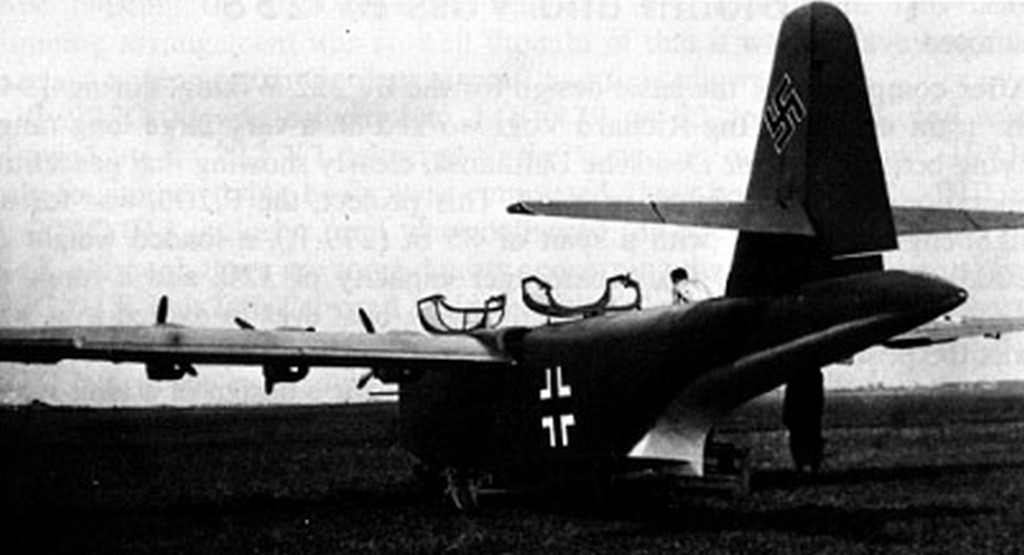
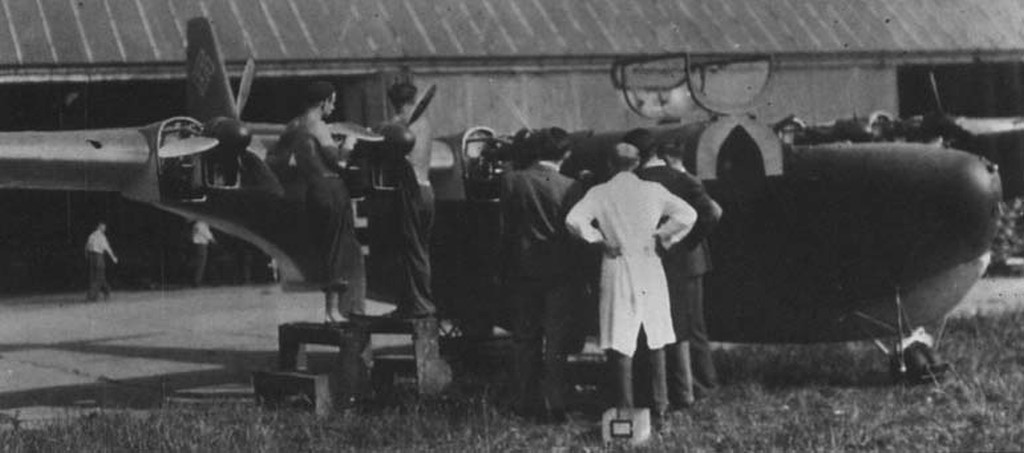
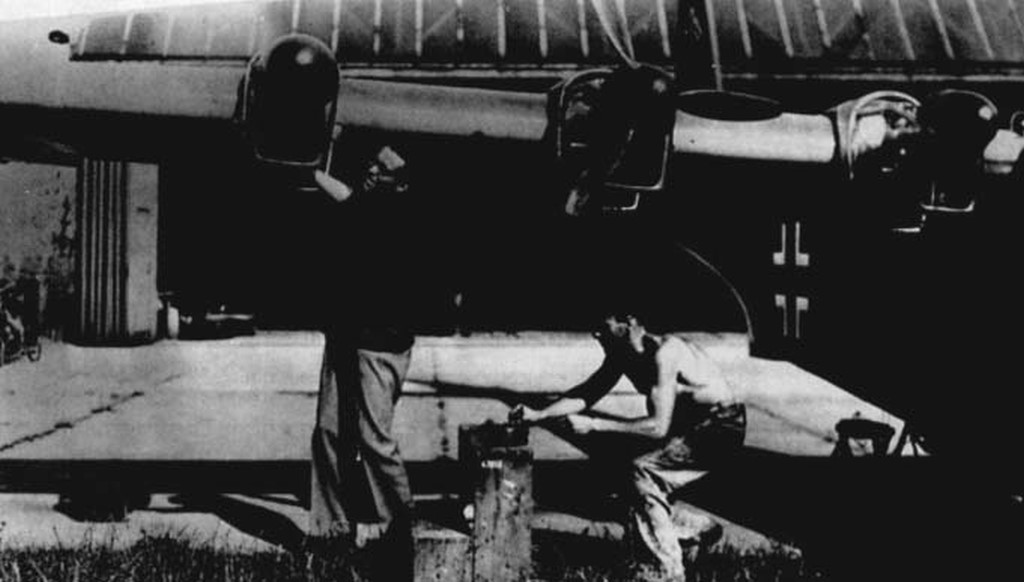
The FGP 227 was a ¼ scale flying model of the Blohm & Voss BV 238 flying boat, built to provide data for the development of the BV 238. The FGP 227 was a faithful scale model with accommodation for a pilot in the front cockpit and a flight test observer in a cockpit aft of the wing. Power was supplied by six 15.7 kW (21 hp) ILO F 12/400 air-cooled two-stroke engines driving three bladed propellers.
Completed early in 1944 the FGP 227 (BQ+UZ) was fitted with a temporary wheeled undercarriage of ten small wheels fitted with low-pressure tyres. Intended to allow flight tests to commence from the manufacturers airfield, the FGP 227 refused to take-off from the grass airfield. To allow flight test to begin the aircraft was dismantled and transported to Erprobungsstelle See, Travemünde, (E-Stelle – flying boat testing station). During transport French prisoners of war loading the wing onto flat-bed trucks allowed it to fall from a crane causing damage which was not repaired until September 1944.
Flight tests commenced in September 1944 as soon as the repairs were completed, but all six engines stopped due to fuel starvation soon after take-off, resulting in a heavy landing on the water. The FGP 227 was again repaired after which the aircraft flew several more times. However, by this time the BV 238 programme had been halted, not least because BV 238 V1 had been sunk at its moorings on Lake Schaal by allied fighters, so no useful data were gleaned from the programme.
Engines: 6 × ILO F 12/400 air-cooled two-stroke, 15.7 kW (21.1 hp) each Propellers: 3-bladed fixed pitch propellers Wingspan: 15.25 m (50 ft 0 in) Wing area: 24.24 m2 (260.9 sq ft) Length: 11.95 m (39 ft 2 in) Empty weight: 1,250 kg (2,756 lb) Gross weight: 1,640 kg (3,616 lb) Crew: 2


 All Aero