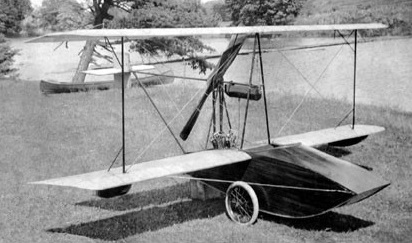
The “Model 1” designation was more symbolic as the ship was built before there was a Waco Company. Designed by Elwood J Junkin and Clayton J Brukner, the 1919 Baby Flying Boat had a mahogany veneer hull, demountable wheels for beaching, and a 6′ propeller.
Notably underpowered, with motor vibrations shaking the craft to an alarming degree, it would not unstick from the Lake Erie, so was retired to its room above a dance hall in Lorain OH, and none of the principals recalls its ultimate fate.
This effort led to the formation of DJB Aeroplane Co which was basis for Weaver Co the following year.
After a two year construction period the XPBS-1 prototype first flew on 13 August 1937. Initial testing with 1050 hp engines revealed a top speed of 227 mph. Stability problems traced to turbulence generated by the wings resulted in the addition of dihedral to the horizontal stabilisers. After being delivered to the Navy in October 1937, the XPBS-1 began competitive trials with the Consolidated XPBY2-1 in mid-1938. Consolidated won a construction order and the XPBS-1 was assigned to Patrol Wing 5 at NAS Norfolk, Virginia, to evaluate long-range patrol-bomber operations until shortly after the US entered World War II. In the spring of 1942 the aircraft was reassigned to VR-2 out of California for transport duties between the West Coast and Hawaiian Islands. On 30 June 1942, while returning from Pearl Harbor, the XPBS-1 struck a log in San Francisco Bay and sank. All on board escaped safely, the passengers including Admiral Chester W. Nimitz, Commander of the Pacific Fleet.
In December 1939, American Export Airlines approached Sikorsky (then operating as Vought-Sikorsky Divistion) with the proposition of creating a commercial variant of the S-44, with the option of acquiring three aircraft as VS-44As.
The VS-44A was a commercial version of the experimental XPBS-1 patrol-bomber flying-boat, which had been built for the US Navy and flown in 1937. Accommodating 40 passengers over short ranges or 16 with sleeping bunks, it was developed by Michael Gluhareff for American Export Airlines. Power was provided by four 894kW Pratt & Whitney Twin Wasp engines.
With war clouds gathering, on July 15, 1940, the new Civil Aeronautics Board granted AEA a certificate to operate between New York and Lisbon, despite protest of Pan American. AEA promptly exercised its December 1939 option on three all metal VS 44A flying boats, powered by four 1,200hp (895kW) Pratt & Whitney Twin Wasp engines, at a total cost of US$2,100,000.
The aircraft were designed to carry 26 passengers on shorter trips, but only 16 over the North Atlantic in sleeper berths. Passengers would enjoy comfortable seats convertible for sleeping, modern lighting and heating systems, and even a galley where stewardesses could prepare freshly cooked meals. It possessed a 3100 mile range, fully loaded, that would allow it to fly the Atlantic non-stop.
The three VS-44 Excalibur passenger flying boats for American Export Airlines were completed as XJR2S-1 for the Navy, but flown by AEA under contract. Civil registrations NC41880-41882 (ATC 752) were allocated, as well as USN s/ns 12390-12392. 04396-04398 were cancelled and possibly refer to the same aircraft. The designation JR2S-2 was used as an alternative.
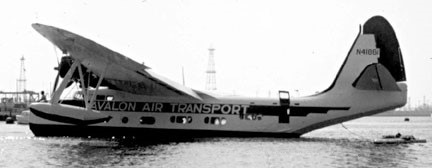
Vought-Sikorsky VS-44A NC41881
Vought Sikorsky completed the first of the ‘Flying Aces’, named Excalibur, in January 1942. A day later, AEAs chief pilot, Charles Blair, eased the flying boat down the ramp and into the icy Housatonic River. Only taxiing tests were planned but, Blair insisted later, the huge airplane “accelerated like a startled greyhound” and lifted off without his permission. Blair brought the willful ship back down, took off again and made a low pass over the Sikorsky plant.
The Excalibur was soon joined by the Excambian and the Exeter, all named for American Export Lines steamships. As the Naval Air Transport Service had taken over the order by then (and contracted with AEA to carry military and government personnel and equipment), the VS 44As were decked out in blue camouflage, with American flags emblazoned on the port and starboard bows to fend off aggressive Allied pilots and anti aircraft gunners. To maintain them, AEA hurriedly erected a tent city at Port Washington on Long Island to house a temporary base until a hangar could be completed at New York LaGuardia. Even that would prove inadequate as the Navy’s requirements necessitated a larger fleet one that would consist mostly of Consolidated P12Y 3R Coronado flying boats, which beat out Sikorsky for a Navy contract. Charlie Blair commanded the Excambian’s initial crossing of the Atlantic on May 27/28, 1942, on the first of two survey flights. Those flights were designed to assure safe operations between Port Washington and Foynes, a flying boat port on the River Shannon, with a fueling stop in Botwood, Newfoundland.
When the Excalibur inaugurated passenger service on June 20, 1942, with Blair again in command, the eastbound flight was uneventful. Travellers relaxed as purser Bill Scouler and Dorothy Bohanna, enjoying her role as the world’s first trans Atlantic stewardess, dished up drinks and hot entrees.
On the return flight to the new LaGuardia base two days later, the crew faced strong headwinds and fog that had socked in Newfoundland, the refueling point. Assessing their grim fuel outlook, co pilot Bob Hixson remarked at one point, “Glad this is a boat.” To stretch mileage, Blair brought the VS 44A down to skim just above the waves. When the flying boat touched down on Flushing Bay 25 hours and 40 minutes later, AEA publicists could claim the first Foynes New York nonstop flight. But only 45 minutes worth of fuel remained.
Eastbound flights were almost always easier, with nonstops of 3,000mls (4,800km) possible in 20 hours or less. On one flight, with the help of hurricane driven tailwinds, Blair crossed from New York to Foynes in a record 14hr 17min. To avoid winter headwinds on westbound crossings, crews had to detour far south of the favored Great Circle route. After mid October, the Sikorskys sometimes flew a circuitous South Atlantic track, via Bathurst, a West African port near the equator much farther from New York than Foynes, their departure point. When they crossed the Atlantic westbound, crews often flew as low as 500ft (150m) to avoid higher altitude headwinds. “There were times when we flew so low that the windshields were spattered with salt spray,” Blair recounted in his book, Red Ball in the Sky. While low flights made for slow trips, they sometimes afforded spectacular views. Pan American Captain Mike Craig, whose father Jim succeeded Blair as chief pilot of AEA, once noted that passengers and crew members “often had memorable flights viewing such sights as seals bathing in freshwater pools atop icebergs a scant few hundred feet beneath their windows.”
AEA’s flightdeck crewmembers, all Naval reservists, dressed in civilian uniforms to avoid problems in neutral countries. Like Blair, the other eight original captains had abandoned secure jobs with domestic carriers such as Eastern and United for the challenge of flying the Atlantic in some of the world’s most exciting aircraft. They were joined by a number of co pilots who had flown Curtiss P 40 fighters in China with the American Volunteer Group.
The second VS-44A, Excambian, was delivered in May 1942, and the third, Exeter, in June. Shortly after all three became operational, they were formally impressed into the Naval service designated JR2S-1.
Excalibur was lost soon after it entered service in a setback to the new airline. A relatively inexperienced pilot, trying to take off from Newfoundland’s Bay of Exploits, forced the reluctant flying machine into the air, causing it to stall and plunge back into the bay. Eleven of the 37 on board were lost, along with AEA’s beloved flagship.
AEA’s two surviving VS 44As would make more than 400 trans Atlantic crossings before the war ended. As early as 1942, when the first VS 44As were being delivered, the CAB had agreed with Pan Am that the Civil Aeronautics Act of 1938 prohibited shipping lines from starting or acquiring airlines. American Export’s airline division would have to be sold, although the ship line could retain a minority interest.
Determined not to let his airline be swallowed up by its arrogant competitor, John Slater, executive vice president, sounded out American Airlines executive Ralph Damon about acquiring AEA. Damon advanced the idea with AA’s wartime president, Alexander ‘Ned’ Kemp, who announced in March 1944 that AA had contracted to acquire control of AEA through a stock purchase. The deal was contingent on government approval, and would be argued along with a case to sort out which US airlines could fly trans Atlantic routes after peace was restored. In the debate that followed, both the Board and Congress rejected Juan Trippe’s efforts to establish Pan Am as the sole US flag carrier for all international service. On July 5, 1945, the CAB gave American permission to purchase 51.4% of AEA’s capital stock from the steamship line for $3 million. AEA’s last flying boat service departed from Foynes on October 22, 1945, with Blair again in command. Both flying boats were sold in 1946 and flown to South America. In mid-1947 Exeter was destroyed during a night landing on the Rio de la Plata River in Uraguay operated by Skyways International, loaded with guns and ammunition intended for Paraguayan rebels, leaving only Excambian.
Blair, still restless, leased that survivor for charter work with his Associated Air Transport, while he flew for American Overseas Airlines. AAT used the VS 44A in summer 1947 to support the construction of the US base at Keflavik, Iceland, flying on one occasion to Stockholm. After retiring from Pan Am, which ultimately acquired AOA from American in 1950, Blair created Antilles Air Boats, a Caribbean commuter service in the Virgin Islands. With business booming for his ‘Streetcar Line of the Virgin Islands’, Blair purchased Excambian in January 1968 from Catalina Air Lines (formerly Avalon Air Transport) of Long Beach, California, for $100,000 to handle the traffic between St Thomas and St Croix. The aircraft was so severely damaged in a landing just a year later that it could not be economically repaired. It remained beached for years at St Thomas until Blair reluctantly turned it over to the National Museum of Naval Aviation at Pensacola, Florida, in 1976. However, as the Excambian was never technically a Navy aircraft, officials waffled about restoring it. It was still vegetating outdoors at the base when Blair died in September 1978 in an aircraft accident. Maureen O’Hara, who stepped in to take command of Antilles Air Boats after Blair’s death, knew something had to be done to save the aircraft. She finally asked the Navy to turn Excambian over to the Bradley Air Museum (now the New England Air Museum) on a permanent loan basis. Sikorsky veteran Harry Hleva mobilized some 130 volunteers to restore the derelict to like new condition at the Stratford plant where it was born. With the restoration accomplished over an estimated 200,000 man hours, Sikorsky trucked the aircraft in parts to the museum’s civil aviation hangar. Even in that cavernous building, the giant nearly touches the ceiling.
Vought-Sikorsky VS-44A NC41881 Wartime paint
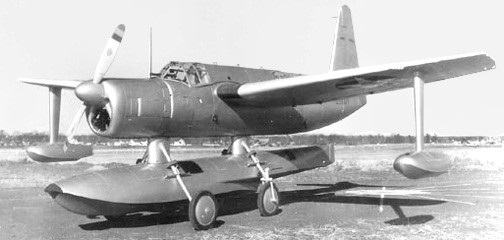
JR2S Wingspan: 124’0″ Length: 76’2″ Top speed: 227 mph
VS-44A Engines: four 1050hp R-1830 Twin Wasp Wingspan: 124’0″ Length: 79’3″ Useful load: 27,300 lb Max speed: 210 mph Cruise: 175 mph Stall: 67 mph Range: 4900 mi Ceiling: 16,600′ Passenger capacity: 35
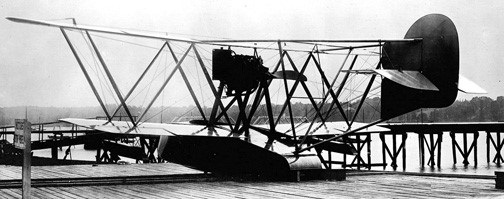
The Vought VE-10 Bat Boat of 1919 was a three-place open-cockpit flying boat built for USN trials. The only flying boat ever built by Vought, it was unsuccessful. Only the one was built.
In 1930 Carl T von Cosel, of Key West FL. Built a two-place cabin, high-wing monoplane amphibian, registered N879Y and powered by a 180hp LeRhône rotary engine.
The wings were never attached, so the plane was never flown. Some reports claimed that von Cosel, an undertaker by trade, kept his dead wife in it for an unstated period of time.
When he left Key West in 1940, he took the plane with him and both disappeared.
This single-seat waterborne biplane glider is designed to be towed in tethered flight behind a conventional motor boat. It was designed at the instigation of Volpar Inc. In February 1977 Volpar engaged Mr Percival H. Spencer, a pioneer pilot and amphibian designer, to design a small but fully manoeuvrable waterbased glider. This was to use modern plastics and foam materials for high strength and low cost, and to have simple controls that could be operated safely by an amateur or non-pilot.
Mr Spencer himself made the first flight of the prototype Drag-N-Fly, on 20 April 1977 (nearly 63 years after his first solo flight) and continued air and water trials have proved very satisfactory. Flight testing during 1978 resulted in the addition of a 1ft extension on each wing tip, to reduce the power requirements of the towing boat.
When in flight the tether can be disconnected by the pilot in an emergency, and will disconnect automatically if the glider tends to overrun the tow boat. The fuselage is hinged so that the Drag-N-Fly can be transported on a light road trailer without exceeding a width of 8ft 0in. The structure makes extensive use of stryrofoam and other lightweight materials; the strut-braced biplane wings are of constant chord and covered in glasscloth laminate, bonded with epoxy resin; there are spoilers on the outer panels of the upper wing. The wings themselves are built up of aerofoil shaped styrofoam blocks, with plywood spar caps bonded to styrofoam shear webs with epoxy resin. There are wooden blocks between the capstrips at each end to provide bolt attachments for joining the panels together. The fuselage and the twin floats which attach directly to the bottom of the lower wing are built up from plywood internal frames and bulkheads and are covered in polyester resin-bonded moulded glassfibre cloth laminate. The cantilever tail unit has a styrofoam core and glassfibre laminate covering; the vertical surfaces have wooden frame edges and the one-piece horizontal tail has plywood spar caps. The latter is hinged at the aft fuselage bulkhead and is statically balanced by means of a bob-weight; trim adjustment is by means of a bungee spring. There is a single open cockpit forward of the wings, an a water rudder is provided for control during towing, as well as the more conventional rudder.
Span: 17 ft 0 in Length: 15 ft 11 in Height: 5 ft 9 in Wing area: 113.0 sqft Aspect ratio: 2.56 Empty weight: 225 lb Max weight : 425 lb Max speed: 75 mph (in smooth air) Required take-off speed: 40 mph
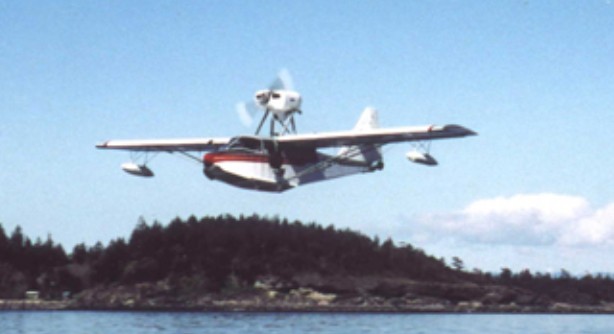
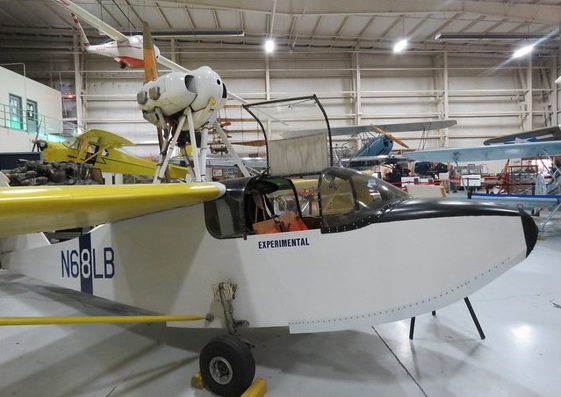
The Volmer VJ-22 Sportsman (or Chubasco) is a two-place, side by side, closed cabin, highwing monoplane, amphibious flying boat. Designed by Mr. Volmer Jensen, the Sportsman first flew on 22 December 1958 as an original design based on an earlier aircraft, the VJ-21, a high-wing pusher that contributed much data for the Sportsman.
Construction of the original Sportsman started in September 1957 and was completed in December 1958. The rigid, corrosion proof hull is made of 1/16 inch and 3/32 inch aircraft mahogany plywood with 1/4 inch plywood at the step for maximum strength and covered with fiberglass for added protection. The fin is built integral with the hull. The Sportsman can use fabric-covered Aeronca Chief or Champion wings. The wing panels are identical to those of the Aeronca Chief and consist of front and rear solid spruce spars, aluminium ribs, steel tube compression members and internal wire bracing. Each panel is externally braced by steel tube V struts to the fuselage. Floats are attached, and are braced to the outboard end of each wing. The main undercarriage retracts by swinging forward 90o. Shock absorption is by means of rubber bungee cord. The tailwheel incorporates a water rudder, and retracts upwards when not required. The pusher engine is mounted on a steel tube structure above the wing. To facilitate storage, the wings may be removed by undoing the few retaining bolts.
Numerous testing from calm water to five foot swells in the open sea have proven the design to be both extremely airworthy and seaworthy. Wings are wood spar and ribs, fabric covered. It takes off from water at sea level in about 20 seconds. The VJ-22 is powered by a Continental C-85, starter and gen. It has a cruising speed of 85 mph and stalls at 45 mph.
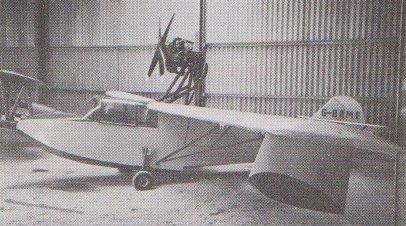
Suited to Continental s from the C85 to the O-200, most VJ-22 have their pylon-mounted engine mounted as a pusher, but one built by Viv Bellamy, G-BAME c/n VHB-1, started in 1971 and first flown from St. Just in early 1974, had a tractor engine. Possibly a Lawrence or Salmson radial.
Viv Bellamy’s G-BAME
Designed to use wings from light aircraft including Auster, Aeronca, and Taylorcraft, In the UK, G-BAHP completed at Rollasons at Croydon by September 1972 featured Aeronca 7AC G-ATXC wings. It was first flown at Biggin Hill in 1973 with a Continental C90 engine.
Engine: Continental, 85 hp HP range: 85-100 Speed max: 110 mph Cruise: 80 mph Range: 225 sm Stall: 45 mph ROC: 550 fpm Take-off dist: (land) 350 ft., (water) 1000 ft Landing dist: (land) 500 ft., (water) 1000 ft Service ceiling: 12,000 ft Fuel cap: 20 USG Weight empty: 1000 lb Gross: 1500 lb Height: 8 ft Length: 24 ft Wing span: 36.5 ft Wing area: 180 sq.ft Seats: 2 Landing gear: tail wheel, retractable Takeoff time 20 sec
Engine: 100 hp ROC: 600 fpm Span: 36 ft 6 in Length: 24 ft Empty wt: 1000 lb Max wt: 1500 lb
Gabriel Voisin began his formal aviation career in 1903 when he was engaged by a prominent French aeronautical promoter, Ernest Archdeacon, to build gliders for him.
June 8, 1905, over the Seine, Gabriel Voisin succeeds on a glider built with Ernest Archdeacon to fly 15 meters high and 150 m.
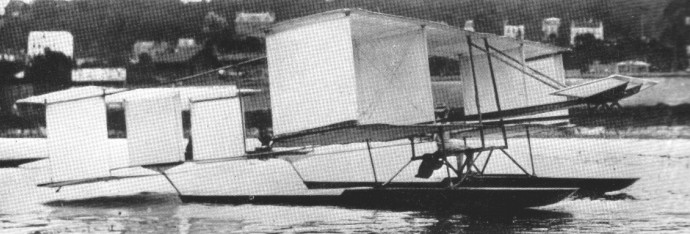
One of the gliders built by Gabriel Voisin in 1905 for towed flights behind a motor boat on the River Seine.
The Voisin-built Archdeacon glider was acquired and motorized as the Bellamy Hydroavion by French inventor Emile Bellamy in 1906.








 All Aero