1926 seaplane training biplane
Amphibian
Caspar-Werke U.2
1922 seaplane prototype for detachable-wing biplanes to be carried by submarines.
Caspar-Werke S.1
twin-float monoplane seaplane
Caproni Ca.316
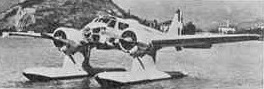
The Ca.316 was a twin-float reconnaissance seaplane powered by two 450-h.p. Piaggio P.VII C.16 radials and intended for catapult launching from warships of the Italian Navy. The Ca 316 was designed to replace the obsolescent I.M.A.M. Ro 43 float biplane, but only prototypes had flown before the armistice stopped further development.
Caproni Ca.97
Powered by a licence built Alfa Romeo (Bristol) Jupiter of 515 hp, the Ca 97 was one of a family of civil and military high wing seaplane transports of 1928 33. The 97 was normally equipped with three 7.7 mm (0.303 in) Breda-SAFAT machine guns and external racks for a small bombload, but it could carry a crew of up to six or cargo internally.
Span: 16.0 m (52 ft 5.75 in)
Length: 10.8 m (35 ft 6 in)
Gross weight: 2595 kg (5720 lb)
Maximum speed: 220 km/h (138 mph)
Caproni Ca.60

Caproni’s Ca.60 had three sets of triplane wings arranged in tandem on top of a hull. Eight 400-hp Liberty engines, four pushing, four pulling, were supposed to make the thing fly, and provision was made for engineers to walk along the extended nacelles to attend the motors in flight.

This craft was launched on Lake Maggiore on 21 January 1921 in the presence of the American Ambassador to Italy, his country having supplied its engines. The first trial hop in March confirmed that the craft was unstable longitudinally. Test pilot Semprini, with sandbags representing a load of 60 passengers, managed to coax the aircraft to 20 m (66 ft) before its nose dipped and dived into the lake and broke up. Semprini was fished out and the wreck was salvaged for rebuilding. A fire conveniently destroyed its remains before the work was completed, whereupon Count Caproni decided that enough was enough.
Engines: 8 x Liberty 400-hp.
Cant Z.515
The Z.515 was a light reconnaissance floatplane powered by two Isotta-Fraschini Delta engines and built as a prototype only 1938-1939.
Cant Z.509
The Z.509 monoplane flying-boat was a further commercial development of the Z.506 differing from the Z.506 in having 1000-h.p. radials.
Cant Z.508
The Z.508 was a monoplane tri-motor flying-boat derived from the Z.501 (three 840-h.p. Isotta-Fraschini Asso XI R.C.40), but only a small production batch was completed.
Cant Z.506 Airone

The Z.505 was developed into Z.506 (1936), built as reconnaissance/ bomber/ASR for Regia Aeronautica (Z.506B Airone) and as commercial transport for Italian airlines (Z.506A and C). Designed and produced by the C.R.D.A. the Z.506B Airone tri-motor, twin-float reconnaissance-bomber seaplane which was developed in 1936 as a military version of the Z.506 commercial floatplane (the Z.509 was a further commercial development differing from the Z.506 in having 1000-h.p. radials), and the Monfalcone factory had produced ninety-five Z.506B float-planes by the time Italy entered the war.
Production began in 1935 and, with accommodation for up to 16 passengers, the type served with Ala Littoria and with the military. Production was subsequently undertaken by Piaggio as a landplane version.
CANT Z.506 prototype I-CANT set several international seaplane records in 1936 before being delivered to the Italian Air Ministry as MM291.
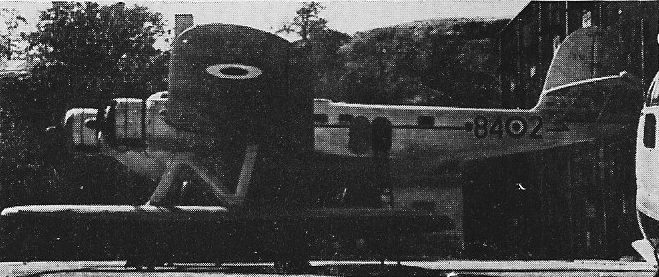
The Z.506B was employed primarily far maritime reconnaissance, bombing and torpedo attacks on shipping around Italy’s coasts. The Z.506S was an ambulance and air-sea rescue version built by Piaggio. The Airone largely replaced the earlier Z.501 single-engined high-wing flying- boat, although some of these obsolescent machines were operated throughout the war.
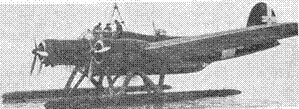
CRDA Cant C. 506 Airone
Engine: 3 x Alfa Romeo 126 RC 34, 740 hp
Length: 63.156 ft / 19.25 m
Height: 24.278 ft / 7.4 m
Wingspan: 86.942 ft / 26.5 m
Wing area: 936.468 sqft / 87.0 sqm
Max take off weight: 27121.5 lbs / 12300.0 kg
Weight empty: 18301.5 lbs / 8300.0 kg
Max. speed: 197 kts / 365 km/h
Cruising speed: 175 kts / 325 km/h
Service ceiling: 26247 ft / 8000 m
Wing load: 28.91 lb/sq.ft / 141.0 kg/sq.m
Range: 1482 nm / 2745 km
Armament: 2x MG 7,7mm, 1x MG 12,7mm, 1200kg Bomb. / Torp.
 All Aero