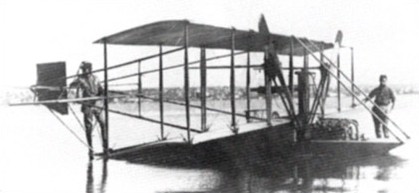
The first Curtiss flying-boat, tried at San Diego on 10 January, 1912, was more a hydro than a true boat. A wide flat-bottomed hull, only slightly longer than the standard Curtiss pontoon, was attached under the lower wing of the de-engined airframe of the tractor seaplane with Type D wings and tailplane. A single 60hp engine was mounted in the hull and drove two tractor propellers through chains in Curtiss’s only deliberate adaptation of a Wright brothers’ feature. There were two side-by-side seats in a cockpit behind the wing. Although No.1 was unable to take off, the experiment did indicate that the flying-boat concept was practicable. Subsequent developments were made at Hammondsport.
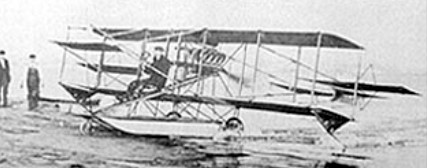
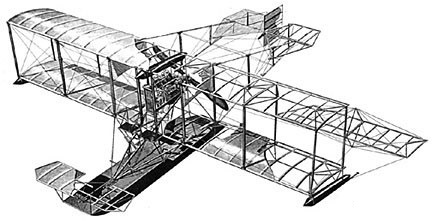
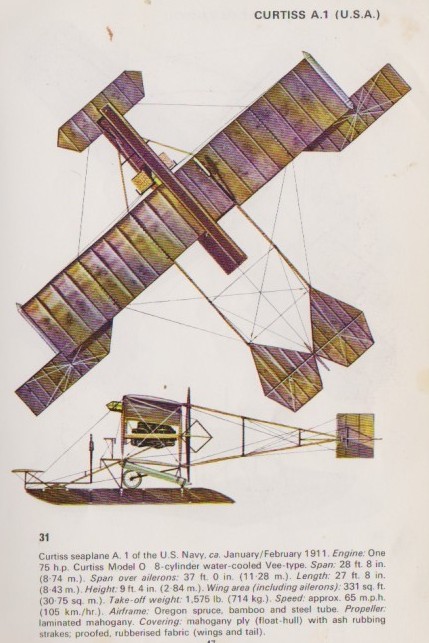
In February 1911, Curtiss introduced the Triad seaplane, which had both wheels and floats.
The Triad A-1 first flew on July 1, 1911, piloted by Curtiss, for a five minute flight at 25′ AGL, and was the US Navy’s first airplane (later being designated AH-1) for $4,400.
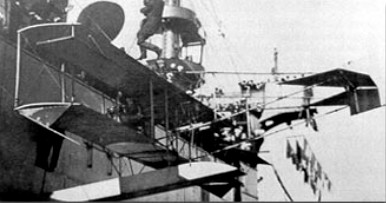
The A-1 was used in a variety of aerial “firsts”—first cross-country flight, 112 miles in 122 minutes; first (albeit unsuccessful) catapult launch (On 31 April 1912); first night landing on water without lights. It also set a world seaplane altitude record of 900′, and completed 285 flights.
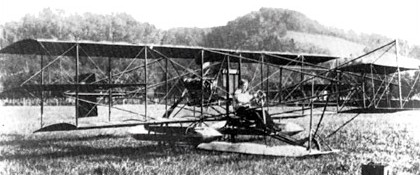
Curtiss A-1 USN Lt T S Ellyson
The Triad was sold to the British, Russian, German and Japanese navies in 1912. The Japanese naval aviation was founded with the purchase of three Curtiss Triads. In 1912, Curtiss won the Robert Collier Trophy for his development of the seaplane.
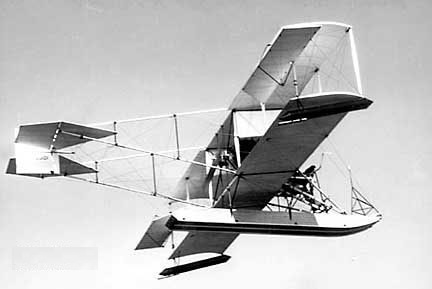
A faithful replica was built by a group of fans in San Diego c.1956.
Curtiss A-1 Replica
Reconstruction during take off
A-1 Engine: 1 x 75 hp Curtiss V-8 Max Take-off weight: 715 kg / 1576 lb Empty weight: 420 kg / 926 lb Wingspan: 11.28 m / 37 ft 0 in Length: 8.71 m / 28 ft 7 in Height: 2.69 m / 8 ft 10 in Wing area: 26.57 sq.m / 286.00 sq ft Max speed: 97 km/h / 60 mph Cruise: 40 mph Range: 112 mi Seats: 2
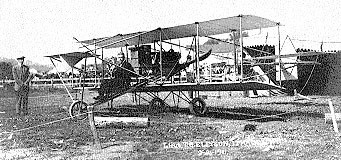
In 1909, Glenn Curtiss decided to try for the $10,000 prize posted by the New York World newspaper for the first flight between Albany, the capital city of New York State, and New York City. After many delays due to weather, the record 251km flight was made on 29 May, 1910. The start was at Albany, with a refuelling stop at Poughkeepsie and a precautionary stop within the northern city limits of New York before the final landing on Governor’s Island. The Hudson Flyer was a stock model Curtiss or the period, modified for the flight. As the entire route was over the Hudson, emergency flotation gear was added. To preclude nosing over on alighting on water, a hydrovane was installed ahead of the nosewheel at the suggestion of Charles Willard, who had made two unintentional alightings in the Golden Flyer. To carry the weight or the extra equipment and fuel, the area of the upper wing was increased by adding strut-braced extensions to the tips.
Curtiss also worked on developing the seaplane, basically a land plane with floats instead of wheeled landing gear. His first seaplane, based on the Model D was manoeuvrable, light, and relatively fast, and was the most widely built type of plane in the United States before World War I.
The D Hydro was a standard, Curtiss-designed 60 hp Type D pusher landplane fitted with a single, flat- bottomed spruce hull built locally by Baker Machine Co. Built and flown by Glenn Curtiss from San Diego Bay on 26 January, 1911, the first practical seaplane.
Curtiss and his hydroplane being hoisted aboard the USS Pennsylvania in San Diego harbour, 1911.
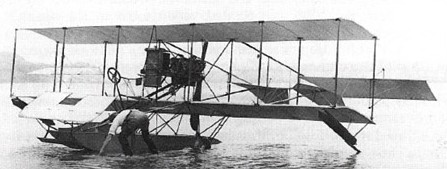
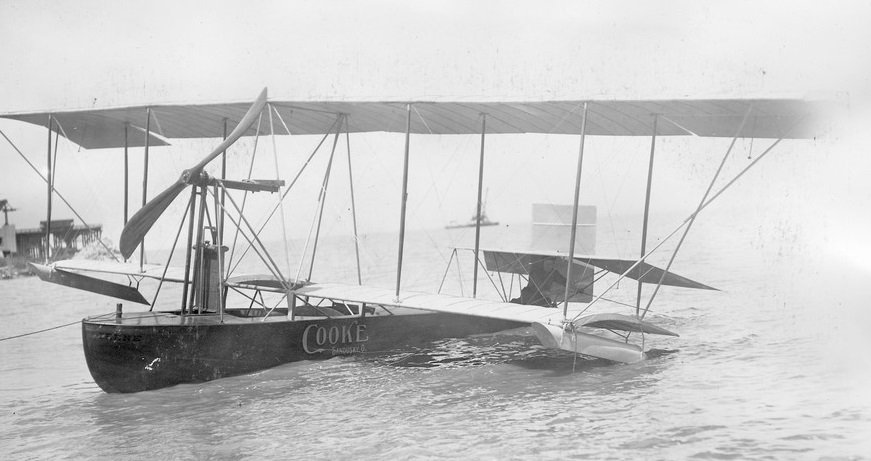
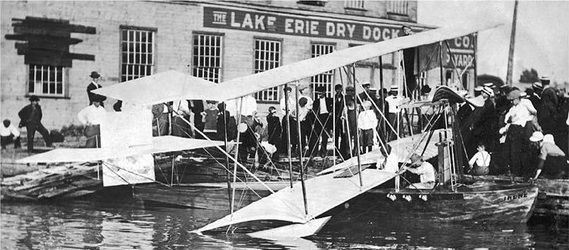
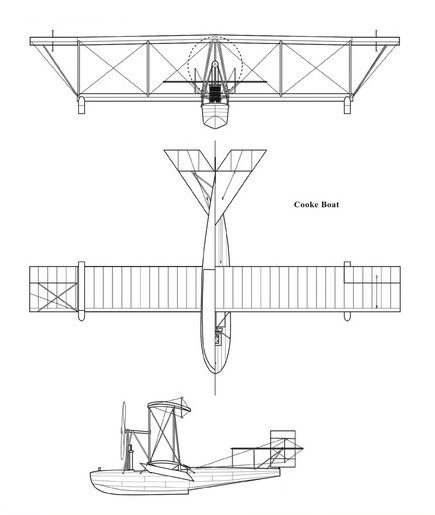
Weldon B. Cooke, an early pioneer who taught himself to fly in a Curtiss pusher, started construction of a flying boat project in California.
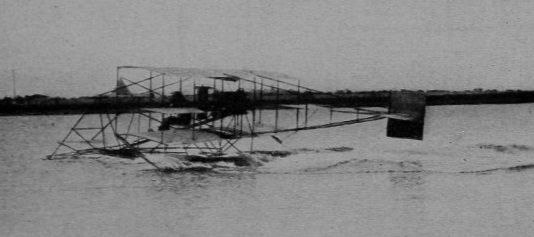
The craft’s biplane wings rested on a full length boat hull that ended in a tail group supported by struts. Its single tractor propeller, mounted forward of the wing, was driven by a belt running from a 75-hp Roberts engine. Sometime in 1913, Cooke shipped the parts by rail to Sandusky, Ohio, where the aircraft was completed and flown.
Although the “Irene,” depicted in this image, suffered from design and construction flaws, she became famous locally when Cooke raced her against C. B. Lockwood’s motorboat “Chinook.” Cooke attained speeds of 35 miles per hour in the water and 50 miles per hour in the air. Lockwood’s fast motor boat reached a speed of 23 miles per hour.
Shortly after Reuben Fleet sold his interest in Consolidated Aircraft Corporation in March 1943 and the company was reorganised as Consolidated Vultee (Convair), the US Navy expressed interest in a new long-range multi-role flying-boat.
Convair’s proposal was for an aircraft powered by four turboprop engines, was the subject of a contract for two prototypes, awarded on 27 May 1946. Designated XP5Y-1, the new aircraft featured a slim fuselage for an aircraft of this class with a length-to-beam ratio of 10 to 1. it was powered by four Allison T40-A4 turboprops, each driving two contra-rotating, reversable propellers through a common gearbox. The type’s main role was anti-submarine warfare, and it was to have been fitted with advanced radar, ECM and MAD equipment in addition to carrying a heavy load of bombs, mines, rockets and torpedoes. The first aircraft was flown from San Diego on 18 April 1950, and in August the type set a turboprop endurance record of 8 hours 6 minutes. August was an eventful month for the XP5Y-1 as the US Navy decided to discontinue its development for maritime patrol, but to persevere with the basic design for use as a passenger and cargo aircraft.
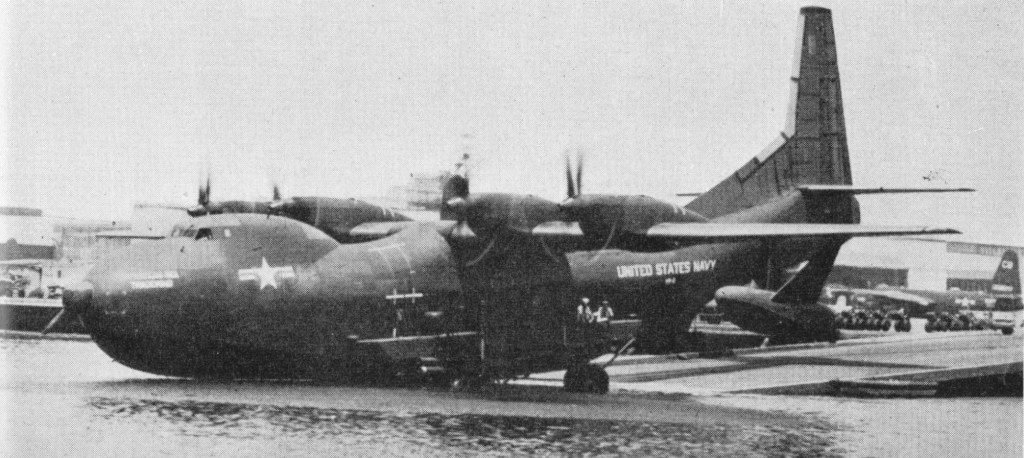
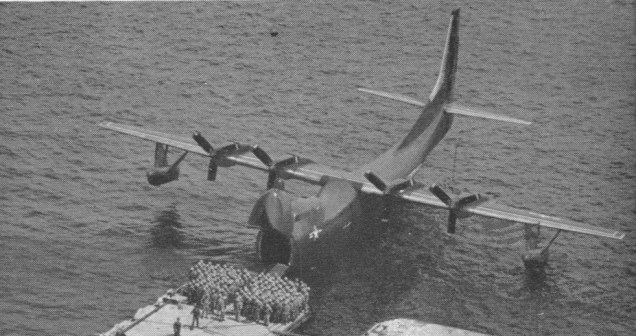
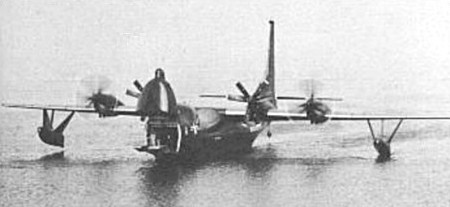
Convair R3Y-1 Tradewind
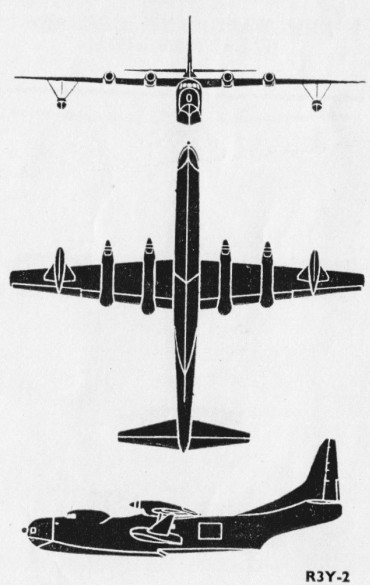
Work continued, despite the loss of an XP5Y-1 in a non-fatal crash off San Diego in 15 July 1953 and the first R3Y-1 Tradewind flew on 25 February 1954. Major changes included the deletion of all armament and of tailplane dihedral, the addition of a 3.05m wide port-side cargo hatch aft of the wing and the provision of redesigned engine nacelles to accept the improved T40-A-10 engines. Cabin sound-proofing and air-conditioning were installed and pressurised accommodation provided for up to 103 passengers or, in medevac configuration, for 72 stretcher cases and 12 attendants; cargo payload was 24.4 tonnes (24 tons). The R3Y-1 was a straight transport version, the R3Y-2 was the assault transport version with the hinged nose. It could also refuel jets in flight using two or four wing pods. The R3Y-2 had a nose loading door and integral hydraulic ramps. The opening door blocked the pilots’ forward view during beach operations. The R3Y-1 ‘s performance was demonstrated on 24 February 1955 when one of the five aircraft built flew coast-to-coast at an average speed of 649km/h on delivery to the Navy Test Center at Patuxent River, Maryland. Similarly, on 18 October a 6 hour 45 minute record flight at an average 579km/h was accomplished between Honolulu and NAS Alameda, California. US Navy transport squadron VR-2 received the first of its mixed fleet of R3Y-1 and R3Y-2 flying-boats on 31 March 1956, but financial considerations and continuing problems with the engine/propeller combination, culminating in two in-flight separations of propellers and gearbox from an engine (on 10 May 1957 and on 2 January 1958), led to a curtailment of Tradewind operations. Squadron strength was first cut to two R3Y-1s and two R3Y-2s and the unit was finally disbanded on 16 April 1958.
R3Y-2
R3Y Engines: 4 x Allison T40-A-10 turboprops, 4362kW, 5500 shp Max take-off weight: 74843-79379 kg / 165001 – 175002 lb Payload: 21750kg / 47951 lb Wingspan: 44.42 m / 145 ft 9 in Length: 42.57 m / 139 ft 8 in Height: 13.67 m / 44 ft 10 in Max. speed: 580 km/h / 360 mph Cruise speed: 480 km/h / 298 mph Range w/max.fuel: 6437 km / 4000 miles Crew: 5 Passenger Capacity: 80 or 24 ton.
R3Y-1 Engines: 4x 5,500 h.p. Allison T40-A-4 coupled turboprops. Wingspan: 145 ft Length: 142 ft. 6 in Loaded weight: 160,000 lb Max. speed: 392 mph Range: 4,500 miles at 300 mph Accommodation: 103 troops, 92 stretchers and 12 attendants or 24 tons of cargo.
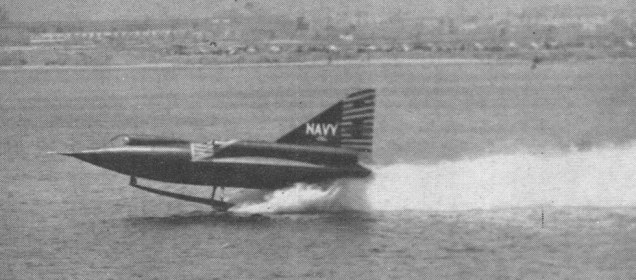
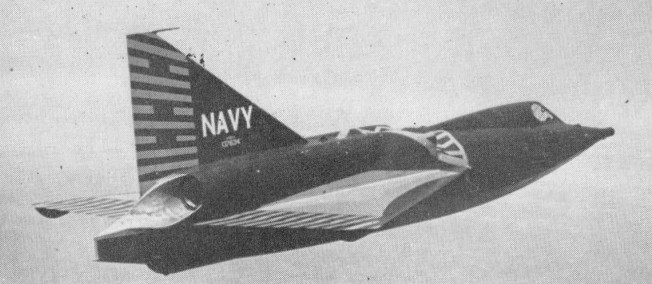
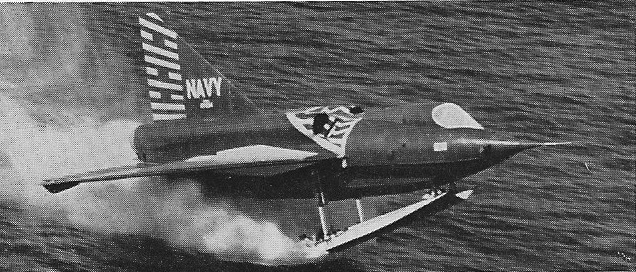
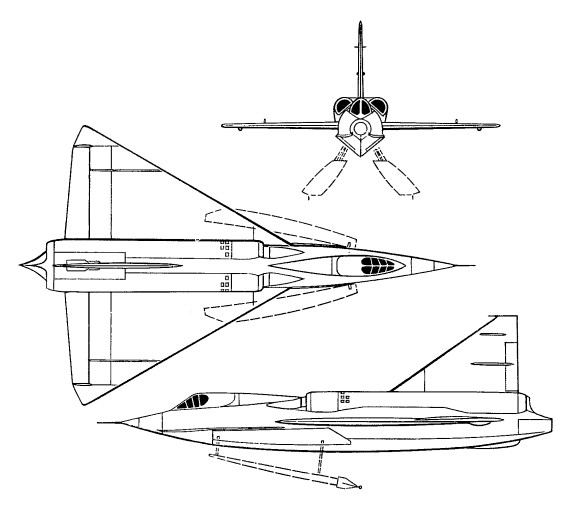
Convair was selected to produce a waterplane interceptor, and the result was XF2Y Sea Dart. The company was instructed to investigate the ‘blended hull’ concept, in which the hull rode so low in the water that the wings provided part of the required buoyancy until the aeroplane had accelerated sufficiently to rise onto a planing bottom, while the National Advisory Committee for Aeronautics (from 1958 the National Aeronautics and Space Administration) investigated the hydro-ski concept. When extended, the hydro-skis lifted the accelerating aeroplane onto the surface of the water, where the skis planed and so allowed the aeroplane to reach take-off speed; and when retracted they formed the lower surface of the fuselage without creating any drag.
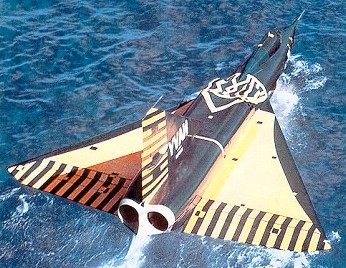
The inlets for its two 3400-lb (1542-kg) thrust Westinghouse J34-WF-32 turbojets located in the dorsal position where they would be shielded from spray.
YF2Y-1
The concept embodied in the Convair Model 2-2 proposal was sufficiently interesting for the US Navy to award a contract for a prototype XF2Y-1 on 19 January 1951, followed by an order for 12 production F2Y-1 fighters on 28 August 1952; to this was added subsequently four YF2Y-1 pre-production aircraft.
First flown on 9 April 1953, the prototype offered performance much below expectations and this factor, coupled with serious vibration problems with the hydro-skis, led to the XF2Y-1 and the production F2Y-1s being cancelled.
During test runs there was considerable vibration and pounding from the two hydro-skis and these were replaced by a single V-shaped ski. More power was needed than the 1542kg thrust provided by each of the Westinghouse J34-WE-32 turbojets installed in the prototype and the first YF2Y-1. This latter aircraft was re-engined with two J46-WE-2s, the rear fuselage being modified to accommodate the engine afterburners and the same powerplant was installed in the remaining three YF2Y-1s. On 3 August 1954 the YF2Y-1 exceeded a speed of Mach 1 in a shallow dive, the first seaplane to become supersonic, but only two of these aircraft were used in a limited test programme that was terminated finally during 1956.
YF2Y Sea Dart Engines: 2 x Westinghouse J46-WE-32, 2722kg Wingspan: 10.26 m / 33 ft 8 in Length: 16.03 m / 52 ft 7 in Height: 6.32 m / 20 ft 9 in Wing area: 52.30 sq.m / 562.95 sq ft Max take-off weight: 7495 kg / 16524 lb Empty weight: 5739 kg / 12652 lb Max. speed: 1118 km/h / 695 mph Ceiling: 16705 m / 54800 ft Range: 826 km / 513 miles Crew: 1
YF2Y-1 Engines: 2 x Westinghouse J46-WE-8 turbojets, 4,800 lb. thrust Wingspan: 30 ft. 6 in Length: 41 ft. 2 in Loaded weight: approx. 22,000 lb. Armament: 4×20 mm. cannon Crew: 1.





 All Aero