USA Formed at Sun Valley, California, in late 1950s to produce modified version of Grumman Widgeon amphibian known as Super Widgeon and powered by two 300 hp Lycoming engines. Company used SCAN 30 airframes (license-built in France) for initial conversions.
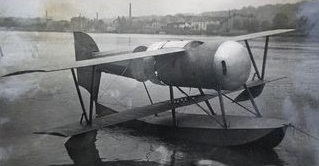
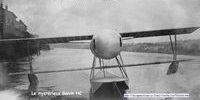
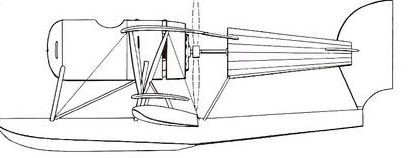
The Galvin HC, where HC stands for Hydravion de Chasse (Seaplane Fighter) is from France with a mid-fuselage propeller. The Gnome rotary engine of 160 hp was mounted in the fuselage.
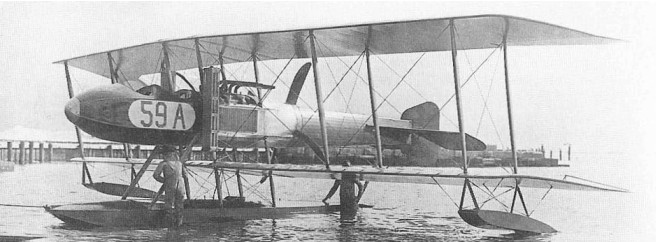
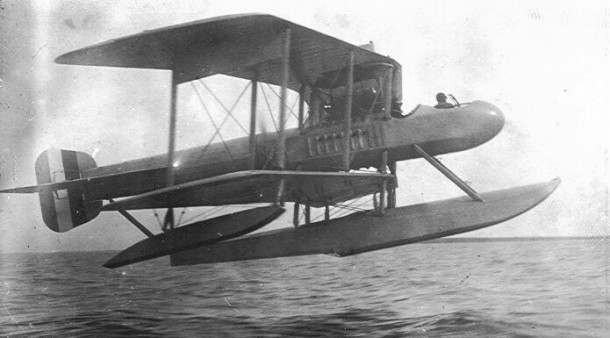
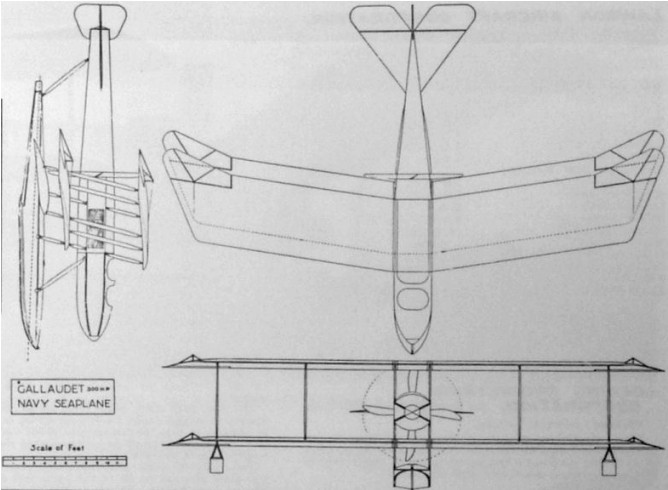
In an effort to produce an aircraft with the best possible forward visibility for the observer, Gallaudet developed the D-2 into the D-4, which placed the observer in the nose, followed by the pilot, with the propeller attached to a ring that circled the fuselage behind the wings. The four blades spun around the fuselage just behind the pilot.
Power for the D-4 was a 360-hp Liberty L-12 engine buried within the fuselage, just behind the pilot. A large pontoon was mounted below the fuselage, and small outboard floats were mounted near the tips of the swept-back wings.
Two D-4 were built for the Navy (A2653, A2654). The prototype crashed during flight testing on 19 July 1918, but the second was accepted by the U.S. Navy. No further aircraft were built, as Gallaudet turned their attention to constructing Curtiss HS-2L flying boats.
Engine: 1 × Liberty L-12, 360 hp ( kW) each Wingspan: 46 ft 5 in ( m) Wing area: 260 sq.ft ( sq.m) Length: 33 ft 6 in ( m) Height: 11 ft 8 in ( m) Empty weight: 4,228 lb ( kg) Gross weight: 5,440 lb ( kg) Maximum speed: 119 mph ( km/h) Range: 390 miles (628 km) Endurance: 3 hr 30 min Service ceiling: 14,000 ft Crew: 2 (pilot, observer) Armament: None
The Gallaudet #1 of 1911 was an open cockpit monoplane with a single float. The 125hp Emerson Aerial engine was mounted amidships turning two props, one at the nose and one at the tail.
Designed by Edson Gallaudet, only one was built, which made test flights only.
A single place, open cockpit biplane Curtiss-type pusher.
One was built for exhibition use by Roy Francis and later, reportedly, one tractor version for Francis and Frank Bryant to share.
Gage-Fowler 1912
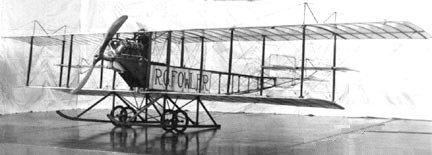
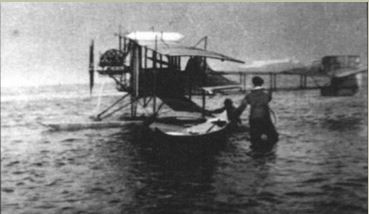
This tractor biplane is more familiar as a land plane, as it is displayed in the Smithsonian, now with a Curtiss engine in place of its original Hall-Scott. It is often referred to as the Fowler-Gage, in recognition of its owner and pilot, Robert G. Fowler. Beginning in October 1912, Fowler made numerous exhibition and passenger flights in California. He made his most famous flight in the airplane in 1913, flying ocean-to-ocean across Panama. With the Gage now on floats, Fowler started his Isthmus of Panama crossing with a takeoff from the Pacific side at 9:45 a.m. on April 27. He completed the 83 km (52 mi) flight in one hour and 45 minutes, landing with his passenger/cameraman, R.E. Duhem, at Cristobal at 11:30 a.m.
A twin-float reconnaissance seaplane introduced November 1914 for coastal patrol and fighter versions. Replaced by FF 49, with more powerful Benz Bz IV engine, introduced in May 1917.
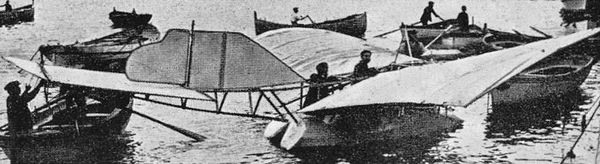
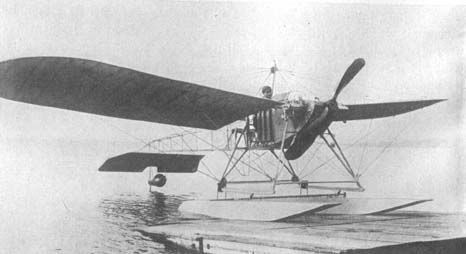
A 1913 development of the floatplane of the Swiss engineer Grandjean, who had patented floats with coils (in German: “Schwimmerabfedering”). Characteristic of this wing warping monoplane is its Orlikon engine of 50 hp, radiators at the fuselage sides and completely open fuselage behind the pilot seat.
Designed to Netherlands naval air service specifications for a torpedo-bomber/reconnaissance aircraft suitable for home and the Netherlands East Indies service, the Fokker T.VIII-W floatplane was built in three versions. The T.VIII-Wg was of mixed wood and metal construction, the T.VIII-Wm was all metal and the T.VIII-Wc, a larger version of mixed construction.
An initial order for five aircraft was placed, and all were completed by June 1939, when a further batch of 26 was ordered, most of them intended as replacements for T.IVs in the East Indies, but none was delivered there. A total of 36 T.VIII-Ws was built, these comprising 19 T.VIII-Wgs, five T.VIII-Wcs and 12 T.VIII-Wms, the difference of five being accounted for by a Finnish order which was not delivered. These were of the T.VIII-Wc variant which had a 1.83m longer fuselage, 2.01m increase in wing span, an additional 8.00sq.m of wing area, and power provided by 664kW Bristol Mercury XI engines. In the event, the Fokker factory was overrun by the Germans before completion of this order, but the aircraft were finished and subsequently delivered to Germany along with 20 ex-Netherlands navy aircraft. A one-off landplane variant, the T.VIII-L built for Finland, was also seized by the Germans. Eight T.VIII-Ws had been flown to England along with other Dutch floatplanes on 14 May 1940, and on 1 June 1940 No. 320 (Dutch) Squadron RAF was formed at Pembroke Dock, to operate the T.VIII-Ws on convoy escort work. These aircraft carried RAF markings, plus a small Dutch triangle badge. Three of the aircraft were lost, and with no spares available the remaining aircraft were flown to Felixstowe for storage. They were joined by another in May 1941, when four Dutchmen escaped from Amsterdam and brought their T.VIII-W down on the sea near Broad-stairs. German navy operations with their group of T.VIII-Ws were confined mostly to patrol work in the Mediterranean.
T.8-Wg Engine: 2 x Wright Whirlwind R-975-E3, 336kW Max take-off weight: 5000 kg / 11023 lb Empty weight: 3100 kg / 6834 lb Wingspan: 18.0 m / 59 ft 1 in Length: 13.0 m / 42 ft 8 in Height: 5.0 m / 16 ft 5 in Wing area: 44.0 sq.m / 473.61 sq ft Max. speed: 285 km/h / 177 mph Cruise speed: 220 km/h / 137 mph Ceiling: 6800 m / 22300 ft Range: 2750 km / 1709 miles Armament: 2 x 7.9mm machine-guns, 605kg of bombs or one torpedo Crew: 3 Passengers: 6
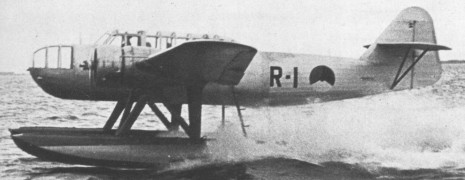
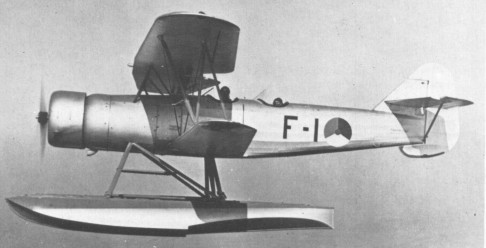
The prototype XIVW. This two‑seater floatplane was designed for the Naval Air Service as a successor to the C.VIIW and 24 were delivered before the outbreak of World War Two.


 All Aero