The Goodyear Aircraft Corporation began to design a small light amphibian before the end of the Second World War. The prototype designated GA-1 first flew in September 1944. It was a cantilever high-wing monoplane with underwing stabilizing floats. The GA-1 had an all-metal fabric-covered wing, an all-metal single-step hull, and a cruciform tail unit. It had a retractable tail-wheel, accommodation for two, and a pylon-mounted piston engine with a pusher propeller. Originally powered by a 107 hp (80 kW) Franklin 4ACG-100-H3 piston engine, later fitted with a 125 hp (93 kW) Franklin 6A engine.
After successful testing of the prototype, 18 demonstration aircraft were built. These differed from the prototype in that they had room for the pilot and two passengers. Two versions were built, the GA-2 with a 145 hp (108 kW) Franklin 6A4-145-A3 piston engine, and the GA-2B with a 165 hp (123 kW) Franklin 6A4-165-B3 flat-six piston engine.
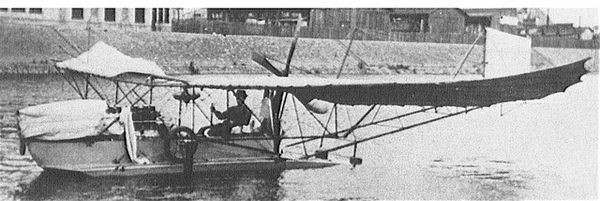
The second Amphibium, or “Amphibium II”, constructed by the Jacob Goedecker Flugmaschinen-Werke in 1912. At the end of August 1912 Goedecker flyer Bernard de Waal took the newly developed “Amphibium” to the First German Seaplane Competition in Heiligendamm district. Due to technical problems the Goedecker flying boat achieved only 4th place in a field of 6 participants. A second flying boat with a more powerful engine was built and tested at the Mainzer Floßhafen, and stationed in a boathouse. In a strong storm on April 6, 1913, the “Amphibium II” was severely damaged and scrapped.
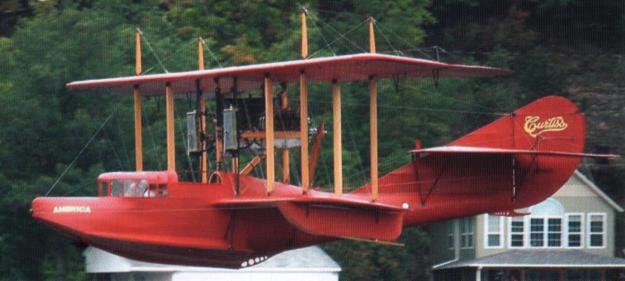
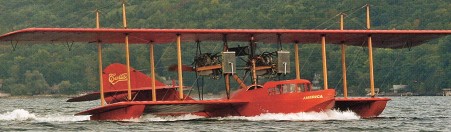
Construction of the replica Curtiss H-1 America began in the spring of 2004 and a total of 6000 man hours went into the construction at the Glenn H. Curtiss Musem at Hammondsport, New York. It has been built using the same materials as the originals with the exception of the glue and fabric covering. At Keuka Lake, New York, attempts were made to fly the replica but despite rigging changes and engine tuning it refused to fly.
The engines were then changed from the 90 hp OX-5 units to counter rotating OXX-6 of 100 hp. The aircraft then flew at Keuka Lake, New York on 13-14 September 2007, piloted by Jim Poel.
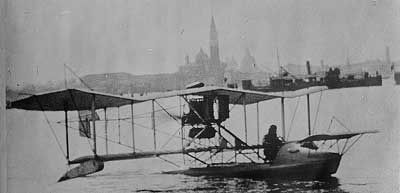
Ginocchio biplane flying boat seen here in 1913 at Venezia (Venice)
Manlio Ginocchio was an Italian aviation pioneer, and an officer in the Italian Navy. After earlier experiences with flying and designing of machines, he designed and built his “Idro-canotto” and powered it with a 90 hp Salmson engine. The machine was not very successful and remained in one example, although it was acquired by the Italian Navy and became part of the early Italian naval establishment in Venice.
Manlio Ginocchio was an Italian aviation pioneer, and an officer in the Italian Navy. After earlier experiences with flying and designing of machines, he designed and built his “Idro-canotto”
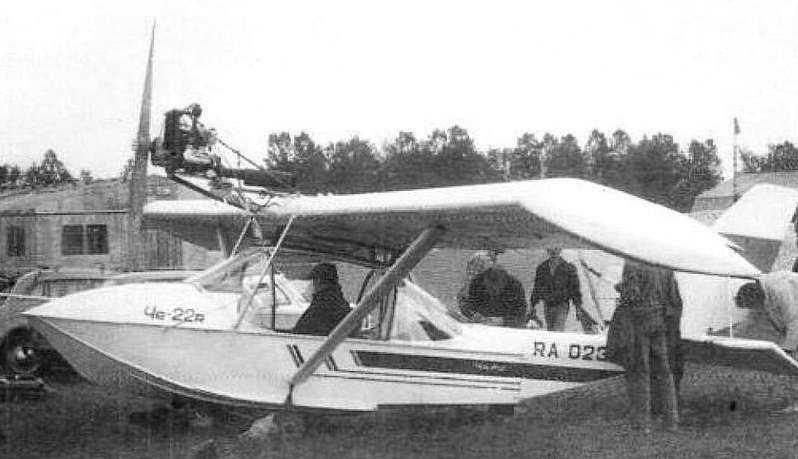
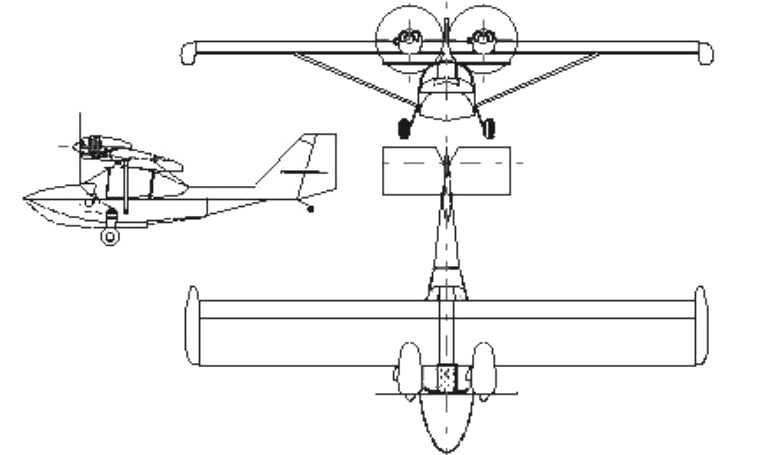
The Gidroplan Che-22 Korvet (English: Corvette) is one of several parasol wing light flying boat Boris Chernov designs of similar appearance, stemming immediately from the Che-20.
Che-22
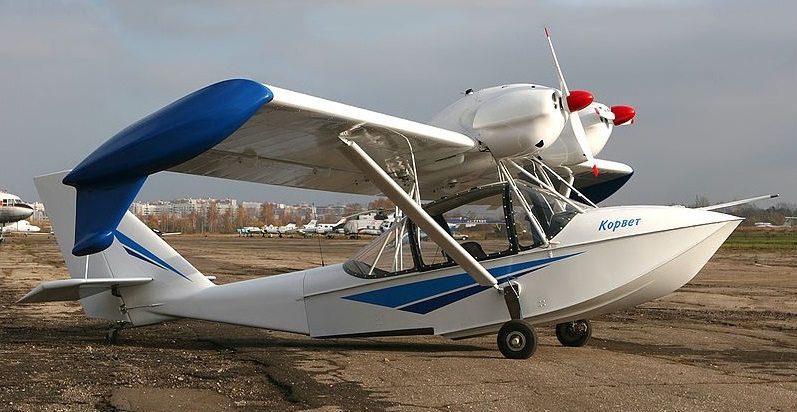
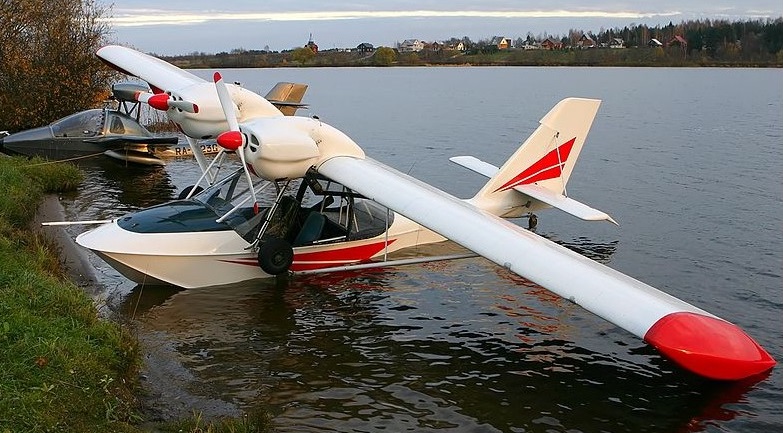
The wing of the Korvet has no sweep and is of constant chord, with 1.5° dihedral; its thick airfoil section has a thickness-to-chord ratio of 0.15. It is a single spar, riveted duralumin covered structure, apart from its full span slotted flaperons, which are fabric covered, and GFRP sandwich, down turned, buoyant wing tips which support the wings when the aircraft is moored. Later aircraft have remodelled tips which include integral miniature float bodies to provide stability at speed on the water; they may also have separate flaps and ailerons. The wing is braced to the mid-fuselage by a single streamlined strut on each side, with the assistance of jury struts. Cabane struts carry the wing over the cabin. The tail unit is a GFRP structure with a straight edged, tapered, swept fin and balanced rudder which carries the unswept, straight edged tailplane, braced from above, a little above the upper fuselage line. The elevators are split by the rudder; the port surface has a trim tab.
The three-seat Che-22 Korvet made its first flight in 1993 and achieved certification in December 2001, with significant structural, control and instrumentation revisions made along the way. It proved successful, with 80 completed by January 2011. Since 1995 Chernov’s designs have either been built by the Gidroplan (Hydroplane) Company or by Gidrosamolet.
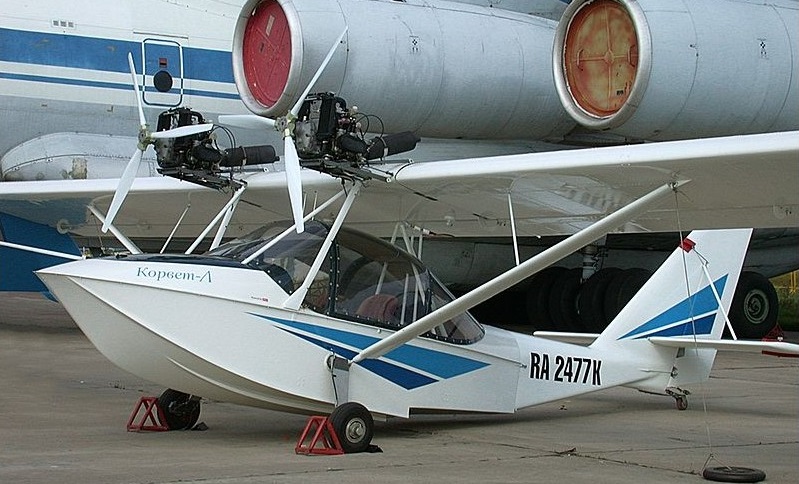
Korvet-L
Different variants of the Korvet have been fitted with several different engine types; some have a single engine and some are twins. In all cases the engines are mounted over and above the wing leading edge. Twins have their engines as close together as the 1.5 m (59 in) propellers diameters will allow. Most engines have been from the Rotax range: the 37 kW (49.6 hp) Rotax 503 UL-2V and the 47.8 kW (64.1 hp) Rotax 582 UL two cylinder two strokes, the first air-cooled and the latter with mixed air and water cooling, and the 59.6 kW (79.9 hp) Rotax 912 UL water-cooled flat four. The 59.7 kW (80.1 hp) Jabiru 2200 has also been fitted. Some drive two blade propellers, though others have three blades.
The Korvet’s fuselage is a flat sided, two step hull design, built from GFRP. The cabin is completely enclosed in a blister canopy which is all transparent apart from the underwing roof, giving all round views. Entry is by upward canopy sections on each side. The flying boat can be equipped as an amphibian with short spring cantilever legs with small mainwheels, the legs rotating through 90° for water touch-downs. There is a small tailwheel below the rudder. Skis are another option.
The first delivery of a Korvet was in 1990, when a pre-production aircraft went to a forest control organization. The first production aircraft flew in 1993, four years after the prototype. After receiving Russian certification at the end of 2001 and JAR/FAR certification a few months later, the Korvet sold quite well, with 60 built by the end of February 2002. An early Korvet 582 was sold in the Philippines, then bought by the Vietnamese and used as a model for the locally built A41 Factory VNS-41. Two Korvet-Js went to Cuba in military markings in 2008. Another Korvet-J was equipped for Earth resource survey with large underwing aerials; after successful trials these aerials were internally accommodated. By January 2011, eighty had been sold, the latest to Costa Rica. Of the eighty built, seventeen were Jabiru powered.
Korvet-L
As well as selling flyaway aircraft, Gidroplan also sell kits in different stages of finish.
Che-22P1 Engine: One Rotax 582
Korvet 503 (Che-22P2) Engines: Two Rotax 503 UL Discontinued by 2013
Korvet 582 (Che-22RS) Engines: Two Rotax 582 UL Precursor to the Korvet-L
Korvet 912 (Che-22D) Engine: One Rotax 912 UL Discontinued by 2013
Korvet-J Engines: Two Jabiru 2200 Tip floats as Korvet-L Flown by 2003
Korvet-L (Che-22RS) Engines: 2 × Rotax 582 UL, 47.8 kW (64.1 hp) Propellers: 2-bladed, 1.50 m (4 ft 11 in) diameter fixed pitch Wingspan: 10.53 m (34 ft 7 in) Wing area: 16.40 m2 (176.5 sq ft) Airfoil: TsAGI P-IIIA Length: 7.25 m (23 ft 9 in) Height: 2.40 m (7 ft 10 in) Max takeoff weight: 675 kg (1,488 lb) Fuel capacity: 100 L (22.0 Imp gal; 26.4 US gal) Optional enlarged tanks 130 L (28.6 Imp gal; 34.3 US gal); fuel weight 58 kg (127 lb). Maximum speed: 159 km/h (99 mph, 86 kn) Cruise speed: 130 km/h (81 mph, 70 kn) Range: 450 km (280 mi, 240 nmi) Service ceiling: 3,000 m (9,800 ft) g limits: +3.8/-1.5 Rate of climb: 7.0 m/s (1,380 ft/min) Take-off run on land: 80 m (262 ft) Take-off run on water: 90 m (295 ft) Crew: One Capacity: Two passengers Static buoyant tips revised to include miniature hydrodynamic float extensions Flown by 2003
Korvet single Engine: One Jabiru 2200 Propeller: three blade Flown by 2008
Korvet Kabriolet Engine: one Jabiru 2200 Open cockpit version, under development in 2010
Refly Pelican Appeared at Oshkosh 2000, but not authorised by Gidroplane Engine: Two Rotax 582 UL
Chernov Che-23 Two seat version, 75 mm (3.0 in) shorter and 170 kg (375 lb) lighter empty than the similarly powered Korvet 912. Raised tailplane; combined tailwheel and water rudder just aft of rear step. One Rotax 582 UL or 912 UL; three blade propeller.
Russia Redan was founded 1992 but known as Gidroplan since 1995. Producing Che- 22 three-seat amphibious flying-boat (first flown 1992), developed from the single example of the Boris Chernov Che-20 two-seat homebuilt prototype that was tested 1989-1992. Che-25 four-seat derivative of Che-22 first flown 1996 but not selected for further production. Has also developed the Tsykada twin-engined very light agricultural monoplane.
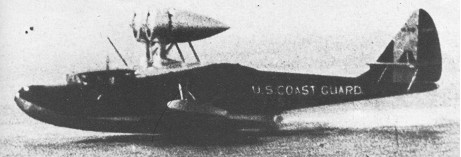
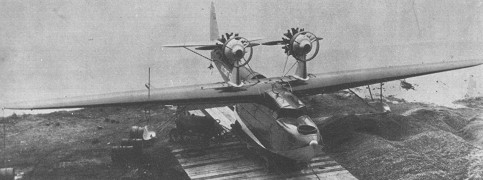
A PJ 2 of the US Coast Guard was converted by the Naval Aircraft Factory from a PJ 1, with pusher propellers, to the PJ 2 tractor. All PJs were equipped with an undercarriage to enable them to beach under their own power.
Fokker was the winner of a competition instigated by the US Coast Guard for an FLB (Flying Boat) for patrol and rescue in the open sea. The PJ-1 flying boat developed from the B.4A amphibious aircraft. Because the American Fokker Factory was owned by the General Aviation Corp, at that time, the five flying boats ordered were designated GA 15, and the Coast Guard designation was PJ 1. They had a four man crew and were equipped with two 420 h.p. Wasp engines driving pusher propellers. The first aircraft was converted by the Naval Aircraft Factory to PJ 2, with tractor propellers. All PJs were equipped with an undercarriage to enable them to beach under their own power. The PJ flying boats the last Fokker aircraft built in America until 1958.
 All Aero