In 1922 and after a break of 5 years DP Grigorovich returned to aircraft construction with the development of more powerful versions of the successful Grigorovich/Schetinin M-9. Grigorovich considered that for a more powerful engine it would be necessary to increase the structural rigidity, which would entail a reinforcement of the fuselage and the need to modify the lines of the hull, but despite this he decided to continue the development of the already recognized model with the main objective to be able to interest new customers and quickly secure a new position in the aeronautical industry.
At that time, Grigorovich had not yet been able to put together a work team and lacked the facilities to develop it, so the design work began in his apartment in Moscow. He would soon invite old collaborators to his side, among them the engineers MM Shishmariov, Ye. I. Mayoranov and V. L. Korvin-Kerber.
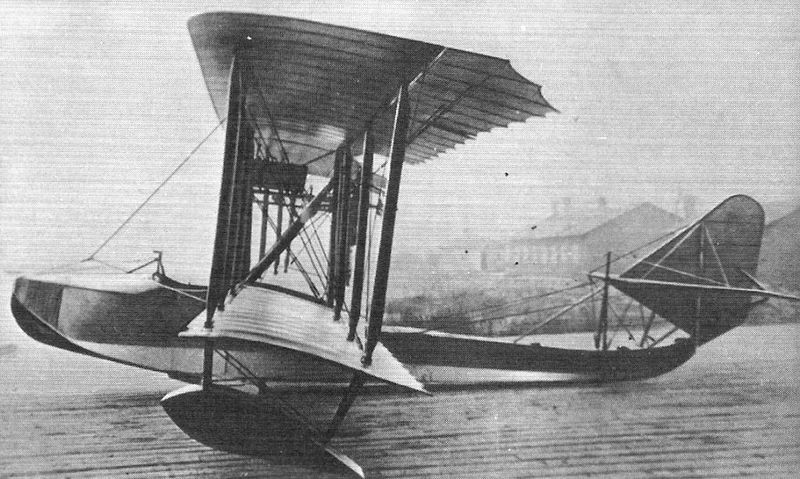
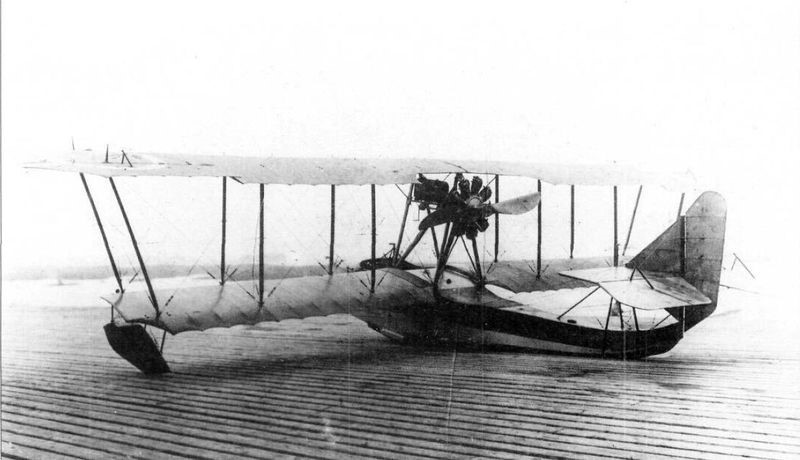
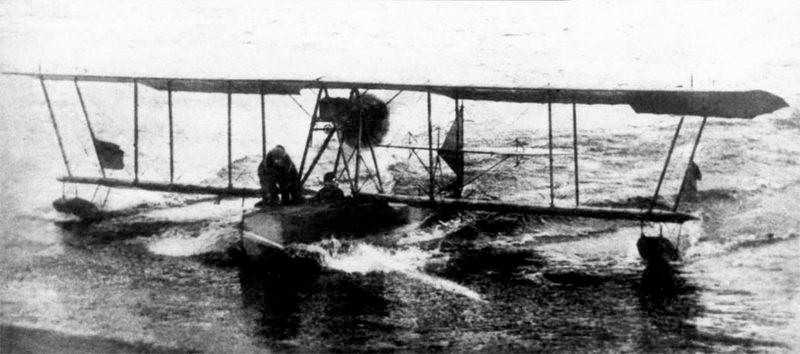
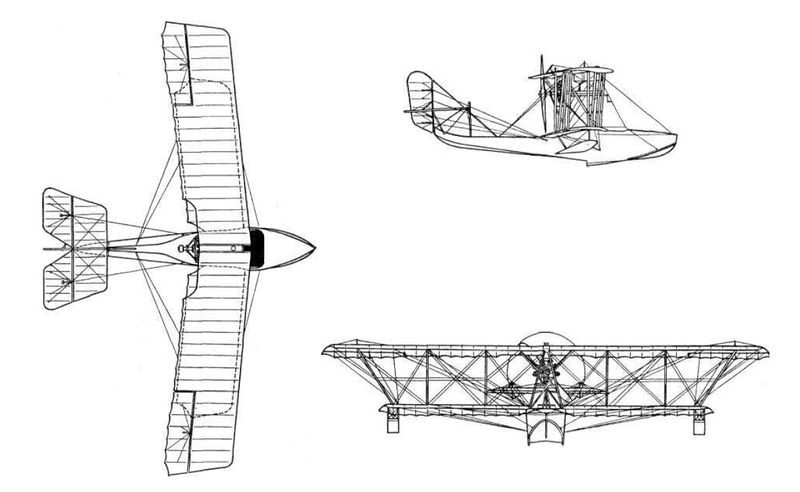
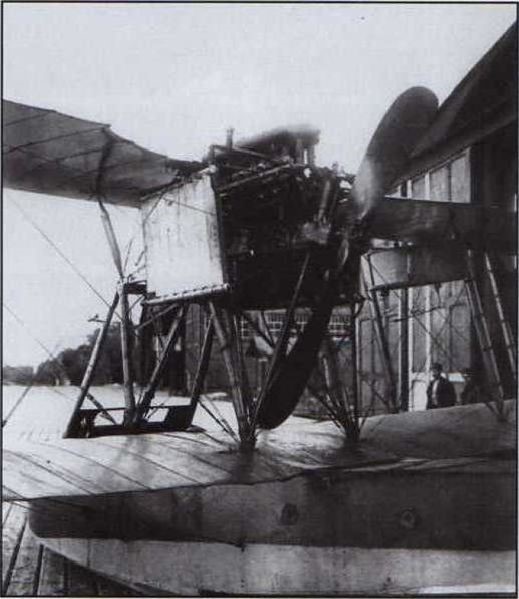
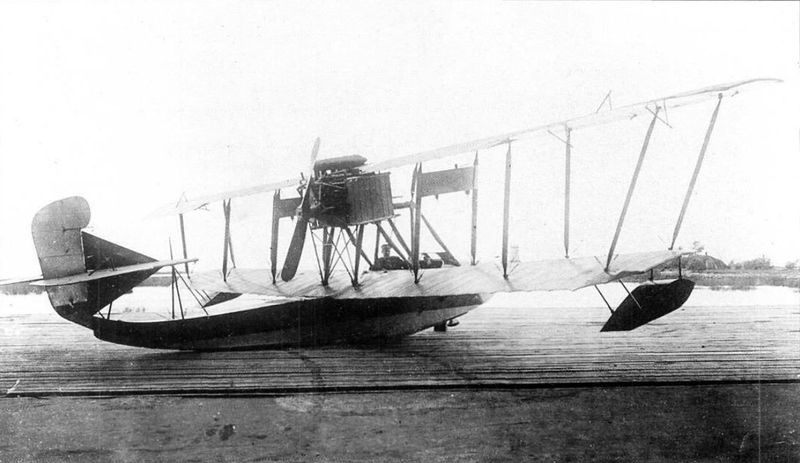
The M-23 (Russian: Григорович М-23) was an interim development of the M-9 line with a new power plant. The initial model project was completed by mid-1923 but was soon abandoned in favour of a modified version designated M-23bis.
The M-23bis was built at the GAZ No.3 “Krasni Liotchik” in Petrograd in the middle of the summer of 1923. During the tests the model refused to take off from the water. The analyses showed that it was a design error of the bow and contour lines of the hull, so the flying boat was stored pending the necessary modifications, but at the end of the year it was destroyed during a flood that occurred in the hangars on Krestovsky Island.
M-23bis Power plant: 1 Fiat, 280 hp Wingspan: 12.5m Wing area: 45.8 m² Empty weight: 1165 kg Takeoff weight: 1615 kg Total load capacity: 450 kg Wing loading: 35.0 kg/m² Power Load: 5.8kg/hp Accommodation: 2
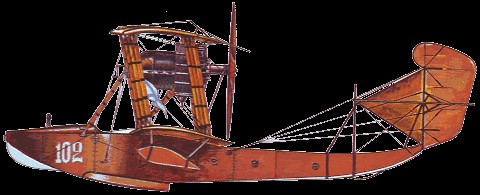
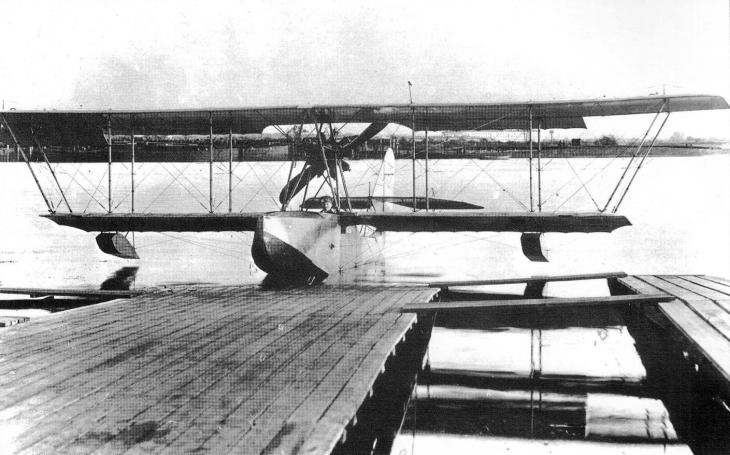
After leaving SS Schetinin and creating his new experimental factory, DP Grigorovich managed to obtain a contract for the construction of 40 training flying boats with Le Rhône engines of 110 and 125 hp. In general, they were Grigorovich/Schetinin M-5 hydros with minor changes in their construction, which is why the contract originally called the airplanes M-5, but when production began they would begin to be delivered as M-20s (Russian: Григорович М-20), to differentiate them from the copies built at the Schetinin factory.
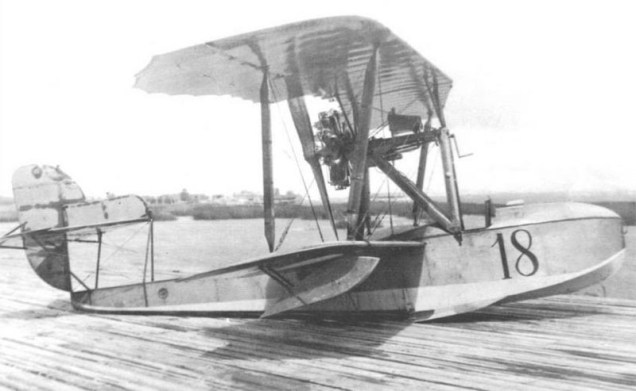
The M-20 was generally similar to the M-5 flying boat, itself a development of earlier models with better hull hydrodynamics and modifications to the tail section for greater efficiency.
From the constructive point of view, the M-20 presented a typical design. The structure was made of ash covered with 3 mm plywood on the edges and 5 – 6 mm on the bottom. 10 mm plywood was used in the recess area. The internal structure was made up of frames with diagonal reinforcement supports in certain areas. Joints in the hull skin were reinforced by plywood plates fixed with copper rivets from the inside. In the lower outer area of the hull, the joints were covered with 0.3 mm copper sheets and soldered together with tin. On the outside the wood coating was covered with varnish and on the inside with pitch.
The construction of the wings, the stabilizer and the keel of the vertical empennage was made of pine wood. The elevators and rudders were built from a light structure of thin-walled steel tubes (30×28 and 20×18 mm) with some wooden ribs and fabric covering. The M-20 simplified the number of guy wires between the supports and the upper flange.
The wing featured a double spar structure, built from I-profile pine pieces with holes to save weight. The wing ribs were made from 20 x 5 x 5 mm pieces of plywood, also lightened by perforations. Its wing profile was extremely thin (4% chord bristle). The interplane supports were made of wood and the cross tensors were made of 5-8 mm cables.
Behind the cabin, the hull became little more than a trapezoidal section stringer with the narrowest face upwards, on which the characteristic drift and rudder assembly was located. The horizontal plane of the tail was raised to distance it from the effect of the water by means of a pyramidal structure of steel tubes and tension cables.
As a power plant, the M-20 used Le Rhône engines of 110 and 125 hp, which were installed in a steel tube structure fixed to the central supports of the wing box. The main fuel tank was located in the hull, behind the cockpit.
Pilot and student were accommodated side by side in an open cabin, located immediately in front of the wings.
In the middle of 1917 the tests of the first copy equipped with a 125 hp engine were carried out and the results obtained resulted in the confirmation of the original production contract. On March 31, 1918, the Grigorovich factory was nationalized and destined for the production of agricultural aggregates, so the engineer went to Sevastopol and only in 1920 would he return to Moscow to renew his work as an aeronautical constructor.
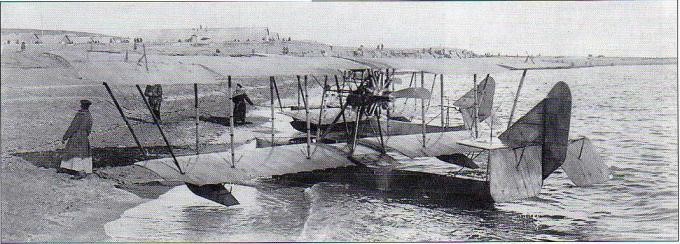
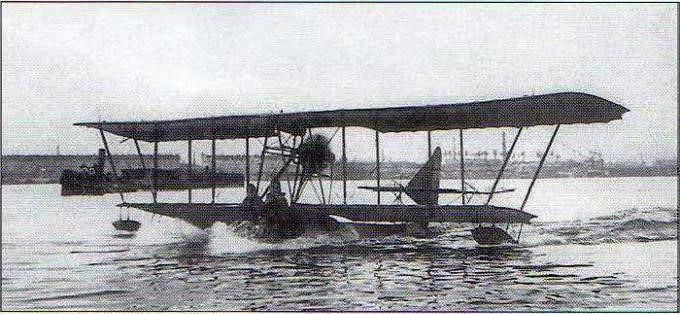
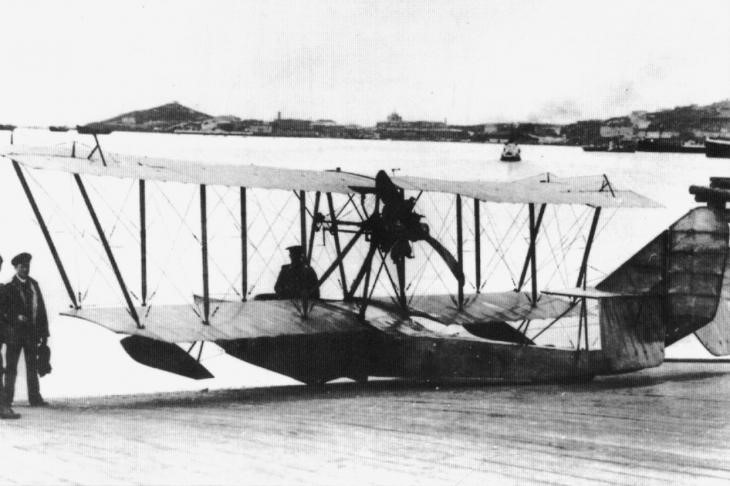
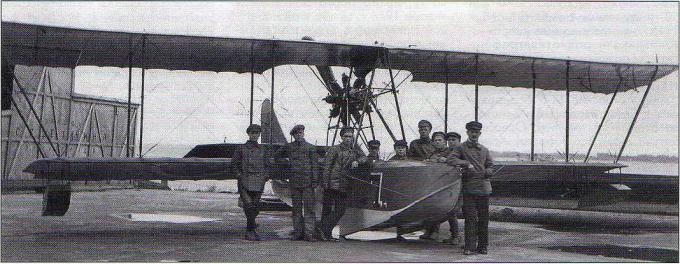
Grigorovich M-20 in Oranienbaum
The production of the model went 1917 to 1920, ending with close to 80 copies at the 1917 price of 16,000 rubles.
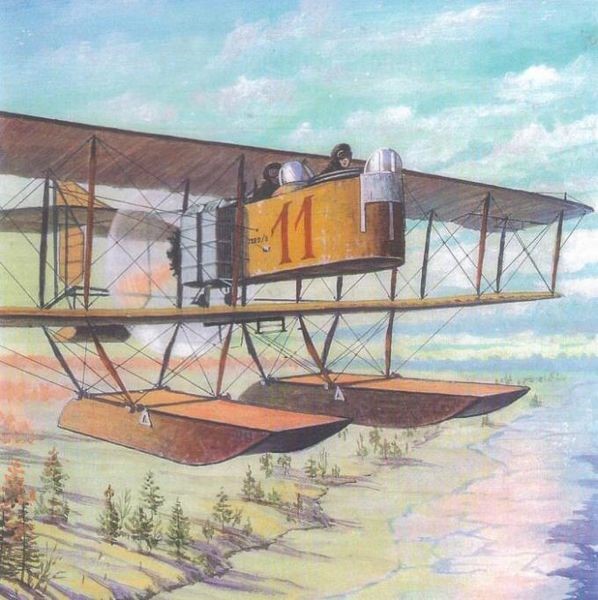
In October 1919 a special commission chaired by NN Polikarpov studied the possibility of transferring the production of the M-20 flying boats to the Tverskoi Wagon Factory and later to the Duks factory in Moscow. The lack of experience in shipbuilding did not allow to develop this idea
Most of the M-20 units participated in the Civil War on the side of the reds. These flying boats flew in the Baltic, Caspian Sea, Volga, Dnieper and North Dvina rivers. As armament some copies carried a machine gun located on a tripod in front of the cabin on the right and bombs of up to 32 kg. Some survived until the mid-1920s.
Damaged M-20 of the 4th Air Brigade of the Red Air Fleet at the Petrozavodsk Naval Station in 1919 (serial number 1588 or 1589.
М-20 Powerplant: One 120 hp Le Rhône Upper plane wingspan: 13.62 m Wing area: 37.96 m² Length: 8.22m Empty weight: 660kg Flying weight: 960kg Fuel and oil weight: 124 kg Maximum load capacity: 300kg Wing loading: 25.3 kg/m² Power Load: 7.1kg/hp Speed at sea level: 115km/h Ceiling: 3500m Time to 1000m: 9min Time to 2000m: 22min Endurance: 4 hr Accommodation: 2
With the beginning of the First World War in Russia, the Army and the Fleet were forced to develop their own research and development units where the prototypes were designed, the production documentation was developed and the experimental units were manufactured, which would later be presented to the national industry in search of a candidate for production. With this objective, it was proposed to create in 1918 the Kherson centers for the Army and the Grebni port center for the Navy. Both institutions would be developed from state funds and rapid results were expected from them.
DP Grigorovich soon understood the situation and decided to offer his services to the Navy, proposing the creation of a specialized construction bureau and an experimental factory for the development of flying boats. The request for support from an experienced engineer was welcomed by the military and soon Grigorovich, who was already 33 years old at the time, was able to count on the necessary material resources to become independent and be able to carry out his ideas independently. SS Schetinin for his part, freed himself from the development. The Navy also gained from the real possibility of presenting real results in the short term and somehow demonstrating to the authorities that the decision to provide it with its own engineering facilities had not been simply another waste of money.
On June 1, 1917 Grigorovich ended his working relationship with SS Schetinin. Grigorovich received bank loans with low interest rates that allowed him to lease some facilities to organize an experimental factory and an empty building belonging to the Ismailovski regiment, at 12 Rota, Building 26. As an aid to be able to make the loan payment, the new facility received an order for the construction of 40 M-5 flying boats (later M-20), which was signed on July 28, 1917 with deliveries scheduled for the period between September 1, 1917 and January 1, 1918. The price of each unit was set at 16,000 rubles. In parallel Grigorovich received requests for the development of several experimental models.
Dmitri Pavlovich designed the flying boat that received the 17th consecutive in the series of naval models (Russian: Григорович М-17), obtained as a development of the M-11 fighter with a 130 hp Clerget engine. The second prototype, slightly modified, would receive the designation M-17bis.
For different objective reasons, the two M-17 copies would only be finished in 1918. The tests of the model began on September 26, 1918 and showed the same problems of the basic model M-11 among which the negative influence of the rotary engine and poor seaworthiness stood out. Despite not successfully testing as a fighter, both the M-17 and M-17bis entered service with the Baltic Sea Fleet, where they remained for some time.
According to VB Shavrov, the M-17 was equipped with the 150 hp Hispano-Suiza engine and several copies were built that served with the Baltic Fleet and between 1921 and 1922 even in the Black Sea. In November 1917 the M-17bis with a 130 hp Clerget engine would appear.
M-17 Power plant: Clerget, 130 hp Wingspan: 8.80m Length: 7.60m Empty weight: 680kg Normal takeoff weight: 940 kg Top speed: 155km/h Cruising speed: 135km/h Accommodation: 1
Pilot Nagurski’s flights in a Maurice Farman MF.11 model to the Arctic in 1914 showed that floats could serve not only to land on water, but also on ice and snow. With the M-11 Grigorovich had shown the possibility of installing skis on flying boats, but the performance was affected in such a way that the need soon arose to create a model capable of operating during the time when the waters froze in the north ocean seas.
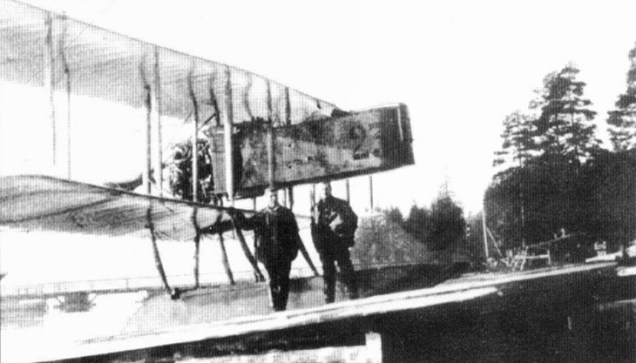
Dmitri Grigorovich began work on the M-16 model between August and September 1916 (it could be a little earlier). Naval pilots needed a “winter” model, capable of operating on the frozen and snow-covered surfaces of the Baltic Sea.
With the war, the Navy was involved in multiple tasks, generally operational, so they could pay very little attention to channelling the interests. The Department of Aeronautics of the Naval General Staff (MGSh) could do little burdened with bureaucratic tasks. Under these conditions, the builders of the aeronautical factories began to define what type of naval aircraft to project, assuming that they would cover the needs of the military. The owners of these factories, on multiple occasions, worked on account and at risk. Military experience and engineering thought were divorced, but this procedure would constitute the seed for the development of an experimental aviation program.
On September 20, 1916 at a meeting attended by representatives of naval aviation, the aeronautical departments of the MGSh and GUK and representatives of factories (BP Dudorov, AA Tuchkov, IN Dmitriev, DP Grigorovich, Yu. A. Brezhniev and AN Tupolev) future requests for naval models were discussed. Those present defined the technical task for the projection of the winter model. This airplane had to have the ability to land on water, ice and snow with a landing speed of no more than 75 km/h. The maximum speed was to exceed 100 km/h.
Schetinin promised to have such a plane ready by mid-October. This model was the Grigorovich M-16 (Russian: Григорович М-16), although it is also known as Sch M-16 or Schetinin M-16, being one of the last works of Grigorovich before becoming independent to his own factory.
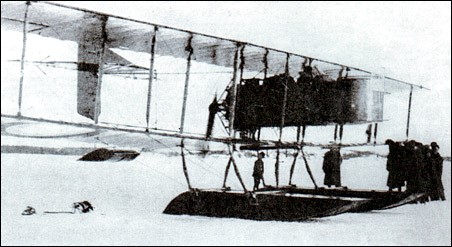
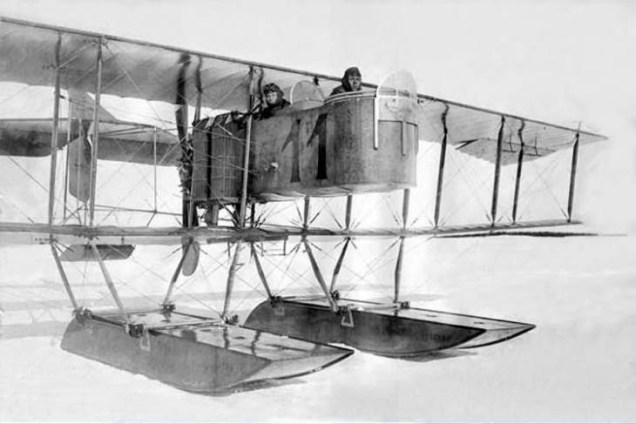
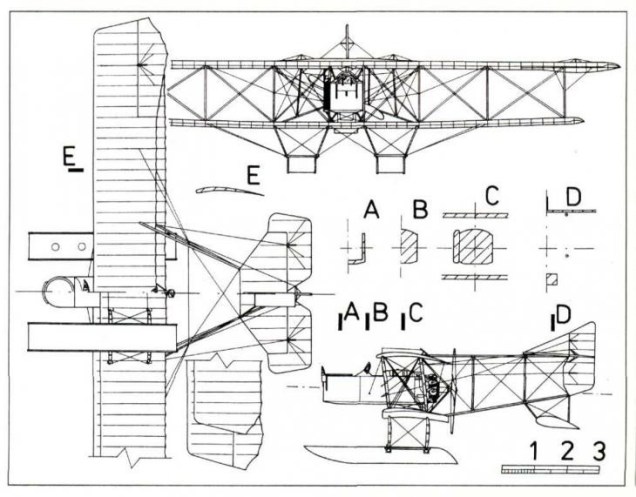
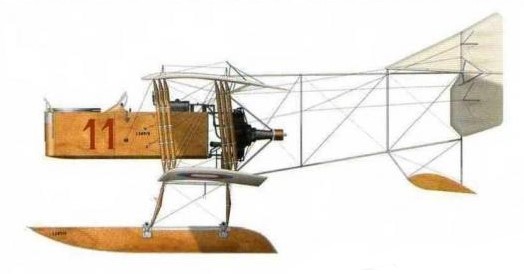
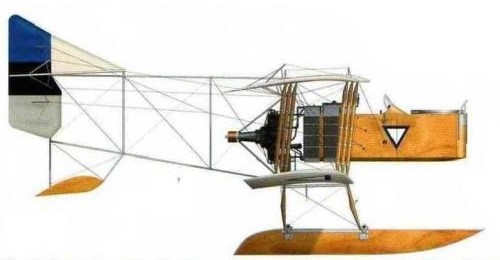
The M-16 was a single-engine biplane with a short crew gondola supported between the planes by a system of struts.
The wing, similar in construction to that of the M-9 model, was characterized by having a large area. The wing featured an unequal span and three sections supported and braced by tension cables.
Two flat-bottomed floats without grooves with a large support surface, necessary to operate on snow, were attached to the lower plane. Each float weighed about 77 kg, to which must be added a third very wide unit located under the tail region and weighing 8 kg.
The tail unit featured a single yoke and rudder assembly; Although similar in general configuration to that of the M-15 flying boat, the new aircraft’s rudder extended behind the horizontal planes, and the stabilizers were supported by four spars from the wings.
The central gondola, Farman type, accommodated the crew located in tandem, the instrumentation, the machine gun and the fuel. Aft of the gondola was a 150 hp Salmson liquid-cooled radial engine driving a two-blade propeller, with radiators located on the sides of the gondola.
Defensive armament consisted of a Lewis, Maxim, or Vickers machine gun located forward on a movable mount and operated by the spotter. The M-16 could carry up to 100 kg of small bombs.
On November 6, a naval commission participated in the factory tests of the M-15 and M-16 prototypes (with factory number 1080). The M-16 with a payload of 350 kg was capable of reaching 500 meters in 6.5 minutes, which was considered enough for a firm request for the construction of 40 examples to be made a couple of weeks later.
At the beginning of December, the first M-16 (it could be the prototype) was delivered to the Third Naval Station in Revel and received the registration ZS-1. On the 13th, piloted by Prokofiev-Severski, he managed to survive an accident about which the captain of the first rank BP Dudorov has left us evidence in a communication issued to the MGSh: “Today during a race on the water after ditching, the M-16 winter aircraft broke the gondola stringers at the engine mounting site, which ended up falling off. Fortunately, everything ended without consequences. I request to stop all construction work on the “winter” apparatus and urgently send engineer Grigorovich to Revel to investigate the causes of this accident.”
Only two days later, Dudorov would recall his request again, since the situation had become extremely complicated due to the impossibility of flying the flying boats due to the winter frost.
On December 16 and with the presence of Grigorovich, the commission of naval aviators reviewed the plane and came to the conclusion that it would be necessary to raise the engine installation by lengthening the float supports and reinforcing the rear amortization system. of both units. It was also proposed to reinforce the entire engine installation system. For this, the rear supports had to be reinforced, adding new steel parts.
Everything seems to indicate that these recommendations were heeded and brought positive results, since in subsequent tests there were no problems with fixing the motors.
Another interesting detail is that on December 30 Military pilot Captain Grigorov, who at that time was studying at the Nikolayevsk Military-Aeronautical Academy, proposed to the Navy to test a self-designed fuel tank protection system on the M-16. Shortly before the war this officer had designed a protection system by coating the tanks with a layer of rubber that was considered cheap and effective and the M-16 greatly needed this system because the fuel tank was located in the nacelle, in front of the engine, so that in the event of a small fuel leak, the proximity to the hot engine could turn into a fire. It is not clear if this system was actually used on the plane, but there is evidence that protections of this type were prepared in the Russian-American Society “Triugolnik” based in Petrograd.
Based on the results of the first month of operation of the M-16, in January 1917 a list of requests for improvements in the construction of the model was delivered to the factory. In addition to the increase in the rear of the floats, the military requested to locate a transparent hatch in the floor of the gondola and the installation of steps that would allow the crew to occupy their positions, to locate a windshield in front of the pilot and to install on the left side a bombardment collimator designed by Senior Lieutenant SA Lishin. It was also requested to move the compass position and install an artificial horizon, as well as the installation of removable supports for bombs to be placed under the gondola and the wings.
The pilots highlighted a strange behaviour of the model from the elevators. When pulling the stick rearward, the plane initially did not react, but when the stick reached a certain position the plane “jumped” upwards. The same thing happened during the descent. It was pointed out that with a full tank and without a passenger, the model behaved quite well, but when the tank emptied a little or was carrying the weight of another person, there was a tendency for the plane to lower its nose, forcing the pilot to maintain constant pressure on the nose.
The initial production contract included a request for 40 complete examples, 10 without motors to be used as spare parts and an unspecified number of float sets. Production started from the end of 1916. In general, the Schetinin factory produced 36-40 examples.
Contract date: November 24, 1916 Number of copies: 40+10 spare without motor Serial numbers: 1201-1232, 1242-1245 18,000 rubles per unit with a 150-hp Salmson engine and 17,700 for spare ones. 3150 rubles for each additional set of floats. Expected deliveries from December 10, 1916 to February 1, 1917.
Contract date: January 30, 1917 Number of copies: 1 Serial numbers: 1080 Contract for the purchase of the prototype
Between November 6, 1916 and July 1917 the Baltic Sea Fleet received at least 36 examples of the M-16. These planes were used primarily as scouts and patrol planes. The model became known to the military as ZS (Zimni s Salmsonom or Invernal con Salmson) and military registrations featured these letters and a consecutive number (ZS-1, ZS-2, etc).
At least one example was severely damaged during a fire on the night of January 6-7, 1917, and another was totally destroyed. The numbers of these were 1205 and 1206. By mid-1917, according to reports in the Baltic Sea Fleet, 15 were registered.
The Black Sea aviation did not need the “winter” models due to the climatic conditions in the area of operations.
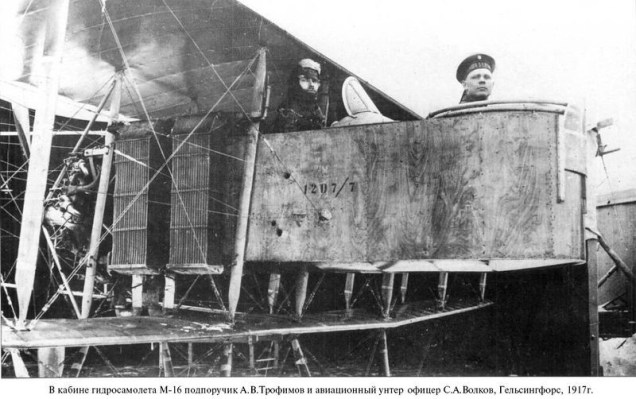
In the cockpit of this M-16 with factory number 1207/7 the sailor AV Trofimov and the officer SA Volkov in Helsingfors, Helsinki in 1917.
Six M-16s fell into Finnish hands during the Russian Civil War. After the abandonment of Revel by the Russian troops, six M-16 in perfect condition went to Finland, where they were exploited for several years until being decommissioned around 1923.
M-16 ZS-11 (factory number 1209). At the controls Finnish pilot Vaino Mikkola.
The first Finnish parachute jump was done on June 17, 1922 from a M-16 by a parachuter named E. Erho. The aircraft were flown until 1923.
Grigorovich M-16 ZS-23 of the Baltic Sea Fleet
By May the Baltic winter campaign was over. The mechanics replaced the alcoholic coolant in the engines with a normal type and on the 22nd of that month, officer G. Ya, Erdeli received the order to prepare six M-16 units with wheels, but there is no evidence that this was done, nor does any evidence support VB Shavrov ‘s assertion that during winter operations some M-16s replaced their floats with skis.
М-16 № 1207/7 in Helsinki in 1917.
In the summer of 1917 the head of the 6th Baltic Sea Air Division, Lieutenant AI Makarevich, modified one of the M-16s in order to improve its performance. The changes were made at the base of the division’s 2nd Brigade based at Abo and as a result the officer hoped to achieve a normal wheelset. Unfortunately this officer would never get to see his finished design. The winds of revolution reached Abo, discipline cracked and Makarevich’s authority degraded to such an extent that the Naval Aviation Command decided to reform the unit. The order came on July 18, but its execution was delayed and by the 30th the sailors, gathered between the hangars, assassinated Makarevich.
By mid-November, however, it was finished in the local workshops and prepared for testing. Apparently, the results were positive, since by the beginning of December at least three M-16 copies had been modified. Foreign intervention and the Civil War that followed erased practically all the evidence and for this reason no data on this project was preserved. Presumably without the heavy floats and their bracing structure the modified M-16 performed better.
With the arrival of the winter of 1917-1918 military activity in the Baltic area practically disappeared, the M-16 was used mainly in reconnaissance and liaison missions. For the summer campaign the model was totally obsolete, being able to be used only as a bomber.
Operators: Estonian Air Force Finnish Air Force Imperial Russian Navy Soviet Naval Aviation
Specifications: M-16 Engine: 1 × Salmson, 150 hp Wingspan: 18.0 m Wing area: 61.8 sq.m Length: 8.60 m Empty weight: 1,100 kg Max. takeoff weight: 1,450 kg Full load capacity: 350kg Fuel and oil capacity: 185 kg Wing loading: 23.5 kg/ m² Power Load: 9.7kg/hp Maximum speed: 130 km/h Speed at sea level: 110km/h Cruising speed: 92km/h Service ceiling: 3,500 m Time to1000m: 15min Time to2000m: 40min Endurance: 4 hr Crew: 2 Armament: 1x MG Bombload: 100 kg
In 1915 the leadership of the Fleet, encouraged by the success of the M-5, decided to ask Schetinin for a larger flying boat. The task of development was assigned to the technical director of DP Grigorovich. The main problem facing the builder was the selection of contours. In the search for the optimal hull, the M-6, M-7 and M-8 were be developed.
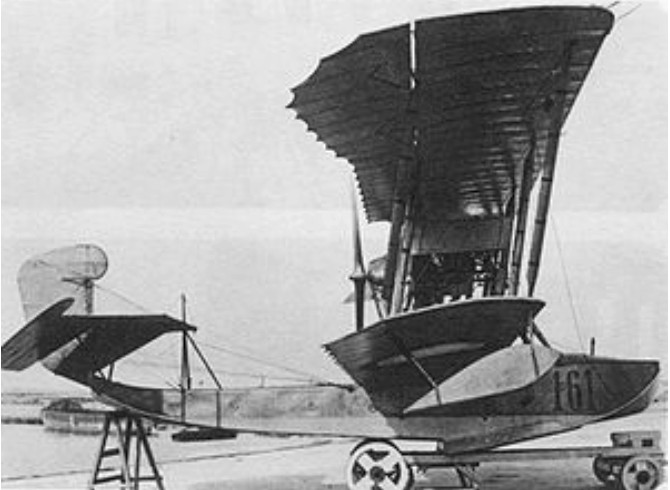
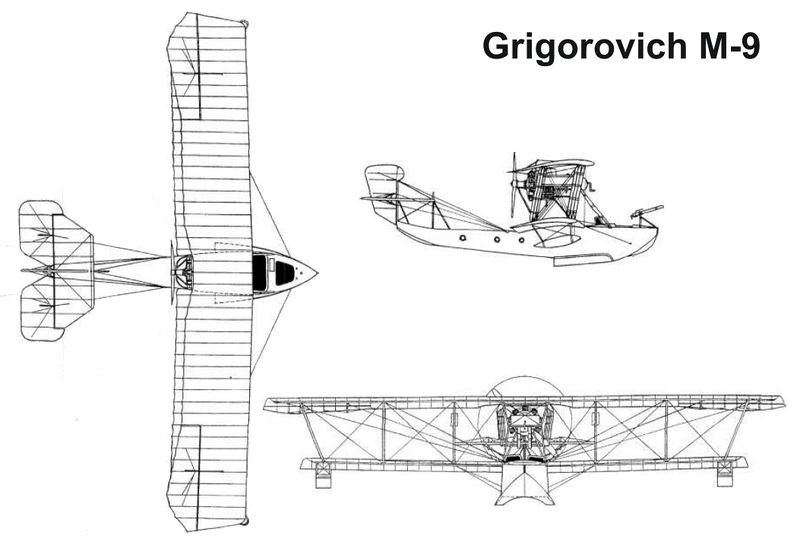
The Grigorovich M-9 (Russian: Григорович М-9, also known as the ShchM-9 or Gidro-9,) was similar to the earlier M-5, but featured larger dimensions and a more powerful powerplant. In general, it was a biplane with three sections and a single-pronged hull.
The double-spar wing was characterized by its large span and differed very little in construction from that of the M-5.
The hull true ribs and a thicker coating. During the development of the model a series of modifications were made to the lines of the hull. The first were characterized by presenting a convex bottom in the region of the rim (similar to those of the M-5) with lateral expansions in the form of three-sided plywood trunks, which is why they were known as “widened rim”. Subsequently, boats with a sharp keel and auxiliary deflectors in the region of the redient were built, 1.5 meters long and 0.1 m wide, which facilitated takeoff.
The weight of the empty aircraft was 1060 kg when it left the assembly workshops, but this increased during operation as the wood absorbed a certain amount of water and through different repairs. Compared to the M-5, the M-9’s rudder was considerably larger in size.
This device could accommodate two or three crew members, divided between a forward cabin for the gunner that communicated with the wide flight deck located in front of the plans and that housed the pilot and the observer seated side by side. In a two-man configuration the forward gunner position was occupied by the pilot on the right (observer), who crawled into the nose position. On some occasions the crew consisted of three people. A Ruzie radio station was installed in the cabin.
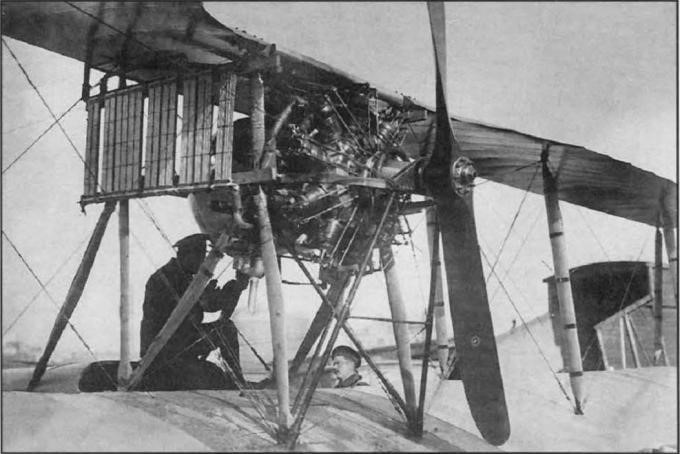
The prototype was powered by a 140hp Salmson engine, but the main propulsion version featured a 150hp Salmson Canton-Unné liquid-cooled radial engine which featured radiators mounted on each side. As alternative power plants, Salmson 130 and 160 hp, Renault 220 hp and possibly Hispano-Suiza 140 hp were installed in a few examples. The engine was installed on a wooden frame fixed to the links between the wings and the fuselage.
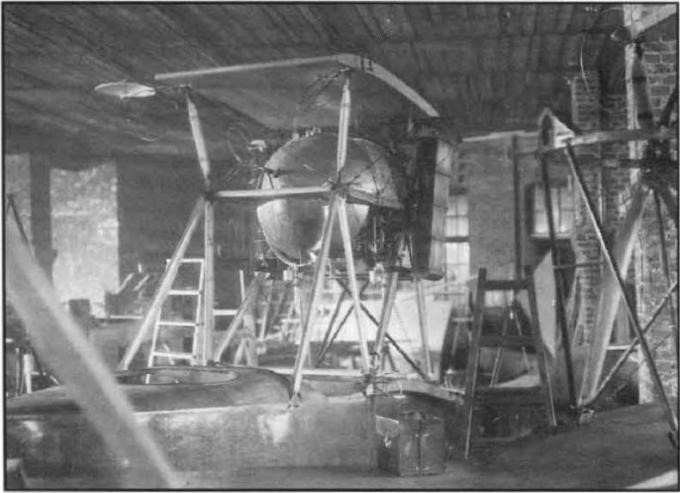
The prototype was characterized by the presence of a spherical fairing covering the fuel supply tank, the oil tank and the front part of the engine. In later specimens, the 15-liter feeding tanks were installed in the space between the inter-wing supports. The main fuel tank, with a capacity of 225 liters, was located in the fuselage, behind the cockpit. The fuel supply was carried out by air pressure in the main tank, obtained through the use of a compressor. To control this process, a special manometer was installed that could be observed from the pilot’s position, turning the head backwards.
The radiator was generally located on either side of the engine and two types were used: trunk and flat, sectioned.
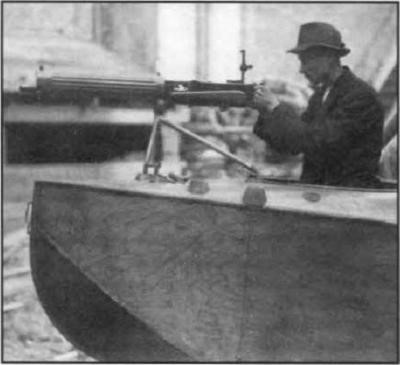
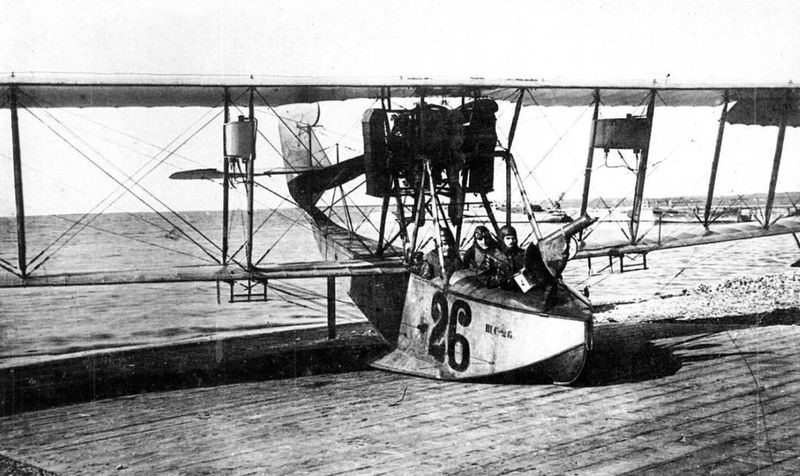
Installation of a Vickers machine gun on the bow of an M-9.
Armament was generally composed of a Maxim or Lewis machine gun located on a tripod. In a certain number of examples, a 20 mm Oerlikon cannon was installed at the bow, destined to beat small naval units, which made the M-9 the first flying boat in the world to use the cannon as a weapon. The Hotchkiss cannon was also used on some examples. Under the lower wing were four mounts capable of carrying a combination of bombs of up to 100 kg.
In 1917, a 37 mm “Pyuto” gun built by the Obukhovsky factory was installed in the bow of the M-9. A production of 50 with this armament was planned, but those plans did not come to fruition.
37 mm cannon installed in the bow of an M-9 flying boat
The prototype of the M-9 flying boat during its construction. The spherical fairing that covered the fuel tank and the Salmson engine is clearly visible.
The first prototype of the M-9 was ready in November 1915. It was winter and in Petrograd and impossible to carry out the tests, so the plane was sent to Baku, to be tested in the Caspian Sea. The maiden flight was carried out on January 9, 1916 at Baku.
The tests, carried out between December 25, 1915 and January 9, 1916, showed good seaworthy conditions and response to controls in the water.
The hull was capable of operating with waves of up to 0.50 m and both take-off and landing were smooth. In the air the M-9 was stable and easy to pilot. In relation to other flying boats of the time, it was characterized by having a good load capacity.
Based on the excellent opinions issued by the test pilots on February 4, 1916, the Schetinin Factory received the request to prepare 50 M-9 copies with deliveries for June 5 of that year. Later another request for 65 machines would be made. with deliveries in August and shortly thereafter another request for 165 M-9s to be delivered in November.
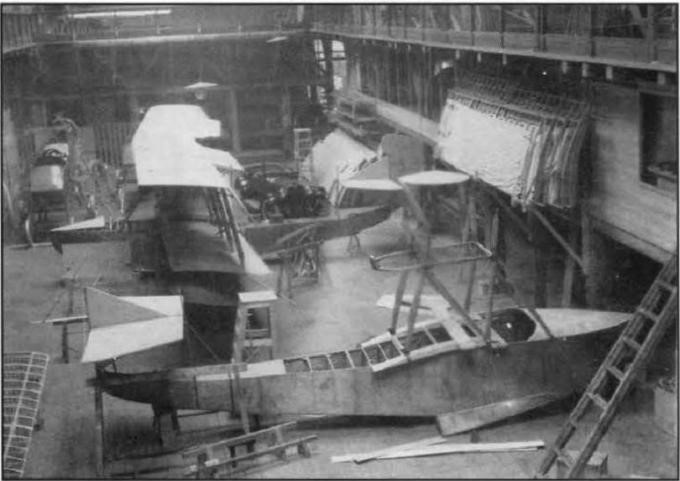
Two Grigorovich M-9 of the early series under construction at the Schetinin factory.
The increase in orders for the M-9 led Schetinin to consider increasing its production capacity. For the development of the tests, the PRTV developed an experimental test station on Krestovski Island in Petrograd with equipment to lower the boats into the water. Another similar station was created in Sevastopol ‘s Kruglaya Bay, where it was hoped to build a branch for aircraft construction and upgrades.
In 1916 Schetinin decided to start developing the Yaroslavl branch, but after the October Revolution these works were abandoned.
Between April 1916 and mid-1917 at the PRTV factory, at least 212 M-9 examples were produced. By the middle of 1917, the aviation of the Black Sea Fleet had received more than 100 units and that of the Baltic Sea some 86 copies. For the creation of this model the Russian Naval Staff awarded Grigorovich the Holy Vladimir Order of the 4th level.
In May 1918 the Schetinin Factory received the name “Gamayún” (by virtue of its telegraphic address). In this year the factory received the task of building 15 M-9 units and on September 19 a new order was received for 40 units. A certain number of copies would be completed in the years of the Civil War. The last M-9s were delivered to the fleet in 1923.
Up to 1923, about 500 copies of the M-9 were produced.
During the Russian Civil War, M-9s participated in the air defence of Baku, dropping approximately 6,000 kg of bombs and 160 kg of arrows. The aircraft also carried out photo reconnaissance, artillery spotting and air combat sorties.
The M-9 flying boat was used in the Baltic against German forces as a coastal reconnaissance aircraft and bomber and in the Black Sea, where it faced Turkish, Bulgarian and Romanian forces.
The main problem of the M-9 was the great resistance of its engine and radiators, so its speed reached about 110 km/h to about 100 km/h. This prevented it from being an effective competitor to the German Albatros fighters with floats, capable of reaching speeds between 150 and 160 km/h.
The M-9 was also used for the first experiments on sea shelve study, participating in the finding of new oil fields near Baku.
An M-9 of the Baltic Fleet based on the Tseriel coastal station in September 1916
Nine M-9s were captured by Finland during the Russian Civil War. One was flown by a Russian officer to Antrea on April 10, 1918. It sank the following day during type evaluation. Eight more were taken over at the airfields at Åland and Turku. The aircraft were used until 1922 by the Finnish Air Force.
Operators were, the Russian Navy, White Army, Finnish Air Force, and Red Army. Several samples of M-9 were purchased by the United States, and the United Kingdom purchased its drawings and technical documentation.
By May 1, 1923, the first of the M-9bis series, with number 1717, was ready and by the beginning of June a commission chaired by the representative of the Scientific Committee of the VVF, the engineer Yermolaiev, developed the first tests of evaluation. The flights were carried out by the naval pilot V. G. Chuxnovski.
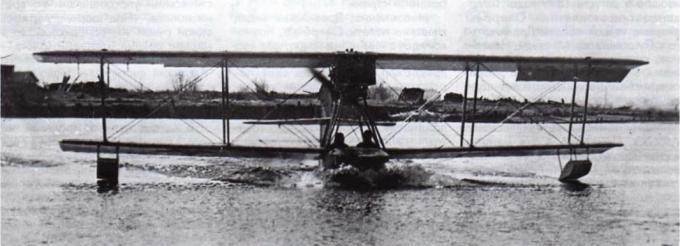
In 1921 GAZ No.3 one of the M-9 was modified with the installation of a 220 hp Renault engine. The prototype was successfully tested and would soon be renamed M-9bis. On July 19, 1922 at GAZ No.3 “Krasni Liotchik, a commission of the aeronautical department of the Main Directorate of the Military Industry (GlavBoyenProm) met, which studied the factory’s capabilities and analyzed the possibility of building eight new aircraft with M-9 hull and Renault powerplant. In August of that year, during the establishment of the industry’s production program for 1922 – 1923, the construction of 56 M-9bis copies was approved.
Taking into account the differences between the modernized model by Grigorovich and the M-9bis, the commission decided to approve the new name M-24, classify it as a naval reconnaissance hydrofoil and gave a positive assessment of the aircraft’s maritime and aeronautical characteristics. It was decided to authorize its serial production as the M-24.
In 1918 all Petrograd aviation factories were unified into the Petrograd Unified Aviation Factory. On June 16, 1921, the “Gamayún” factory (former SS Schetinin PRTV) was practically destroyed by fire. All the equipment and materials that could be salvaged were transferred and distributed between the RBVZ and the old Lievediev factory. After the restructuring of the economy, this unified factory would be renamed the State Aviation Factory (GAZ) No.3 “Krasni Liotchik” (Red Pilot).
In this factory, even before the arrival of Grigorovich , it was decided to continue the production of the flying boat M-9. In 1921 in one of these assembled examples a 220 hp Renault engine was installed. The prototype was successfully tested and would soon receive a new designation M-9bis.
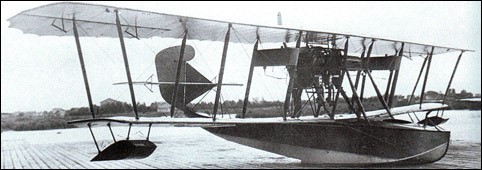
M-9bis with 220 hp Renault engine and sectioned radiators
Designed by RM Kholotov, the modified prototype was successfully flown for two years and the pilots claimed that in relation to the M-9 the new model presented better flight characteristics and behaved better in the water. The recorded speed reached 130 km/h, well above the 90-100 km/h recorded by the M-9 floatplanes in operation.
Grigorovich M-9bis
Motivated by this positive evaluation, the “Krasni Liotchik” factory received a request from the naval aviation directorate to modify another three examples, but soon in its operation it was shown that the structural resistance of the model did not respond to the new engine power and worsened the operation on water. It was concluded that it was not enough to increase the engine power, it was necessary to make modifications to the flying boat in order to achieve an effective result.
M-9bis
M-9s intervened in the Baltic, some from the Orlitza hydro transport and others from the bases on the island of Saaremaa and Tallinn. The first copies would arrive at these units in May 1916.
Led by Jan Nagursky, nine M-9s from the Kilkond (now Kihelkonna) naval airbase bombed the German base at Angern in June 1916. Intercepted by German fighters, Nagursky broke contact by looping, a maneuver never performed to date in a flying boat. On September 17, 1916 Nagorsky repeated the stunt on his own base and with maximum payload on board. Two loops were made with a passenger on board. The record was confirmed by the council of the Imperial Flying Club on November 12, 1916, being considered world-wide.
In the Baltic the absence of a machine gun covering the rear hemisphere caused heavy losses when engaging new enemy fighters, so from 1917 in the Baltic it was necessary to accompany the M-9s with Nieuport-17 and Nieuport-21 ground fighters. Some pilots independently tried to solve this problem by installing backward-firing machine guns on the lower wing (above or below) and creating a whole range of combat methods in order to achieve some result with them.
In this period, Russian pilots managed to claim at least a dozen kills of enemy aircraft against similar losses of their own. On July 12, 1916, an air combat took place between an M-9 piloted by Lieutenant PA Turzhanski and five German flying boats, one of the latter being shot down.
In July-August 1917, some 30 M-9s (with SchS registration) and 13 M-15s (with SchI) were located on these bases, with the following distribution:
By the end of 1917, in the Baltic naval aviation , it was considered that the M-9 could only be used where there was no enemy strength in the air, since the absence of rear defense and low vulnerability made it an easy prey for enemy fighters.
Starting with the 1918 offensive, the number of M-9 flying boats available decreased considerably. After the evacuation of Finland there were about 10 M-9 copies.
A number of examples were taken into service with the Red Air Fleet in the Petrograd region.
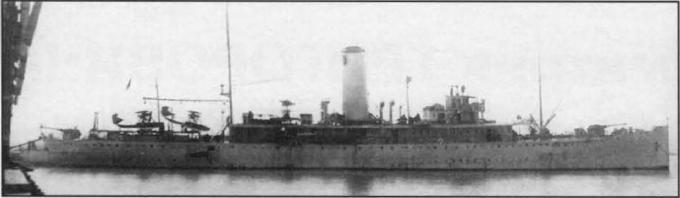
M-9s from the Black Sea entered service with the air divisions based in Odessa and Sevastopol. At the beginning of 1915 the seaplane carriers Alexandr I and Nikolai I entered service in the Black Sea, constituting a division of hydroplane cruisers together with various support vessels. Each hydro transport was equipped with eight flying boats, initially Curtiss F and Grigorovich M-5. Mid 1916, these hydrocanoes were replaced by M-9, which were lowered into the water and hoisted on board by means of large cranes supplied on the ship itself. Later, some merchant ships of Romanian origin were converted into transport ships for M-9s.
The Grigorovich M-9s, both from their transport ships and from installations on the mainland, carried out a large number of raids against shipping and naval bases in Bulgaria, Romania and Turkey, conducting air raids over the Bosporus, Varna, Constanta and other military objectives. During the summer of 1916 several M-9s were fitted with Oerlikon guns for anti-ship missions.
In the Caspian Sea during 1918 and early 1919, two M-9 were used, of which at least 1 was used in military operations against Turkish forces. By the end of 1922, one of these flying boats was used in the Baku area for the purpose of carrying out studies on the sea. Flying at altitudes of 500 – 900 m, the pilots managed to find new oil deposits.
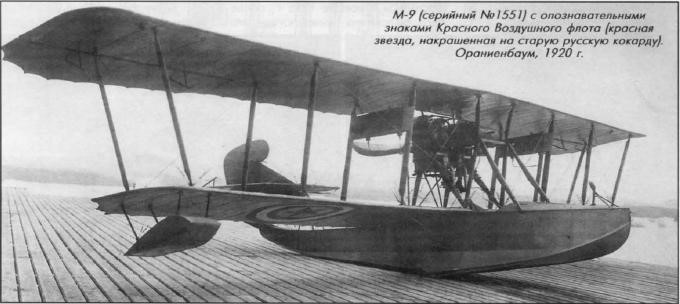
M-9 serial number 1551
The M-9s took an active part in the Russian Civil War. White forces used 5 M-9s in the Black Sea area in the summer-autumn of 1919. Three other examples were made airworthy in the Don Air Division.
Until mid-1919, some 40 examples of the M-9 were prepared at the “Gamayún” factory (former PRTV of SS Schetinin), which entered service with the Baltic Sea Air Brigade.
A distinctive feature of the Civil War in Russia was its development along the course of the great rivers (Northern Dvina, Dnieper, Volga, Kama). The fundamental milestones of their performance were marked by some devices flown by Bolshevik pilots: they operated from special barges anchored in the Volga and Don rivers. These barges were towed to the areas of operations when their presence was required and, once there, the M-9s were floated on the surface of the river using purpose-built ramps.
Particularly famous was the “Komuna” barge, capable of carrying 6 flying boats in a special hangar and belonging to the Volga Air Division. In April 1919 this division’s flotilla consisted of 6 M-9s, 2 M-20s, and one Nieuport-23 wheeled fighter. The total number of M-9s used by the forces of the Red Air Fleet in 1920 totalled about twenty examples. By 1921, this figure was maintained thanks to constant repair and maintenance actions, but from then on it gradually decreased.
M-9 on the deck of the hydro-cruise “Alexandr I”, belonging to the Black Sea Fleet in 1916.
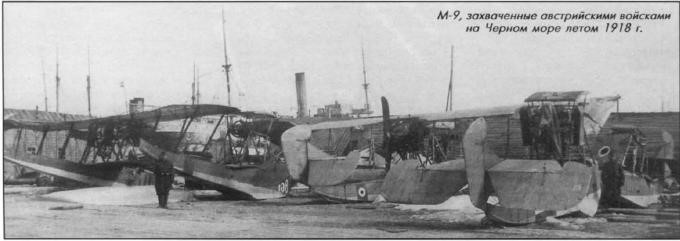
In the middle of 1917 in the Black Sea 48 M-9 were registered. Beginning in the fall, the M-9s changed owners on several occasions, which was reflected in their availability. In the spring of 1918, during the Austro-German occupation of the Black Sea, these forces occupied about 40 examples, but practically did not use them, so that by 1919 there were very few left in flight conditions.
M-9 flying boats occupied by Austrian troops in the Black Sea in 1918.
After the evacuation of the Russian troops from Finland, there remained about 10 M-9 that were used by the Air Force of this country. One of them was flown by Russian officers to Antrea on April 10, 1918 and would be sunk the next day during evaluation flights of the model. At least 8 copies were deployed to the airfields of Åland and Turku. The M-9 remained in service in Finland until 1922.
M-9 with Salmson engine and “Hazet” type radiator of the Baku Flight School.
The excellent characteristics of the M-9 attracted the attention of other countries. Several examples were sold to the United States. The plans and technical documentation for a possible series production were delivered to England, which never came to fruition.
By the beginning of the 1920s, the few examples in flight condition began to be withdrawn from active service. A certain number of copies remained in service until the middle of that decade, basically in training functions and fishing patrol flights.
It is known that in December 1927 an M-9 with civil registration R-RDOM was in operation at the OSOVIAJIM in Ulyanovsk and another M-9 with the word Activist painted on the sides was kept unarmed in the warehouses.
By 1923 the factory would achieve another development using the same power plant, which was called the Grigorovich M-24.
The management of the Navy, convinced that it had an excellent flying boat, never submitted requests for improvements, so no development versions were made during its use with the Fleet aviation. The main changes were linked to the use of different types of radiators, engines, bracing cables and minor detail modifications, but in general all the M-9s produced differed little from the original prototype.
Among the main modifications of the M-9 are:
Kukuranov’s M-9: In 1919, at the request of the pilot AP Kukuranov, a modification of an M-9 with a 130 hp Salmson engine and much thicker profile wings was made. According to VL Korvin-Kerber, who flew this aircraft in 1921, it outperformed the 150 hp Salmson-powered production models on many metrics.
M-9bis: A rather different version was developed by engineer RM Jolostov in Petrograd in the winter of 1919 (1921). This version featured a 220 hp Renault powerplant and reached 130 km/h. It was not produced in series because in 1923 the M-24 appeared.
M-19: According to Shavrov a development of the M-9 with a wingspan of 13 m, a length of 8.50 m and a wing area of 48 m²; powered by a 160 hp Salmson engine
M-23bis: Experimental model developed on the M-9 with a 280 hp Fiat engine.
M-24: A development of the Renault-powered M-9 design appeared in 1923 and produced in certain numbers.
M-9 Engine: 1 × Salmson Canton-Unné, 111 kW (150 hp) Wingspan: 16.00 m (52 ft 6 in) Wing area: 54.8 sq.m (589.6 sq.ft) Length: 9.00 m (29 ft 6 in) Height: 3.3m Empty weight: 1060 kg Maximum takeoff weight 1 540 kg Fuel and oil weight: 220 kg Maximum load capacity: 480 kg Wing loading: 28.10 kg/m² Power load: 10.3kg/hp Maximum speed: 110 km/h (59 knots, 68 mph) Cruising speed: 98 km/h Landing speed: 85 km/h Service ceiling: 3,000 m (9,840 ft) Time to 1,000m: 12min Time to 2,000m: 30min Range: 450km Endurance: 3.5 hours Crew: 2 – 3 Armament: 1x 7.7 mm MG or 1x 7.5 mm MG or 1x 20 mm cannon or 1x 37 mm cannon Bomb load: 100kg
According to Shavrov the Grigorovich M-8 (Russian: Григорович М-8) was a new prototype on the way to the M-9, in which the contours of the hull were once again modified with a higher recess (about 150 mm). In this case the prototype did not even manage to take off from the water.
AO Alexandrov handles another theory since the following statement appears in a Navy document dated October 26, 1915: “Currently at the Schetinin factory two large experimental flying boats with increased range are being built. At this time one of them (the minor) is ready and is in the testing stage…”
According to Alexandrov this document refers to the M-7 and M-8 models.
The idea of creating the M-8 as a large flying boat with a long range could respond to a request from the pilots of the Baltic Fleet. In the Naval General Staff, many plans related to naval aviation were related to the giant models of Igor Sikorski and their possible modification to navalized versions. Unfortunately, the only example of the Ilya Múromets bomber in floatplane configuration with floats was destroyed by an accident caused by its pilot’s error during landing in the first days of the war.
At the end of July or beginning of August 1915 D. P. Grigorovich presented to the Aviation Committee of the Baltic Fleet the project of a biplane and twin-engine flying boat with an empty weight of 3.1 tons and a payload capacity of 2 tons. The large fuel capacity (970 kg) allowed it a range of 8 hours of flight at cruise power from its 600 total hp engines. The calculated speed was about 105 km/h.
On August 12, the military pilots supported the idea and proposed giving the aeronautical manufacturer an advance of 50% of the value requested to start the construction of the experimental prototype. The other 50% would be delivered once the specimen was finished and successfully tested, considering that the data presented could only reach a deviation of 10% with respect to the calculated ones.
On August 22, Captain 2nd Rank BP Dudorov, Head of the Aviation Department of the Baltic Sea Liaison Service , approved the idea, but expressed his disagreement with the proposed form of payment. Instead he proposed that the firm apply for a loan and deliver the engines of the requested power.
Everything indicates that SS Shchetinin put great hopes in the project, for which he ordered to start its construction at risk. It was also oriented to expand the factory with new workshops capable of accommodating large flying boats under its roof.
According to a report from the Naval General Staff (MGSh), issued on September 24, the model was built with two 220 hp engines, which would allow a horizontal speed of 95 km/h with a climb of 2,000 meters in 30 minutes. Cargo capacity was also reduced to only 1.7 tons, including crew, weapons and fuel capacity for 7 hours of patrolling. Neither the Navy nor the company were able to obtain the long-awaited 300-hp engines, but hope remained that they could be delivered before construction of the prototype was completed.
From then on, all the evidence that could link the fate of the M-8 disappears. Probably the requested power plant could not be obtained and the performance with the 220 hp engines ceased to be of interest to the Navy, but these are only guesses.
In a paper presented to a meeting of the Imperial Flying Club on November 25, 1915 , AO Alexandrov found some technical data on an airplane that he associated with the M-8. These data are the following: Number of motors: 2 Total power: 600 hp Take-off weight: 5100kg Payload Capacity: 2000kg Endurance: 8 hours Fuel weight for 10 hours of flight: 970 kg Armament weight in 5-hour flight: 650 kg Armament weight in 10-hour flight: 135 kg Crew: 5 people Speed with maximum load: 105 km/h Wingspan of upper plane: 33 m Wingspan of the lower plane: 24 m Height: 3.8m Length: 14.6m
The Grigorovich M-7 (Russian: Григорович М-7) appears in different literary references with great contradictions, even denying their existence. Given that there is no documentary evidence to confirm which of the versions could be closer to reality, we will have to present them all referring to their main speakers.
Mijaíl Maslov, researcher and historian and author of innumerable works in relation to the M-7 writes: The M-7, like the earlier M-6 appears to be an enlarged and unsuccessful version of the M-5 with a 150 hp Sunbeam engine. During the tests it failed to take off from the water. Modification attempts were of little help and eventually the aircraft was disassembled for spare parts. VB Shavrov however alleges that the M-7 featured modified contours, higher tread and a wide angle keel. The takeoff was heavy but in the air the model behaved normally.
AO Alexandrov agrees with Maslov that the M-7 was originally unflyable, but tells of possible later tests in Baku.
According to Alexandrov, the M-7 was a three-seat development model of the M-7 created in the PRTV in a period between July and August 1915. A document dated September 24 is preserved where it is detailed that in a few days this three-seater model would be tested.
Apparently the decision to build the M-7 was generated as the company’s own initiative with the aim of presenting a model that would compete with the Curtiss K.
For unclear reasons, which could be due to the lack of the right engine or the terrible autumn conditions, the tests did not begin until November. On the 4th the prototype was sent to Revel, but the trip to that city took about two weeks.
SS Shchetinin considered it essential to participate personally in the development of the tests, since he had a great interest in their results. Unfortunately, her hopes were dashed when the M-7 flying boat refused to take off from the water at the end of November. The company’s specialists kept hoping for an effective design and for this reason continued to work on the model. By mid-January 1916 the flying boat with a 150 hp Sunbeam linear V engine known as “Crusader”, was tested at the branch of the Petrograd Naval Pilot Officers School opened in Baku, on the shores of the Caspian Sea.
The results obtained with the new model M-9 led to the abandonment of attempts to continue working on the M-7. The subsequent fate is unknown.
M-7 Power plant: 1 Sunbeam 150 hp Propeller: 3 m diameter / 2.25 m pitch Accommodation: 3 Payload Capacity: 450kg Calculated top speed: 95km/h Calculated time to 2000 m: 30 min Calculated endurance: 5 – 5.5 hours
Vadim Borisovich Shavrov, aeronautical constructor, coworker of DP Grigorovich at OMOS and historian in his encyclopedic work “Aeronautical Construction in the USSR up to 1938” defines the M-6 (Russian: Григорович М-6) as a temporary version in the towards the M- 9:
M-6 with 150 hp Sunbeam engine. The hull of the flying boat was similar to that of the M-5 but with an enlarged keel. The forms were not very successful and the takeoff from the water was difficult.
Mijaíl Maslov, another prominent researcher and historian and author of innumerable works of recognized historical value, has not found clear evidence and in relation to the M-6 he writes:
Possibly this denomination was assigned to a new Grigorovich flying boat with a 150 hp Sunbeam engine that showed unsatisfactory results during the tests. In any case, to date no documents have been found that confirm the existence of a model with that name.
The aeronautical historian AO Alexandrov in his book “The airships of the Imperial Fleet 1894 – 1917 expresses, however, another theory that is still interesting:
There is evidence that SS Schetinin clandestinely built five copies of the Curtiss F model for the Black Sea Fleet, which were delivered between October and December 1915 at a unit cost of 5,595 rubles per unit.
According to Alexandrov, it could have happened that this adventure of creating the necessary flying boats without a license had led SS Schetinin to seriously think about the possibility of establishing an important production contract without development expenses and given the possibility that the M-5 model would not approved (especially since the Baltic Fleet rejected this flying boat in favor of the French FBA) to have an “Ace up the sleeve” in the form of a proven and successful design that could be presented to the Navy under the name public M-6 in order to avoid pretensions of the North American firm.
It is noteworthy that no Navy document mentions the M-6 model and the 5 copies of the Schetinin Curtiss F delivered to the Black Sea Fleet in the documents are only referenced with their registration number and sometimes with the letter “k” at the end.
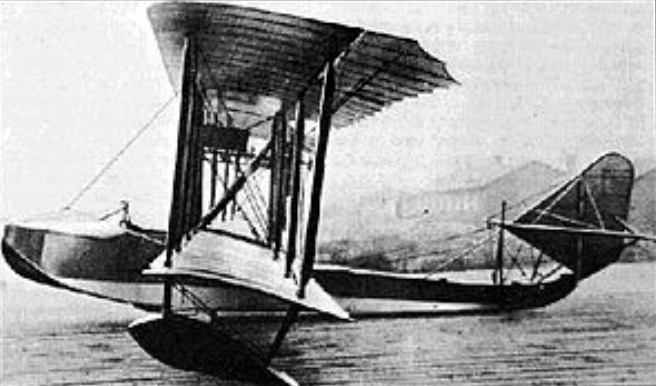
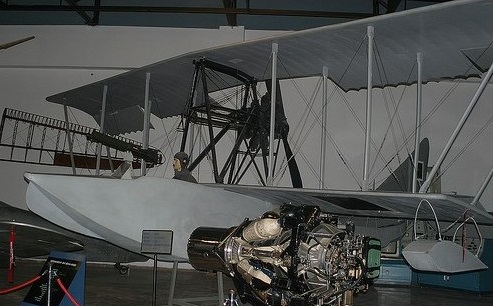
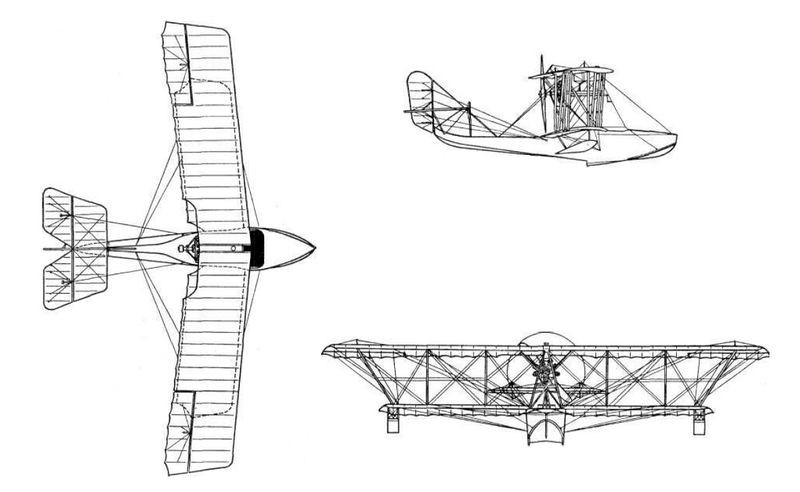
Grigorovich M-5 (alternative designation Shch M-5, sometimes also Shchetinin M-5 (Russian: Григорович М-5)) was a successful Russian World War I-era two-bay unequal-span biplane flying boat with a single step hull, designed by Grigorovich. It was the first mass production flying boat built in Russia.
During the summer and autumn of 1914 several flights were made on the M-2, proving that it still needed to work on the design in order to achieve a model capable of satisfying the needs of the Russian naval forces. The improvements introduced in the M-3 model did not bring the expected success either and this was understandable considering that the M-3 was just a version of the previous model with a more powerful engine and a new wing profile. The tests of this model did not show great differences in relation to the base model. Also unsuccessful was the later model M-4, a version with slight improvements to the hull design, new changes to the airfoil, and the same engine as the M-3.
It was produced, primarily to replace foreign built aircraft, including Curtiss Model K and FBA flying boats.
In his design Grigorovich used the information obtained from the French FBA models, which operated with the Baltic Fleet. On the way to obtaining the best possible design for the new model, Grigorovich decided to go to the Petrograd Polytechnic Institute, where one of the best aerodynamics laboratories in all of Europe existed, with a wind tunnel run by VA Sliesariev.
The M-5 was of a wooden construction, the hull was covered in plywood and the wings and tailplane were covered in fabric. Aft of the step the hull tapered sharply into little more than a boom, supporting a characteristic single fin and rudder tail unit, which was braced by means of struts and wires. It was normally powered by a 100 hp Gnome Monosoupape engine mounted as a pusher between the wings, but some used 110 hp Le Rhône or 130 hp Clerget engines. The pilot and the observer were accommodated side-by-side in a large cockpit forward of the wings, the observer provided with a single 7.62 mm Vickers machine gun on a pivoted mounting.
The M-5 was a development of the previous models with better hull hydrodynamics and modifications to the tail section for greater efficiency. Unlike earlier models, the wings were inserted into the sides of a deeper hull. The wingspan and surface of the lower plane were increased.
Grigorovich devoted great attention to strengthening the hull structure, especially in the areas that were in direct contact with the water. The railing was modified with a decrease in its height in the center to 70 mm and towards the sides of 140 mm. The sides of the bottom had some slats that allowed the flying boat to stay on the launching surface when leaving the water.
The structure was made of ash covered with 3 mm plywood on the edges and 5 – 6 mm on the bottom. 10 mm plywood was used in the recess area. The internal structure was made up of frames with diagonal reinforcement supports.
The assembly of the hull was done with brass screws with a lead or zinc coating. The joints in the hull skin were reinforced by plywood plates fixed with copper rivets from the inside. In the lower outer area of the hull, the joints were covered with 0.3 mm copper sheets and soldered together with tin. On the outside the wood coating was covered with varnish and on the inside with pitch. A special “marine” glue was also used during the assembly of the different pieces. It is interesting to note that all the work was manual. The hull had good rigidity, but even so breakages were common in aviation schools by inexperienced students.
The construction of the wings, the stabilizer and the keel of the vertical empennage was made of pine wood. The elevators and rudders were built from a light structure of thin-walled steel tubes (30×28 and 20×18 mm) with some wooden ribs and fabric covering.
The wing featured a double spar structure, built from I-profile pine pieces with holes to save weight. The wing ribs were made from 20 x 5 x 5 mm pieces of plywood, also lightened by perforations. Its wing profile was extremely thin (4% chord bristle). The interplanar supports were made of wood and the cross tensors were made of 5-8 mm cables. Cables were also laid between the wing box and the nose of the flying boat. The cables for the control surfaces were located on the outside of the flying boat, making them easy to service and repair.
The horizontal plane of the tail was raised to distance it from the effect of the water by means of a pyramidal structure of steel tubes and tension cables. This structure failed to ensure good rigidity and as a result the M-5’s tail twisted appreciably during turns and constantly vibrated. Despite this, an accident due to breakage of the tail unit was never recorded. The stabilizer was fixed to the tail bar and could be adjusted on the ground to change the angle of incidence. The bottom ski-paddle tested on the M-4 was eventually removed.
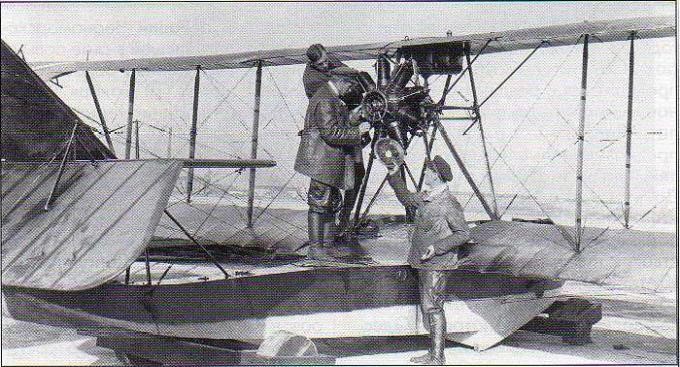
Most of the M-5s used the 100 hp Gnôme Monosoupape, which was installed in a steel tube structure fixed to the central supports of the wing box. This engine drove a 2.60 meter Shauviere propeller. Grigorovich constantly tried to improve the characteristics of the M-5 by using more powerful power plants (the 110-120 hp Le Rhône and the Clerguet were tested) of 130 hp, but when using these engines the performance worsened instead of improving, because as the weight increased, stability worsened and control became more difficult.
The manual ignition crank was located in the front region of the engine. The main fuel tank was located in the hull, behind the cockpit. The M-5 eliminated the tank from the upper plane. To get the fuel to the engine, a manual pump was used, which generated pressure in the tank, causing the fuel to rise constantly. The oil tank was originally located at the junction of the upper half-planes, but was soon enlarged to be located a little lower, at the junction of the central supports.
Pilot and observer were accommodated side by side in an open cabin, located immediately in front of the planes; In a few examples, the observer, located on the right, was in charge of handling a single machine gun mounted on a mobile mount. Additionally, the M-5 could carry an assortment of 8 kg bombs or two 50 kg bombs, directly in the cabin in the case of the small ones and hung in the case of the larger ones.
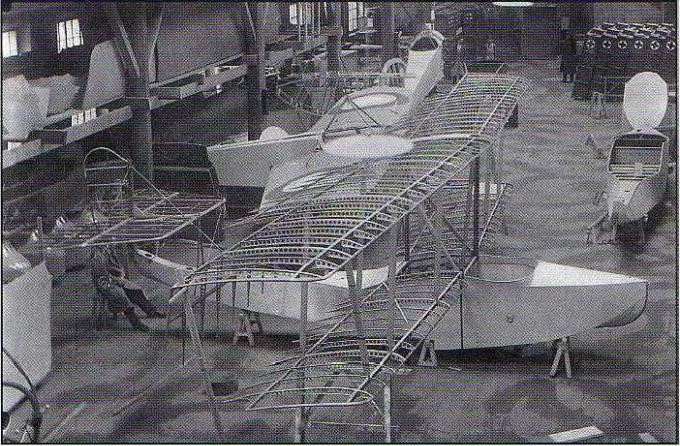
Assembly of M-5 at the Schetinin Factory
The first prototype M-5 was built at the Schetinin Factory in April 1915 and in May Ya. I. Siedov-Sierov carried out the tests on Kestovski Island. As early as April 16, S. S. Schetinin informed the Naval General Staff (MGSh) about the readiness of the factory to build four M-5 specimens at a cost of 9,500 rubles per unit, with deliveries from May 10 to 5 June. This proposal was accompanied by the promise to send, if necessary, all these planes and the assembly brigade made up of engineer, pilot and mechanic to Sevastopol to carry out the tests in which it was expected to reach a climb of 500 meters in 10 minutes. with a payload of 310 kg.
One of the first M-5s factory number 331 during the tests at the PRTV experimental station in July 1915.
In response to this proposal, a group of naval pilots visited the factory and on April 20, 1915, the commander of the port of Petrograd received the instruction to negotiate the contract, signed on May 27 for 12 copies to be delivered between May 30 and June 15. The closeness between the dates of signing the contract and the first delivery implies that the Schetinin Factory had several ready at that time.
Famous pilot George Friede, who flew on the M-5 under all the bridges on the Neva River, described the plane as outstanding. They possessed excellent seaworthiness, on tests exceeded some characteristics recorded in the technical specifications. For example, instead of the recorded 275 kilograms of cargo, it took 300 kg, the maximum height was gained not in ten minutes, but in three and a half.
The production company managed to fulfill the contract with only 5 days of delay in delivery. The reception was entrusted to Lieutenant GA Fride, an experienced pilot recognized as an aeronautical constructor.
M-5 number 331 showing the tail unit fixed by brackets and cables and the upper plane trailing edge fins.
Production of the series began in June 1915 and ran until mid-1917. By the time production was completed, some 200 examples had been delivered, of which the majority were built at the Schetinin Factory in Petrograd and another quantity at the Anatra factory in Odessa. After the October Revolution, production at Factory No.3 “Krasni Liotchik” in Petrograd was maintained until 1923, registering a total of about 300 copies.
M-5 contracts
Contract date: 27 May1915 Number: 12 Serial numbers: 316-327 9500 rubles per unit without motor Deliveries from May 30 to July 15
Contract date: 17 July 1915 Number: 10 Serial numbers: 331-340 Delivery for September 10, 1915
Contract date: 10 August 1915 Number: 3 Serial numbers: 328-330 Post-delivery contract. Delivered on July 20, 1915.
Contract date: 12 November 1915 Number: 16 Serial numbers: 440, 441, 537-542 10500 rubles per unit without motor Deliveries from November 1915 to March 1916.
Contract date: 21 December1915 Number: 10 Delivery of 10 frames without glue and motor. 4750 rubles per unit.
Contract date: 1 April1916 Number: 35 Serial numbers: 656-683, 687-690, 892,893, 895 Completed by September 23
Contract date: 16 June 1916 Number: 20 Serial numbers: 684-686, 894, 896-899,907-909, 993-995, 998, 999, 1001, 1018, 1020, 1021 10,500 rubles per unit without motor. Deliveries between July and August of that year.
Contract date: June 1916 Number: 20 Serial numbers: 904-906, 910, 996, 1000, 1002, 1019, 1022, 1023, 1028, 1030-1036 Contract intended for reserve, but later several entered service
Contract date: 2 September 1916 Number: 30 Serial numbers: 900-903, 911, 1024, 1025,1027, 1029, 1037-1045, 1047-1055. 1057 11,000 rubles per unit without motor Deliveries between October 1 and December 1, 1916
Contract date: 27 April 1917 Number: 70 11,000 rubles per unit without motor Deliveries between December 1, 1917 and April 1, 1918. Cancelled
Contract date: 29 April 1917 Number: 10 10 spare frames Completed for May 25, 1917
Contract date: 26 May 1917 Number: 25 Serial numbers: 1441-1460, 1461-1465 (possibly) 11,000 rubles per unit without motor Deliveries for July 20, 1917
Contract date: 28 July 1917 Number: 40 16,000 rubles per unit with a 125 hp Le Rhône engine Deliveries September 1, 1917 to January 1, 1918 Contract assigned to the new experimental factory Grigorovich
The M-5 was used primarily in the Black Sea and Caspian and in various flight schools, initially with the Imperial Russian naval air arm and later with both sides in the Russian Civil War. The low speed and the poor range did not allow it to stay for a long time in front-line tasks and by 1916 almost all went to the role of trainers. By 1917 the M-5 was already obsolete and did not meet to the requirements of the Navy. Some remained in service until the late 1920s as trainers, reconnaissance and utility aircraft.
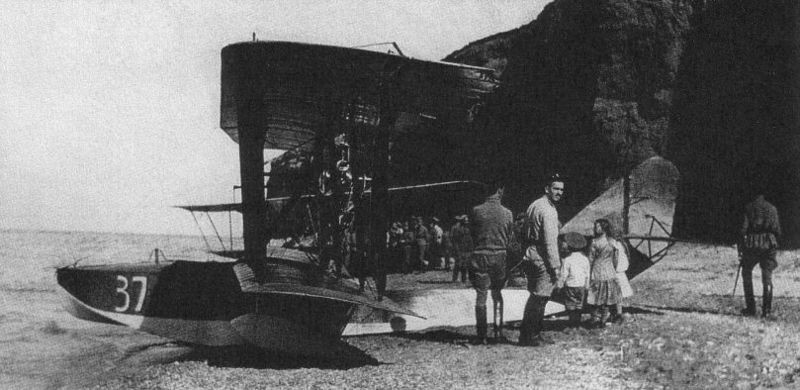
M-5 “37” Black Sea 1916.
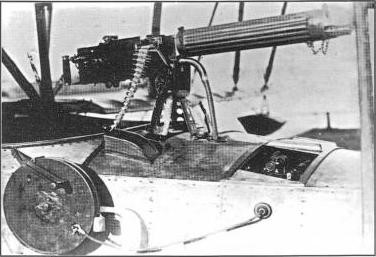
The installed armament consisted of a Maxim, Vickers or Lewis machine gun installed on a bracket in front of the right-hand post usually with 450 rounds and an assortment of 8 kg or two 50 kg bombs. Small hand bombs could be carried in the cockpit and heavier ones could be hung under the wing. Starting in November, radio-telegraphy stations with a range of 40 km and Potte cameras (designed by Russian Army Sub-Colonel VF Potte) were installed on some. It was a 9-kg semi-automatic camera of weight with a lens of 21 cm of focal length and cassettes for 50 photos of 13 x 18 cm.)
Maxim machine gun installed on an M-5 of the Black Sea Fleet.
In the Black Sea Fleet the M-5 model saw the most active use. By 1915 this force had outdated Curtiss F flying boats, which due to their performance and length of service were much inferior even to the Grigorovich M-4, of which two had been received. For this reason, the arrival of the first M-5 on May 16, 1915 was very well received. Soon this would generate an order for 12 serial copies. In total during the operational period of this flying boat in the Black Sea Fleet 71 were received.
In 1916 the naval pilots of the Black Sea receivef instruction called “Fight in the air” in which the combat methods of the M-5 were defined. The authors considered that the position of the machine gun on the M-5 guaranteed an excellent firing sector to the front, up and to the right. To the left it was only possible to cover about 60º. For this reason, M-5 crews were recommended to operate in pairs, with the second flying boat to the left and above the leader. At a distance of about 500 meters the first machine was to open fire in short salvos of 15-20 projectiles and upon reaching 100-150 meters begin continuous fire. In case the machine gun jammed, the crew had to use their Mauser pistols or Nagan revolvers.
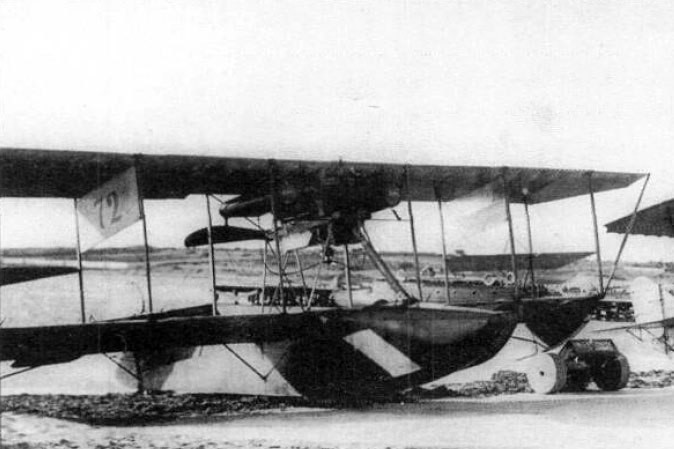
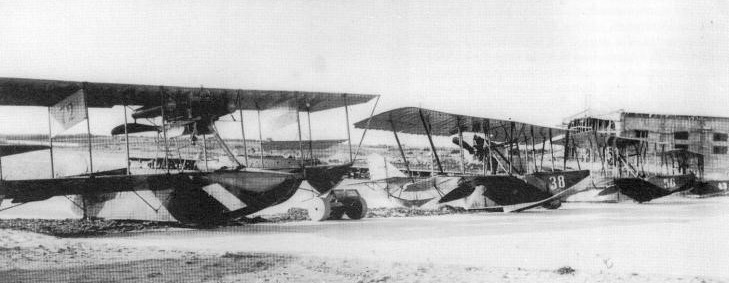
M-5 numbers 38, 56 and 43 next to Schetinin Curtiss F with number 72 at the naval station in the Kruglaya Bay in Sevastopol.
The aircraft of the Black Sea Fleet were based in Sevastopol, serving in the 1st and 2nd brigades of the air division, in Odessa and in Batumi. A certain amount was delivered to the 1, 2 and 3 air brigades on the cruisers “Alexandr I” and “Nikolai I” (capable of transporting 14 aircraft) and sometimes in the “Almaz” and “Pamyat Merkurya”. Aircraft of these cruisers participated in raids on the Turkish and Bulgarian borders. The most significant was the attack on the Turkish port of Zonguldak on January 24, 1916. This was carried out by the ship of the line “Empress María”, the cruiser “Kagul” and the cruisers “Alexandr I” and “Nikolai I”. 14 seaplanes were used, of which 11 managed to hit the target. The attack was carried out under heavy cloud conditions and return fire from the ground. Despite this, and due to the direct impact of a bomb, it was possible to sink the transport ship “Irminhard”, damaging several smaller ships and port facilities.
Repair of the Gnôme Monosoupape engine in an M-5
At the beginning of 1918 practically all the M-5 based in the Black Sea were in the zone occupied by the white troops or the Austrian interventionists. They continued to fly until 1919 – 1920.
On July 28, 1915, the Naval Aviation Officers’ School was opened in Petrograd. This center initially had four M-5 flying boats and two FBAs. Soon it was decided to open a branch of this school in Baku, on the Caspian Sea, which began operations on November 22, 1915.
Two flying boats of the Baku Flying School on the shores of the Caspian Sea.
The total number of M-5 flying boats used by the Petrograd school is unknown, but evidence has been found that in 1918, when the decision was made to evacuate the school to Nizhni-Novgorod after the start of the war with Germany, there were five in flight conditions, which were evacuated.
That same number existed at the Trotsky school, opened on November 1, 1918, on Gutuyevskaya Island in Petrograd. In the period from May to October 1919, the M-5s of this school participated in combat actions against the army of General Yudenish, who was advancing towards Petrograd.
M-5 navigating the Neva River in Petrograd.
In December 1919 the two former schools were unified into the Aviation Military Naval School, which was transferred to the Volga River near Samara. The school was installed on a barge called “Yevpraksya” specially equipped with hangars and systems for raising and lowering seaplanes into the water. Between 1920 and 1921 and basically using the M-5, 44 naval pilots were trained. In December 1921 this school was transferred to Sevastopol, where some M-5 were used until the mid-20s. By December 1925 in the Soviet naval aviation there were 22 M-5 and M-20 (version with different engine plant.)
An M-5 flying boat launched in Baku in the winter of 1915.
Starting in 1917, the Baku branch became an independent training center equipped with excellent material conditions in terms of hangars, workshops and support systems for the operation of flying boats. Up to 20 M-5 were accumulated in this unit. Some of these flying boats participated in mid-1918 in the response to the Turkish offensive in the South Caucasus or Transcaucasia area. Active use resulted in most soon becoming unusable and by 1919 only two were still in flight condition. Due to the consequences of the Civil War, the school of naval pilots of Baku ceased to exist.
M-5 “7” Trotsky flight school on Gutuyevsky Island November 1918.
At least one M-5 flying boat was used in Finland after 1918 when it was found drifting at Kuokkala in 1918. This example was captured at Kuokkala in that year and remained in service with the Finnish Air Force until 1919, when it sank.
It is also known that at least one other fell into the hands of the Turks (possibly number 31 and delivered to the Black Sea Fleet on June 10, 1915), and is preserved to this day in the Hava Museci museum in Istanbul.
The M-5 was soon obsolete and was generally used as a training model. According to the evaluation of its pilots, the “Pyatak” (nickname assigned to the model and that could be translated as Little Fifth) was “pleasant” in flight, light and easily steerable. At sea it behaved well, being able to remain operational in rough seas with waves of 0.5 meters. The strong bottom allowed it to land directly on ice and snow and its excellent design made take-offs and landings easy.
On the other hand, its performance was not high. Flight speed was 100-105 km/h with a ceiling of only 3000 meters.
The M-5 basic production version was usually powered by a 100 hp Gnôme Monosoupape engine. Nearly 300 examples were produced at the Schetinin and Anatra factories before the Bolshevik triumph and later at Factory GAZ No.3 in Petrograd.
The 1916 М-10 version was characterized by maintaining the same Gnôme Monosoupape power plant and hull but with a reduced wing span which allowed the speed to be increased to 125 km/h. DP Grigorovich did not participate in the development of this version.
The М-20 1916 version was developed on the basis of the M-5 model with a new 120 hp Le Rhône power plant. A small series of 5 examples was built, characterized by a 40 cm shorter hull, which did not show great increases in performance.




 All Aero