In 1936 Hall flew the XP2H-1 four-engined patrol bomber, largest American-built flying-boat at that time.
Amphibian
Hainan Yingge Wing CYG-11 Oriole
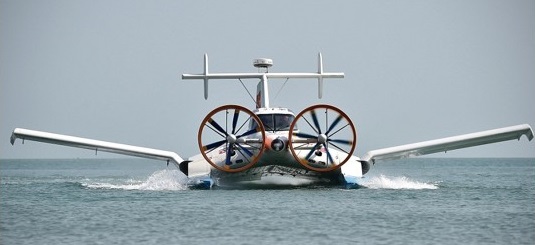
A development of TsKB Rostislav Alekseev went to China under a contract, to Hainan Yingge Wing who developed the modernized version of the Volga-2 ekranoplan. Hainan Yingge Wing conducted flight tests of CYG-11 (Oriole) vehicles on the coast of Hainan Island, near the city of Haikou.
Grumman G.73 Mallard

The Mallard was Grumman’s entry into the civilian/commercial use amphibian category. Based on the smaller Goose and Widgeon designs, the larger G73 featured tricycle landing gear. Only 59 Mallards were ever built, but some saw a new life as a turboprop with Pratt & Whitney PT6A out front. A supplemental type certificate was issued for the kerosene burning versions in 1960, but even the performance boost delivered by the more powerful engines was not enough to keep the Mallards in service.
Only 59 were built.

G-73
Engines: 2 x Pratt & Whitney R-1340 Wasp Junior, 600 hp.
Gross wt. 12,750.
Empty wt. 8,750.
Max Speed 187-191 kts.
Cruise 157-187 kts.
Initial climb rate 1,290-1,350 fpm.
Range 1,655 nm.
Ceiling 23,000-24,500 ft.
Cruise: 160 mph.
Pax cap: 12.
G-73T
Engines: 2 x Pratt & Whitney PT6A turboprop.
Seats: 12
Grumman G-64 / HU-16 Albatross / UF-1

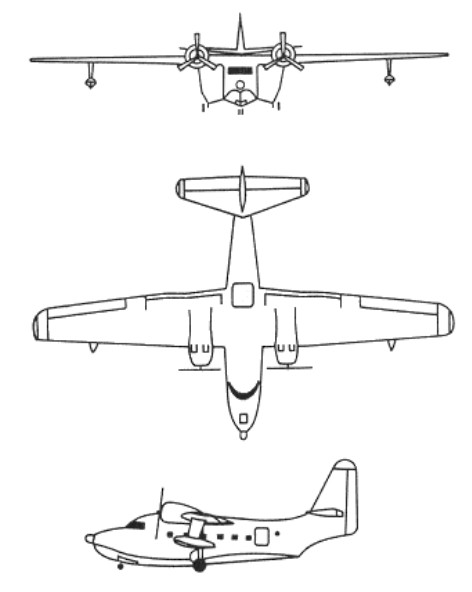
In 1944 Grumman initiated design of its Grumman G-64 aircraft, which was to be named Albatross, and which saw service with the US Air Force, US Coast Guard and US Navy. The Albatross was first ordered as the XJR2F 1 utility transport for the US Navy and the prototype was flown first on 24 October 1947, and was of generally similar configuration to its predecessor. Fixed underwing floats were retained, but these and the entire structure had been considerably refined to reduce drag. Other changes included the provision of a cantilever, instead of strut-braced, tailplane; tricycle type retractable landing gear; and pylons beneath the wing, outboard of the engines, which could carry weapons, or drop-tanks to increase range. The wings and tailplane are unswept, the tailplane with dihedral. The controls are conventional and flaps are split trailing edge type. Additional fuel could also be carried in the underwing, non-retractable, floats. Accommodation was provided for a crew of four and the cabin could accommodate 10 passengers, stretchers, or cargo, according to requirements.
Grumman G-64 / HU-16 Albatross Article
Initial production was of the UF-1 model, and a modified version introduced in 1955 was the UF-2. This latter aircraft had a 16 ft 6 in increased span, a cambered wing leading edge, ailerons and tail surfaces of increased area, and more effective de-icing boots for all aerofoil leading edges.
Many SA-16A were modified to SA-16B standard.
In the tri-service rationalisation of designations in 1962, these aircraft became HU-16C and HU-16D respectively.
Winterised aircraft for Antarctic service were designated UF-1L (later LU-16C), and five UF-1T dual-control trainers were re-designated TU-16C.
The US Navy’s UF-2 general duties amphibian and Coast Guard’s UF-2G were similar to the SA-16B. In 1965 the Coast Guard operated 71 UF-2Gs.
Also operated by the US Navy as the UF-1F and UF-1L. The UF-2S was a modification of the UF-2 for anti-submarine hunter-killer duties. It utilizes much of the equipment developed for the S2F Tracker. Norway ordered 16 examples of the UF-2S. More than 450 Albatross were built.
The USAF found the G-64 attractive for rescue operations, the majority of the 305 ordered serving with the MATS Air Rescue Service under the designation SA-16A. Most of which were converted to SA 16B form with extended wings and tail for operation at greater weight. An improved version, equivalent to the US Navy’s UF-2, entered service in 1957 as the SA-16B; in 1962 these became HU-16A and HU-16B respectively. HU-16E was the designation (originally UF-1F) of Albatross aircraft operated by the US Coast Guard, and 10 supplied to Canada were designated CSR-110.
In service in 1955 with air-sea rescue units of the U.S.A.F. (SA-16A) and with the U.S.N. (UF-1) and U.S.C.G. (UF-1G) for general utility duties. One version has a sprung ski under the hull and small skis under the wing-tip floats, to permit operation from land, water or ice without modification.
An anti-submarine version with nose radome, retractable MAD gear, ECM radome and searchlight was introduced in 1961, and was equipped to carry a small number of depth charges. The versatile Albatross continues in service with a few air forces and navies, but its powerful and fuel-hungry engines have meant that surplus aircraft which became available for use were not a particularly attractive proposition to airline operators, and in consequence few were adapted for such a role.
Several nations used the Albatross, including Argentina, Brazil, Canada, Chile, Greece, Indonesia, Italy, Japan, Norway, Philippines, Portugal and Spain. Many still in service are of the anti-submarine type first flown in 1961, with nose radome, tail MAD boom, underwing searchlight, ECM installations and provision for carrying antisubmarine depth charges, torpedoes or other stores. Full all weather electronics and anti icing equipment are standard.
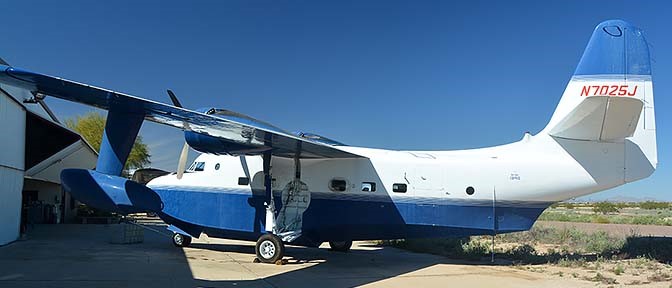
The unique capabilities of the big amphib have caused numerous attempts to modernize the basic hull. In the 1970s, Grumman reconfigured the military design to make room for 28 passengers, and added a galley for food and room for a fight attendant. The new airplane was designated the G111 and awarded FAA certification in 1980. Other Albatrosses have been converted to turbine power.
The Grumman G-111, civilianised version of the HU-16 Albatross, entered service on 1 July 1981 with Chalks International Airline to operate scheduled service between Fort Lauderdale and Paradise Island, Nassau. Chalks is a subsidiary of Resorts International, which has arranged the programme to convert U-16 to G-111 standard. Sub-contracted to Grumman, Chalks took two of the initial batch of five G-111. Up to 50 more were available for conversion.
Transland Aircraft modified HU-16B for civilian use with ATC A2GL.
Principal versions – UH-16A (short-span navy model), UH-16B (long-span navy model), UH-16C (short- span air force model), UH-16D (long-span air force model), and UH-16F (coast guard model).
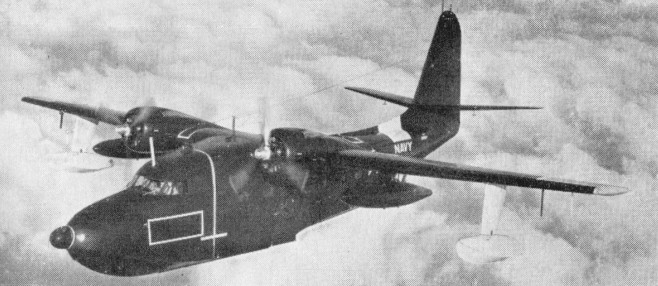
UF-1
Air-sea rescue amphibian.
Engines: 2x 1,425 h.p. Wright R1820-76B
Wingspan: 80 ft
Length: 62 ft. 2 in.
Loaded weight: 27,025 lb.
Max. speed: 247 mph
Typical range: 2,700 miles at 225 mph with 2×300 USG external tanks.
Armament: None.
Crew: 4-6
Capacity: 10 passengers or 12 stretchers.
UF-2S
Engines: 2 x Wright R-1820-76A, 1425 hp
Props: 3 blade
Wing span: 96 ft 8 in
Length: 62 ft 10 in
Height: 25 ft 10 in
Wing area: 1035 sq.ft
MTOW: 37,500 lb
Fuel capacity centre section: 562 Gal
Float fuel capacity: 2 x 166 Gal
Underwing fuel capacity: 2 x 250 Gal
Service ceiling: 21,500 ft
Range: 2850 mi at 124 mph
Wing Hardpoints: 4
HU-16C Albatross
Engines: 2 x 1,425-hp (l,063-kW) Wright R-l820-76A Cyclone
Max range: 2200 nm.
Crew: 4-6
HU-16D Albatross
Engines: 2 x 1,425-hp (l,063-kW) Wright R-l820-76 Cyclone
Maximum speed 236 mph (205 kts / 380 km/h)
Cruise speed: 360 km/h / 224 mph
Service ceiling 21,500 ft (6,555 m)
Range 2,850 nm (4,587 km)
Empty wt.: 22,883 lb (10,380 kg)
MTOW: 35,700 lb (16,193 kg)
Wing span: 96 ft 8 in (29.46 m)
Length 61 ft 3 in (18.67 m)
Height 25 ft 10 in (7.87 m)
Wing area 1,035.0 sq ft (96.15 sq.m).
Crew: 4-6
Grumman G-44 Widgeon / J4F / SCAN 30 / Gannet Super Widgeon
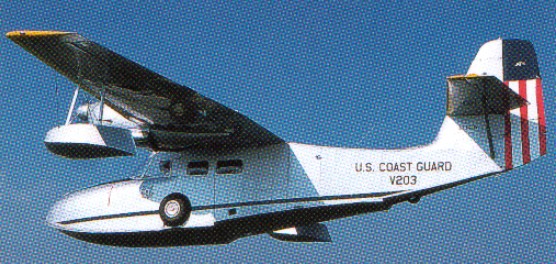
The Widgeon was a military utility version of the four-five-seat commercial Model G-44 amphibian. The four seat G 44 Widgeon was test flown by LeRoy Grumman himself and Bud Gilkes on June 28, 1940.
It first went into service with the US Coast Guard as the J4F-1 in 1941 and as the J4F-2 with the US Navy in the following year. It also served with the USAAF (as the OA-14) and with the RCAF and Royal Navy as the Gosling.
In 1946 the G-44A appeared incorporating a number of improvements, including a deeper bow, step vents to improve hydrodynamics and modified internal equipment. The Widgeon originally seated four, but the G-44A was built with five seats, and some have been converted to seat six with the middle row of seats facing aft and their backs against the wheel wells. Grumman built 76 G44As.
Production of the Widgeon, with 200 hp Ranger inline engines, totalled more than 200.

Société de Aéro-Navale / SCAN of France built 40 aircraft as the SCAN 30, after the war circa 1956, most of which had their 149kW Ranger L-440-5 engines replaced by 223kW Lycoming R-680s.
McKinnon Enterprises converted more than 70 Widgeons into Super Widgeon executive transports powered by two 201kW / 270 hp Lycoming GO-460-B1D engines.
Gannet Aircraft at Sun Valley, California, in late 1950s produced a modified version of Grumman Widgeon amphibian known as Super Widgeon and powered by two 300 hp Lycoming engines. The company used SCAN 30 airframes (license-built in France) for initial conversions.
G-44A
Engines two 200 hp Ranger 6-440-C5
Wingspan: 40 ft
Length: 31 ft 1 in
Height: 11 ft 5 in
Wing area: 245 sq.ft
Empty wt. 3,240 lb
Gross wt. 4,525 lb
Fuel capacity 108 USG
Top speed 153 mph.
Cruise 65%: 138 mph.
Initial climb rate 700 fpm.
Range 920 sm.
Ceiling 14,60 ft.
Société de Aéro-Navale G-44A
Engines: 2 x 270h.p. Lycoming GO-480-B1D, 260 hp.
Wing Span: 40′ 0″
Length: 31′ 1″
Height: 13ft (4 m)
Speed: 153 mph
Seats 4-5
J4F-2
Crew: 5
Engine: 2 x Ranger L-440C-5, 149kW
Max take-off weight: 2040 kg / 4497 lb
Empty weight: 1447 kg / 3190 lb
Wingspan: 12.19 m / 39 ft 12 in
Length: 9.47 m / 31 ft 1 in
Height: 3.48 m / 11 ft 5 in
Wing area: 22.76 sq.m / 244.99 sq ft
Max. speed: 246 km/h / 153 mph
Cruise speed: 222 km/h / 138 mph
Ceiling: 4450 m / 14600 ft
Range: 1480 km / 920 miles
McKinnon Super Widgeon G-44
Engines: 2 x Lycoming GO-480-B1D, 270 hp.
Seats: 6.
Wing loading: 22.4 lb/sq.ft.
Pwr loading: 10.2 lb/hp.
Max TO wt: 5500 lb.
Empty wt: 4000 lb.
Equipped useful load: 1401 lb.
Payload max fuel: 321 lb.
Range max fuel/ 75% cruise: 915 nm/5.7 hr.
Service ceiling: 15,000 ft.
Max cruise: 143 kt.
Stall: 54 kt.
1.3 Vso: 70 kt.
ROC: 1500 fpm.
SE ceiling: 5000 ft.
Min field length – land: 1200 ft.
Fuel cap: 648/1080 lb.
Gannet Super Widgeon
Engines: 300 hp Lycoming R-680-E3
Wingspan: 40 ft
Length: 31 ft 1 in
Height: 11 ft 5 in
Wing area: 245 sq.ft
Empty weight: 3800 lb
Loaded weight: 5500 lb
Useful load: 1700 lb
Max speed: 190 mph
Cruise speed: 170 mph
ROC: 1850 fpm
Range: 1000 mile
Fuel capacity: 158 USgallons
Water take-off: 10 seconds
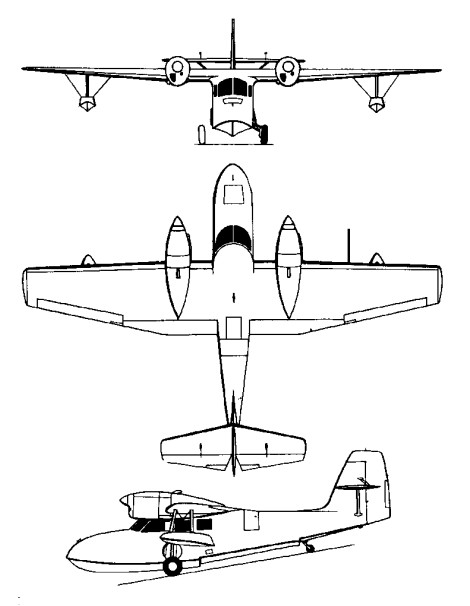
Grumman G-65 Tadpole
Flown in 1944 with Leroy Grumman at the controls, Grumman ultimately decided not to undertake production.
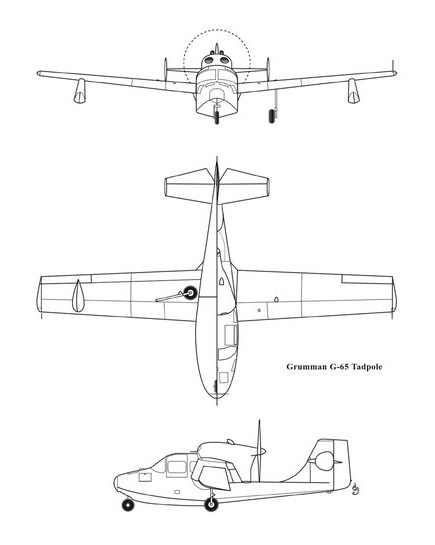
Grumman G-21 / JRF Goose
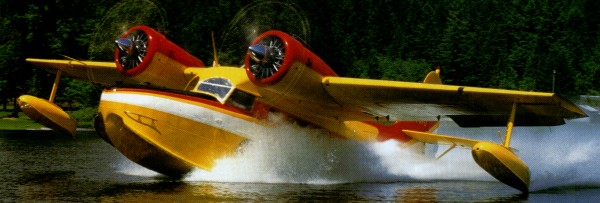
The G-21A eight-seat commercial amphibian first flew on 29 May 1937 and was Grumman’s first aircraft produced for the private and commercial market.
Proving successful, 20 were delivered prior to 1 October 1938. The G-21 was adopted by the US Navy, under the designation JRF, first entering service in 1939, and by the US Navy as the JRF-5. However most of the 300 or so aircraft built went into military service, The US Navy initially received JRF-1s and the US Coast Guard JRF-2s in 1939-40.
The series included JRF-1A aircraft, fitted for target towing and photography and JRF-3 fitted with anti-icing equipment and autopilot for use in northern waters by the US Coast Guard.
The JRF-4 was a development of the JRF-1, and JRF-5 (OA-9) for the USAAF and fitted for photography.
The JRF-6B was a navigational trainer.
The JRF-5s also served with the RCAF and the JRF-5 and -6 with the RAF as the Goose.
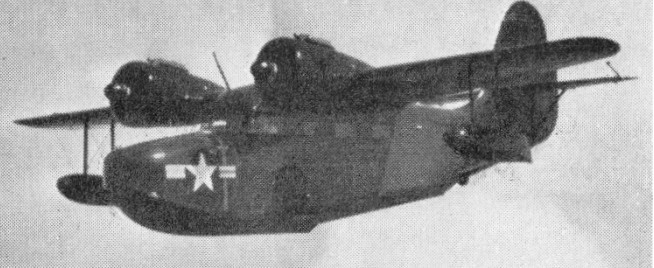
Production of the JRF ceased in September 1945, but the type continued to serve as a general/utility amphibian with the US Navy and Coast Guard.
More than 300 of the G-21A Goose series with 450 hp Pratt & Whitney engines were built just before and during World War II. Large numbers of’ these amphibians were still used by the U S Navy and Coast Guard for an-sea rescue and transport duties in 1955.
After the war McKinnon Enterprises began a conversion programme, replacing the original 335kW Pratt & Whitney R-985-AN-6 engines with four 253kW Lycoming GSO-480s and incorporating other refinements to produce executive transports. This programme was superseded by the turboprop-powered G-21C, D and G Turbo-Goose conversions, initiated in 1966. The turboprop version is powered by two 680 shp / 507kW Pratt & Whitney Aircraft of Canada PT6A turboprop engines. Other improvements include retractable wing floats and increased fuel capacity.
Grumman G 21 A / JRF Goose
Engine: 2 x Pratt&Whitney R-985-AN6 Wasp Junior, 450 hp
Length: 38 ft 4 in / 11.68 m
Height: 15 ft / 4.57 m
Wingspan: 49.016 ft / 14.94 m
Wing area: 375.018 sq.ft / 34.84 sq.m
Max take off weight: 7955.6 lb / 3608.0 kg
Weight empty: 5426.5 lb / 2461.0 kg
Max. speed: 174 kts / 323 km/h / 201 mph
Cruising speed: 166 kts / 307 km/h
Service ceiling: 21,000 ft / 6400 m
Cruising altitude: 5003 ft / 1525 m
Wing load: 21.32 lb/sq.ft / 104.0 kg/sq.m
Range: 556 nm / 1030 km
Fuel capacity 220.
Crew: 2
Seats: 4-6
JRF-5 Goose
Engines: two 450 h.p. Pratt and Whitney R-985-N-6
Span: 49 ft
Weight: 8,500 lb
Max Speed: 180 mph
Maximum range: 800 miles approx
Crew: 2-6
McKinnon Turbo Widgeon G-21E
Engines: 2 x P&WAC PT6-27, 715 hp.
Wing loading: 33.1 lb/sq.ft.
Pwr loading: 7.3 lb/hp.
Max TO wt: 10,500 lb.
Empty wt: 6635 lb.
Equipped useful load: 3507 lb.
Payload max fuel: 0 lb.
Range max fuel/ cruise: 1131 nm/5.8 hr.
Service ceiling: 20,000 ft.
Max cruise: 174 kt.
Stall: 73 kt.
1.3 Vso: 95 kt.
ROC: 2000 fpm.
SE ceiling: 12,000 ft.
Min field length – land: 1500 ft.
Fuel cap: 3956 lb.
Seats: 10.
McKinnon G-21G Turbo Goose
Engines: 2 x Pratt -Whitney Canada PT6A-27, 507kW / 680 shp
Wingspan: 15.49 m / 50 ft 10 in
Length: 12.06 m / 39 ft 7 in
Wing area: 35.08 sq.m / 377.60 sq ft
Max take-off weight: 5670 kg / 12500 lb
Empty wt: 6635 lb
Equipped useful load: 5507 lb.
Payload max fuel: 1551 lb.
Fuel cap: 3956 lb
Wing loading: 33.1 lb/sq.ft.
Pwr loading: 9.19 lb/hp.
Max. speed: 391 km/h / 243 mph
Max cruise: 174 kt.
Stall: 73 kt.
1.3 Vso: 95 kt.
ROC: 2000 fpm.
Service Ceiling: 6095 m / 20000 ft
SE ceiling: 12,000 ft.
Min field length – land: 1500 ft.
Range max fuel/ cruise: 1131 nm/5.8 hr.
Seats: 13
Grumman J2F Duck / OA-12 / JF / G-15
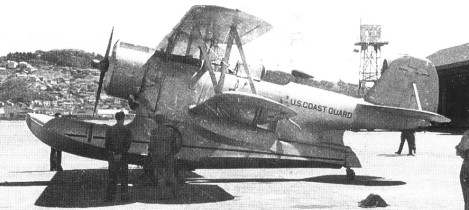
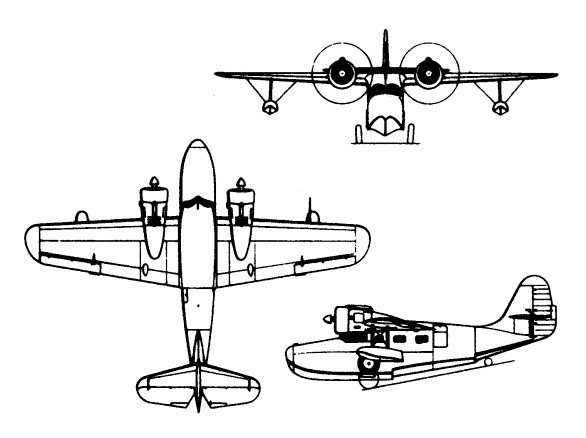
The J2F was an equal-span single-bay biplane with a large monocoque central float which also housed the retractable main landing gear, a similar design to the Leroy Grumman-designed landing gear first used for Grover Loening’s early amphibious biplane designs, and later adopted for the Grumman FF fighter biplane. The aircraft had strut-mounted stabilizer floats beneath each lower wing. A crew of two or three were carried in tandem cockpits, forward for the pilot and rear for an observer with room for a radio operator if required. It had a cabin in the fuselage for two passengers or a stretcher.
The Duck’s main pontoon was blended into the fuselage, making it almost a flying boat despite its similarity to a conventional landplane which has been float-equipped. This configuration was shared with the earlier Loening OL, Grumman having acquired the rights to Loening’s hull, float, and undercarriage designs. Like the F4F Wildcat, its narrow-tracked landing gear was hand-cranked.
Production of this general utility amphibian began in 1933 when the first prototype flew, and production continued until 1945. In all, nine series of the Duck were built.
The J2F-1 Duck first flew on 2 April 1936, powered by a 750 hp (559 kW) Wright R-1820 Cyclone, and was delivered to the U.S. Navy on the same day. The J2F-2 had an uprated Wright Cyclone engine of 790 hp (589 kW). Twenty J2F-3 variants were built in 1939 for use by the Navy as executive transports with plush interiors. Due to pressure of work following the United States entry into the war in 1941, production of the J2F Duck was transferred to the Columbia Aircraft Corp of New York. They produced 330 aircraft for the Navy and U.S. Coast Guard. If standard Navy nomenclature practice had been followed, these would have been designated JL-1s, but it was not, and all Columbia-produced airframes were delivered as J2F-6s.
The first appeared for the Navy in 1933 as the JF-1, powered by a 521.6kW Pratt & Whitney R-1830 Twin Wasp engine. This was followed by the JF-2 Coast Guard version, powered by a 559kW Wright Cyclone radial, and the JF-3.

The amphibian was originally used for photography, target-towing, scouting, and rescue work. Although the Duck is normally flown as a two-seater in tandem fashion, a folding floor in the rear cockpit gives access to a lower compartment for use in rescue work and the like; the lower compartment could house either two extra crew members or a stretcher.
A number of JF-2s were also delivered to Argentina.
By the beginning of 1941 about 115 JF and J2F-1 (company designation G-15) to J2F-4 Ducks were in service as general/utility amphibians for photographic, target-towing, scouting and rescue work. The J2F was an improved version of the earlier JF Duck, with its main difference being a longer float.
These were followed by J2F-5s and J2F-6s. The J2F6 was by far the most common. It featured aerodynamic improvements over the previous models, including a long-cord engine cowling.
The J2F-6 was produced in 1944 by the Columbia Aircraft Corporation of Valley Stream, Long Island, under licence from Grumman, bringing the total number of JF/J2Fs built to over 600.

J2Fs of the utility squadron of US Patrol Wing 10 were destroyed at Mariveles Bay, Philippines, by a Japanese air raid on 5 January 1942. The only Duck to survive the attack had a dead engine but had been concealed at Cabcaben airfield during the Battle of Bataan, to be repaired afterwards with a cylinder removed from a destroyed J2F-4 submerged in Manila Bay. Following repairs the J2F-4 departed after midnight on 9 April 1942, overloaded with five passengers and the pilot, becoming the last aircraft to depart Bataan before the surrender of the Bataan to the Japanese only hours later. Among its passengers was Carlos P. Romulo (diplomat, politician, soldier, journalist, and author), who recounted the flight in his 1942 best-selling book I Saw the Fall of the Philippines (Doubleday, Doran & Company, Inc., Garden City, New York 1943, pp. 288–303), for which he received the Pulitzer Prize for Correspondence.
Several surplus Navy Ducks were converted for use by the United States Air Force in the air-sea rescue role as the OA-12 in 1948.
The Argentine Naval Aviation received four new-build Grumman G-15s (equivalent to J2F-4s) in 1939, to supplement the eight Grumman G-20s (export version of the Grumman JF-2) received in 1937. In 1946–1947, 32 ex-US Navy Ducks (consisting of one J2F-4, 24 J2F-5s, and 7 J2F-6s) were acquired, with the last examples remaining in use until 1958.
The Colombian Navy operated three examples from 1948.
The Mexican Navy operated three ex-U.S. Navy J2F-6s from 1950–1951.
The Peruvian Navy operated one ex-USN example from 1961–1964.
In the United States the United States Army Air Forces, United States Coast Guard, United States Marine Corps, and United States Navy all operated the J2F.
A Grumman J2F-6 Duck was owned and operated by Kermit Weeks at Fantasy of Flight in Polk City, Florida.

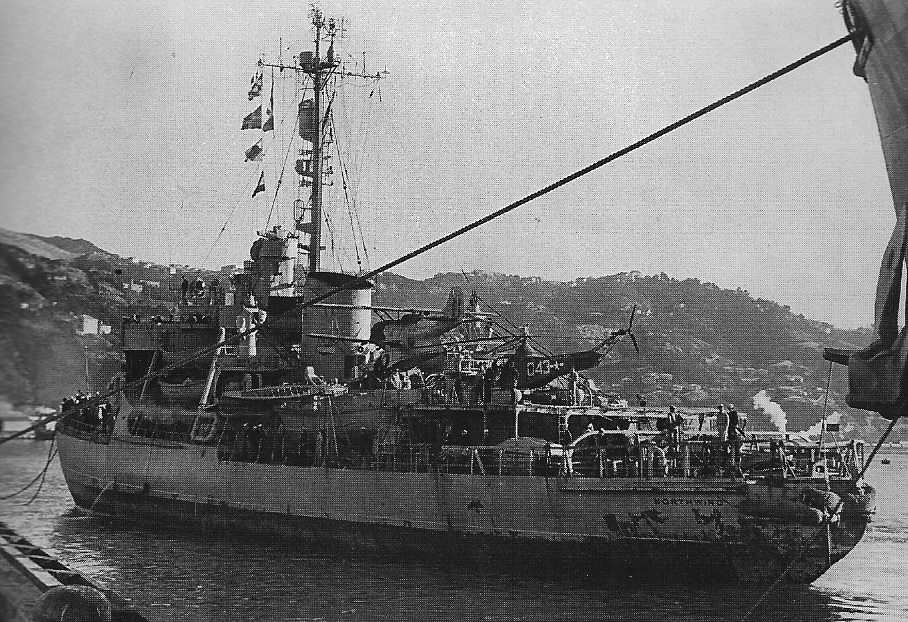
The United States Coast Guard worked with North South Polar, Inc. to recover a J2F-4 Duck, serial number V-1640, downed in a storm on a Greenland glacier on 29 November 1942. Two Coast Guard airmen were lost along with a rescued U.S. Army Air Forces passenger from a downed B-17 searching for a downed C-53 with five on board. The three men of the Duck are presumed to still be entombed at the site. North South Polar, under the auspices of the Coast Guard team, located the aircraft in August 2012 resting 38 feet beneath the surface of the ice sheet.
Variants:
J2F-1
Initial production version with 750 hp R-1820-20 engines, 29 built.
J2F-2
United States Marine Corps version with nose and dorsal guns and underwing bomb racks, 21 built.
J2F-2A
As J2F-2 with minor changes for use in the United States Virgin Islands, nine built.
J2F-3
J2F-2 but powered by an 850 hp R-1820-26 engine, 20 built.
J2F-4
J2F-2 but powered by an 850 hp R-1820-30 engine and fitted with target towing equipment, 32 built.
J2F-5
J2F-2 but powered by a 1,050 hp R-1820-54 engine, 144 built.
Engine: 1 × Wright R-1820-54 nine-cylinder radial engine, 900 hp (670 kW)
Wingspan: 39 ft 0 in (11.9 m)
Wing area: 409 ft² (38 m²)
Length: 34 ft 0 in (10.37 m)
Height: 13 ft 11 in (4.25 m)
Empty weight: 5,480 lb (2,485 kg)
Loaded weight: 7,700 lb (3,496 kg)
Maximum speed: 190 mph (304 km/h)
Cruise speed: 155 mph (248 km/h)
Stall speed: 70 mph (112 km/h)
Range: 780 mi (1,255 km)
Service ceiling: 20,000 ft (6,100 m)
Rate of climb: ft/min (m/s)
Crew: two (pilot and observer)
Capacity: two rescued airmen
Armament: 1 × Browning .30 cal machine gun (7.62 mm) on flexible mount in rear cockpit
Bombload: 650 lb (295 kg)
J2F-6
Columbia Aircraft built version of the J2F-5 with a 1,050 hp R-1820-64 engine in a long-chord cowling, fitted with underwing bomb racks and provision for target towing gear; 330 built.
OA-12
Air-sea rescue conversion for the United States Army Air Forces (and later United States Air Force, OA-12A).
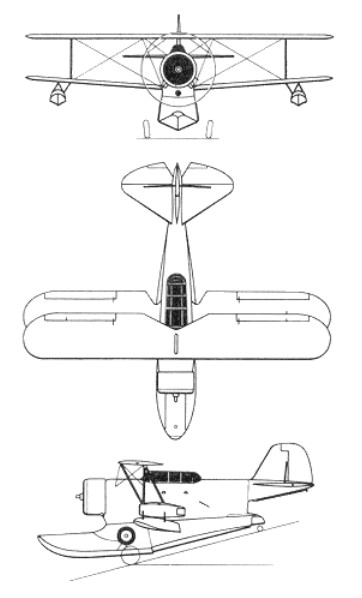
Grover-Loening XS2L / XSL-2
Grover-Loening built a small amphibian flying-boat XS2L for U.S. Navy in 1931. Delivered XSL-2 experimental submarine-borne version in 1933.
Grigorovich GASN / Shchetinin GASN
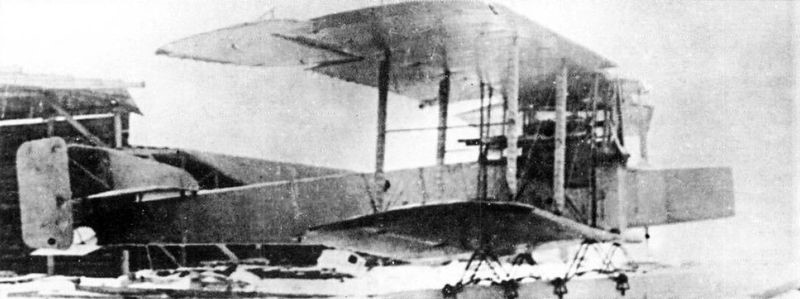
The bases of this project go back to an idea presented by Fleet Senior Lieutenant II Golenischev-Kutuzov, who proposed to build a special hovercraft capable of carrying out torpedo attacks on enemy ships. Little by little the idea of the hovercraft was derived from a specialized seaplane. This idea of Golenischev-Kutuzov was presented to PRTV for its implementation.
The plane began to be designed and built in 1916 at the Shchetinin Society. Co – engineered by Mikhail Mikhailovich Shishmariov, who headed the construction department at the Shchetinin factory. Shishmariov developed the entire technical project for the new aircraft, while Grigorovich was in charge only of the general conception of the model and the general direction during the preparation of the plans and technical documentation.
The GASN was designed as a huge twin-engine sesquiplane with a pair of floats and capable of carrying a 450-hp torpedo designed at the “Novi Lessner” factory in Petrograd. The power plant consisted of two 220 hp Renault engines located between both planes on steel tube supports and moving large four-blade propellers.
The initials GASN (Григорович/Шишмарев ГАСН) correspond to G idro Aeroplan S petsialnovo N aznachenia (Special Missions Hydroplane), although the model was also known as SON ( Samoliot O sobovo N aznachenia ) and in either of the two names it was considered to create an aircraft capable of carry and launch a naval torpedo, making this model the world’s first naval torpedo boat. We must add that this subject was considered highly secret, so in fleet documents references to the project are made as Type K.
The floats had a traditional construction similar to that used for the hull of submarines at the time and were fixed to the lower wing by means of uprights in an inverted V made of steel tubes with rubber attachment points.
The fuselage had a rectangular cross section secured by cables and covered with fabric.
The tail was of the biplane type with three rudders and a small keel on the central empennage.
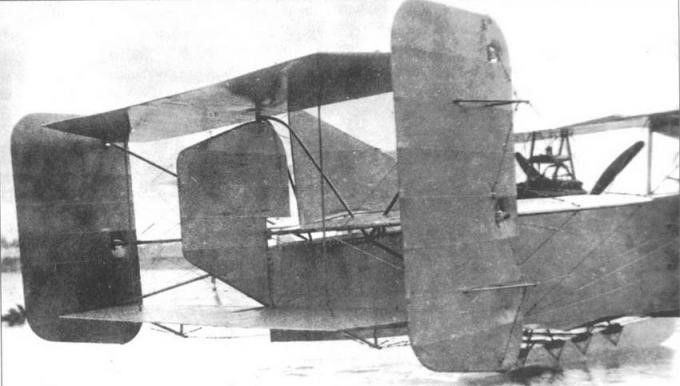
The large-span wing featured traditional wood-frame construction with fabric covering. The structure had three auxiliary spars to be able to fix the large ailerons. The shape in the plane of the wing was rectangular with a constant chord, but instead of being straight it presented a slight sagging.
The leading edge of the upper wing had indentations in the area of the propellers. The interplane supports were built with steel tubes on which they installed fabric-covered aerodynamic fairings and cable tensioners.
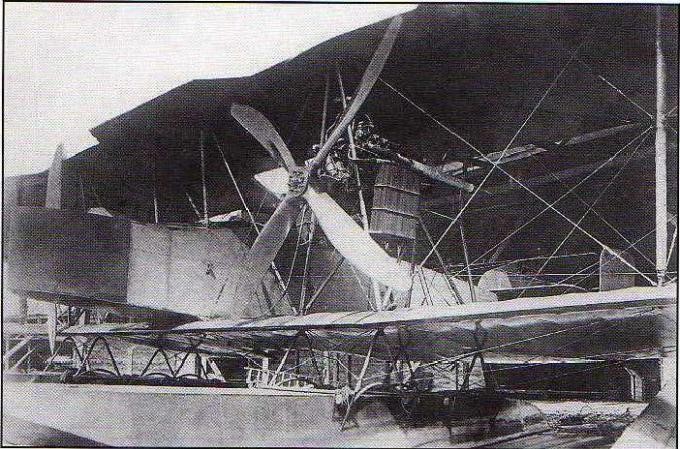
The GASN crew consisted of 3-4 people. In the bow area there was a position reinforced with sheets of plywood for an observer-gunner in charge of defending the forward hemisphere. Behind this position was the cockpit for two pilots and behind the wing box a third position for a gunner.
Even without completing the assembly of the first example, a request for the construction of 10 examples had been sent to Shchetinin.
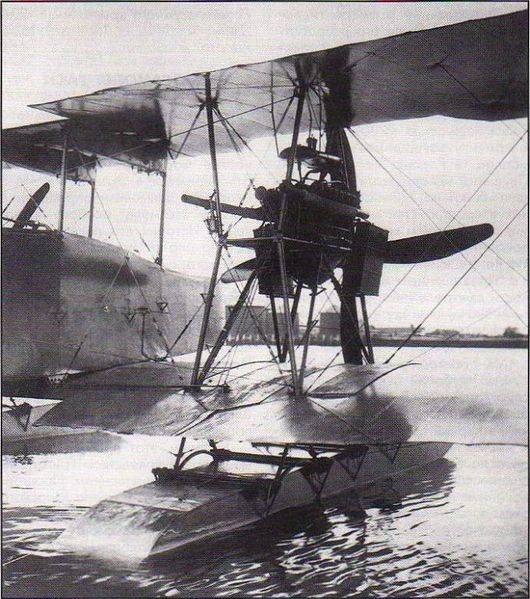
The first flight of the prototype took place on August 24, 1917 in Petrograd under the leadership of Senior Lieutenant A. Ye. Gruzinov. The first tests showed that the GASN had good behaviour in the water and was easily controllable, but it was necessary to modify the trim and improve the response of the rudders. It was proposed to advance the engines, locate certain weights and increase the wing’s rake angle to advance the center of gravity of the airplane. It was also proposed to increase the surface of the rudders.
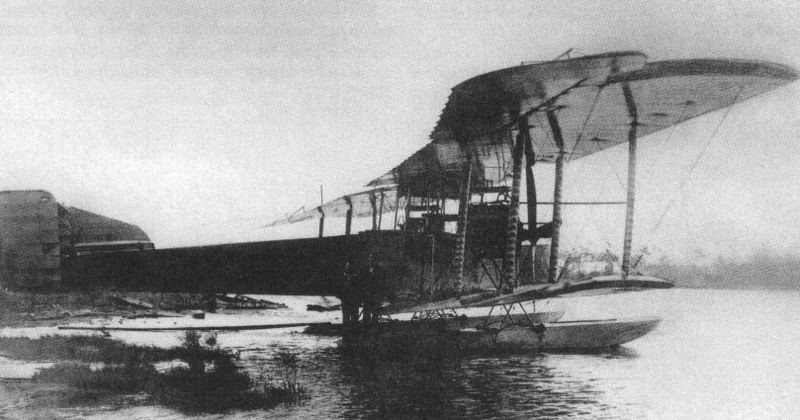
On September 24, during one of the flights, one of the floats was damaged, showing the need to reinforce its structure. After the repairs the plane began to fly again. These flights produced another series of problems, which is why the possibility of the Navy not continuing development and adapting the “Ilya Muromets” bomber or the Jioni twin-tailed plane for this role was considered.
The events of the revolution in Petrograd and the chaotic situation of the first years of the revolution prevented further development. Despite these factors, the GASN and an important set of construction elements of the started series of 10 copies were preserved intact, initially at the Shchetinin factory, which had changed its name to “Gamayún” and later at the “Krasni Liotchik” Factory.
The intention to continue the works would arrive in 1920. In that year Grigorovich traveled to Moscow and received an engineering post in Glavnoavia. His first task consisted of trying to continue the development of the projects stopped in the period 1917-1918. Grigorovich proposed to restore the work on the GASN torpedo bomber, knowing the state of conservation of the prototype and a good number of parts and components to assemble various aircraft of this type.
In November 1920 the GASN was made airworthy and the pilot LI Giks began carrying out the tests. Dmitri Pavolvich was on the shore supervising the process. On the 4th of that month, after long checks on the state of the engines, the mechanic Ozolin told Giks that the plane was ready for flight. The pilot stood in the cockpit and gave instructions to release the seaplane into the water.
During takeoff runs, tabs of fire began to come out of the exhaust pipes of one of the engines. Fearing a fire Giks decided to interrupt the test.
The engines were once more overhauled and the plane was finally cleared to take off, despite the fact that the weather conditions had deteriorated with a southerly wind that made take off difficult and the appearance of floating ice in the bay.
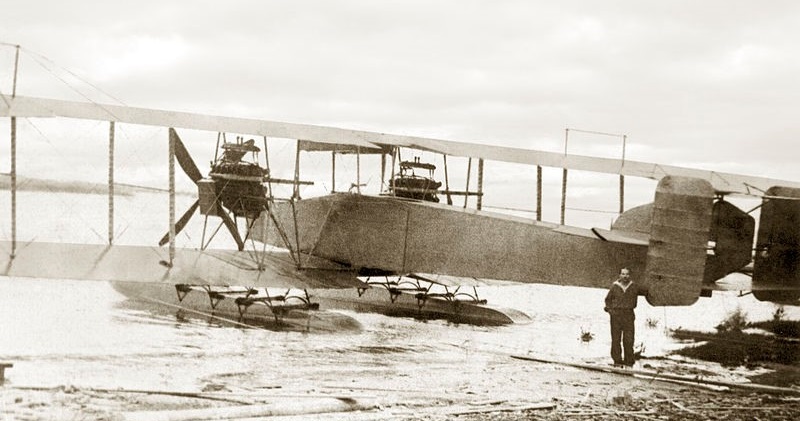
Steering the plane in the direction of Volni Island, Giks turned the plane upwind and took off. The plane was beginning to climb without difficulty when suddenly the engine on the right stopped working. The pilot turned for a landing near Krestovski Island. After gliding, the pilot managed to land and tried to steer the seaplane with a single engine. It was found that the seaplane’s rudder was ineffective and the aircraft only rotated around one axis. Giks directed the mechanic to go to the wing to try to compensate by sinking the float, but that didn’t help either. Waiting for help Giks switched off the engines. The plane began to drift freely.
The crew members removed the cushions from the seats, sprayed them with gasoline and lit them, throwing them near the plane as a signal for help, but help did not appear anyway.
For a whole day the plane drifted. At dawn the crew confirmed that they were about three kilometers from the shore and that the entire plane was surrounded by sheets of ice that made rescue difficult. Finally it was possible to bring the plane to the shore. The analysis of the accident showed that during the preparation of the flight, instead of oil, it was poured into the diluent tank.
With this the development came to an end.
GASN
Power plant: 2 x Renault, 220 hp
Upper plane wingspan: 28.0 m
Wing area: 150.0 m²
Length: 14.50m
Payload: 1450kg
Speed at sea level: 110-120 km/h
Accommodation: 3 – 4
Armament: two machine guns
Bombload: 450 kg torpedo or 480 kg of bombs

 All Aero