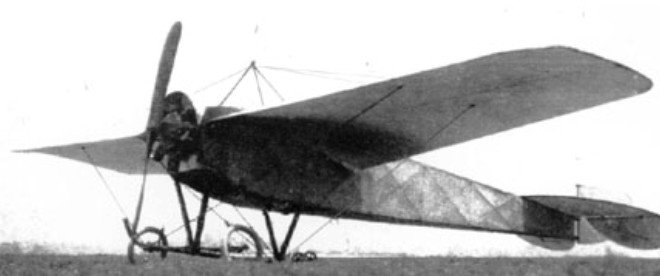
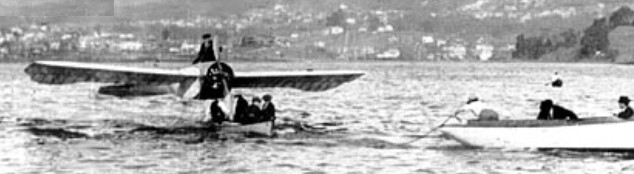
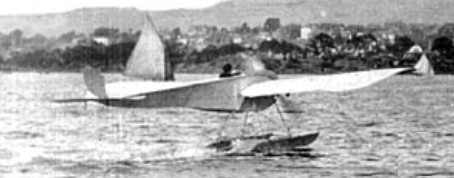
Stanley Hiller Snr began designing gliders in 1909 and this, his first powered aircraft, flew at Alameda and a 1911 air meet at Tanforan race track in South San Francisco. On pontoons, it was flown from Lake Merritt, Oakland, by Charles Patterson in August 1912.
Power was 60hp and 80hp Hiller rotary built from Hiller’s plans by C E Kelsey, San Francisco.
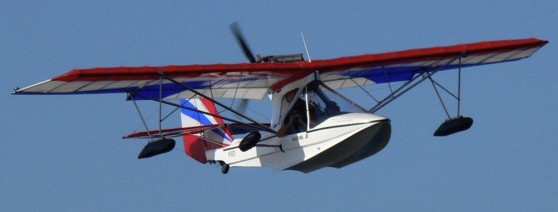
Receiving the “Best New Design” award at Oshkosh 1984 the Buccaneer was a conventional double-surface high-wing, three-axis control ultralight. Powered by a Rotax 277 single-cylinder, it came in three models — open framework, pod, and retractable amphibian. The landing gear was taildragger, or retractable/amphibian, using reinforced fiberglass hull & sponsons. Centre mounted joy stick, rudder pedals, tailwheel steerable through rudder pedals. Later marketed by Keuthan Aviation as the Buccaneer SX and Buccaneer II, and by Arnet Pereyra Inc as the Aventura 1 HP/A and Aventura II A. A modified version, retrofitable to Buccaneers was marketed by Advanced Aeromarine as the Mallard. The Mallard was available as a conversion for existing Buccaneers or as a complete kit. First flown in 1993. Although produced as an amphibious flying boat, the Buccaneer can be converted to a land plane by removing the boat hull and floats.
The Aero Adventure Aventura II Sport is a new model designed to minimize the expense and complexity of buying, building, and flying a two seat Aventura. With a strong 65 H.P. Rotax 582, the complete kit started at only $33,400. This is by far the most inexpensive two place amphibian on the market. Invest 250 hours of assembly time and this plane will be flying you and a friend anywhere. The 100 H.P. 4-Stroke Rotax 912ULS with its 18 gallon fuel tank allows a solid 3 hours of flight with reserve. $44,900 for the complete kit. The Aventura II XLR has a new engine cowling available, a new graphics package, an amazing new panel with AVMAP’s daylight readable GPS, a VSI, mode-C transponder, and more. Electric gear with indicator lights, differential hydraulic brakes, carpeting, headliner, 600-6 Soft Turf Tires, a 100 H.P. Rotax 912 ULS with an Air Box, a custom stainless steel exhaust, a warp drive 3-blade nickel edge prop and a spinner.
The Arnet Pereyra Buccaneer SX first flew in May 1986. The Arnet Pereyra Buccaneer II first flew in March 1984. The Arnet Pereyra Aventura UL and HP first flew in March 1995. The Arnet Pereyra Aventura II first flew in June 1995.
Buccaneer (Land) Empty wt: 228 lbs. Empty weight (De Luxe) 250 lbs. Wing span: 35 ft. Wing area: 147 sq.ft. Aspect ratio 8:1 Length: 17 ft 6 in Fuel cap; 4.5 USG. Construction: Aluminium, Dacron. Engine: Rotax 277 (268cc) 28hp. Max wt: 500 lbs. Stall speed: 20 mph. Max speed: 51 mph. Vne: 75 mph. Climb rate: 600 fpm @ 28 mph. Design limit: +5, -3.5g. Glide ratio: 8-1. Wing loading: 3.4 lbs/sq.ft. Power loading: 17.86 lbs/hp. Pilot weight category 90-225 lbs all models.
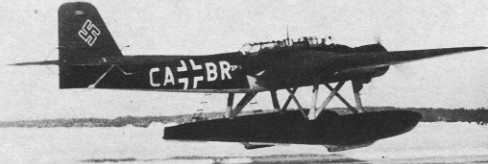
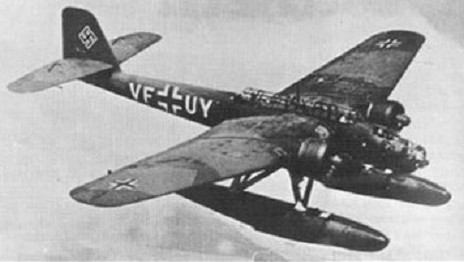
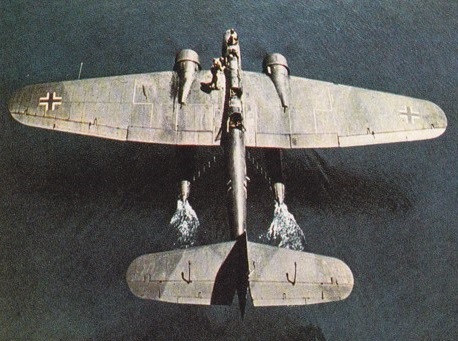
Design of this large seaplane started in 1935 as a faster and more manoeuvrable replacement for the He 59. It was an all metal mid wing monoplane with single step metal floats. For its size it handled well and gave good performance.
The prototype He 115 V1 (D AEHF) was first flown in August 1937, powered by two 800 hp BMW 132K nine cylinder radials. After further flight trials its two machine-guns were then removed, their positions faired over, and on 20 March 1938 the aircraft set eight payload/speed records.
This aircraft was followed by three more prototypes of which the He 115 V3 (D ABZV) was the first aircraft to be given the extensively glazed nose of the final production version. The field of view for two of the three man crew was increased still further by extended glazing of the canopy from the cockpit back to the mid-¬fuselage position. The fourth prototype was the production prototype with float/ fuselage bracing wires replaced by struts.
An evaluation batch of ten, designated He 115A 0, also produced in 1937-38, were followed in 1939 by 34 He 115A 1s, powered by uprated 960 hp BMW 132K engines. The He 115A 0s were armed with a single 7.9 mm (0.311 in) machine gun in the extreme nose while A 1 models were fitted with an extra MG 15 gun and were used as torpedo attack aircraft. Some A 1s were built for export and designated A 2: Norway bought six and Sweden 10.
The first large scale production version for the Luftwaffe derived from the V5 (itself modified from an A 0) which developed into the He 115B series. These aircraft had structural improvements to accommodate the heavier payload, an increased fuel capacity, and provision for up to five 250 kg (550 lb) bombs. Alternatively, two 250 kg (550 lb) bombs and an 800 kg (1760 lb) or 920 kg (2030 lb) torpedo or mine could typically be carried. Manufacture continued until 1944, by which time production totalled 138 air¬craft, excluding prototypes.
The B series was followed by the He 115C series, begun in 1940 and entering Luftwaffe service the following year. The C 1 had an additional under nose MG 151 cannon and two rearward firing MG 17 machine guns mounted in the rear of the engine nacelles. Subsequent C variants were generally similar, the C 2 having reinforced floats; the C 3s were fitted with mine-laying equipment; and the C 4s were used as torpedo bombers, armed with only three rearward firing machine guns.
A one off He 115A 1, converted to become the He 115D, was armed with one cannon and five machine guns, carried a fourth crew member, and was powered by two 1600 hp BMW 801MA radial engines. It was used operationally but did not go into series production.
The He 115 stayed in useful service until 1944, and was used mainly in Scandinavia, the North Sea and English Channel, the north of Germany, and to a lesser extent in the North African and Mediterranean theatres. Two of the Norwegian He 115A 2s escaped to the UK in 1940 and, together with an ex-Luftwaffe B-1, were used by the RAF to carry agents between Malta and North Africa. During their service lives, the He 115B and C models were fitted with a variety of Rustsatze (field conversion kits) comprising variations in the nature of the operational payload carried. The particular kit was indicated in a suffix to the main designation: thus, for example, the He 115B-1/R1 was a standard B-1 carrying a photo reconnaissance twin camera installation (R1), whereas the He 115B 1/R3 was equipped with one 920 kg (2030 lb) or two 500 kg (1100 lb) aerial mines and their release gear.
He 115C-1 Engines: 2 x BMW 132K, 960 hp / 872 kW Span: 22.3 m (73 ft 2 in) Length: 17.3 m (56 ft 9 in) Height: 21 ft 7.25 in / 6.59 m Wing area: 933.23 sq.ft / 86.70 sq.m Empty weight: 15,146 lb / 6870 kg Gross weight: 10680 kg (23550 lb) Maximum speed: 300 km/h (186 mph) at 3280 ft / 1000m Climb to 3280ft/1000m: 5 min 6 sec Service ceiling: 18,040 ft / 5500m Range: 1740 mi / 2800 km Seats: 3 Armament: 1 x 15mm cannon / 4 x 7.92mm mg Bombload: 2756 / 1250 kg or 1 x 1102 lb / 500 kg torpedo
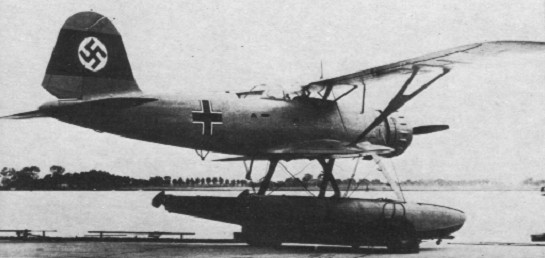
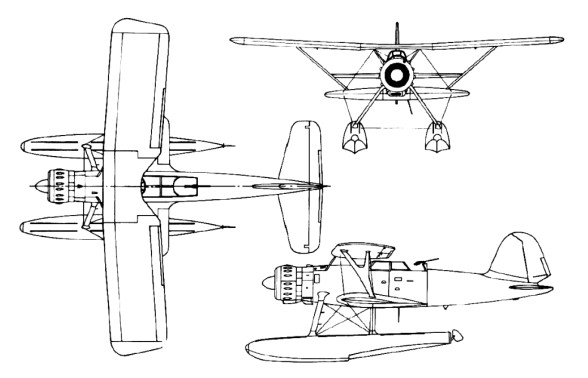
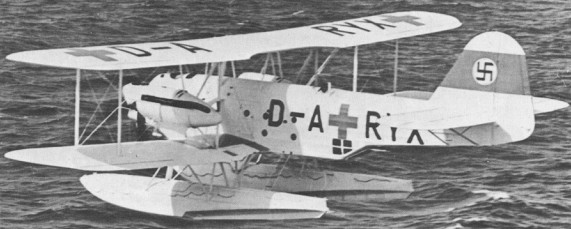
Begun by Heinkel under Luftwaffe contract at the beginning of 1936, the first of five variously ¬powered prototypes flew in the late spring of that year. It was a two seat, all metal two float seaplane of sesquiplane configuration, fitted with a 960 hp DB 600A engine driving a three blade wooden propeller.
The five prototypes, flown in 1936 and 1937, were powered by a variety of engines, including the 716kW Daimler-Benz DB 600, the 477kW Junkers Jumo 210, the 656kW BMW 132Dc and the 716kW BMW 132K.
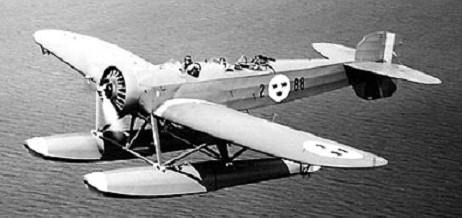
These five, and the first of ten pre-production He 114A-0s, were delivered to the Luftwaffe during 1937, with the BMW 132Dc engine, which was adopted also for the 33 He 114A-1 trainers, though they were neither armed nor fitted with catapult hooks. Thirty three 865-hp BMW-132N engined A 1s were built as trainers by Weser. Earlier that year the German aviation ministry accepted the V9 (D IHDG) as prototype for the He 114A 2 series, which were powered by an uprated (960 hp) BMW 132K engine driving a three blade constant speed propeller and fitted with catapult gear. It flew for the first time on February 16, 1937 and a small batch of A 2s, again built by Weser, were delivered to the Luftwaffe later in the year. The He 114A-2 was the first operational version, armed with a fixed forward-firing 7.92mm MG 17 machine-gun and an identical weapon mounted in the observer’s cockpit.
They were equipped with catapult points and could carry two 50 kg (110 lb) bombs. The Luftwaffe pilots found their handling on the water and in the air to be somewhat unstable, and the He 114 never superseded the He 60 in service. The prewar A 2s were later converted by Weser for export to Sweden (14 as He 114B 1s) and Romania (six He 114B-2 aircraft, three with DB 600 engines and three with Jumo 210s). Romania also bought 12 He 114B-2S with BMW 132K engines. 14 He 114A-2s were exported to Sweden as the He 114B-1. Fourteen He 114C 1s were used by the Luftwaffe as commerce raiders, and four unarmed C 2s were delivered for use as trainers in December 1939, having the 865 hp BMW 132N engine. At the outbreak of the Second World War, the C l s and some other models were equipped with one or two additional MG 17 machine guns in the pilot’s cockpit, firing past the propeller. Some He 114s carried four 50 kg (110 lb) bombs for antisubmarine duties (only two when additional machine gun armament was carried). The He 114 was phased out during the first two years of the war, after limited Luftwaffe service. Production ceased in 1939.
He 114A 2 Engine: 1 x BMW 132K, 610kW Wingspan: 13.6 m (44 ft 7.5 in) Length: 11.65 m (38 ft 2.75 in) Height: 5.2 m / 17 ft 1 in Wing area: 42.3 sq.m / 455.31 sq ft Max take-off weight: 3420 kg / 7540 lb Empty weight: 2314 kg / 5102 lb Max. speed: 292 km/h / 181 mph Cruise speed: 265 km/h / 165 mph Ceiling: 4800 m / 15750 ft Range w/max.fuel: 1050 km / 652 miles Range w/max.payload: 910 km / 565 miles Armament: 1 x 7.92mm machine-guns Crew: 2
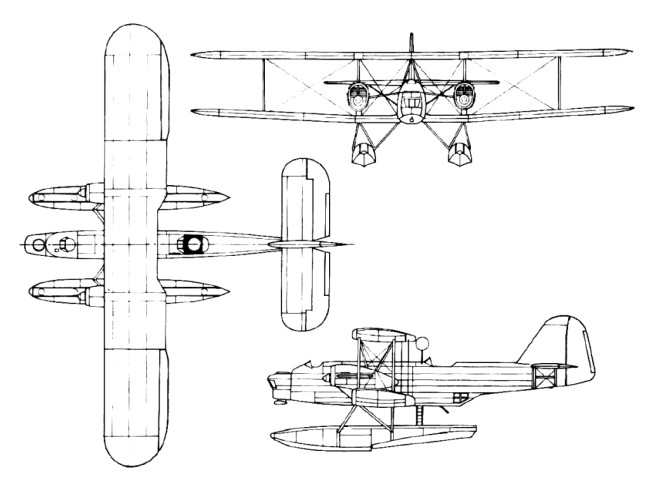
The design project for this large fuselage torpedo bomber/reconnaissance biplane was begun in 1930 by Reinhold Mewes of the Heinkel company, and was the largest of the company’s designs up to that time. The first prototype to fly, the He 59A (D 2215), was of sturdy appearance with a faired in wheeled undercarriage and was powered by two 492kW / 660 hp BMW VI liquid cooled engines. The airframe comprised a welded steel tube fuselage, with wooden frame wings, all of which were fabric covered.
As its intended role was for overwater reconnaissance, all production models and the He 59B first prototype (which was the second example to fly) were fitted with twin float undercarriages. After service trials of the He 59A, production began in spring 1932 with a pre series batch of 16 armed He 59B-1s. It is fairly certain that these were built by Heinkel, but the next production orders, for 140 He 59B 2s and B 3s, were executed by the Arado Flugzeugwerke. The B series differed basically in internal equipment only. The B 1s were equipped with a 7.9 mm (0.311 in) ring mounted MG 15 machine gun in the extreme nose. Two additional MG 15s were fitted on the He 5913 2, in the dorsal and ventral positions. A crew of four was carried. A long range reconnaissance version, the He 59B 3, carried extra fuel in place of one of the guns.
In 1936 10 He 59B 2s were sent to Spain to join the Legion Condor, their floats prompting the nickname “Zapatones,” or “Big Shoes,” three of the planes being transferred to Franco when the Germans returned home. The He 59C-1, used for training, had additional maritime navigation equipment installed and all armament deleted. The He 59C 2 was used for air sea rescue duties and it too was unarmed, carrying instead six dinghies plus additional radio equipment. Other variants included the He 59D 1 for air sea rescue and training, with a rounded, all metal ‘solid’ nose; the He 59E 1 torpedo trainer; and the He 59E 2 photographic reconnaissance trainer model. All of the C, D and E models were converted for their various roles from He 59B aircraft of the original order by the Walter Bachmann Flugzeugbau. The He 59N was a Bachmann conversion from the He 59D 1 for specialized navigation training duties, and was equipped to carry a practice torpedo plus smoke bombs. Although more or less obsolescent when it entered service with the Luftwaffe in 1934, the He 59 was to remain in production for four more years and in service for about a decade, not disappearing finally from active duty until the middle of the Second World War. Its long service was due chiefly to the versatility of its roomy fuselage, virtually all of which was available for crew and payload since fuel was carried in the floats. In the maritime bomber role, this meant the ability to carry two 500 kg (1100 lb), four 250 kg (550 lb) or 12 50 kg (110 lb) bombs internally; or, alternatively, one or two 700 kg (1540 lb) or 1000 kg (2200 lb) externally slung torpedoes. The He 59 was ‘blooded’ in the latter part of 1936 in the Spanish Civil War as part of the Luftwaffe’s Legion Kondor, operating both in the maritime role and as a night bomber. Some examples were fitted with a 20 mm (0.79 in) MG FF cannon for attacks on shipping. At the start of the Second World War there were still about 30 He 59s on the strength of the Kustenfliegergruppe (coastal aviation group) covering the North Sea area. In addition to the majority by then employed in various training roles, the He 59 continued in Luftwaffe service until as late as 1943 on air sea rescue, mine-laying, convoy-shadowing and coastal reconnaissance duties, latterly in the somewhat less dangerous waters of the Mediterranean, Aegean and Black Seas. It was important as an electronic-warfare platform and as a special trials aircraft.
He 59B 2 Engine: 2 x BMW VI 6.0 ZU, 485kW Max take-off weight: 9100 kg / 20,100 lb Empty weight: 5440 kg / 11993 lb Wingspan: 23.7 m / 77 ft 9 in Length: 17.4 m / 57 ft 1 in Height: 7.1 m / 23 ft 4 in Wing area: 153.4 sq.m / 1651.18 sq ft Max. speed: 240 km/h / 149 mph Cruise speed: 205 km/h / 127 mph Range w/max.fuel: 800 km / 497 miles Crew: 4 Armament: 1-2 7.92mm machine-guns 15 or 1 x 20mm machine-guns FF cannon
He 58 D-1919 Bremen Atlantic being loaded onto the catapult on SS Europa
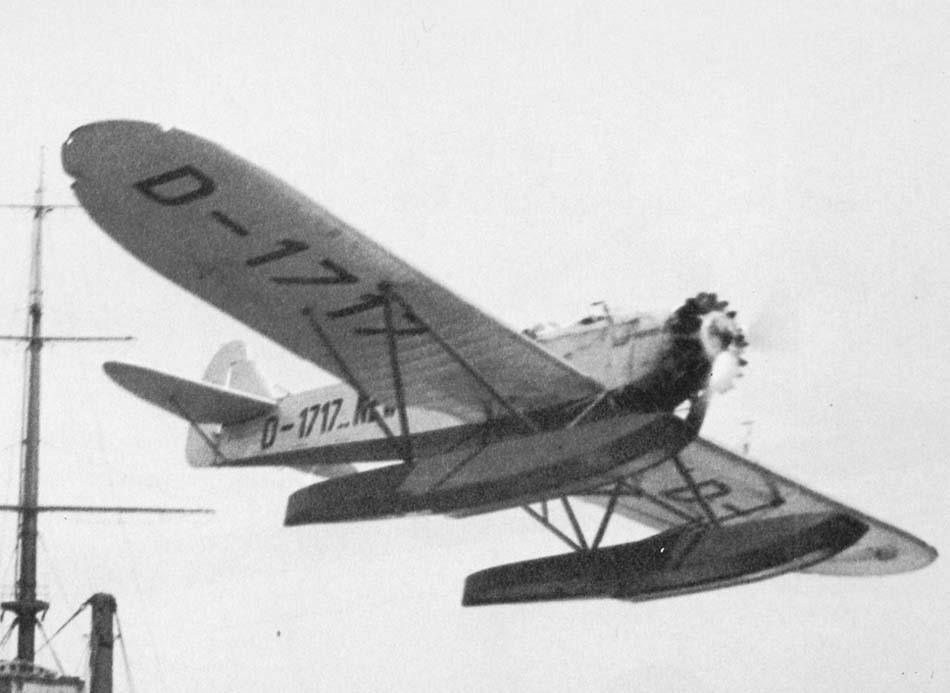
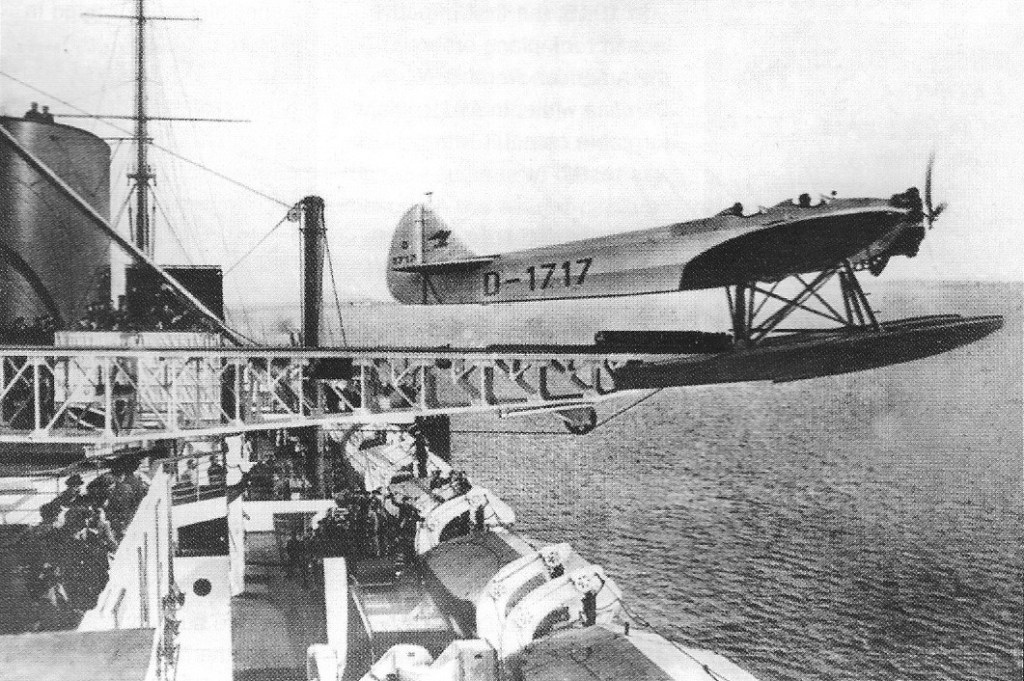
The concept was hit upon after Norddeutscher Lloyd (NDL) had carried a Junkers F.13 seaplane aboard the Lutzow during 1927 to provide joyrides for passengers when the liner was in port. NDL officials realised that a seaplane based on a liner could have a more practical commercial application, taking off with the liner’s airmail while still a long distance from port, therefore drastically cutting down time taken for the mail to arrive. Heinkel designed a catapult, which NDL planned to install on its new liners, the Bremen and Europa, and an aircraft to carry the mail. Since the crew of Lutzow had trouble providing the necessary maintenance for the F 13, Deutsche Luft Hansa agreed to provide the operational support for the venture, and when Bremen departed on her maiden voyage in 1929, a single HE 12 (D-1717) was carried aboard.
A second aircraft, (D-1919, Atlantik), was built for flying from Europa, sister-ship of the Bremen. Designated He 58, the second aircraft was slightly larger overall than the He 12, with increased payload and accommodation for the crew in a side-by-side open cockpit. Power was supplied by a 370 kW (500 hp) BMW Hornet A, initially un-cowled, but later fitted with a full long-chord cowling with cooling slits in the forward face.
The He 58, (D-1919, Atlantik), continued in service on Europa until replaced by Junkers Ju 46 floatplanes.
He 58 Engine: 70 kW (500 hp) BMW Hornet A Wingspan: 17.2022 m (56 ft 5.25 in) Wing area: 49.4 m2 (532 sq ft) Length: 11.7793 m (38 ft 7.75 in) Height: 4.70 m (15 ft 5 in) Empty weight: 1,850 kg (4,078 lb) Gross weight: 3,140 kg (6,922 lb) Payload: 200 kg (440 lb) of mail Maximum speed: 204 km/h (127 mph) Cruise speed: 159 km/h (99 mph) Service ceiling: 3,800 m (12,500 ft) Crew: Two, pilot and radio operator
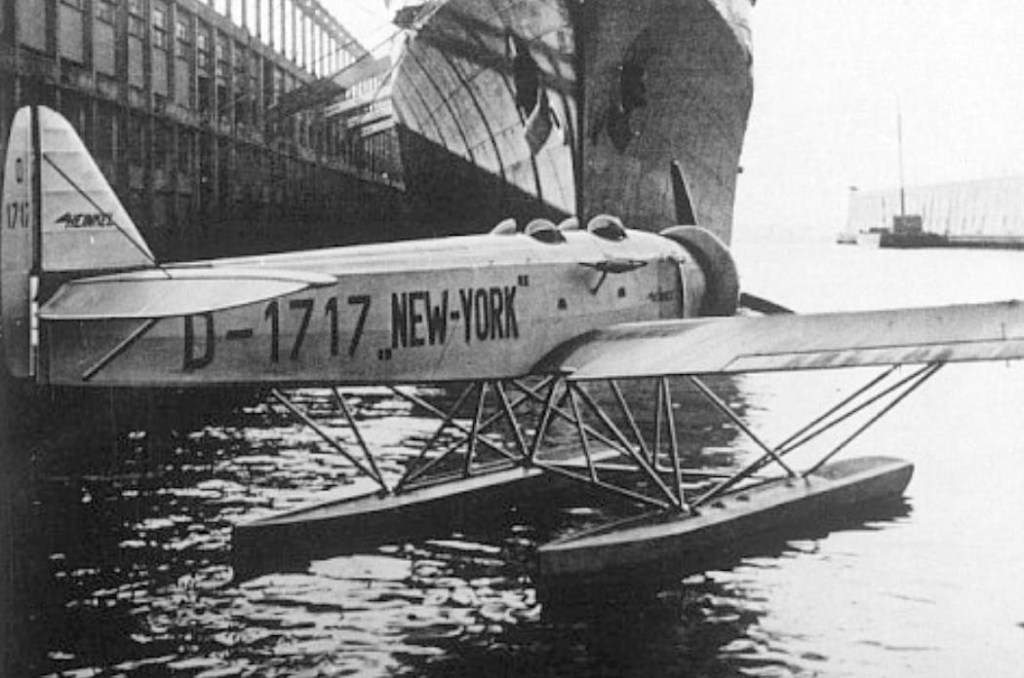
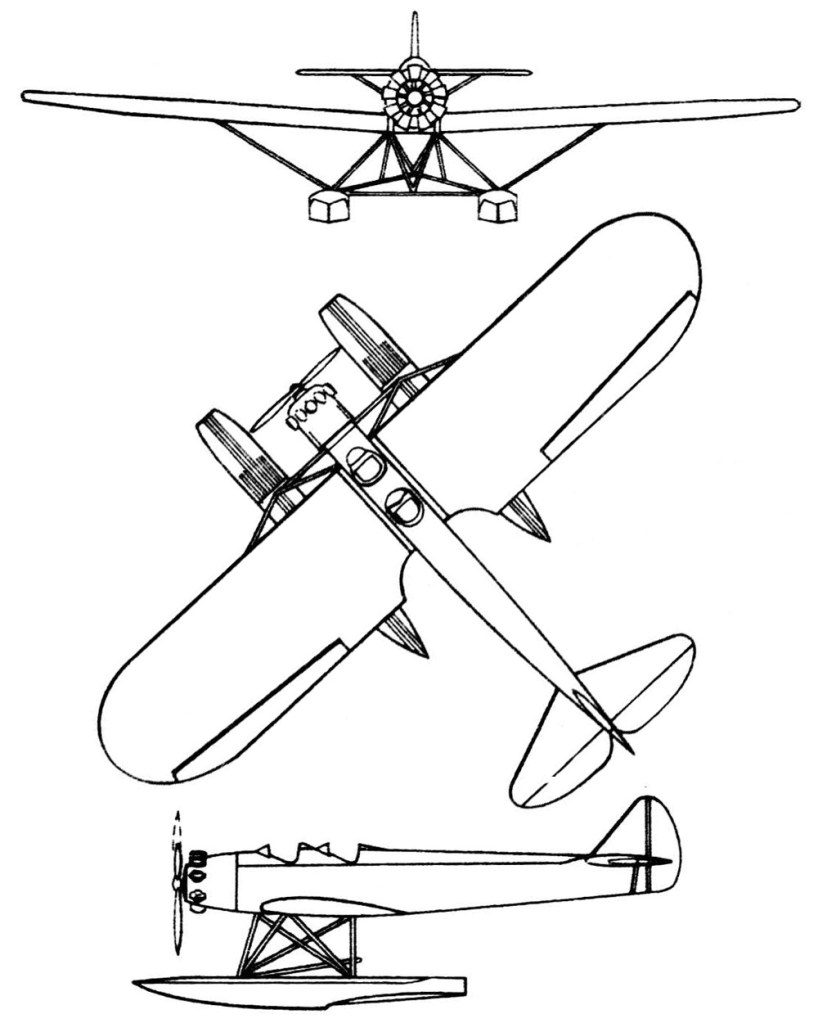
The Heinkel HE 12 was a pontoon-equipped mail plane built in Germany in 1929, designed to be launched by catapult from a liner at sea.
The concept was hit upon after Norddeutscher Lloyd (NDL) had carried a Junkers F.13 seaplane aboard the Lutzow during 1927 to provide joyrides for passengers when the liner was in port. NDL officials realised that a seaplane based on a liner could have a more practical commercial application, taking off with the liner’s airmail while still a long distance from port, therefore drastically cutting down time taken for the mail to arrive. Heinkel designed a catapult, which NDL planned to install on its new liners, the Bremen and Europa, and an aircraft to carry the mail. Since the crew of Lutzow had trouble providing the necessary maintenance for the F 13, Deutsche Luft Hansa agreed to provide the operational support for the venture, and when Bremen departed on her maiden voyage in 1929, a single HE 12 (D-1717) was carried aboard.
With the catapult the aircraft took-off at 110 kph / 69 mph at the nd of a ramp 20 m / 65 ft long.
The HE 12 was a derivative of the military HE 9 design; a conventional, low-wing, strut-braced monoplane. The pilot and radio operator sat in tandem, open cockpits with the mail carried in a compartment behind them.
On 22 July, while still 400 km (250 mi) out of New York City, Bremen successfully launched the HE 12. When the seaplane was unloaded 2+1⁄2 hours later, mail from Berlin had taken just 6+1⁄2 days to reach New York. The next day, in front of a crowd of 3,500 people, mayor Jimmy Walker christened the HE 12 with the name of the city. On the return journey, the newly christened New York launched from Bremen near Cherbourg on 1 August, landing in Bremerhaven four hours later, in time for the mail to be transferred to another aircraft and arrive in Berlin the same afternoon, 5+1⁄2 days after leaving New York. Use of the seaplane saved around 20 hours on the westward trip, and 1–2 days on the eastward journey.
HE 12 (D-1717, New York) flew regularly from Bremen until severely damaged in an accident at Cobequid Bay on 5 October 1931.
Engine: Pratt & Whitney Hornet, 450 hp Wingspan: 16.7958 m (55 ft 1.25 in) Wing area: 48.46 sq.m (522 sq ft) Length: 11.56 m Height: 4.60 m (15 ft 1 in) Empty weight: 1580 kg (3,483 lb) Normal take-off weight: 2600 kg (5,732 lb) Payload: 200 kg mail Maximum speed: 216 km/h Cruise: 192 km/h (119 mph, 103 kn) Range: 1600 km Service ceiling: 3,800 m (12,500 ft) Crew: 2
The He 8 floatplane, a development from the He 4 and 5, appeared in the autumn of 1927.
A single-engined seaplane with three seats inline in separated open cockpits. A low wing monoplane, braced underwing with by 4 pairs of masts in N configuration uniting the two floats in the catamaran and the base of the fuselage. The cantilever horizontal stabilizer was on the back of the fuselage. Construction was wood and fabric for the aerofoil, wood and plywood for the fuselage. Powered was a 335kW / 450 hp Armstrong Siddeley Jaguar radial engine. Twenty two were ordered by the Danish naval flying corps, 16 of which were built in Denmark under the designation H.M.II. They were mainly used for reconnaissance and survey work as far north as Greenland. Some served until 1940. Maximum level speed was 218km/h. Armament comprised a rear-mounted machine-gun. Total production: 22
Engine Armstrong Jaguar IV 420 hp Propeller: two-bladed wooden fixed pitch Wingspan: 16,80 m / 55 ft 1.5 in Length: 11,50 m / 37 ft 8.3 in Height: 3,90 m Wing area: 49 sq.m Empty weight: 1500 kg MTOW: 2325 kg / 5126 1b Wingg loading: 47,5 kg.sq.m Power loading: 5,476 kg/hp Max speed: 210 kph Ceiling: 6000 m Range: 800 km Armament: 1 Madsen 7,7 mm
By 1927 the German authorities were becoming less intimidated by the restrictions imposed by the Versailles Treaty, and in that year Heinkel produced the He 6 reconnaissance seaplane. This incorporated much navigational and wireless equipment obviously with a view to future military use. The He 6 was a three/four seat long range monoplane, with an enclosed cockpit for the pilot, navigator and radio operator. Powerplant was an 800¬hp Packard engine.
Development of the basic design continued with the He 4 and He 5 reconnaissance seaplanes produced in 1926. Production figures for the He 5 are also unknown. It was fitted with the 335kW / 450 hp Napier Lion engine, and proved itself by gaining three world seaplane climb/payload records in September 1926.
A single-engined float seaplane, with three seats inline in separated open cockpits. A monoplane low wing braced underneath by 4 pairs of masts in N configuration uniting the two floats in the catamaran and the base of the fuselage. The cantilever horizontal stabilizer was directly on the back of the fuselage, two floats in catamaran. The He5 was constructed of wood, with a plywood wood coating for the fuselage.
The He 5 was licence-built in Sweden for the Navy by Svenska.
In the second-half of the 20’s the Soviets decided to acquire an aircraft carrier. Realising that experience of design of catapults nor suitable aircraft was in the country, thel VVS turned to the German firm “Ernst Heinkel. In 1927 the Soviets purchased two He.5 float monoplanes. Tests showed that the flight-performance data was considerably lower than declared by firm, but the aircraft was steady, and it possesses not bad maneuverability. These machines served for a while in 65- m squadron, which was in Nakhimova bay in Sevastopol. Total production: 100
He 5 Engine Napier Lion II, 450 hp Propeller two-bladed wooden fixed pitch Wingspan: 16,80 m Length: 12,19 m Height: 4,23 m Wung area: 49 sq.m Empty weight: 1634 kg MTOW: 2900 kg Wing loading: 59 kg/sq.m Power loading: 6,4 kg/hp Max speed: 230 kmh Ceiling: 6000 m Range: 800 km Armament: 2 x 7,92 mm mg
He 5b Engine: Bristol-board Jupiter VIII, 480 hp
He 5c Engine: Bristol Pegasus IIm3, 660 hp Max speed: 280 kph Ceiling: 7000 m


 All Aero