Incorporated in 1926, the company began production of the Ireland Neptune, a five-seat amphibian flying-boat.
Amphibian
International Aeromarine TA16 Seafire
International Aeromarine Corp was founded in 1982, partly owned by David Thurston, to produce TA16 Seafire amphibian.
Icon A5
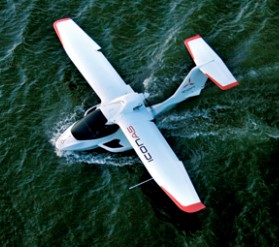
The Icon A5 amphibious LSA was unveiled at a very rock ’n’ roll premiere in Los Angeles in June 2008.
The ICON A5 has two seats and is made mostly of composite materials, with a high wing, T-tail, pusher prop, and tricycle landing gear. It is powered by a Rotax 912 flat-four engine, with hybrid air-water cooling and providing 75 kW (100 HP). All landing gear assemblies have single wheels, the nose gear hinging forward, the main gear retracting into sponsons that also provide flotation stability. Seating is side-by-side, the canopy hinging forward for access. The wings fold back along the rear of the aircraft for ease in handling.
Designed for recreation rather than transport and first flown in July 2008, the A5 is a sport plane available in 2008 for US$139,000.
The A5 received a lot of publicity but no production machine had flown yet.
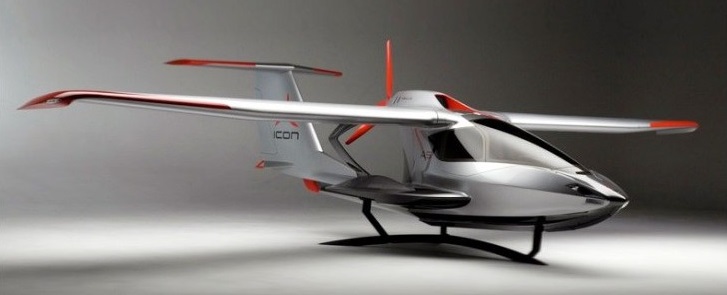
The long-delayed amphibian could at last be nearing production after wrestling with overweight issues for years. In 2012 the manufacturer awaited FAA’s final decision on whether that agency would allow an additional 250 pounds beyond the LSA amphibious spec of 1,430 pounds or 1,680 pounds MTOW.
Icon’s stated grounds for exception: The extra weight is needed for its spin-resistant wing design. The ruling would only benefit the A5, not any other amphib or float plane.
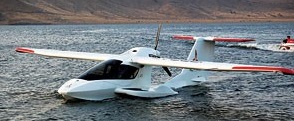
Engine: Rotax 912, 75 kW
Wing span: 10.4m / 34 ft
Length: 6.7 m / 22 ft
Empty weight: 450 kg / 1,000 lb
Max speed: 192 kph
Stall: 80 kph
Huntingdon 12
A four/six-seat amphibian with a Pratt & Whitney Wasp engine.
Hughes H-4 / HK-1 Hercules / Spruce Goose
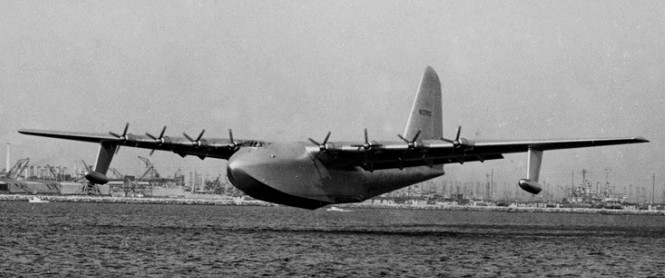
American shipbuilder Henry Kaiser introduced the Liberty ship but the vessels were being sunk prompting him to think of a massive cargo aircraft. Initially rebuffed by the US Government, Kaiser sought a partnership that would lend credence to his plan. That partner was Howard Hughes. Howard Hughes sponsored the Hughes H-4 Hercules. Made entirely of wood, almost entirely of laminated birch, this eight-engined flying-boat had the greatest wingspan (320 ft; 97.54 m) of any aircraft built to date.
The aircraft was not completed until September 1945. The design problems which Hughes and his team encountered in creating a 183 tonne (180 ton) aircraft from non strategic materials delayed the project until after the war, assembly began in June 1946.
House movers being engaged to transport its 66.75 m (219 m) laminated plywood hull along specially laid roads from Culver City, California to Terminal Island, Long Beach where final assembly began.
On 2 November 1947 Hughes boarded the Hercules, started the eight 3000 hp Pratt & Whitney Wasp Major engines and taxied out into the bay, ostensibly for water handling tests. Once on the open water, however, Hughes opened up the Spruce Goose’s and took off, flying for about 0.6 km (1 mile), for less than a minute, at a height of 70 feet (21 m) at a speed of 80 mph (128 kph).
The Hercules never flew again. It was stored in a specially constructed hangar at Long Beach, where it remains today, heavily guarded by Hughes employees, the largest aircraft ever to fly. Some say that having proved his point that the machine could fly, Hughes simply lost interest; others claim that even in those few brief moments of flight the Hercules creaked and groaned and handled so badly that Hughes never dared fly it again.
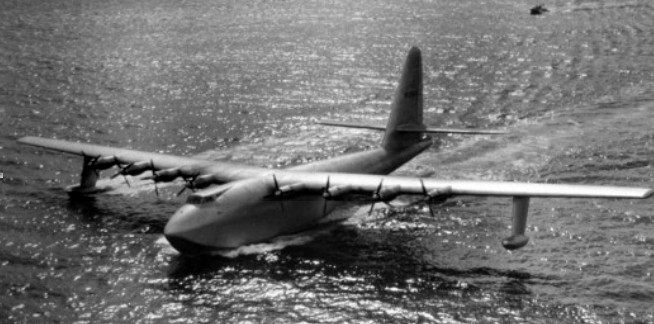
Engines: 8 x 3,000 h.p. Pratt & Whitney R-4360-4A radial. Replaced in 1951 by P&W Wasp Major TS13-3Gs.
Propellers: 8 x Hamilton Standard 24F60-35s
Prop diameter: 17ft 2in diameter (Engine No 4 had a 16ft 2in-diameter)
Wingspan: 320ft 0in
Tailplane span: 113ft 6in
Wing area: 11,430 sq.ft
Maximum wing thickness: 11ft 6in
Length: 218ft 6.25in
Height overall: 79ft 3 3/8in
Fuselage height 30ft 0in
Payload: 180,0001b
Maximum weight: 400,0001b
Internal fuel: 14,000 USgal
Maximum speed: 218 m.p.h.
Cruising speed: 175 m.p.h.
Alighting speed: 78 m.p.h.
Maximum range: 3,500 miles
Service ceiling: 24,000ft (300,0001b gross weight)
Rate of climb: 700ft/min to 1,000ft/min, depending on weight
Honningstad Norge Model B
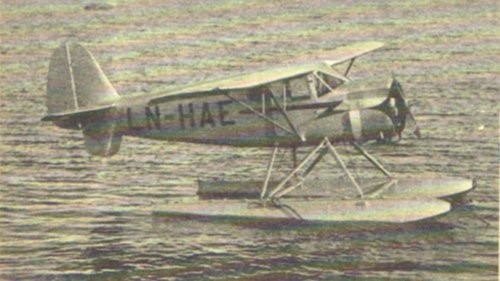
Designed by Aksel Kristiansen and built by Honningstad in 1946.
Honningstad Finnmark 5A
The Finnmark 5A amphibious flying boat, designed by Birger Honningstad and built by Norsk Flyindustri A.S., was produced specifically to suit the special climatic conditions prevailing in Norther and Artic regions, and the sole example of this type was flown on 17 September 1949.
The Finnmark carries two crew members and twelve passengers, and outrigger floats replaced the original hull sponsons which housed the retractable combined wheel and ski undercarriage.
Operated as a pure flying boat, the Finnmark was owned by A.S.Norronafly.
Engines: 2 x Pratt & Whitney R-1340 Wasp, 600 hp
Span: 62 ft 6 in
Length: 46 ft 4 in
Wing area: 522 sq.ft
Empty weight: 9966 lb
Loaded weight: 13,100 lb
Max speed: 195 mph
Cruise speed: 160 mph at 60% pwr
Max range: 840 miles
Hoffman X-4 Mullet Skiff
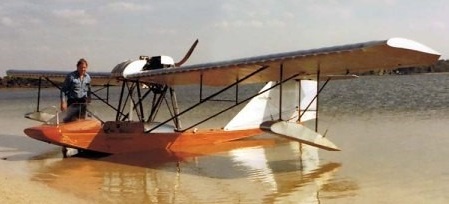
The X-4 “Mullet Skiff” was built by Hoffman and his son Ed Jr. in 1980 and was an amphibious development of the earlier X-2 two-seat flying boat, but also slightly larger with side-by-side seating. The 115 hp Lycoming O-235 powered X-4 (N5597N c/n 1) was kept active well into the 2000s by Ed Jr.”
Hoffman X-2
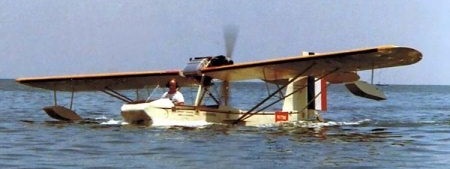
The X-2 designation was used for two light flying boats designed by Edward C. Hoffman. The first X-2 (registered N9159R and first flown 1962) was named Little Orphan Annie and was built by Hoffman. Engine was a 75 hp Continental A75 and in the construction the wings of a Taylorcraft BC-12D were used.
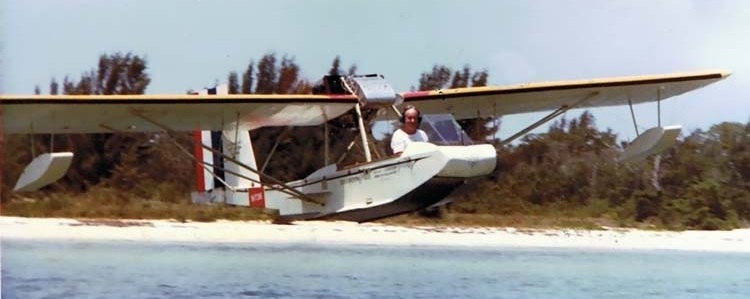
The second X-2 (N1736 and known as the PBY) was in 1964 completed by another amateur constructor and had a 108 hp Lycoming O-235 engine. Other changes were new built wings and a slightly taller vertical tail. The PBY was later also acquired by Hoffman, but it was lost in an accident.”
Hiro Naval Air Arsenal Navy Type 90-1
Hiro’s Navy Type 90-1 three-engined flying-boat, built in the early 1930s, had Japanese-built Hispano-Suiza engines and bore a close resemblance to the German Rohrbach flying-boats.
 All Aero