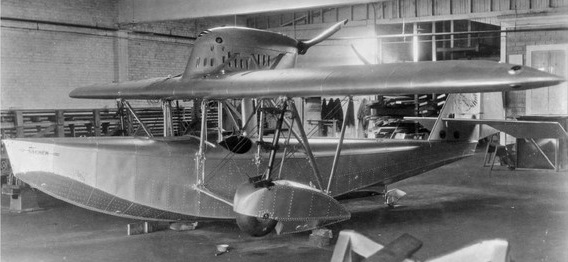
The first flying-boat produced by Latecoere was the Late 21, built for Aéropostale for its Marseille-Algiers postal and passenger routes. The prototype, first flown in 1926, had a parasol wing with lower stub wings which acted as stabilising sponsons. Two 313kW Gnome-Rhone Jupiter 9Ab radials were mounted in tandem on the wing, and the single-step hull terminated in a large single fin and rudder. Open side-by-side pilots’ cockpits were located in line with the wing leading edge and there was cabin accommodation for seven passengers. Successful tests with the Late 21 led to the construction in 1927 of five slightly modified Late 21bis and a single Late 21ter, with Farman 12We engines. The Late 21 bis spanned 22.00m, had a maximum take-off weight of 5730kg and possessed a maximum speed of 172km/h. The Late 23 was an enlarged version of the Late 21, powered by Farman engines and spanning 28.00m.
Variants: Laté 21 – 1926 parasol monoplane flying boat, 2 x push-pull 420 hp GR Jupiter 9Ab, 21 m span
Laté 21: prototype N°1/72 F-ESDH, conv. into Laté 21bis F-AIHN
Laté 21bis: production model, different hull length, fins shortened 1 x Laté 21 conv., plus F-AIIE, ‘FH, ‘HN, ‘HP (conv. to Laté 23), ‘HQ
Laté 21ter: 2 x 500 hp Farman 12We W12 engines F-AIKL N°1/76 ,1927 to Aéropostale, discarded Oct 1931
Engine: 2 x Gnome-Rhone Jupiter 9Ab , 420hp Max take-off weight: 5730 kg / 12633 lb Empty weight: 3530 kg / 7782 lb Wingspan: 22.00 m / 72 ft 2 in Length: 17.95 m / 58 ft 11 in Height: 4.85 m / 15 ft 11 in Wing area: 88.00 sq.m / 947.22 sq ft Max. speed: 172 km/h / 107 mph Cruise speed: 144 km/h / 89 mph Ceiling: 3600 m / 11800 ft Range: 800 km / 497 miles Crew: 3 Passengers: 5-7
The Lakes Sea Bird was a two-seat floatplane built during 1912 by the Lakes Flying Company using the fuselage of the Avro Duigan. First flown on 28th August 1912, it gave many visitors to Windermere their first flight in the summer of 1913 After damaging his aircraft and returned to Australia the fuselage and tail unit was sold to the Lakes Flying Co. based at Windermere, who rebuilt it as a two-seat floatplane. The straight parallel-chord high aspect ratio wings of irregular three-by layout resembled those of Avro’s Avro Type D. It was originally fitted with a single central two step float, later changed to a pair of narrower floats, and demountable so that the aircraft could readily be used as a landplane. It was powered by a rotary 9-cylinder Gnome of 50 hp (37 kW), The single Sea Bird carried many holiday makers in 1912-3. Later, it was restored for training and it was ultimately lost when a student pilot spun in in 1915.
Powerplant: 1 × Gnome 9-cylinder rotary, 50 hp (37 kW) Wingspan: 39 ft 4 in (12.00 m) Height: 10 ft 6 in (3.2 m) Wing area: 350 sq.ft (32.5 sq.m) Length: 29 ft 4 in (8.94 m) Seats: 2 Maximum speed: 62 mph (100 km/h)
Water Bird was succeeded by the Lakes-built Water Hen, their first complete product. It was initially almost identical to its predecessor apart from straight edged ailerons. Larger, later modifications removed much of the similarity between the two aircraft, the later Water Hen having a much wider central float.
Water Bird’s successor, identical, but entirely designed and built at Windermere by Capt. Wakefield’s Lakes Flying Company later in 1912, was known as “Water Hen”. Its only Avro component was the airscrew and at first it could be distinguished from its Avro-built forerunner by the wingtip floats and straight trailing edges to the ailerons. These were mounted parallel to the chord line of the mainplanes instead of at a considerable angle to it. They were later remounted in the angled position but by that time more drastic modifications had been made and all similarity to Water Bird ceased.
In the summer of 1910 A. V. Roe and Company declared its willingness to build aeroplanes to other people’s designs. A Curtiss-type, of the familiar outrigger-tail and front-elevator variety with 50 h.p. Gnome rotary, was built in 1911 to the order of Capt. Edward W. Wakefield of Kendal. He wanted it to follow the basic layout of the USA’s Curtiss machine – hence sometimes known as Avro-Curtis. This was never given an Avro designation.
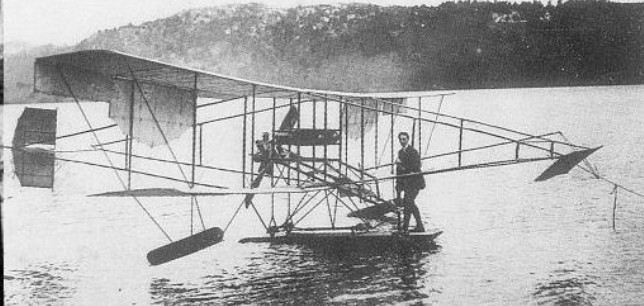
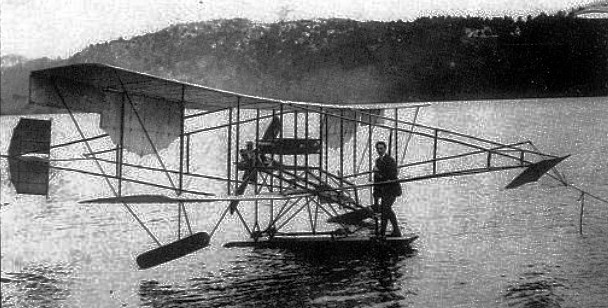
The Lakes Water Bird was built for Wakefield, of the Lakes Flying School, Windermere. It was built as a landplane with the intention of converting it to a seaplane once testing was complete. Wakefield had been interested in water-borne aircraft since 1909 and had performed experiments with different float designs towed at speed across Lake Windermere. Unsticking problems persisted until he visited Henri Fabre in France and got useful advice on float design. The 12 ft (3.66 m) long float for the Water Bird followed Glen Curtiss’ three-step float and was built by boat builders Borwick of Bowness-on-Windermere using mahogany reinforced with metal strips and canvas covered by local.
Avro built the aircraft in Manchester, transporting it to Brooklands on 25 May 1911 for its first flight on 19th June. It was a two-bay seat pusher biplane with wings of unequal span. The outer half of each upper wing carried a pair of ailerons; the larger inner one had a semicircular trailing edge extending well behind the wing trailing edge. Bamboo outriggers fore and aft of the wings supported leading elevators and tail surfaces plus rudder. Both elevator and rudder were operated by bamboo pushrods. Power was provided by a 50 hp (37 kW) Gnome 7-cylinder rotary engine driving an 8 ft 6in (2.59 m) propeller.
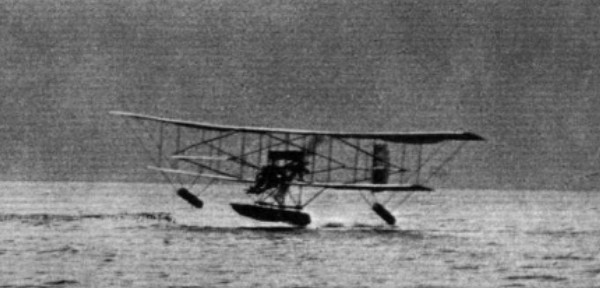
It was operated by the Avro School for a short period before being dismantled on July 7th 1911 and moved to Lake Windermere. At the Avro School during it was flown by F. P. Raynham, R. C. Kemp, F. Conway-Jenkins and Louis Noel. After testing as a landplane at Brooklands in May 1911, the Water Bird was brought to the Hill of Oaks on Windermere and the float fitted in place of the wheeled undercarriage. A pair of cylindrical floats was mounted below the wing-tips for lateral stability on the water. Once at Windermere it was known simply as Waterbird. It had a Gnome 50hp engine and the successful first flight was on 25 November 1911, with ex-Avro school pilot H. Stanley Adams. The floats were all made by Borwicks at Windermere. The press where invited to an exhibition flight two days later, the favourable description’s in the press seem to lead to the name ‘Lakes Water Bird’ being adopted.
Water Bird was the first consistently successful seaplane in the United Kingdom and during the next few months its fame spread quickly and a considerable waterborne joyriding business was done during December 1911 and January 1912. Sixty flights were made in the first 38 days, the best being of 20 minutes duration up to a height of 800 ft. On December 7, 1911 Stanley-Adams flew the whole length of the lake at a speed of approximately 40 m.p.h. These operations continued throughout the winter, but the night of March 29-30, 1912 brought gales which demolished the lakeside hangar at Cockshott and damaged “Water Bird” beyond repair. Its float, tailplane and rudder (the last still proudly displaying the legend “A. V. Roe and Company, Manchester”) are still in the possession of the Wakefield family at Windermere.
Engine: 1 x Gnome et Rhône 7-cylinder rotary, 50 hp (37 kW) Length: 36 ft 5 in (11.10 m) Wingspan (upper): 41 ft 0 in (12.50 m) Span (lower) 32 ft. 0 in. Wing area: 365 sq.ft (33.9 sq.m) Empty weight: 780 lb (354 kg) Gross weight: 1,130 lb (513 kg) Maximum speed: 45 mph (72 km/h) Service ceiling: 800 ft (244 m) Maximum speed 45 m.p.h. (72 km/h) Crew: 1 Capacity: 1
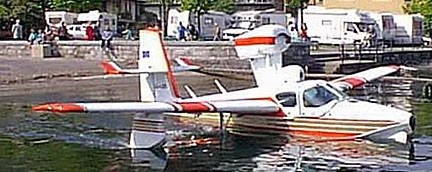
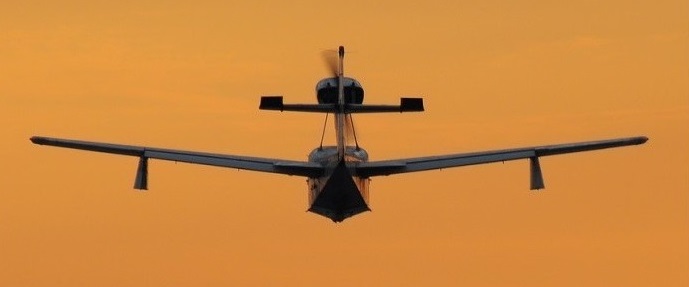
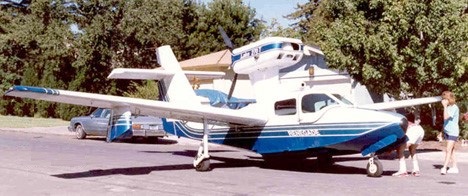
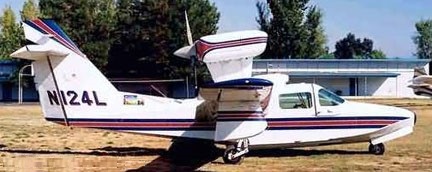
Lake Aircraft Corp marketed the Colonial Skimmer as the Lake Skimmer, and developed the aircraft into the LA4. The initial Lake prototype, the “LA-4P”, very similar to the C-2 Skimmer, performed its initial flight in November 1959; it was followed by two “LA-4A” prototypes in 1960, N1001L c/n 244 and N1002L c/n 245, which featured a 1.22 meter (4 foot) wingspan stretch and structural reinforcement. Power was a 180hp Lycoming O-360A1A pusher.
The LA-4A in turn led to the production “LA-4”, which featured a bow stretched by 43 centimeters (17 inches), with the nose gear now fully retracting. Powerplant remained the O-390-A1A. The first production model of this version flew in 1960, N261B c/n 121. Total production of the initial model of the LA-4P appears to have been about 70 aircraft, including a one-off pure seaplane with no landing gear. In 1970 Lake removed the retractable gear from some LA-4s and offered them as seaplanes with detachable beaching gear.
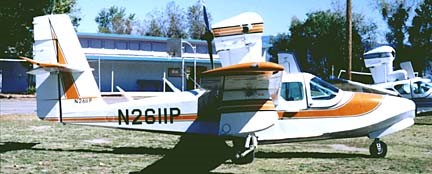
Lake LA-4 N2611P
In 1968, work began on a new model with a Lycoming IO-360-A1B engine featuring 150 kW (200 HP), with an LA-4 converted as a testbed. The “LA-4-200” went into production in 1969 and did much to raise the profile of the LA-4, with sales picking up. It featured other modest improvements, notably fuel storage in the floats, plus an optional combustion heater in a fairing above the cockpit, and also acquired the name of “Buccaneer”. Performance increased substantially, as did the price tag. Both the 180 hp and 200 hp Buccaneer versions are similar in appearance and differ only in instrument layout apart from the engine power.
Lake LA-4-200
It then generated a modestly refined version, designated the “LA-4-200EP”, the “EP” indicating “Enhanced Performance”, other interpretations being “Extended Propeller”, that being one of the features. It also had a new IO-360-A1B6 engine, same horsepower but smoother operation, a revised engine nacelle, batwings, cargo door, and fuel floats as standard equipment. An “LA-4-200EPR” was also introduced that was much the same, but with a reversible propeller. Some LA-4-180, -200, and -200EP had after-market Rajay turbochargers.
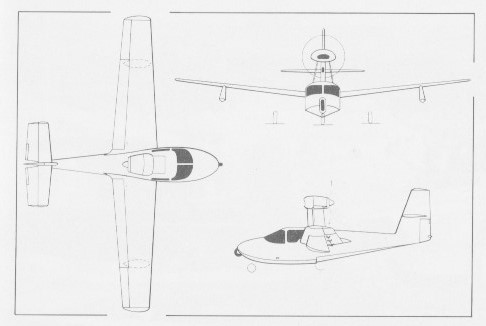
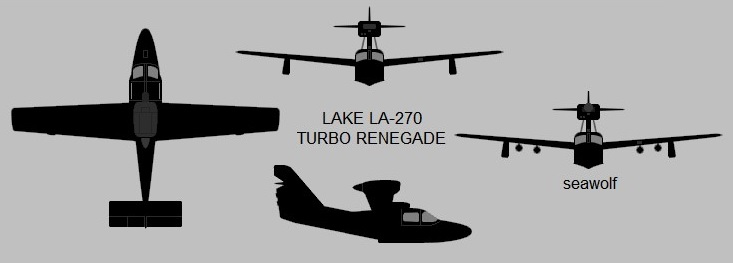
In 1984 Lake then produced the LA-250 Renegade, which featured a stretch of 1.05 meters (41 inches), permitting accommodations for four or six, with additional pop-up doors on each side of the rear cockpit; a revised and more rakish tailfin with a forward fillet of greater area; and a Lycoming IO-540-C4B5 flat-six air-cooled engine providing 185 kW (250 HP). A militarized version of the LA-250 was introduced in 1985 as the “Seawolf”, featuring four underwing pylons and radar, the radome being mounted on the front of the engine nacelle. The pylons could carry munitions including bombs and rockets, reconnaissance pods, or parachutable survival pods kitted for different environments.
Lake discontinued the LA-4 and the Seaplane and concentrated on production of the Buccaneer and the Renegade. Standard fuel tanks in the Lake were 40 gallons until someone decided that the pontoons could also be used as fuel links. The new auxiliary tanks took 7-1/2 gallons on each side, and the total capacity increased to 55 gallons. The extra 20 hp in the 200-hp Buccaneer has increased cruising speed by 12 mph and top speed by 14 mph. Allowable gross weight also increased an additional 200 pounds.
The LA-250 led in turn to the LA-270 Turbo Renegade, which was much the same but had a turbocharged TIO-540-AA1AD engine providing 200 kW (270 HP). The major visible difference was a turbocharger inlet extension at the base of the engine pylon. A militarized Seawolf version was offered as well. Sources mention a “Sea Fury”, which was an LA-250/270 with salt-water corrosion protection.
Sun Lake Renegade
The Renegade T270 is longer in the fuselage and is fitted with six seats. The model offered four to six passenger seating, improved useful load and 90 gallons of fuel on board. In 1987 turbo charging was added via the Lycoming TIO-540-AA1AB, resulting in 20 more horses to the Renegade and a ceiling of up to 23,800 ft. The Turbo 270 Renegade, which differs from previous versions in having a lengthened cabin, a turbocharged 250 shp (186 kW) Lycoming IO-540-C4B5 flat-six engine. The Seawolf is a maritime patrol version with underwing stores pylons.
Lake Aircraft’s 270 hp turbocharged Renegade has set four new world records in the light seaplane class, including an altitude record of 27,300 feet.
In 1987 the Buccaneer model was put into retirement. Latest models of the 250 and 270 hp Lakes are all marketed under the name Seafury, and incorporate improvements in corrosion protection for operation in salt water.
The LA-4 1960 base price was $26,580 and the 1968 LA-4-200 Buccaneer $31,000, rising to $53,000 in 1980. The LA-4-200EP Buccaneer $96,600 in 1983, and by 2004, $110,000-125,000. The Renegade sold for $146,000 in 1982, and $220,000 by 1986. About 135 had been built to 2005.
Twenty-four were built to 1961 and about 916 to 2005, excluding Renegade. More than 1,200 of the Lake series single-engined amphibians had sold to 1990. The LA-270T / Turbo Seafury sold for $348,000 in 1991, and $745,500 by 2001.
The four seat Lake LA 4 200EP am¬phibian, first built in 1983, has been revived by LanShe Aerospace in Florida and in 2004 was selling for US$299,000. The EP version has an IO 360 engine and a payload of around 900 lbs. It has Keelson boosters on the hull and “bat wing” wing root fillets to increase performance. The LA-270T / Turbo Seafury was priced at $348,000 in 1991, and $745,500 in 2001. The sole 1969 gearless Lake was for sale at $23,562.
The 1985 Seawolf was a military version of the LA-4-250, 2 of which reportedly were boosted to 290hp. One prototype, N1401G, was built.
The final Lake amphibian was produced in 2007. At last notice, the Lake firm was still in business, but it had been reduced to a small shop providing parts and service to the customer base.
Lake 250 Renegade Engine: Textron Lycoming TIO 540 AA2AD, 266 hp Length : 29.659 ft / 9.04 m Height: 10.007 ft / 3.05 m Wingspan: 38.320 ft / 11.68 m Aspect ratio: 8.96 Wing area: 164.043 sq.ft. / 15.24 sq.m Max take off weight: 3139.9 lb / 1424.0 kg Weight empty: 2074.9 lb / 941.0 kg Max. payload weight: 1065.0 lb / 483.0 kg Landing speed: 49 kt / 91 km/h Cruising speed: 155 kt / 287 km/h Take off distance: 879 ft / 268 m Landing distance: 607 ft / 185 m Initial climb rate: 905.51 ft/min / 4.6 m/s Service ceiling: 20013 ft / 6100 m Wing load: 19.07 lb/sq.ft / 93.0 kg/sq.m Range: 1120 nm / 2074 km Crew: 1+3
Rivard LA-4-250 Renegade / Sun Lake LA-4-250 Renegade / Sun Lake Renegade 2 1982 Engine: Lycoming IO-540-C4B5, 250hp Prop: 3 blade metal Wing span: 38’0″ Length: 28’4″ Gross wt. 3,140 lb Useful load: 1200 lb Empty wt. 1,850 lb Fuel capacity 90 USG Cruise speed: 140 mph / 122 kt Stall: 56 mph Initial climb rate: 900 fpm Ceiling: 12,500′ Takeoff run (land) 650 ft. Takeoff run (water) 1,125 ft. Landing roll (land) 475 ft. Landing run (water) 600 ft. Seats: 4-6
Sun Lake Renegade 2T Engine: Lycoming TIO-540-AA1AD Prop: 3 blade metal Wing span: 38’0″ Length: 28’4″ Fuel capacity: 90 USG Seats: 4-6
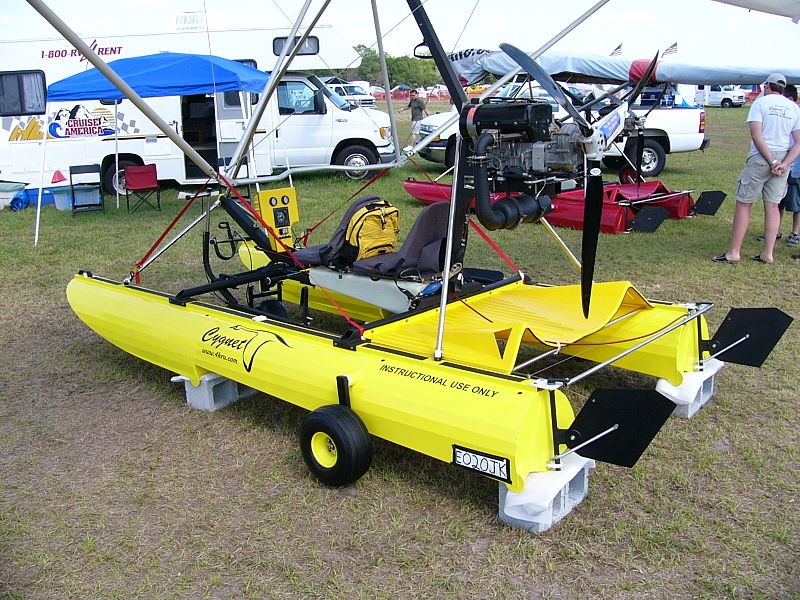
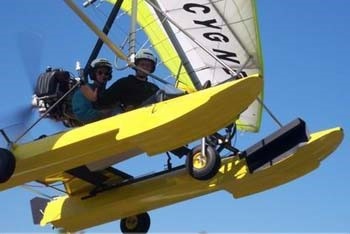
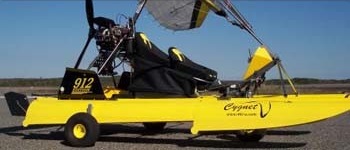
The Krucker Cygnet amphibious ultralight trike was designed by J.P. Krucker and initially produced by his company Krucker Manufacturing in Sudbury, Ontario, Canada. Supplied as a kit for amateur construction or as a complete ready-to-fly-aircraft, the aircraft was designed to comply with the Fédération Aéronautique Internationale microlight category and the US light-sport aircraft rules.
It features a strut-braced hang glider-style high-wing, weight-shift controls, a two-seats-in-tandem open cockpit, retractable wheeled tricycle landing gear and dual floats and a single engine in pusher configuration.
The aircraft is made from bolted-together aluminum tubing, with its single surface wing covered in Dacron sailcloth. Its 10.3 m (33.8 ft) span wing is supported by struts and uses an “A” frame weight-shift control bar. The standard powerplants are the twin cylinder, liquid-cooled, two-stroke, dual-ignition 65 hp (48 kW) Rotax 582 engine, the four cylinder, air and liquid-cooled, four-stroke, dual-ignition 80 hp (60 kW) Rotax 912UL and the 100 hp (75 kW) Rotax 912ULS engines.
A number of different wings can be fitted to the basic carriage, including the North Wings Pulse 17 m2 (180 sq ft) and 19 m2 (200 sq ft) sizes. The LSA-approved wings are the North Wing Mustang 3 in 15 m2 (160 sq ft), 17 m2 (180 sq ft) and 19 m2 (200 sq ft) and the Keitek Hazard.
The Cygnet was awarded Best Trike at Sun ‘n Fun in 2005.
SLSA #99 was the Krucker Cygnet amphib trike. The SLSA completed on 3 July 2009 accoring to U.S. representative, Michael Percy, of XL Kites who imports the Cygnet to the US.
The Cygnet was later manufactured by Sea and Sky of Fort Walton Beach, Florida, United States, selling for US$49,600 (with Rotax 912) in 2011, and still in production in 2013.
Cygnet 2 / North Wings Pulse 17 wing Engine: 1 × Rotax 582, 64 hp (48 kW) Propeller: 3-bladed composite Wingspan: 33 ft 10 in (10.3 m) Wing area: 189 sq ft (17.6 sq.m) Empty weight: 529 lb (240 kg) Gross weight: 992 lb (450 kg) Fuel capacity: 10 U.S. gallons (38 L; 8.3 imp gal) Wing loading: 5.2 lb/sq ft (25.6 kg/sq.m) Maximum speed: 60 mph; 52 kn (96 km/h) Cruise speed: 37 mph; 32 kn (60 km/h) Stall speed: 31 mph; 27 kn (50 km/h) Rate of climb: 490 ft/min (2.5 m/s) Seats: 2
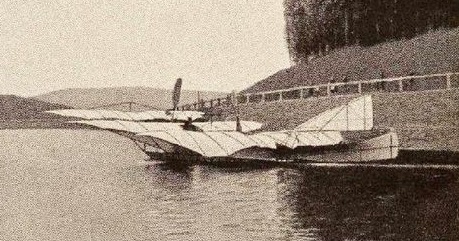
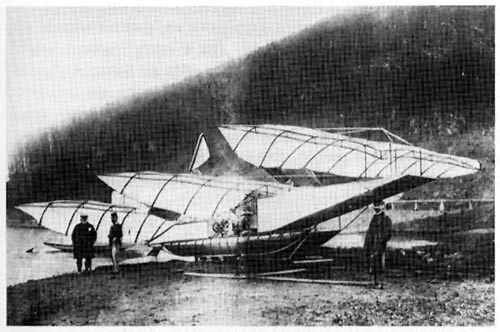
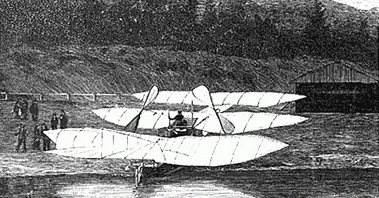
Also known as the Kreß (Kress) Drachenflieger, the Kreß Flugapparat 3-wing-in-tandem flying boat of 1901 was an effort of Austrian Wilhelm Kreß and only fell short of actually flying because of a too weak an engine.
Kreß himself, then already at advanced age, intended to test fly the machine on October 3, 1901 but the machine capsized and sank in the Wienerwaldsee-Untertullnerbach.
Designed by Felix Knoll and built by Brayton Aeronautical Corp, the Sachem appeared in 1931 as a three place, parasol wing amphibian powered by a 160 hp Menasco B-6 pusher enclosed in a streamlined nacelle. The single step hull was all metal while wings and tail surfaces were fabric covered. Strut mounted sponsons also contained retractable landing gear.
The pontons proved to offer too much resistance in the water and limited speed sufficiently to prevent lift-off from water. Although the craft was equipped to take off and land on the ground, attempts were to wait until water laft-off was achieved.
The Sachem was entered into Govt. competition won by Grumman. Destroyed in New Bedford Ma. 1938 Hurricane
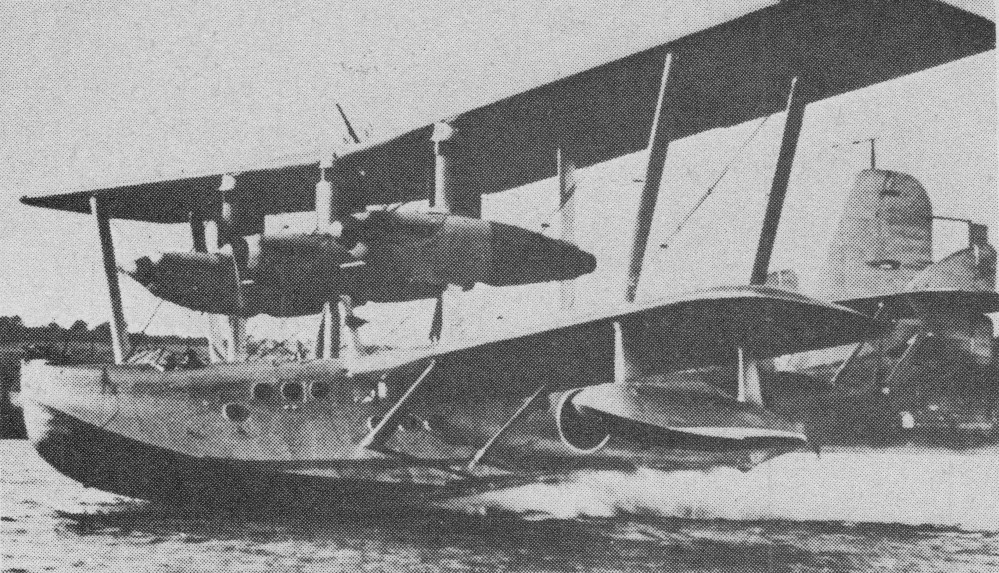
Designed by Short as the KF.1, the prototype was built by Short and delivered to the Japanese Naval Air Force.
Five were built in Japan and at least one saw service in World War II as the Kawanishi H3K1 Type 90-2, a troop and supply transport assigned the code name Belle.
Later models produced by Kawanishi versions had enclosed cockpits and remained active until replaced by H6K2 Type 97 flying boats in 1938-39.


 All Aero