Allan and Malcolm Loughead built the F-1 twin-engined flying-boat in 1918. With the help of designer Jack Northrop, Lockheed built the F1, but it was turned down by the Navy.
Amphibian
LISA Airplanes Akoya
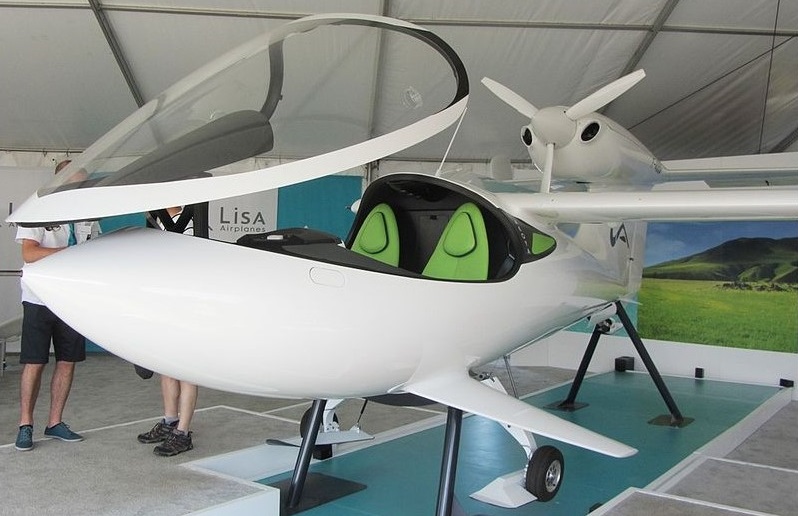
The LISA Akoya (Akoya is a species of pearl oyster) is a light aircraft designed to operate from land, water or snow without adaptation and incorporating a wing of variable area.
First flying on 22 August 2007 the LISA Akoya is a French single-engine light aircraft, seating two in side-by-side configuration. It is an amphibious aircraft capable of alighting on land, water or snow without adaptation. It has a high-aspect-ratio electrically-folding wing, with trailing edge extensions rather than flaps, and a rear-mounted tractor configuration engine.
Some other features are unusual: it has a wing which folds for transportation by horizontal rotation through almost 90° and a single engine mounted high on the fin in tractor configuration. It is built entirely from carbon-fiber-reinforced polymer composites.
The cantilever wings of the Akoya have an aspect ratio of about 18:1, they have constant chord apart from the angled tips. Instead of conventional hinged flaps, the inner 2⁄3 of the trailing edge can be extended rearwards, exposing new fabric surface stored within the wing in roller blind fashion. Fully extended for landing and half extended for take-off, these surfaces provide a large increase in wing area. Conventional ailerons are fitted outboard. High mounted, the wings attach at a rotatable fairing on the highest point of the fuselage, allowing the rotation for storage.
The fin and rudder together form a swept, short and parallel chord surface which carries at its top both the tailplane in T-tail configuration and the engine. The tailplane, like the wing, is of high aspect ratio and has full span elevators. The engine is a 73.5 kW (98.6 hp) Rotax 912 ULS flat four, driving a three bladed tractor propeller.
The Akoya’s fuselage is pointed at the nose and almost circular at its greatest diameter. In elevation it has a curved underside and, above, the large one piece canopy over the side-by-side, dual control cabin forms an unbroken line with the fuselage. There is an electrically operated retractable undercarriage of the taildragger variety, with the main gear legs rotating backward and inwards into the fuselage, and the tailwheel arm rotating forward. All wheels have hydraulic brakes. Operation from water, without a planing bottom or floats, is performed undercarriage up on the round fuselage underside with the aid of a pair of fixed hydrofoils, called shark-fins, sharply tapered planes set at about 50° to the vertical just outboard of the mainwheels. Small tip floats are an option for better lateral stability on water. The Akoya, it is claimed by the manufacturer, can also land on snow, though skis are an option.
A full-size mock-up appeared at the Friedrichshafen Aero ’07 show in April 2007, and the prototype flew in August 2007 at Chambery. By May 2009 F-WURE had flown 150 hours and 50 orders placed. Production was initially expected by mid-2011.
In March 2012 the company was pursuing light-sport aircraft approval of the design to facilitate sales in the United States.
In July 2012 the prototype had flown its first passenger and has been exhibited at AirVenture 2012. LSA approval and the start of production was still pending. Also in July 2012, the company was placed in receivership for financial restructuring after existing investors were not forthcoming with additional funds.
By February 2013 a 75% controlling interest in the company had been purchased by the Heima Mining Company of China for US$20 million. The Heima Mining Company was to name its own chairman of LISA and planed to open two new production lines in France. The Chinese investment permitted finalizing the Akoya’s design for production.
In late 2014 the aircraft was priced “all inclusive” at 300,000 Euros. In July 2015 information about the aircraft was shown at AirVenture, and the price was indicated as US$330,000, and the company claimed about 100 orders.
In March 2017 it was announced that an updated second-prototype would fly in April 2017, it included a new retractable landing gear that would enable the aircraft to operate on water, land and snow.
The second prototype, Pre-Series 1, first flew in August 2017 and features revised fuselage fins, that are horizontal, instead of canted downwards. This change enabled shortening the main landing gear legs to improve cockpit visibility when taxiing.
Akoya
Engine: 1 × Rotax 912 ULS with 1:2.34 reduction gear, 73.5 kW (98.6 hp)
Propeller: 3-bladed
Wingspan: 11.00 m (36 ft 1 in)
Wing area: 6.70 sq.m (72.1 sq ft)
Length: 6.90 m (22 ft 8 in)
Height: 2.35 m (7 ft 9 in) including propeller
Empty weight: 400 kg (882 lb)
Max takeoff weight: 650 kg (1,433 lb)
Fuel capacity / normal: 70 l (18 US gal; 15 imp gal)
Fuel capacity / optional: 110 l (29 US gal; 24 imp gal)
Cruise speed: 210 km/h (130 mph, 110 kn) economical
Stall speed: 64 km/h (40 mph, 35 kn) flaps down
Never exceed speed: 290 km/h (180 mph, 160 kn)
Range: 1,250 km (780 mi, 670 nmi) at economical cruising speed without optional tank
Rate of climb: 5.2 m/s (1,020 ft/min) maximum
Seats: 2
Avionics: VHF, intercom, transponder. Two screen EFIS with emergency backup instruments
Lioré-et-Olivier H-246
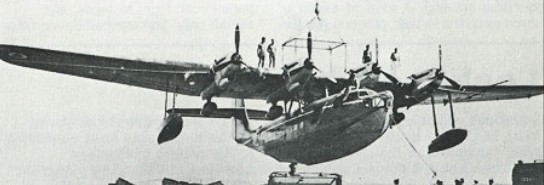
In January 1938, Air France ordered six H-246.1 aircraft in addition to the prototype, and two aircraft were about to enter service on the Marignane-Algiers route when war broke out. The French navy intended to impress all six series aircraft for maritime reconnaissance, but in the event only one was converted. This was the third series aircraft, which flew in June 1940, and then went into service with Escadrille 9.E with a modified extended glazed nose section. It was armed with four 7.5mm Darne machine-guns and 600kg of bombs.
From October 1939 to November 1942 the civil LeO boats operated the route to Algiers for Air France. After that they were seized by the Luftwaffe, converted to carry 21 troops or 14 stretcher cases, and armed with five 7.92mm MG 15 machine-guns, one in a bow turret, two in lateral positions and two more firing through windows at the rear of the flight deck. They were used on a variety of tasks, including brief operations in Finland. Post-war, two surviving LeO H-246.1s were used for a time on the Air France Marignane-Algiers route.
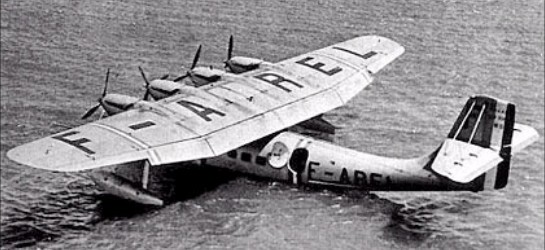
Designed to an official requirement of 1935, the Liore-et-Olivier LeO H-246.01 flying-boat prototype flew on 30 September 1937. A graceful parasol-wing monoplane, its metal hull incorporated a flight deck for the four-man crew and a main cabin for 26 passengers.
H-246.1
Engine: 4 x Hispano-Suiza 12Xgrs/Xhrs V-12, 537kW
Max take-off weight: 15000 kg / 33070 lb
Loaded weight: 9800 kg / 21605 lb
Wingspan: 31.72 m / 104 ft 1 in
Length: 21.17 m / 69 ft 5 in
Height: 7.15 m / 23 ft 5 in
Wing area: 131.0 sq.m / 1410.07 sq ft
Max. speed: 330 km/h / 205 mph
Ceiling: 7000 m / 22950 ft
Range: 2000 km / 1243 miles
Lioré-et-Olivier H-24
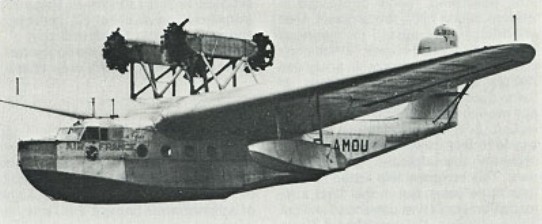
The result of prolonged design work by Benoit and his design team, the Liore-et-Olivier H-24.01 made its first flight in November 1929. A cantilever high-wing monoplane flying-boat, the H-24 had an enclosed pilot’s cockpit, cabin accommodation for 10 passengers and a distinctive tall single fin and rudder, and was powered by two 373kW Renault 12Jb V-12 engines mounted in tandem on a pylon over the hull. This single aircraft was used purely for development, making a number of test and demonstration flights before being scrapped at Antibes in 1934.
Developed from the H-24 was the H-24-2, of similar configuration but powered by four Gnome-Rhone radial engines mounted in tandem pairs over the thick-section wing. The first two of 14 production aircraft for Air France were H-24-2s, and the remaining 12 were H-24-2/1 aircraft with a revised engine installation. The first H-24-2 had flown for the initial time in March 1933, and before long all the machines were employed on Air France routes linking Marseilles with Athens, Tunis and Beirut. Ten aircraft were still operational in September 1939, and were flown under Italian supervision after the German occupation of southern France in November 1942. It is understood that most were scrapped shortly afterwards. The H-24-2 and H-24-2/1 had an enclosed crew cabin with side-by-side pilots’ seats and a navigation and radio compartment; 15 passengers could be accommodated in a cabin beneath the wings, and there was a sizeable luggage and mail hold at the rear.
LeO H-24-2/1
Engines: 4 x Gnome-Rhone 7Kd Titan Major radial, 261kW
Max take-off weight: 8700 kg / 19180 lb
Loaded weight: 5868 kg / 12937 lb
Wingspan: 28.0 m / 91 ft 10 in
Length: 18.45 m / 60 ft 6 in
Height: 6.33 m / 20 ft 9 in
Wing area: 116.25 sq.m / 1251.30 sq ft
Max. speed: 240 km/h / 149 mph
Ceiling: 4500 m / 14750 ft
Range: 1100 km / 684 miles
Levy-Lepen HB-2
Twelve Levy-Lepen HB-2 reconnaissance flying-boats were operated in France by the U.S. Navy, and three were taken to U.S.A.
Levasseur PL.200
The PL 200 monoplane was intended as an advanced reconnaissance seaplane, with a shoulder-wing mounted on a short nacelle for the three crew members, at the front of which was the 537kW Hispano-Suiza 9Vbrs radial engine.
Test-flown in February 1935, the PL 200 achieved a maximum speed of 225km/h by comparison with the 208km/h of the production PL 15. It was re-engined with a 552kW Gnome-Rhone 9Kfr engine in October 1935 as the PL 201, but development was abandoned soon afterwards
Leisure Sports S.5 / Airborne Designs Supermarine S.5
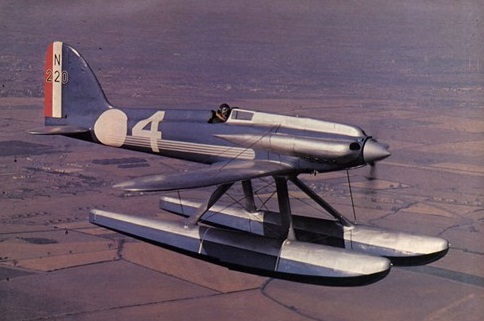
Ray Hilborne of Leisure Sports designed and built a full-scale S.5 replica, G-BDFF. Construction by Aviation Design Bureau under J.Hall took place at Thruxton Airport, Hampshire, over a 2.5 year period, and registered G-BDFF cn ADB-1 on June 13, 1975 the aircraft began preliminary water taxiing tests at Thorpe Water Park, Surrey, the same day.
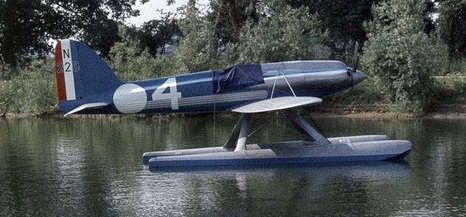
The seaplane was not a true replica, although externally resembling the original S-5 it was basically an entirely different aircraft, while 50 % lighter than the original. The all-wood construction, loadings, systems and performance were different; other differences included a different wing section, smaller floats, water rudders, and a slightly wider cockpit and fuselage. Powerplant was a 210 hp Rolls-Royce Continental engine, driving a two-blade variable-pitch propeller. The replica had an overall weight reduction to an all-up weight of just 1,500 lb, less than 1/2 that of the original.
The first flight was made on Southampton Water, near Calshot, Hampshire by Captain Keith Sissons on August 28, 1975 and lasted 14 minutes.
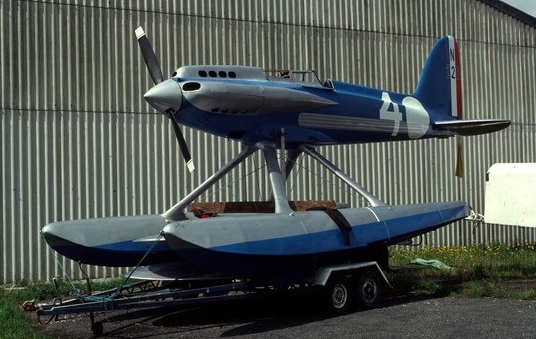
The aircraft was wrecked on September 23, 1982, when due to an engine failure on takeoff it crashed into Thorpe Water Park, the wings and float supporting structure were destroyed. The remains were acquired by hotelier William ‘Bill’ Hosie of Newquay, Cornwall, who rebuilt the aircraft at Bodmin using only the rear fuselage of the original, and on April 17, 1985 the aircraft was registered to the Hosie family. Bill Hosie was killed May 23, 1987 near Falmouth when the rudder separated shortly after takeoff, followed by the tail surfaces.
Le Gaucier Amphibian Flying Boat

An invention of a French law student living in Chicago named C. Le Gaucier that once completed, was to have been christened “Napoleon”. Construction of this steam-powered flying boat was started at Cicero Aviation Field in the spring of 1913 with the long-range intent of crossing the Atlantic with it once tested and proven on Lake Michigan. The “Napoleon” was intended to be of a special construction of aluminium steel and be equipped with four 250 hp steam turbines, with four propellers – the span of its monoplane wing; 100 feet, with a 14-foot cord. The machine had an ingenious four wheel design along the sides of the hull whereas the wheels could be moved up or down, thus allowing for the capability to take off and touch down on land.
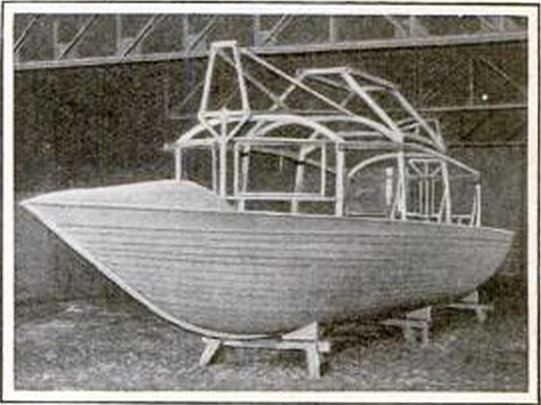
Note the changes to the design. The hull is the same, but now sponsons have been added. Above the gunnel, everything has been altered. The boat is fully faired from the bow on back, and there is a completely different superstructure.
For the first time, we get a view of the wings. The wing spars are most likely the tubular “aluminum steel”. The airfoils may well be one of Eiffel’s designs, not surprising given the cultural origins of the aircraft’s designer.
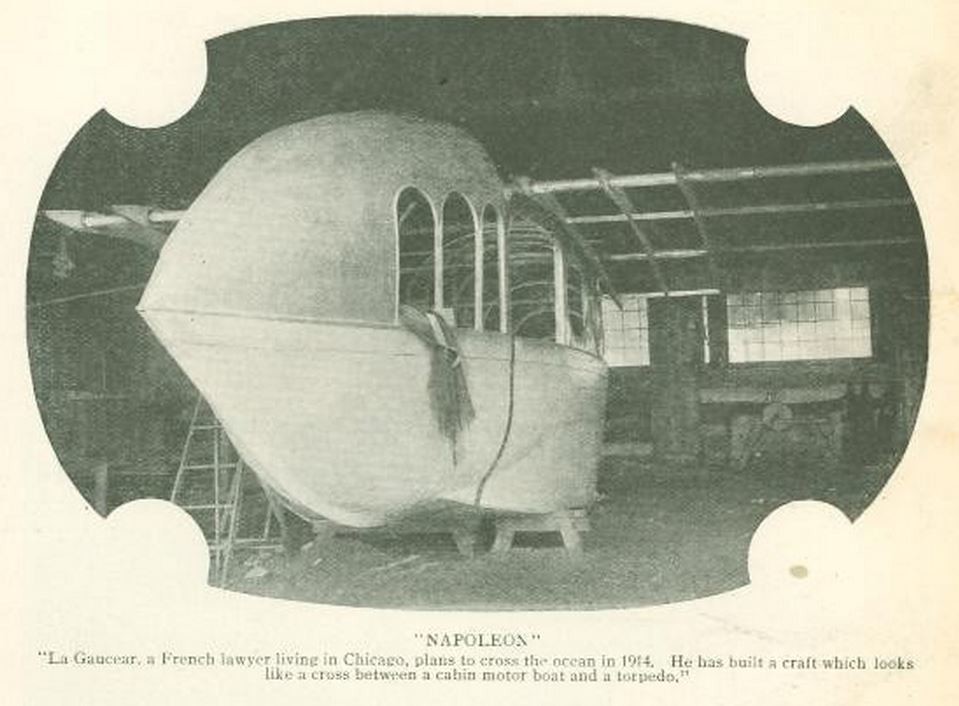
The image was lifted from Technical World Magazine, Feb 1914 issue, pg 843. Here’s a scan of the full page:
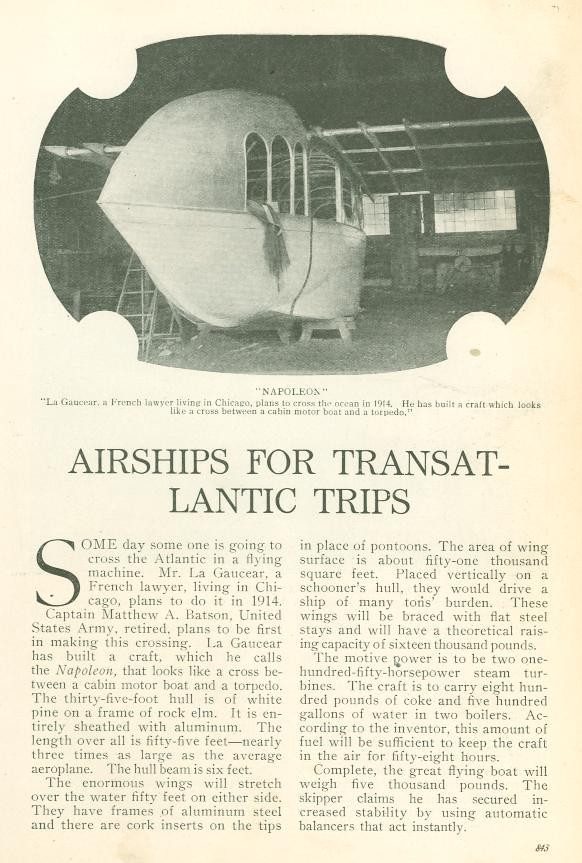
Most of the technical details supplied in the article match up with those in the Popular Mechanics’ piece, the exception being as to wing area, which Popular Mechanics says is 1,655 sq ft, but which Technical World states is 51,000 sq ft.
Jacques Le Gaucear founded the Le Gaucear-Rowe Engine Co. of Chicago, in 1915. It had capital of $8,400, and was incorporated by Charles A Rowe, Evanston, Ill., Jacques Le Gaucear and H.H. Armstrong.
And this is what the company worked on – the Rowe Le Gaucear Aeroplane Engine. This is from The Wisconsin Engineer, December 1916:
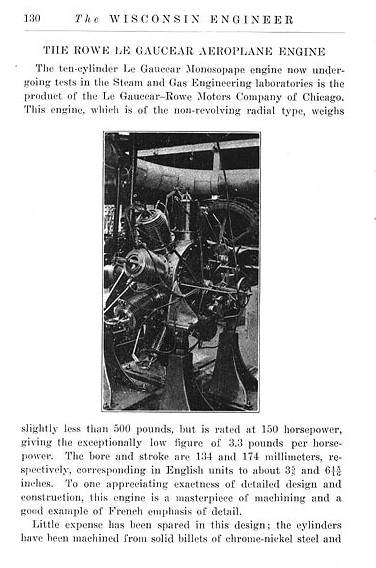

Note that it is not steam-powered, but a radial internal combustion engine. It’s no co-incidence that the engine is rated for 150hp, exactly the same as the steam powered engines that had been spec’ed for the Napoleon. The article makes specific mention of the “French emphasis of detail”. This seems to be the only time the engine ever garnered a mention in the press.
The Le Gaucear-Rowe Engine Co. lasted at least till 1917, as one of their employees – Charles Froesch – worked with them from 1915 to 1917. Froesch later rose to be Vice President-Engineering of Eastern Air Lines.
Latécoère Late 631
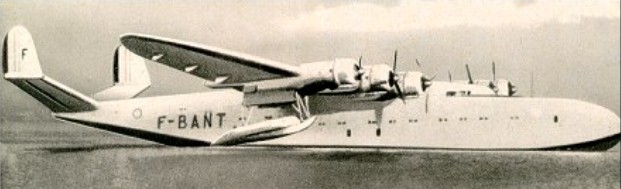
Developed in 1939, construction of the L.631 was interrupted by the war. The prototype Late 631 flew for the first time on 4 November 1942. It was a high-wing monoplane flying-boat powered by six 1,192kW radial engines. Accommodation was provided for 46 passengers in two- or four-berth cabins. However this aircraft was confiscated by the Germans during the occupation of France. It was flown it to the Bodensee (Lake Constance) on the German–Swiss–Austrian border. In 1944, it was attacked and destroyed at anchor by RAF Mosquitos.
Despite the war raging through France, Latécoère managed to complete the first production model in March 1945, now powered by Wright Cyclones instead of its original Gnome et Rhône engines.
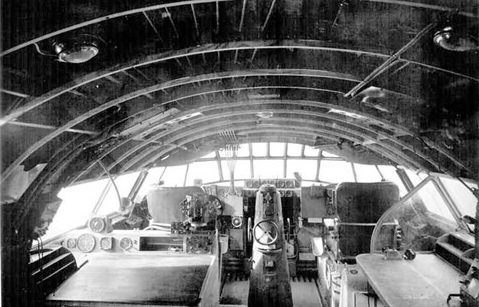
In October of 1945 a propeller on F-BANT separated in flight with a blade slicing through the cabin and killing two passengers. Four production models were bought by Air France and inaugurated transatlantic services between their base at Biscarosse, south-west of Bordeaux, and Fort-de-France in Martinique on 26 July 1947.

Other operators were SEMAF (Société d’Exploitation du Matériel Aéronautique Français) and SFH (Société France Hydro).
The first Transatlantic Flight, Geneva, Switzerland to Fort de France, Martinique by “Latecoere 631” was on June 14, 1948. They covered the distance of nearly 5000 km in 16 hours.
A special mail flight arrived at Fort de France on June 16th, 1947. The plane disappeared on its return flight.
In February of 1948, F-BDRD crashed in the English Channel during a snowstorm killing all 19 on board. After just over one year of service, there was the total loss, with all passengers and crew, of F-BDRC on 1 August 1948. In March of 1950, F-BANU was lost off the coast of France, again with no survivors and finally in 1955, SFH’s F-BDRE had a wing failure, crashing with the loss of half of the 16 people on board.
The Societe France-Hydro operated one on cargo services in French Equatorial Africa for three years, but it crashed: after which all remaining Late 631 were broken up.

Production total: 11
F-BAHG 01 First flown 4/11/1942
F-BANF (not completed)
F-BANT 02 First flown 6/03/1945
F-BANU 3 First flown 15/06/1946
F-BDRA 4 First flown 22/05/1947
F-BDRB 5 First flown 5/09/1947
F-BDRC 6 First flown 9/11/1947
F-BDRD 7 First flown 26/01/1948
F-BDRE 8 First flown 28/11/1948
F-BDRF 9 First flown 20/11/1948
F-BDRG 10 First flown 7/10/1949
F-BDRH 11 not completed
Engines: 6 x Wright Cycl. GR 2600-A5B, 1175kW
Max take-off weight: 71350 kg / 157301 lb
Empty weight: 32332 kg / 71280 lb
Wingspan: 57.4 m / 188 ft 4 in
Length: 43.5 m / 142 ft 9 in
Wing area: 350.0 sq.m / 3767.37 sq ft
Max. speed: 405 km/h / 252 mph
Cruise speed: 320 km/h / 199 mph
Range w/max.fuel: 6000 km / 3728 miles
Crew: 6
Passengers: 70
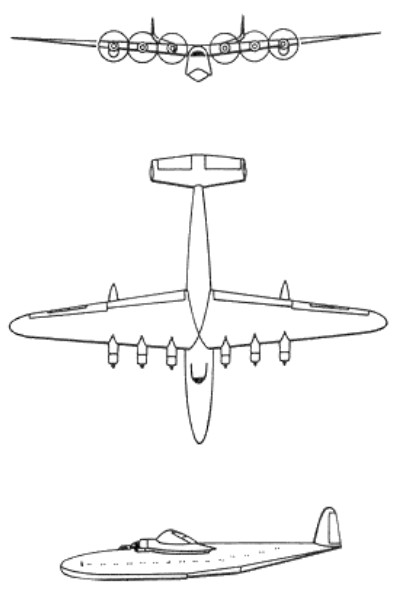
Latécoère Laté 610 / 611 / 612
The Latécoère Laté 610 Series were 1935 4-engined long-range flying boats
Laté 610: [Project] May 1935 recce flying boat for Aéronavale
Laté 610 as designed, single fin, span 38 m, length 24.5 m
Laté 611: enlarged recce flying boat to mod. Dec 1935 spec.
Laté 611 as planned, 4 x 1000 hp HS.79.02 radials
Laté 611-01: 1939, conv. under const. to 4 x 10¹⁰ hp G-R 14N4/5
Laté 611-01, G-R 14N30/31 engines substituted after trials
Laté 612 diff. in having 4 x powered turrets (incl. tail turret)
 All Aero