Phoenix Dynamo built two Phoenix P.5 Cork flying-boats.
Amphibian
Peyret-le Prieur Hydroplan
A 1924 light biplane seaplane trainer designed for Yves le Prieur (of aerial rocket & aqualung design fame)
Engine: 1st trials 16 hp 4-cyl Sergant, then replaced by 45 hp Anzani 6
Petrolje Macchi M-5
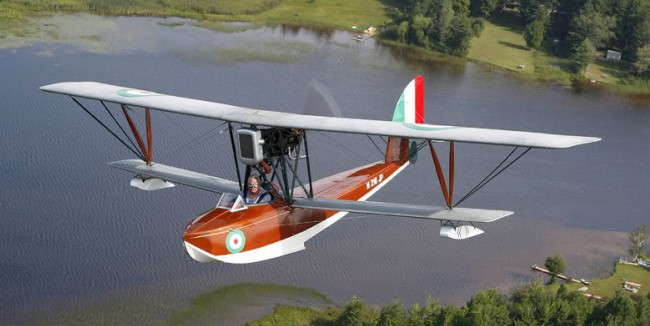
Jason Petroelje’s first project, an Emeraude RG, was a 1979 Oshkosh award winner and a feature in the May 1980 EAA Sport Aviation magazine. Other airplane projects included two World War I reproductions for a museum.
“I was building a SPAD replica for them, and they mentioned the Macchi,” Petroelje said. “I didn’t know anything about the type, but when I looked into it I decided I really liked it.”
Jason Petroelje built his beautiful Macchi M.5 flying boat using only his left hand – the one hand he had to use after a stroke 10 years earlier. “I built this thing after I had the stroke,” Petroelje said about his three-quarter scale Macchi M.5 flying boat. He added, “I built it with my left hand.” It didn’t stop him, however, worked about 5,000 hours, day and night, in the cramped workshop next to his home on Hazel Avenue, turning out everything from the wing struts to the tiniest of fittings.
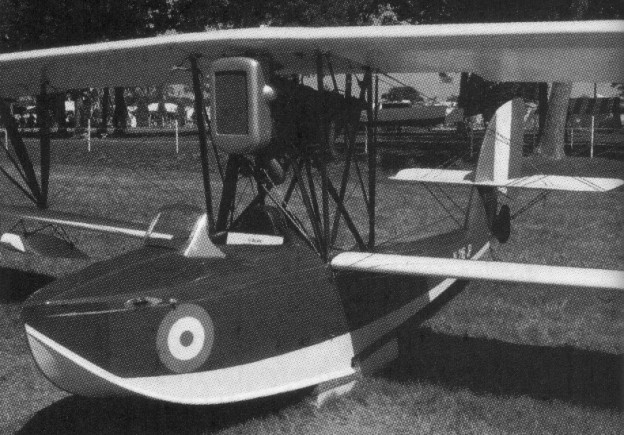
Petroelje’s Macchi, a type used as a fighter by the Italian forces in World War I, has the appearance of a fine, classic watercraft with a natural Honduran mahogany skin and a solid Brazilian rosewood instrument panel. The woods are both adorned with a deep, high gloss marine finish.
The control stick has a hand-carved Madagascan ebony handle, and thrust comes from a hand-laminated, hand carved cherry-and-birch propeller.
His little flying boat is three-quarter scale for a good reason. The reason for building the airplane in 7/8 scale is unique to seaplanes. Hangers next to the water with easy access are very rare. Jason had a friend who used to have a Volmer Sportsman. He had sold the airplane, but the hanger remained. Jason had to scale down the airplane to fit in this existing hanger.
No original drawings of the Macchi existed, so Petroelje had to create his own designs from a set of dimensions and from photographs. “I just went more by the dimensions,” Petroelje said of the plans, which he secured years ago for $40 from “WWI Aero” magazine.
A variation drawn from experience was a decision to scale the tail to 80 percent instead of 75 percent. Petroelje said the 75-percent version was just too small.
The hull of the seaplane varies from the original as well. Petroelje layered the bottom first with plywood, then foam, and finished it off with fiberglass. The modern bottom is more durable than the likely single-plywood layer of the original and should better tolerate the rigors of normal water operations. As for the mahogany finish, no color photos exist of the type, so that choice may well be artistic license on Petroelje’s part.
The wings of the plane fold back, a feature certainly not part of the original. But at three-quarter scale, the collapsed craft is only 8 feet wide, well within legal trailering limits. This has a more modern airfoil, a 4412 like on a Luscombe.
A modern air-cooled Lycoming powerplant provides the motive force. The radiator on Petroelje’s plane, necessary for the liquid-cooled powerplant on the original, is purely decorative.
The Macchi M.5 Italian fighter is mostly authentic, except for not sporting machine guns like those used during the plane’s heyday.
Registered as N216JP, to Jason Petroelje of Michigan, Eric Presten did the first three flights on the Macchi M-5.
The airplane performed well, but due to limited aileron travel, Presten was only able to do flights down the lake in ground effect on the first day. It has since been flown to altitude. It gets out of the water easily on only 125 hp. The missing outer struts are now installed. The landing gear shown is only a beaching gear, as the airplane is a true seaplane. Cruise speed for the craft is around 75 miles per hour.
The replica appeared at Oshkosh 2009.
Engine: Lycoming 125-horsepower
Fuselage length: 24 feet
Wing span: 31 feet
Weight: 940 pounds
Cruising speed: Up to 70 mph
Fuel capacity: 12 gallons
Hours to build: About 5,000
Size of workshop: 18 by 24 feet
Pereira GP-3 Osprey 2
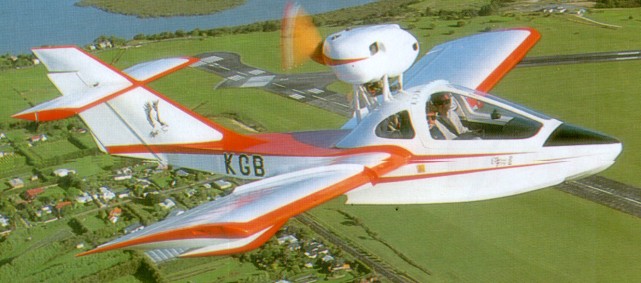
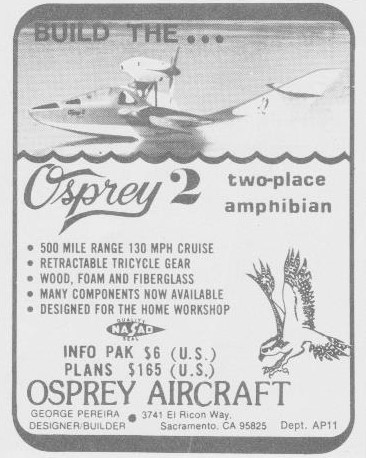
Design and construction of the two place Osprey 2 amphibian began early in 1972 following development of a military version, the U.S. Navy X-28A Air Skimmer, for civil police use in Southeast Asia. The designer, George Pereira, evolved a unique construction technique for the single-place Osprey I by coating the underside of the all-wood fuselage structure with polyurethane foam, later sculptured to the desired shape and covered with several protective layers of fiberglass bonded with resin. The result is a light, strong structure able to resist the shock of hard water landings.
The pusher engine is a Lycoming O-320 flat-four of 160 hp mounted on a pedestal so the prop wash blows directly over the cruciform tail surfaces. Wings are of all-wood construction with a single box spar, while the landing gear for use on land is of the retractable tricycle type. The wings just outboard of the main gear are removable for towing and home storage.
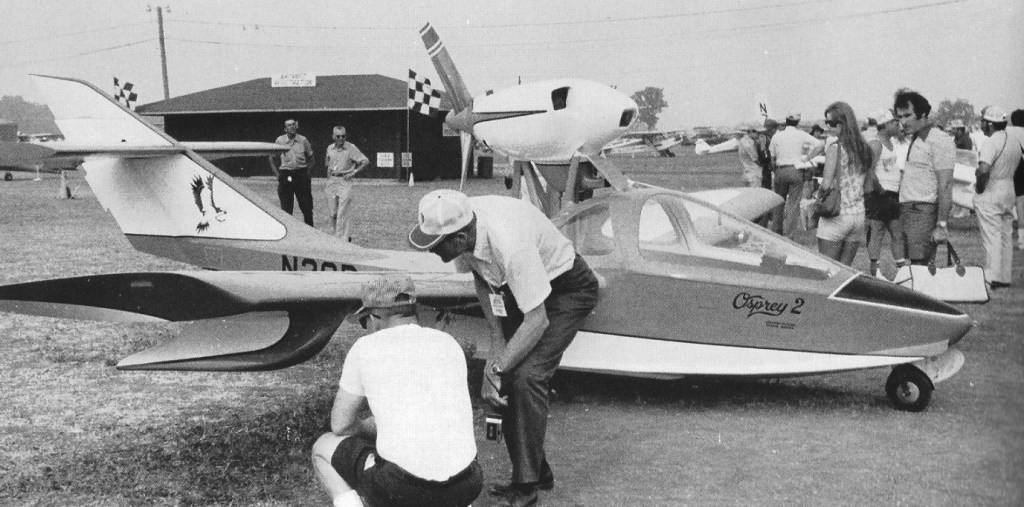
The Osprey 2 was designed to be built, in its entirety, in a workshop with no molds required, and first flew in 1973.
Detailed construction plans are available. They consist of 46 sheets, drawn with amateur builder in mind, plus step-by-step, photo illustrated, construction manual. Price 1982: $3,690 (Excludes engine, propeller, Instruments and paint). Units delivered to June 1981: 500.
Seats: 2
Engine: Lycoming 150-160 hp
Length: 21 ft
Cabin Width: 43 in
Wing Span: 26 ft
Wing Area: 130 sq ft
Wing Load (full gross): 10.09 lbs/sq ft
Span Loading: 80.45 lbs/sq ft
Aspect Ratio: 5.2
Dihedral: 5 Degrees
Gross Weight: 1,560 lb
Empty Weight: 960 lb
Useful Load: 420 lb
Fuel: 32 USG
Baggage: 10.5 sq ft – 75 lbs
Wheel Track: 8′
Wing Airfoil: 23012
Range at 75%: 500 +
Takeoff run (land): 300 ft
Takeoff run (water) 520 ft
Landing roll 600 ft
Climb Rate @ MSL: 1,200 fpm
Service Ceiling: 20,000 +
Vmax: 150 mph
Cruise Speed 75%: 130 mph true
V s1 (stall clean): 65 mph
V s0 (indg config): 60 mph
Pereira Osprey I / X-28
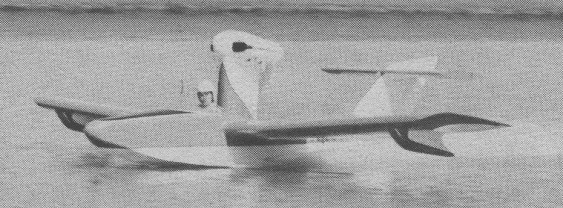
The Osprey 1 is a single-seat flying boat designed and built by George Pereira in 1970. First flown on 12 August 1970 it is built from fir and pine, with the vertical fin an integral part of the structure. The hull is skinned with mahogany plywood and glassed. The steel-tube pylon mount for the engine is bolted to the wing center section. A simple wing-folding mechanism holds the wings in position with the same steel pin which locks them in the ex¬tended position. Power is provided by a 90-hp Continental.
N3337 was re-named X-28 158786 when the US Navy commissioned the Naval Air Development Center to do a study for reconnaissance flights in the Mekong Delta during the Viet Nam war. The aircraft was evaluated with three other entries and selected for production in South East Asia. George was asked to help set up production; however, the war ended before production plans were finalized. The X-28A is on display in the Kalamazoo Aviation History Museum.
The Osprey 1 was designed with folding or removable outboard wings and launched from a boat type trailer. It is very light weight (600 lb), and 90 hp gives remarkable water and climb performance.
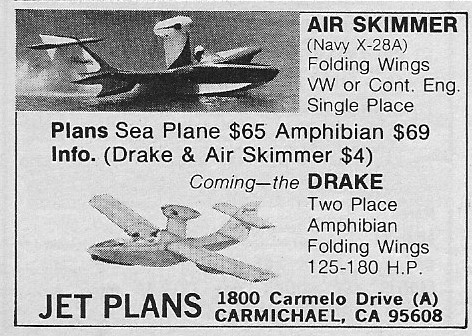
Complete plans (including the trailer) were available for $150 U.S. plus $20 U.S. for overseas.
Engine: Continental C-90-12, 90 hp
Length: 17’ 9”
Wingspan: 24’ 9”
Height: 5’ 3”
Wing area: 103 sq.ft
Empty: 600 lb
MTOW: 900 lb
Fuel capacity 16 USG
Maximum speed: 135 mph
Top level speed: 120 mph
Cruise 105 mph
Stall 55 mph
Range: 370 miles
Service ceiling: 17,994 ft
Rate of climb: ft/min 2,200
Takeoff run: 200 ft
Wing loading: lb/sq.m 9 sq. ft.
Crew: 1
Pensacola Metal Aircraft Co
Pensacola FL.
USA
In 1930 Pensacola Metal Aircraft Co built a four-place float-equipped biplane, powered by four 575hp P&W Hornet.
Designed by Walter Eade, the all-metal aircraft had a wingspan of 80’0″.
Pennsylvania Aircraft Syndicate XOZ-1
The 1934 Pennsylvania Aircraft Syndicate XOZ-1 N8602 was a two-place autogyro floatplane, designed by E B Wilford and built from Consolidated (Fleet) XN2Y-2 parts. Only the one was built.
Engine: 110hp Warner Scarab, later 125hp Kinner B-5 and 155hp R-5
Rotor: four-blade
Rotor diameter: 32’0″
Max speed: 107 mph
Cruise: 90 mph
Range: 150 mi
Seats: 2
Penhoet Flying Boat

Peel Glider Boat
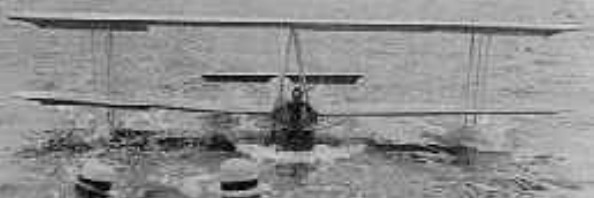
The Peel Glider Boat Company of Flushing Bay, NY was in business around 1930, designing and building the Glider Boat, a biplane glider with stepped flying boat hull and wingtip floats. A number of examples were sold.
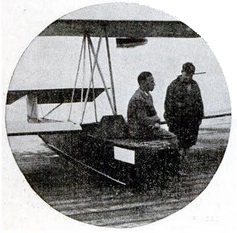
The two occupants sat in tandem in an open cockpit with conventional controls, but without instruments. The structure was wooden spar, steel ribs, fabric covered, and a duralumin hull.
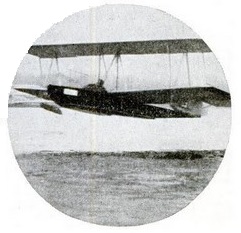
Normal method of launch was behind a motor boat, the towrope being joined to a bridle which attached to either side of the nose outside the front cockpit.
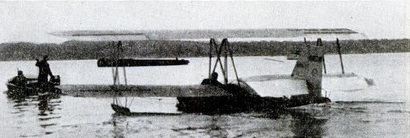
One example belongs to the National Soaring Museum.
Wing span: 9.45 m / 31 ft
Wing area: 25.08 sq.m / 270 sq.ft
Empty Weight: 113 kg / 250 lb
Payload: 159 kg / 350 lb
Gross Weight: 272 kg / 600 lb
Wing Load: 10.84 kg/sq.m / 2.2 lb/sq.ft
L/DMax: 15
Seats: 2
Paterson-Francis 1913 flying boat
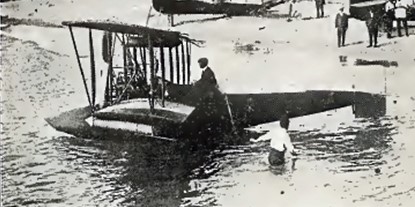
A flying boat with the engine mounted in the front of the (boat) fuselage, driving two tractor propellers via chains. Roy Noel Francis was a designer and aviator who in 1913 founded the Paterson-Francis Aviation Company. Charles Paterson was probably the financier. The machine was built in 1913 for the Great Lakes Reliability Tour. It apparently did survive the Great Lakes event and is reported to have been packed up by Francis and sent home, but nothing seems to be mentioned afterward. Around the same time, Paterson was reportedly building a monoplane flying boat.
 All Aero