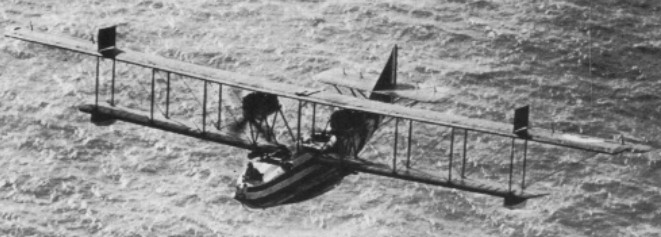
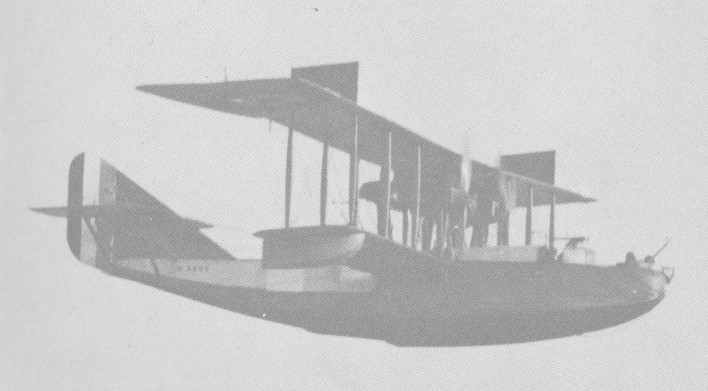
Progressive Aerodyne

1995-2007: 520 Clifton St, Orlando, FL 32808, USA.

Progressive Aerodyne was founded in 1991 by Kerry Richter and his business partners, Wayne Richter and Paige Lynette. With a long family history of building ultralight amphibious aircrafts, the company took the opportunity to create a new amphibious aircraft design and named it the Searey. Thus, the Searey took form and began flying in November 1992.

The next year, the Searey Classic was introduced to the general public and was very well received, assuring two years worth of orders for the company.

Progressive Aerodyne is a family business of Kerry Richter, and three generations of his family, together with their friend and partner Paige Lynette, all work in the company that has produced over 400 flying aircraft.

In 2009 Kerry is the President of the company and was in full time research and development of improvements to the SeaRey and of new aircraft designs for the future. A full time aeronautical engineer, Damir Blazevic has over 30 years engineering experience, the last 19 of which were with Airbus including on the Airbus 380 design. Damir has personally built over 9 aircraft, many of his own design. Damir’s specialty is quality control. The team works with state of the art computers and aircraft design software to ensure airworthiness and compliance with aviation standards.

In January 2010, a significantly improved model, the Searey LSX, was introduced to the aviation community. To date, close to 600 Searey Kits had been delivered to customers and over 500 are flying worldwide.

In May 2010, the company moved their headquarters from Orlando to Tavares, Florida, to facilitate its growth. A year later, Adam Yang, also a Searey pilot, owner, and builder, joined Progressive Aerodyne as CEO.

In June 2014, Searey expanded it global reach with the opening of its sales office in Shanghai, China, to support the sale of Searey Light Sport Amphibious Airplanes. The Searey was first presented to the China market at air shows in 2009, where interest in Searey airplanes was overwhelming. Since then, Progressive Aerodyne participated in subsequent air shows and invested in research and marketing in order to advance the Searey in China. The company is currently working with Chinese aviation authorities to gain certification of the Searey. The Shanghai office to manage all marketing and sales and work with government authorities in China.

Progressive Aerodyne in Tavares, Florida manufactures finished Searey seaplanes in full production of two configurations of Searey models, the Searey Sport and the Searey Elite, both of which have received FAA certification for airworthiness. In addition, the company continued to manufacture Searey Kit Airplanes.
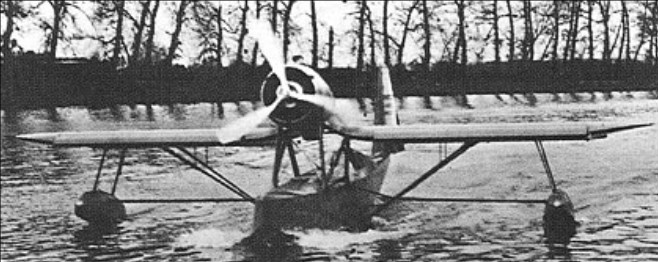
Potez 453

A contender to fulfil the 1933 Marine Nationale requirement for a single-seat float fighter suitable for catapult operation from 10,000-ton cruisers, the Potez 453 was based broadly on the design of the two-seat Potez 452 light observation flying boat. Competing with floatplanes tendered by Bernard (H.52), Loire (210) and Romano (R-90), the Potez 453 flying boat first flew on 24 September 1935. Of mixed construction, it was powered by an 800hp Hispano-Suiza 14Hbs radial engine and was intended to carry an armament of two 7.5mm machine guns. The engine was carried on bracing struts ahead of the wing, the thrust axis passing high above the CG of the flying boat with the result that, in view of the small dimensions of the aircraft, a considerable diving moment was induced at full throttle which could not be easily counteracted. Take-off was, in consequence, difficult and could be effected only by reducing engine power. Further development of the Potez 453 was therefore abandoned.

Max take-off weight: 1937 kg / 4270 lb
Empty weight: 1534 kg / 3382 lb
Wingspan: 11.20 m / 37 ft 9 in
Length: 10.20 m / 33 ft 6 in
Height: 3.45 m / 11 ft 4 in
Wing area: 19.00 sq.m / 204.51 sq ft
Max. speed: 318 km/h / 198 mph
Range: 540 km / 336 miles

Potez 453

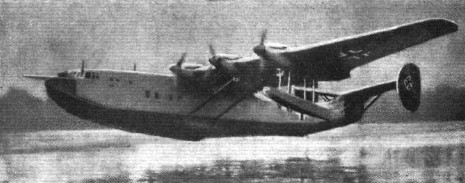
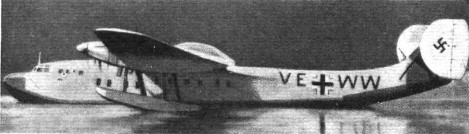
Potez CAMS 161

The Potez-CAMS 161 was one of three French large, six-engined flying boats intended as airliners on the North Atlantic route. The others were the Latécoère 631 and the SNCASE SE.200. In the summer of 1938, the 161’s aerodynamics had been investigated and refined with the Potez-CAMS 160, a 5/13 scale flight model.

Potez-CAMS 161 in foreground with the type 160 scale flight model behind. Floats retracted.

The 161 was an all-metal monoplane with a high, semi-cantilever wing, braced on each side by a pair of parallel struts between the lower fuselage and the wing near the first outboard engine. The engines were mounted on a constant chord central section but the outer panels were tapered, with ailerons interconnected to Handley Page slots near the wing tips. The trailing edges carried split flaps. The flying boat’s wing stabilizing floats retracted vertically to the outer engine cowlings. The tail unit was of the twin endplate fin type with the tailplane, mounted with marked dihedral, on a fuselage pedestal and externally braced from below. The D-shaped fins were fixed to the tailplane a little below their horizontal mid-lines and were also lightly braced, with struts between them and the upper tailplane surfaces.

The CAMS 161 was powered by six 664 kW (890 hp) Hispano-Suiza 12Ydrs liquid cooled V-12 engines driving three blade propellers. These were cooled via both wing surface and frontal radiators, the latter retracted after take-off. Its two step hull was flat sided forward of the wing but more rounded aft; there were long wing root fillets. Ten square windows on each side lit the passenger cabin, where twenty were provided with seating and sleeping compartments and flown and looked after by six crew.

Very different dates for the first fight appear in the literature: a contemporary report in Flight gives it as within few weeks before 7 December 1939, with “further flying tests” in the first half of 1942, whereas Hartmann has 20 March 1942 as the first flight date. In either case the CAMS machine was the first of the three to fly.

In Hartmann’s account, the March flight was from the Seine, with the aircraft in German markings. Earlier it had been painted in Air France Atlantique trim and at some point it received a French civil registration.

Full flight trials and performance measurements were never done, so the figures remain estimates, but there is clear evidence that the empty weight had increased by about 33% from the 1938 estimates by the time the 161 was flying, with a corresponding 16% increase in gross weight.

It seems to have been destroyed by enemy fire toward the end of World War II, but there is disagreement on exactly when and where: Hartmann locates the event to the Baltic, others to Lake Constance. Cuny states that the SE.200 and the Laté 631 were destroyed on the lake early in 1944, but that the Potez escaped.

Engines: 6 × Hispano-Suiza 12Ydrs, 660 kW (890 hp) each
Propellers: 3-bladed
Wingspan: 46 m (150 ft 11 in)
Wing area: 261 m2 (2,810 sq ft)
Length: 32.11 m (105 ft 4 in)
Height: 8.87 m (29 ft 1 in)
Empty weight: 17,220 kg (37,964 lb) ; Flight (1942) has 22,979 kg (50,660 lb)
Gross weight: 37,000 kg (81,571 lb) ; Flight (1942) has 43,001 kg (94,800 lb)
Fuel capacity: 15,500 kg (34,172 lb) including oil
Maximum speed: 335 km/h (208 mph; 181 kn) at 1,000 m (3,281 ft)
Cruise speed: 300 km/h (186 mph; 162 kn) at 4,000 m (13,123 ft)
Range: 6,000 km (3,728 mi; 3,240 nmi) in a 60 km/h (37 mph) wind, full load, std fuel
Crew: Six
Capacity: Twenty passengers

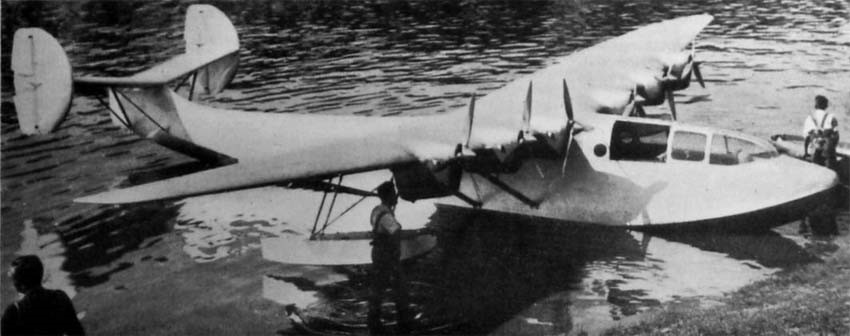
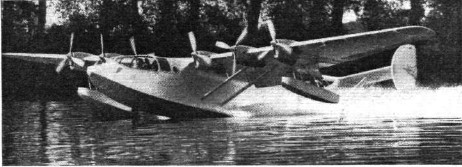
Potez-CAMS 160

In 1936 the design bureau of Potez-CAMS was beginning the development of the Potez-CAMS 161 six engine, trans-Atlantic passenger flying boat, intended to be a key component of Air France’s Transatlantique fleet. To test the design they built a 5/13 scale flying scale model of it, careful not just to scale dimensions of the flying surfaces and hull, but also to copy the form the nose around the cabin, engine cowlings and retractable float housings. Control surface detail and the flaps of the 161, together with its variable-pitch propellers, were included on the resulting Potez-CAMS 160. It was intended to prove both the aerodynamic and hydrodynamic behaviour of the airliner.

The 160 was a high-wing monoplane. The wing was a semi-cantilever structure, with two parallel bracing struts on each side from the lower fuselage to the wing just inside the central engines, straight-edged in plan with taper on the trailing edge only and rounded tips. It was fitted with interconnected Handley Page slots and ailerons as well as split flaps. It was powered by six four-cylinder inverted inline air-cooled Train 4T engines, each producing 30 kW (40 hp) driving three blade, variable-pitch propellers. The engines were mounted on the wing underside, housed in long, narrow cowlings intended to mimic those around the 664 kW (890 hp) Hispano-Suiza 12Ydrs water-cooled V-12 engines of the full scale aircraft.

The little flying boat had a conventional stepped hull and was stabilized on the water by a pair of floats, attached under the outboard engines and retracting into their cowlings. Its enclosed, tandem seat cockpit was shaped to reproduce the form of the 161’s nose, though the full sized aircraft had proportionally shorter glazing. The 161 had a twin fin empennage with a N-strut braced, parallel chord tailplane mounted on top of the fuselage on a short pillar with marked dihedral. The fins were of the endplate type, with curved leading edges and roughly symmetric above and below the tailplane; on each, the rudder was split into an upper and lower part. All of these features appeared on the final, full size airliner.

It flew for the first time on 20 June 1938.

The Potez-CAMS 160 appeared, after its first flight, at the 1938 Paris Aero Show.

Engines: 6 × Train 4T, 30 kW (40 hp) each
Propellers: 3-bladed variable pitch
Wingspan: 17.69 m (58 ft 0 in)
Wing area: 38.7 sq.m (417 sq ft)
Length: 12.37 m (40 ft 7 in)
Height: 3.41 m (11 ft 2 in)
Gross weight: 2,275 kg (5,016 lb)
Maximum speed: 222 km/h (138 mph; 120 kn) at 950 m (3,116 ft)
Power/mloadng: 75 W/kg (0.047 hp/lb)
Wing loading: 58.5 kg/sq.m (12.0 lb/sq ft)
Crew: Two, pilot plus observer

Potez (CAMS) 141

The acquisition by Potez in 1933 of Chantiers Aero-Maritimes de la Seine (CAMS) brought increased interest in the development of maritime aircraft, and the Potez (CAMS) 141 was designed to meet an official requirement for a maritime reconnaissance flying-boat. A large-span monoplane wing was carried on a faired superstructure above the hull, to which it was braced on each side by large N-struts. A stabilising float was strut-mounted beneath each wing, and the two-step all-metal hull carried at the rear a twin fin-and-rudder tail unit. Carrying a crew of nine to 12, the 41m span Potez 141 was powered by four 694kW Hispano-Suiza 12Y-26/27 Vee engines in wing-mounted nacelles. First flown on 21 January 1938, successful testing led to large orders, but changing policies and the development of World War II meant that no production aircraft were built.

Max take-off weight: 25900 kg / 57100 lb
Max. speed: 320 km/h / 199 mph
Bomb load: 1500kg

Porte Super-Baby / Felixstowe Fury

Porte’s ultimate design was a triplane flying boat, unofficially nicknamed the ‘Porte Super Baby’, but officially designated Felixstowe Fury. With wings spanning 37.5 m (123 ft), the Fury was powered by five 360hp Rolls Royce Eagle engines, two as tractors and three as pushers. Flying controls, initially, were power assisted by servomotors. After successful flying trials, the Fury was in the last stages of preparation for a projected flight to South Africa on August 11, 1919, when it was wrecked in Harwich harbour. All work on a second Fury was then stopped and the Fury programme cancelled. In October 1919, John Cyril Porte, the man whose inventive genius had conceived the F series of flying boats, died in Brighton of tuberculosis.

Engines: 5 x 334 hp Rolls-Royce Eagle VII
Span: 37.5 m (123 ft)
Length: 19.2 m (63 ft 2 in)
Height: 8.4 m (27 ft 6 in)
Maximum speed: 156 km/h (97 mph) at 609.5 m (2000 ft)

Porte F.2A America

The Admiralty placed orders for Curtiss H.4 and H.12 flying-boats in 1924-15 on the recommendation of Squadron Commander John Porte. When they arrived, Porte fitted some with much improved hulls of his own design, built at the Naval Air Station of Felixstowe and by private manufacturers.

The engines were also replaced by Rolls-Royce Eagles in the H.12’s, which were redesignated F.2A.

They featured three-bay biplane wings with two spar wood construction and fabric covering. The hull was wood with plywood covering. Conventional controls with ailerons on the top wings only. Stabilising floats were under each lower wing tip.

Normal defensive armament was four Lewis machine guns: one in the nose cockpit, one in the rear cockpit aft of the wings and one on each side of the fuselage. Sometimes the nose and rear positions were each fitted with two guns, and an additional gun could be mounted above the pilots’ canopy. Racks for two 230-lb bombs were under the wings.

Best known was the F.2A, which, in the last year of the war, formed the backbone of RNAS/RAF ocean activ¬ity. Carrying up to seven Lewis guns and two 220 lb bombs, it had a maximum weight of 11,000 lb, its two 345 hp Rolls¬Royce Eagles gave it a top speed of 95 mph and it could reach 2,000ft in 3.5min and 10,000ft in 39.5min. Despite its 120ft wingspan it was surprisingly agile. Gradually F.2s replaced H12s.

The F2A was basically a Porte II hull married to the wings and tail unit of the Curtiss H.12. Utilised by Britain during WW 1 and credited with shooting down Zeppelins L.22, L.43 and L.62.

F.2A
Engines: 2 x Rolls-Royce Eagle VIII, 345 hp
Propeller: 4 blade
Wingspan: 95 ft 7.5 in
Wing area: 1133 sq,ft
Length: 46 ft 3 in
Height: 17 ft 6 in
Empty weight: 7549 lb
MTOW: 10,978 lb
Max speed: 95 mph at 2000 ft
Service ceiling: 9600 ft
Endurance: 6 hr
Armament: 4-7 Lewis machine guns
Bombload: 2 x 230 lb

Porte II / Felixstowe F.2

By July 1916 first examples of a larger Curtiss flying boat design began arriving in England. Designated H.8, these were quickly modified to accept more powerful twin 250 hp Rolls Royce engines, and redesignated Curtiss H.12s, or ‘Large Americas’ as the RNAS crews usually referred to them. The Curtiss H.12 hull soon proved to be inadequate for its tasks, so Porte designed a new hull (the Porte II), resulting in all round improvement in performance. With a new tail unit added, the modified craft was designated Felixstowe F.2, and its general structure became a prototype for succeeding F boats.

Large scale production of the F.2 was ordered, and the type began to equip RNAS units in late 1917. Carrying a crew of four, and a bombload of approximately 272 kg (600 lb), the F.2a (its production designation) could achieve a maximum speed of some 145 km/h (90 mph), with an endurance of perhaps six hours. It was cumbersome to handle and slow in manoeuvre, yet gave formidable operational service for the rest of the war. With at least four machine guns in nose, tail, and flank locations, it also gave a good account of itself when engaged by German seaplanes. The F.2a’s main duty was antisubmarine hunting; an air deterrent which undoubtedly proved successful in the protection of Britain’s vital mercantile shipping.

Span: 29 m (95 ft 7.5 in) (upper), 20.8 m (68 ft 5 in) (lower)
Length: 14.1 m (46 ft 3in)
Height: 5.3 m (17 ft 6 in)
Maximum speed: 153.7 km/h (95.5 mph) at 609.5 m (2000 ft)

Porte Baby

On the outbreak of the First World War, among the Admiralty’s chief responsibilities was the aerial defence of Britain, as well as the more traditional role as guardian of the island’s surrounding sea¬ways. At that time the Royal Naval Air Service was almost wholly equipped with floatplanes of limited range and unreliable performance. The obvious need for a sea¬going aircraft of long range led Captain Murray Sueter, Director of the Naval Air Department, to purchase two Curtiss flying boats.

After some operational use of these initial Curtiss flying boats, Commander John C Porte set out to improve some of the more obvious weaknesses in the design.

In September 1915, Porte was appointed in command of RNAS Felixstowe and while there finally produced his own design of flying boat. It was a large, three engined aircraft, and was allocated the serial number 9800. Quite unofficially, it was titled the ‘Porte Baby’. The largest flying boat design of its day, the ‘Baby’ was put into limited production some 20 machines and most of these saw operational service in 1916 17.

It had three Rolls Royce Eagle engines, two installed as tractors and one as a pusher. One successfully launched a Bristol Scout from its top wing while airborne over Felixstow.