Russia
Established 1991. Developed the two-seat Pony amphibian (first flown 1994), produced by Pony JSC. Four seat Prize, based on Pony but with twin engines, under development.
Amphibian
Ravard Aeroscaphe
The Aeroscaphe of Ravard was a machine designed to move either on water or in air. It was an aeroplane with pontoons or floaters. The supporting surface aggregated 400 square feet, and the gross weight was about 1100 pounds. A fifty horse-power Gnome seven-cylinder motor at 1200 revolutions drove two propellers of eight and ten and one-half feet diameter respectively: the propellers being mounted one behind the other on the same shaft.
Rand KR-3
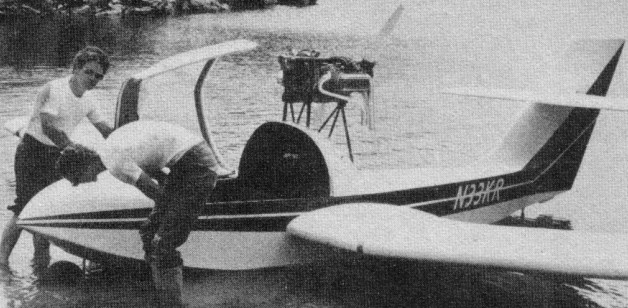
The KR-3 amphibian was originally designed and built by Ken Rand and Stu Robinson in 1976. The prototype was first tested in June 1977. Following Ken’s tragic death in a plane crash, the improved prototype was completed in February 1981, and was undergoing FAA certification as an Amateur-Built aircraft.
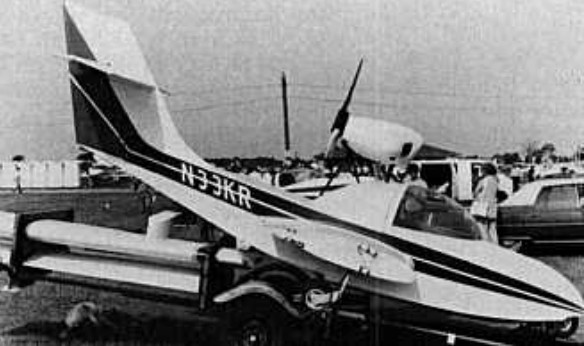
The KR-3’s wings are removable and the aircraft is trailerable. The new fuselage is 9” longer than the original, with the C of G moved forward 8” and the airfoil changed from GA(W)-1 to basically a Clark Y 4418 tapering to 4412. Following the trend-setting construction techniques of the KR-1 and KR-2, the KR-3 amphibian is quick and easy to build from wood, foam, Dynel and epoxy resin. The engine is a 2100cc Revmaster VW conversion with a three bladed Rand-Robinson propeller. The tricycle gear is hydraulically actuated. Retraction and extension are a matter of flipping a micro switch to the appropriate position and pumping a light handle located between pilot and passenger. Turbocharging permits the KR-3 to operate efficiently at altitudes up to 15,000 feet.
Engine: 2100cc Turbo Revmaster VW
Span 25’
Length 17’9”
Wing Area 83.17 sq.ft
Seats 2
Gross Weight 1000 lb
Empty Weight 630 lb
Fuel 17 USgal
Cruise 115 mph
Ceiling 15,000’
Range three hours + 45 min res
Ramphos Aircraft Ramphos
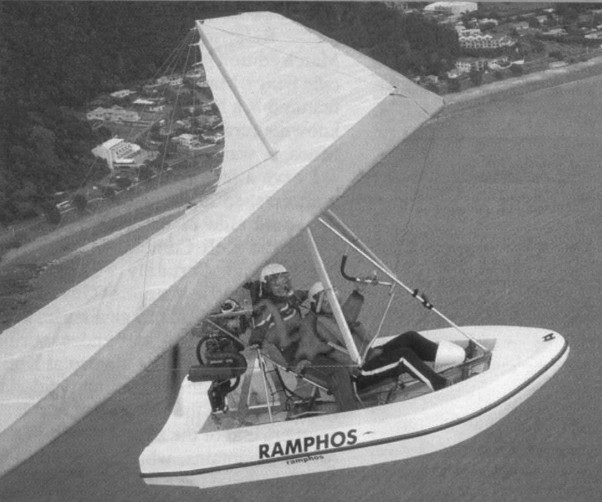
The Italian Trident amphibious ultralight trike was designed to comply with the Fédération Aéronautique Internationale microlight category, including the category’s maximum gross weight of 450 kg (992 lb). The Trident features a strut-braced hang glider-style high-wing, weight-shift controls, a two-seats-in-tandem open cockpit with a rigid boat hull, retractable tricycle landing gear and a single engine in pusher configuration.
Introduced in 1998, the Ramphos Trident is designed and produced by Ramphos of Fontanafredda. The aircraft was supplied as a kit for amateur construction or as a complete ready-to-fly-aircraft, in production in 2013.
Ramphos is an amphibious boat shaped flying hull with wings made of anti-UV mylar of 15 sq.m mounted as standard. Wings up to 21sq.m or a new strong foldable wing (tested +6/-3G) can be mounted. The 15sq.m wing is manufactured in Treviso, Italy.
The hull is a triple “V”, stepped to enhance its rough and glassy water performance. It has a retractable tricycle undercarriage, which enables it to be taxied from the beach to the water and is also suitable for ordinary airstrips.
The aircraft is made from bolted-together aluminum tubing, with its double surface wing covered in Dacron sailcloth and its boat hull made from either fibreglass or carbon fibre and Kevlar.
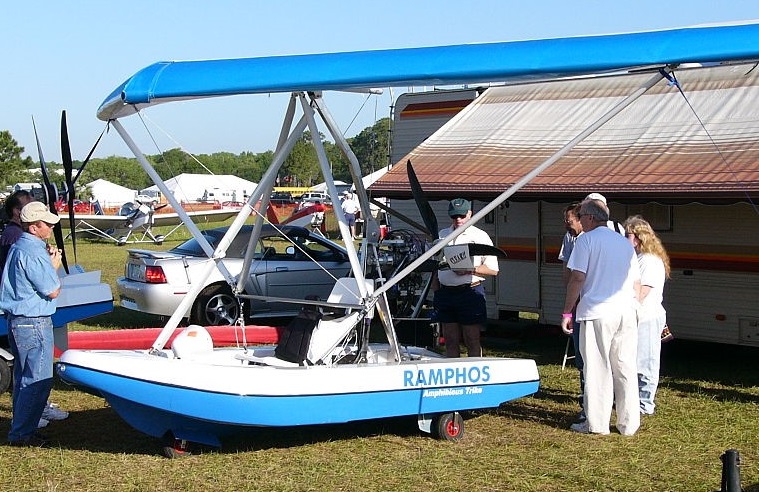
Its 10.5 m (34.4 ft) span Hazard wing has struts and uses an “A” frame weight-shift control bar. The powerplant is a twin cylinder, liquid-cooled, two-stroke, dual-ignition 64 hp (48 kW) Rotax 582 engine or a four-cylinder, air and liquid-cooled, four-stroke, dual-ignition 80 hp (60 kW) Rotax 912UL engine or a 78 hp (58 kW) converted Smart Car four stroke turbocharged engine. All engines are fitted with a clutch that stops the propeller from turning when the engine is at idle to permit water handling. The three ¬blade Warp Drive propeller has nickel inlaid edges for operation from water sur¬faces. The propeller can be two or three bladed, made of wood or composite material. The propeller ring functions as a protective as well as an anti-noise device. Engines can range from 50 to 80 Hp (Rotax, Hirth, etc.). The boat hull features a water rudder.
Starting in 2005 the frame and wing portion of the aircraft was taken from the Skyrider Sonic ultralight trike, built by Skyrider Flugschule.
Variants:
Hydro
Initial flying boat model that lacks wheeled landing gear. Introduced in 1998 and in production in 2013.
Trident
Amphibious model with fibreglass boat hull, in production in 2013.
C
Amphibious model with carbon fibre/Kevlar boat hull and lexan windows in the bottom of the hull to allow visibility downwards. In production in 2013.
Trident
Engine: 1 × Rotax 912UL, 60 kW (80 hp)
Propellers: 2-bladed composite
Wingspan: 10.5 m / 34 ft 5 in
Wing area: 15 m2 / 160 sq ft
Stall: 26 kt / 30 mph / 48 kmh
Cruise: 59 kt / 68 mph / 110 kmh
VNE: 78 kt / 90 mph / 145 kmh
Empty Weight: 210 kg / 463 lbs
MTOW Weight: 450 kg / 992 lbs
Take-off distance (50ft obstacle): 330 ft / 100 m
Seats: 2
Radley-England Waterplane
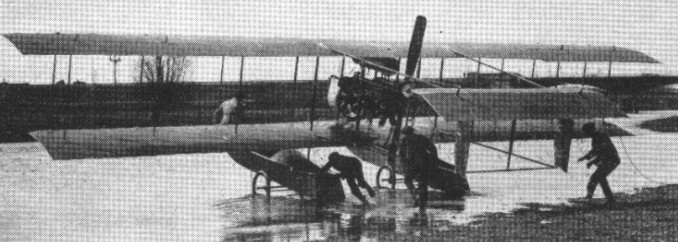
Designed and flown by E.C. Gordon England circa 1909. It had three engines, geared to a single propeller. Pilot and passengers sat in the twin floats.
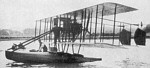
The 1913 Radley England No. 2 waterplane was designed and built by James Radley and Eric England
1913 Radley England No. 2 waterplane
Span: top51′ 7.5″ bottom 45’10”
Length: 29’9″
Hull length: 18′
RAAF Experimental Aircraft Station Widgeon II
The first design was the Widgeon 1, a flying boat, followed by a much larger amphibian, the Widgeon II, powered by a 440 hp A.S. Jaguar engine. In 1927, the Widgeon II undertook a 9,000 mile flight around Australia.
RAAF Experimental Aircraft Station Widgeon 1
The first design was the Widgeon 1, a flying boat, followed by a much larger amphibian, the Widgeon II.
Quikkit Corp
USA
Developed the composites-constructed Glass Goose two-seat amphibious biplane (introduced in kit form in 1992) from the former Aero Composites Sea Hawker of 1982 first flight.
1995-2009: 9002 Summer Glen No.B, Dallas, TX 75243, USA.
Progressive Aerodyne Sting Ray
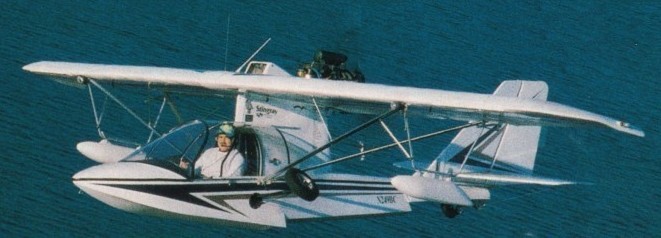
The Stingray is the single seat version of the Searay.
Engine options include the Rotax 447, 503, and 582.
Engine: Rotax 447, 40 hp
HP range: 40-65
Height: 6.2 ft
Length: 21.4 ft
Wing span: 30.83 ft
Wing area: 150 sq.ft
Weight empty: 470 lb
Gross: 800 lb
Fuel cap: 6 USG
Speed max: 85 mph
Cruise: 65 mph
Range: 100 sm
Stall: 27 mph
ROC: 600 fpm
Take-off dist: 175 ft
Landing dist: 200 ft
Service ceiling: 9,000 ft
Seats: 1
Landing gear: retractable tail wheel
Progressive Aerodyne Sea Rey
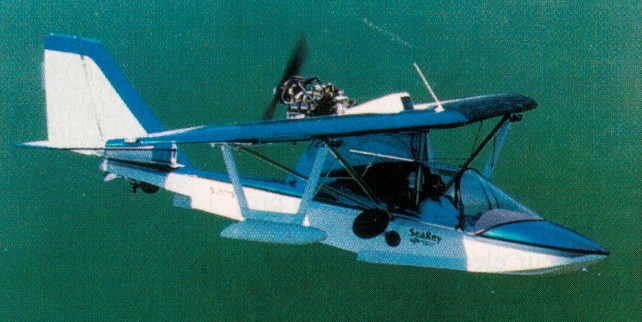
A side-by-side, high wing amphibian, related to the Adventure Air Adventurer 333. It is a high wing, pusher, tail dragger configuration, and a panoramic lexan cockpit. The wings are swept back at the leading edge with a straight trailing edge to form a tapered wing. The engine is mounted on top of the wing, which is supported above the fuselage by a vertical pylon.
The Cabin is designed with side-by-side seating. Entry into the cabin is through a sliding canopy into the 44 in/112cm cockpit. Dual flight controls enable flying from either seat. There is storage space behind the seats (L48 x W44 x H17 in.) for baggage.
The SeaRey is the ability to fly unaffected with the individual dual sliding canopies either opened or closed. The retractable landing gear handles unimproved grass runways. The take off roll on land at gross weight is about 375 feet (115m). Lift off takes place at around 45-50 mph (40 – 45 knots), and 65-70 mph (55-60 knots) is the best rate of climb speed. Rate of climb is 1,000+ ft per min (300m+ per min) Solo and around 800 feet per minute (245m per min) at gross weight.
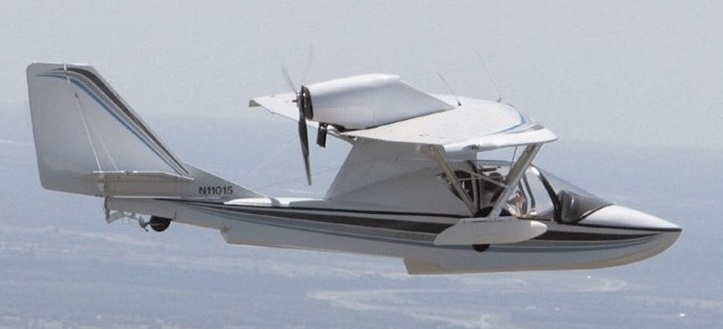
In cruise the SeaRey settles at 90 mph (80 knots). Top speed is 113 mph (98 knots). Due to the installation of special leading edge extensions on the wings, the stall is very docile and the aircraft is spin resistant. Upon throttling back and applying 20 degrees of flaps, the aircraft slows to the stall speed of around 40 mph (34 knots). The stall is gentle and straightforward and recovery is conventional. The retractable undercarriage comes with a simple manual system or alternatively an electric mechanism. An over center lock mechanism is a feature of this simple design.
Best approach speed for a water landing is 65 – 70 mph (55-60 knots) with 10 degrees of flaps. Upon reaching short final, 20 degrees of flaps can be initiated to further slow the aircraft’s touch down speed on the water. Landing flare begins lower than conventional land-only aircraft. A nice touch down speed is 45-50 mph (40-45 knots). This lands the aircraft “on step” and produces very smooth contact with the water.
The SeaRey is capable of handling quite rough water conditions but until such time as the pilot has developed their seaplane water experience, operations in moderate conditions with wave size under 12 inches (30cm), is recommended.
With 20 degrees of flaps for takeoff the SeaRey will come “on plane” in around 4 seconds. A further 6 to 8 seconds to get airborne. The hull produces a very flat spray pattern preventing water from going through the propeller. Accelerating to 45-50 mph (40-45 knots) to rotate and lift off. Established in the climb and at a safe height, reduce the flaps to 10 degrees.
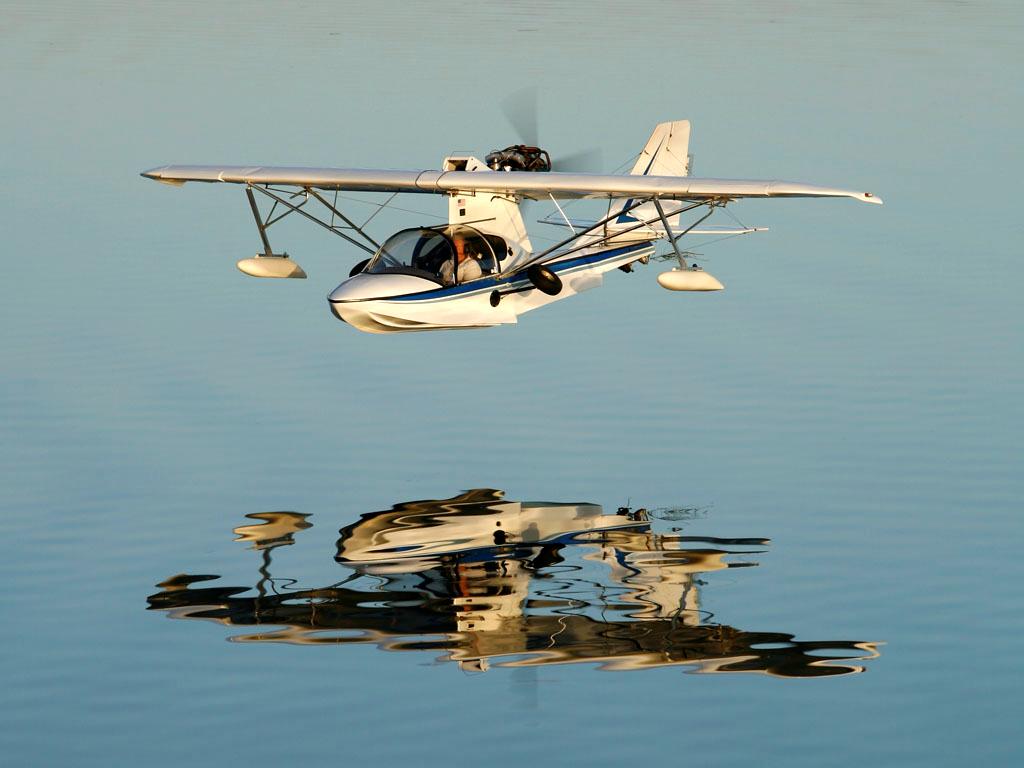
The LSA Searay has dual controls with electric trim, and engine options include 65, 74, 80, and 115 hp Rotaxs.
The basic kit was $21,900 less engine in 2000.
By 2012, the American-made SeaRey has been out in kit form for 21 years (600 kits delivered) and was also an S-LSA. The 2012 models were the Sport and Elite S-LSAs, and the LSX kit (E-LSA or EAB). Prices: US$144,000 (Elite); US$125,000 (Sport) and US$34,900 (LSX airframe-only kit).
SeaRay
Engine: Rotax 912 (80hp)
Cruise Speed: 85 mph
Top Speed: 105 mph
Stall Speed: 40 mph
VNE: 120 mph
Rate of Climb: 650 fpm
Takeoff Land: 400 feet
Takeoff Water: 400 feet
Empty Weight: 820 lbs
Gross Weight: 1370 lbs
Useful Load: 550 lbs
Length: 22′ 5″
Wheel Track: 78 inches
Height: 77 inches
Fuel Capacity: 18 US gallons (optional 26 gal)
Wing Span: 30′ 10″
Endurance: 3.5 to 4 hours
Wing Area: 157 sq. feet
Cabin Width: 44 inches
Root Chord: 76 inches
Cabin Height: 38.5 inches
Tip Chord: 46 inches
Above Seat: 33.5 inches
Aspect Ratio: 6.055
Baggage Area: 13 cubic feet
Taper Ratio: 0.6
Baggage l w h: 48 x 44 x 17 in.
L.E. Sweep: 7.5 degrees
Hull Draft: 10 inches
Stab. Span: 110 inches
Flap Settings: 13, 24, 35 degrees
Engine: Rotax 912s (100hp)
Cruise Speed: 93 mph
Top Speed: 113 mph
Stall Speed: 40 mph
VNE: 120 mph
Rate of Climb: 800 fpm
Takeoff Land: 375 feet
Takeoff Water: 375 feet
Empty Weight: 830 lbs
Gross Weight: 1370 lbs
Useful Load: 540 lbs
Length: 22′ 5″
Wheel Track: 78 inches
Height: 77 inches
Fuel Capacity: 18 US gallons (optional 26 gal)
Wing Span: 30′ 10″
Endurance: 3.5 to 4 hours
Wing Area: 157 sq. feet
Cabin Width: 44 inches
Root Chord: 76 inches
Cabin Height: 38.5 inches
Tip Chord: 46 inches
Above Seat: 33.5 inches
Aspect Ratio: 6.055
Baggage Area: 13 cubic feet
Taper Ratio: 0.6
Baggage l w h: 48 x 44 x 17 in.
L.E. Sweep: 7.5 degrees
Hull Draft: 10 inches
Stab. Span: 110 inches
Flap Settings: 13, 24, 35 degrees
Engine: Rotax 914 (115hp)
Cruise Speed: 100 mph
Top Speed: 120 mph
Stall Speed: 42 mph
VNE: 120 mph
Rate of Climb: 900 fpm
Takeoff Land: 350 feet
Takeoff Water: 350 feet
Empty Weight: 850 lbs
Gross Weight: 1370 lbs
Useful Load: 520 lbs
Length: 22′ 5″
Wheel Track: 78 inches
Height: 77 inches
Fuel Capacity: 18 US gallons (optional 26 gal)
Wing Span: 30′ 10″
Endurance: 3.5 to 4 hours
Wing Area: 157 sq. feet
Cabin Width: 44 inches
Root Chord: 76 inches
Cabin Height: 38.5 inches
Tip Chord: 46 inches
Above Seat: 33.5 inches
Aspect Ratio: 6.055
Baggage Area: 13 cubic feet
Taper Ratio: 0.6
Baggage l w h: 48 x 44 x 17 in.
L.E. Sweep: 7.5 degrees
Hull Draft: 10 inches
Stab. Span: 110 inches
Flap Settings: 13, 24, 35 degrees
 All Aero