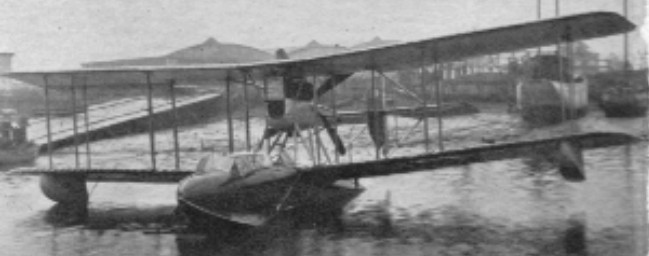
1917 Patrol. Flying-boat. Other engines also fitted.
Engine: 1 x 230-h.p. R.A.F.3a
Span: 46ft 0in
Loaded wt: 4,912 lb
Speed: 88 mph
1917 Patrol. Flying-boat. Other engines also fitted.
Engine: 1 x 230-h.p. R.A.F.3a
Span: 46ft 0in
Loaded wt: 4,912 lb
Speed: 88 mph
1915 Experimental. Seaplane
Engine: 1 x 150-h.p. R.A.F.4
Seats: 2
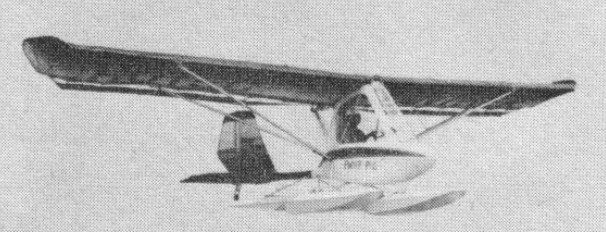
The Sea Panther is basically a Panther+ with a pair of Lightening floats, a fiberglass pilot pod, and powered by a Rotax 447.
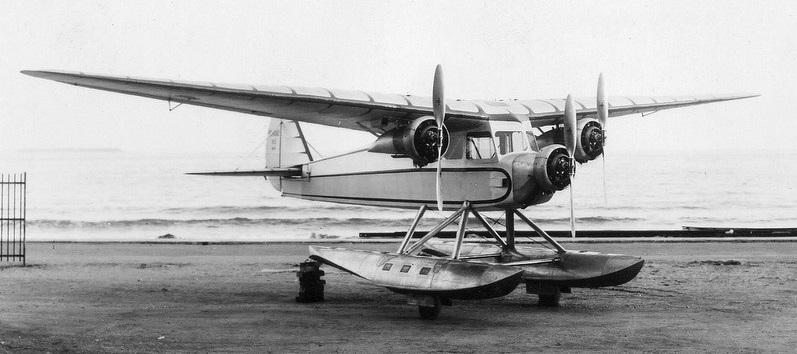
The R.15 was a high-wing floatplane of all-metal construction built in France by Romano. The pilot and passenger were seated in an enclosed cabin. It first flew in 1933 and showed good flight characteristics, but failed to win orders from the civil aviation industry.
Powerplant: 1 × Salmson 9Aer, 56 kW (75 hp)
Wingspan: 14.45 m (47 ft 5 in)
Length: 9.06 m (29 ft 9 in)
Height: 3.47 m (11 ft 5 in)
Wing area: 26.30 m2 (283.1 sq ft)
Empty weight: 928 kg (2,046 lb)
Gross weight: 1,268 kg (2,795 lb)
Maximum speed: 186 km/h (116 mph, 100 kn)
Cruise speed: 160 km/h (99 mph, 86 kn)
Range: 500 km (310 mi, 270 nmi)
Service ceiling: 6,500 m (21,300 ft)
Crew: 2

In 1929 the French Air Ministry drew up a programme of military aircraft specifications to meet France’s needs over the next few years. One part called for a reconnaissance and observation seaplane and the R.5 was Romano’s response; at least two other manufacturers also built prototypes, though funding was not yet assured.
The Romano R.5 was an all-metal flying boat. Its parasol wing was built in three parts; its centre section mounted a 480 kW (650 hp) Hispano-Suiza 12Nbr water-cooled V-12 engine in tractor configuration on its leading edge and was braced 1,650 mm (65 in) over the fuselage by parallel pairs of struts from its outer ends to the mid-fuselage. Six short cabane struts braced it centrally. The inner and cantilever outer panels together provided a trapezoidal plan wing out to rounded tips; ailerons occupied most of the outer panels’ trailing edges. Structurally a mixture of steel and duralumin, with dural skinning, the wing was built around two spars; in the centre section these were elaborated into a trellised girder.
Its 15-metre-long (49 ft 3 in), flat-sided hull was built with of dural and with vedal, layers of dural and pure aluminium, for parts in direct contact with sea-water. The V-form underside had a single step under the wing and, further aft, a water rudder. The R.5 had a pair of Dornier-style sponsons, 6.3 m (20 ft 8 in) in span and 2.5 m (8 ft 2 in) at their broadest, mounted on the lower sides of the fuselage instead of wing mounted floats. There were plans to use these to contain retractable wheels to turn the R.5 into an amphibian.
In the nose there was a position for mooring operations, navigation equipment and a machine gun mounting. The pilots’ cabin was ahead of the propeller disc, fully enclosed and with side-by-side seats and dual controls. Behind the wing there were positions for a navigator who also operated the bomb release controls and for a radio and camera operator. Behind them was a dorsal gunner’s position, midway between the trailing edge and the tail. The fuselage became slender to the rear, where the tall fin carried a deep, rounded unbalanced rudder. The R.5’s tapered tailplane was raised out of the spray well up on the fin and supported from below with a pair of parallel struts from the upper fuselage. Its elevators were inset and unbalanced but far enough forward to only require a small central nick for rudder movement.

The Romano R.5 first flew in September 1932. Soon after, it was delivered to the Forces Aérienne de la Mer along with its competitors, the Amiot 110-S and CAMS 80. Only one was built.
Engine: 1 × Hispano-Suiza 12Nbr, 480 kW (650 hp)
Wingspan: 22.60 m (74 ft 2 in)
Wing area: 67.5 m2 (727 sq ft)
Aspect ratio: 7.6
Length: 16 m (52 ft 6 in)
Height: 4.50 m (14 ft 9 in)
Empty weight: 3051 kg
Gross weight: 4,300 kg (9,480 lb)
Maximum speed: 217 km/h (135 mph, 117 kn) at 1,500 m (4,900 ft)
Cruise: 172 kph
Range: 1,500 km (930 mi, 810 nmi)
Service ceiling: 6,700 m (22,000 ft)
Time to altitude: 6 min 5 sec to 1,500 m (4,900 ft)
Armament: two 7.5-мм Darne machine guns
Bomb load: 200 kg
Crew: Three
A seaplane with Hispano-Suiza engine built in early 1920s to carry out research on seaplane floats.
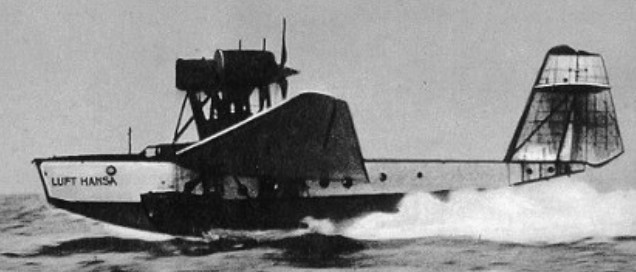
A long-range passenger flying boat, the first prototype flew on August 7, 1928.
Two models were produced. The Romar I (Werk Nrs 29,30 and 31), registrations D-1693, D-1734, and D-1747 respectively.
The single Romar II built, Werk Nr 62, went to France on the 1st April 1931 as F-AKEM.
The difference in the models was that the Romar II had BMW VIaU engines driving through a Farman gearbox.
At some point the fin was changed on all models.
The three German aircraft, named “Hamburg”, “Bremen” and “Lubeck”, were all scrapped in 1933.
Ro X Romar
Engines: 3 x BMW VIUZ, 485kW
Wingspan: 36.9 m / 121 ft 1 in
Length: 22.0 m / 72 ft 2 in
Height: 8.5 m / 28 ft 11 in
Max take-off weight: 19000 kg / 41888 lb
Empty weight: 9900 kg / 21826 lb
Max. speed: 210 km/h / 130 mph
Ceiling: 2800 m / 9200 ft
Range w/max.fuel: 4000 km / 2486 miles
Crew: 4-5
Passengers: 12
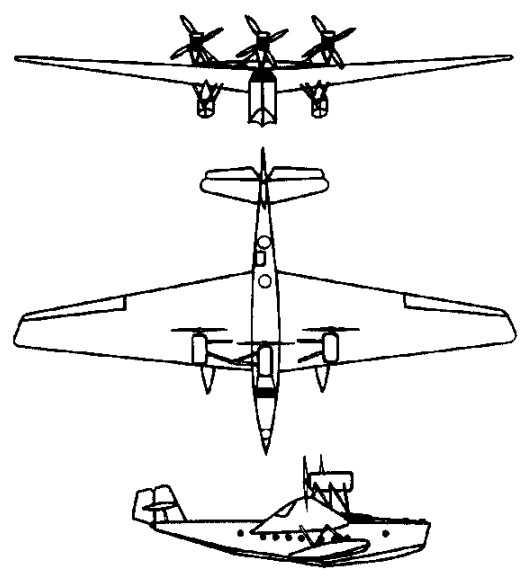
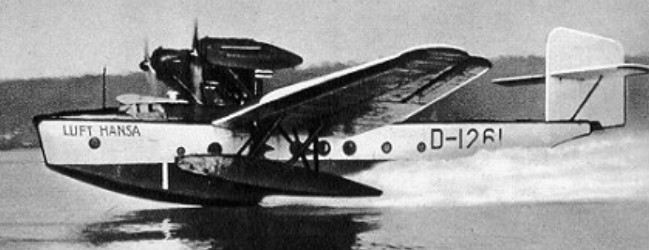
Werk Nr 26 was flown by Severa GmbH for comparison flights with the Dornier Super Wal, then latter as a seaplane trainer.
The one aircraft was built in 1927, and was used by Lufthansa between 21st May and 15th June 1928 for 47 flights between Travemunde and Oslo via Copenhagen and Gothenburg after this it was delivered to the Erpobungstelle at Travemunde.
Ro V Rocco
Engines: 2 x Rolls-Royce Condor, 480kW
Wingspan: 26.0 m / 85 ft 4 in
Length: 19.3 m / 63 ft 4 in
Height: 6.7 m / 22 ft 0 in
Wing area: 94.0 sq.m / 1011.81 sq ft
Max take-off weight: 9600 kg / 21164 lb
Empty weight: 5990 kg / 13206 lb
Max. speed: 220 km/h / 137 mph
Cruise speed: 168 km/h / 104 mph
Ceiling: 3150 m / 10350 ft
Range w/max.fuel: 2400 km / 1491 miles
Crew: 3
Passengers: 10
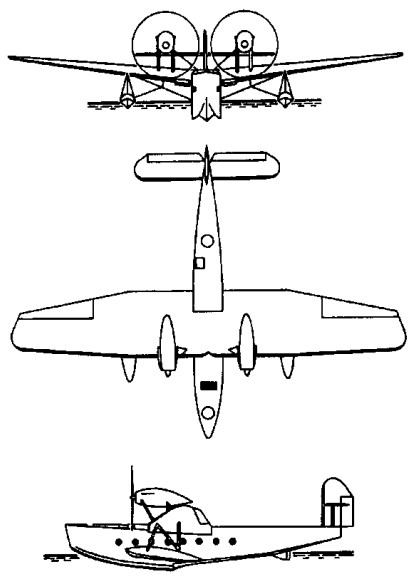
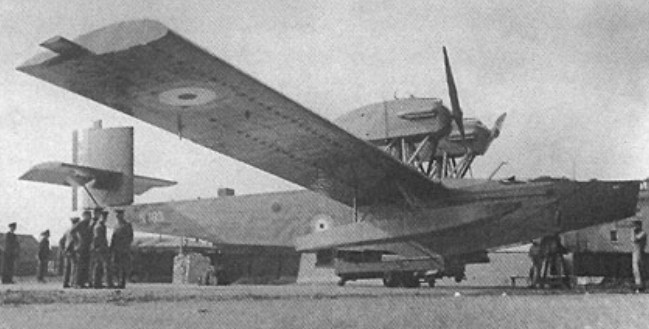
The Rohrbach RoIV was designed by Adolf Rohrbach. The first aircraft (N183) was built in the Rohrbach factory in Denmark from parts manufactured in Berlin before being sent to Beardmore. The second aircraft (N184) was built by Beardmore. Both aircraft had short lives and were scrapped in 1925.
A twin-engine flying-boat
 All Aero