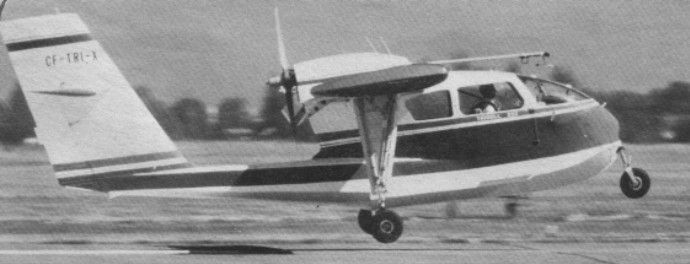
P. H. Spencer and Bob Dent decided the world needs is a new and better Seabee, so they dreamed up the Trident. That was back in the 1960s. Spencer and Dent started their work, in Los Angeles, with only $125,000 which soon ran out. Hazelwood bought the project, took it to Vancouver where the idea for it had been born. He has been at it for six years. After a brief romance with the Canadian Federal Government, which loaned Hazelwood’s company money through the prototype stages, the project by 1976 had moved under the wing of Canadian Aircraft Products, a manufacturer of aircraft floats and subassemblies in Vancouver. That company’s president, D. C. Cameron, says that the airplane is “on the back burner, and we’re not doing too well in our attempts to find a backer for production.” Cameron says certification of the initial prototype is within a few percent of completion. The airplane has flown about 275 hours and needs to fly another 40 or so. A second conformity prototype is 75 percent complete, he says, and will have to fly off its own approval program under the regulations of Canada’s Ministry of Transport.
Hazelwood is an indefatigible supporter of the airplane, and although each year seems to bring only the minimally sustaining increments for progress toward his goal of a full production airplane, his enthusiasm is unflagging or at least he must be very good at hiding any discouragement he may feel. All specs are being met or exceeded, and the abandonment of the Tiara 320 engine at the insistence of the government backers in favor of the certificated 285 (the 320 wasn’t certificated) has resulted in little loss of performance. He is delighted with the progress of the certification flights, he says. The production prototype is coming nicely, with engineering changes incorporated to cut the number of parts in half, eliminate many machined parts, use fiberglass instead of aluminum for the cabin enclosure (which is nonstructural) and add some beading in the skin. “Technically and physically, the airplane is just great. What we need is ‘trigger’ money to kick us off; we have plenty of follow on funds once we get past. . . . There is little chance of finding that kind of funding in the commercial loan market in Canada; they are mostly keyed to mortgages and are no help at all. It will take government help, and we feel we’re entitled to part of the support that’s being given the airframe industries right now.”
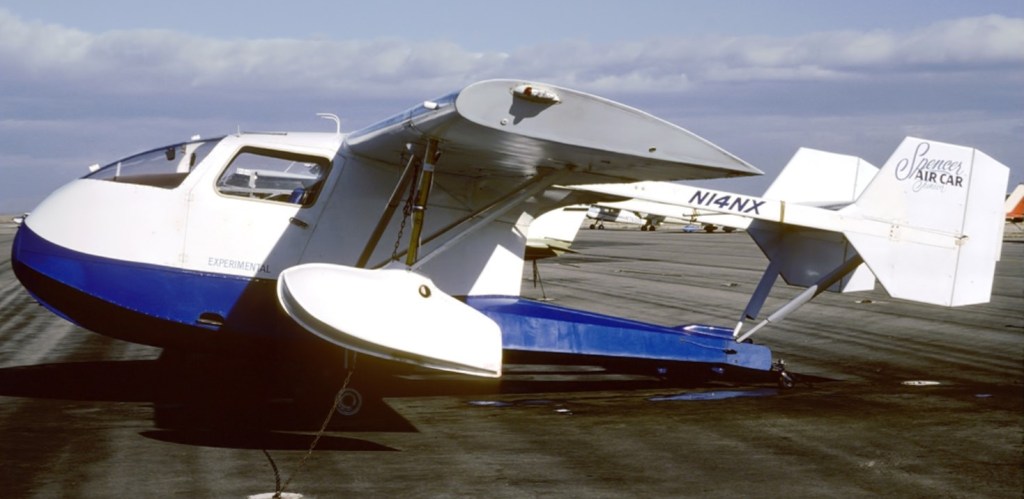
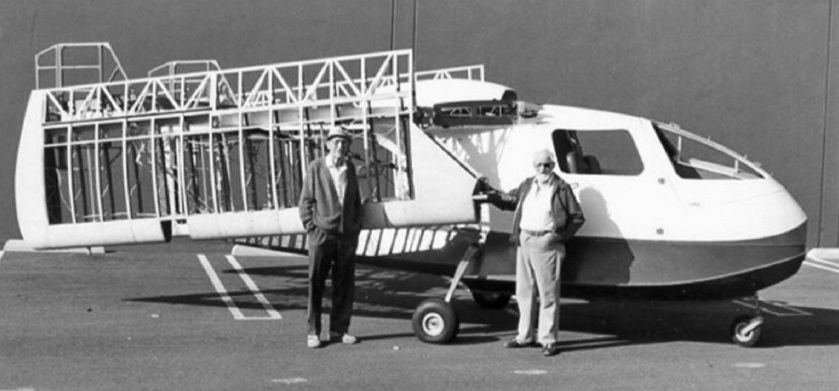
In 1980, the two seat S-14 Junior program began, as a reduced version of the previous S-12C / D / E with folding wings for road transport, with composite materials.
Registered N14NX and powered by a Lycoming O-320, Spencer went on a maiden flight on November 4, 1983, at the age of 86. Even with modifications, the design did not meet expectations and the program was terminated in 1984.
Percival H. Spencer and Dale Anderson with the S-14
Spencer and Anderson had invested nearly $85,000 in the project, but friend William Randolph Hearst Jr purchased the Junior for salvage price of $25,000 and donated it to EAA Museum in 1984.
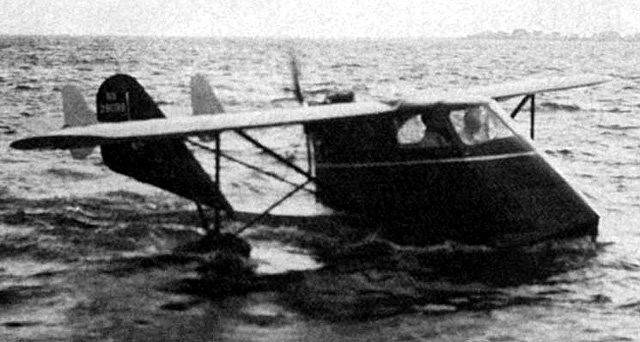
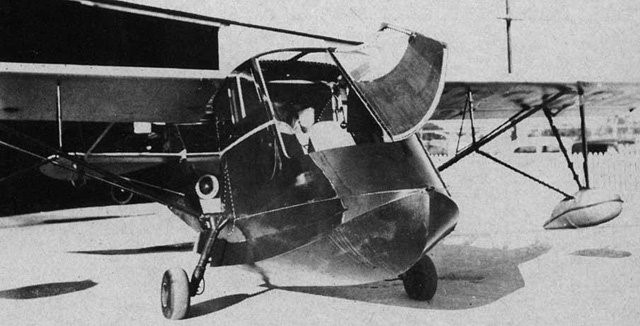
Percival H. Spencer left Spencer-Larsen in September 1940 and starts the work on his own S-12 Air Car amphibian design. The Spencer Air Car was his 12th design. On 1 March 1941, the first parts are cut for the amphibian Air Car. It was built of steel tube and fabric, featuring an angular cabin with a high wing, a slender low-mounted tail boom, and an engine mounted at the back of the wing / cabin, driving a two-bladed propeller in pusher configuration.
S-12 Air Car
The Spencer S-12 Amphibian Air Car, NX29098, took to the air for the first time on 8 August 1941, from sea on Belmore, Great South Bay, Long Island.
S-12 Air Car NX29098
After the USA is at war, from the Pearl Harbor attack on 7 December 1941, Spence put the Air Car in storage.
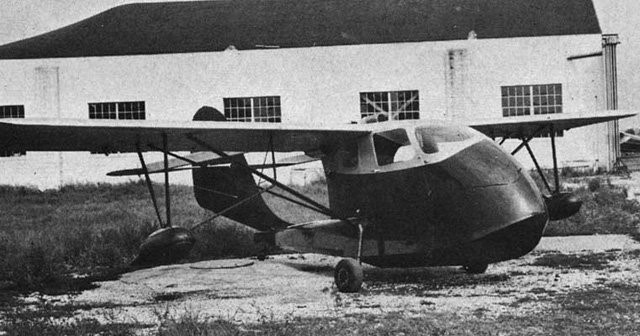
Spence accepts a job offer from The Mills Novelty Company, Chicago, IL, which was interested in the potential of the Air Car as a promotional gimmick for their company, in 1943. In April the Air Car was flown from Long Island to Chicago, Illinois. Using the wood-forming facilities at Mills, the Air Car forward cabin or reformed to a rounder ‘egg’-shape.
S-12 Air Car
The Mills Novelty Company was not likely to put the Air Car into production, so Spencer showed it off to his former employers at Republic. By that time, Republic officials were thinking of what the company should be doing when the war came to an end. Expecting private aviation to boom once the fighting stopped, the Air Car plans and manufacturing rights were sold to Republic Aviation Corporation, Farmingdale, New York, in December 1943. Redesign of the Air Car design started in January 1944, to develop an all metal production version. The first development prototype is named Model RC-1 Thunderbolt Amphibian.
Republic RC-1 Thunderbolt
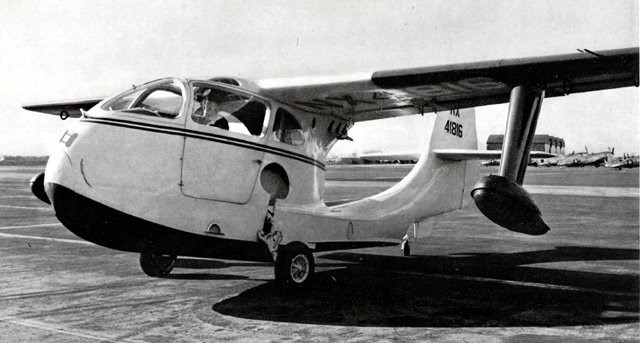
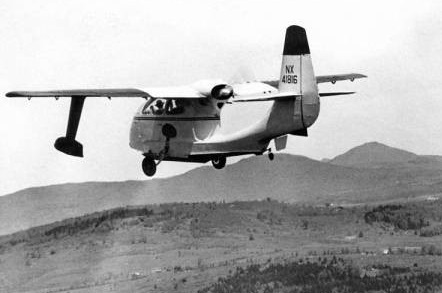
The RC-1 prototype, NX41816, made her first flight from Republic Farmingdale Airport on Long Island, on 30 November 1944. Spence is at the controls.
Republic RC-1 Thunderbolt Amphibian (NX41816)
The Republic Amphibian was presented at the St. Louis Convention in December 1944. A ‘Seabee’ diorama was displayed at the RAC booth at Jefferson Hotel and tentative arrangements are made with the first distributors. Quota commitments made at the convention totals 1972 airplanes at a basic retail price of $3,500. The Republic Aviation Corporation’s Board of Directors approved the plans for RAC’s entry into the personal plane market. Also, in December 1944, NX41816 is demonstrated for the USAAF, US Navy and USCG from National Airport, Washington D.C.
The US Navy officially approved the commercial use of the name “Seabee” for the new Republic amphibian on 19 February 1945.
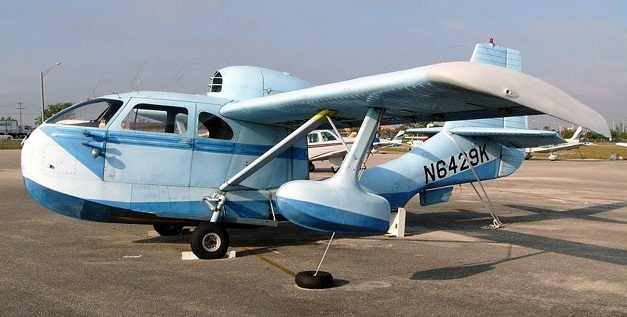
May 1947 saw Seabee NC6429K (s/n 674) built. It was delivered new by Republic’s pilots and demonstrated by Republic’s pilots for a total of two days to the USAAF as Model YOA-15. The Republic pilots then flew it back to the factory where it was used by the factory as a demonstrator on the east coast the rest of that year and the next.
NC6429K was never assigned a military number or painted any other color than a standard Seabee. Republic sold it to a John Philbrook, who used it in his air charter business, Adirondiacs Airways Maine. John had a second Seabee in the business and was killed in that one. Mr. Herman Mau bought it from the estate and based it at his Florida home, land locked (for a few years) because the water level in the lake it is on is too low to fly it out.
Republic RC-3 Seabee NC6429K (s/n 674)
On 17 April 1945, RAC President Alfred Marched ordered full steam ahead for engineering, tooling and manufacturing divisions, after initial contract is made with US Army for the order of OA-15 Seabees to be used for rescue work in the Far East. The projected military rescue amphibian was to be powered by a geared engine and have a cabin arrangement for 2 litters. The contract is later cancelled, when US Army after V-J Day cancelled orders with RAC for $242,000,000.
Republic RC-3 Seabee
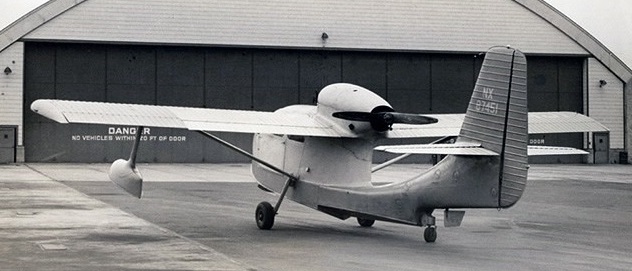
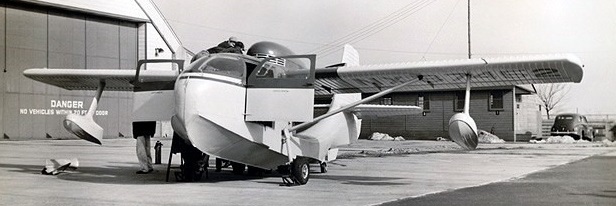
In the wake of massive cutbacks following the end of the war in August 1945, the military orders for the Seabee were cut; it is unclear if the military ever got their hands on any. Work on the civilian Seabee continued, with the prototype of the production RC-3 Seabee, NX87451, rolled off the construction line at Republic Aviation Corporation on 22 November 1945. At 9:17 a.m, 1 December 1945, the first prototype Model RC-3 Seabee, NX87451, makes her first flight, taken to the air by designer and test pilot Percival H. Spencer from Republic Airport, Farmingdale.
Republic RC-3 Seabee
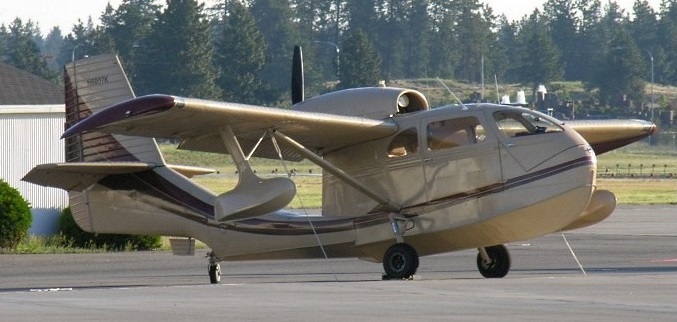
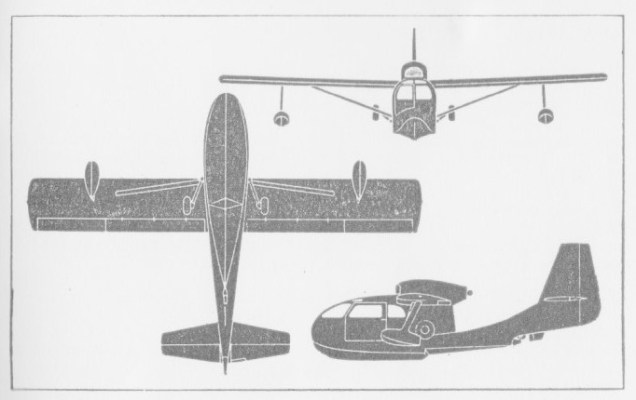
The first standard production Model RC-3 Seabee rolled off production lines at Republic in March 1946. As the production RC-3 Seabee emerged, it was built mostly of metal, with an egg-shaped forward fuselage and a slender tailboom, both riding on a stepped boat hull. It had a high strut-braced wing with fixed floats mounted just outboard of mid-span. It was powered by Franklin 6A8-215-B8F or -B9F air-cooled flat-six piston engine providing 160 kW (215 HP), mounted in pusher configuration at the rear of the cabin, behind the wing. Images of surviving Seabees show them to have a three-bladed variable-pitch propeller, but apparently the RC-3 was originally built with a two-bladed fixed-pitch prop. The fuel tank was in the wing center section.
The Seabee had tailwheel landing gear, all gear with single wheels, the main gear retracting up and back to (not into) the fuselage, the tail wheel hinging up behind the rear of the boat hull. There was a water rudder behind the tail wheel. Flight controls were conventional — ailerons, elevators, rudder, and one-piece flaps. There were seats for four, including the pilot, access being through a front-hinged car-style door on each side of the fuselage.
P. H. Spencer, designer of Republic’s Seabee, smilingly painted the ‘NC’ on the tail of Seabee NC87457 (ex NX87457) to celebrate the CAA certification of the Seabee on 21 July 1946.
The first Seabee, N87463 (s/n 13) is officially delivered to a customer on 25 July, 1946, when handed over to president J. G. (Tex) Rankin, Rankin Aviation Industries, Tulare, California, at Republic.
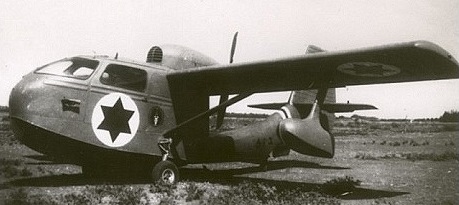
In 1947 Republic RC-3 Seabee s/n 1019 (NC6731K) was sold from Republic Aviation to a businessman. Official RAC records list says that s/n 1019 was imported to Israel by Aerogypt High Speed Development Company, Palestine, Israel. This businessman donated the Seabee to the new Israel AF for utility flying. The Seabee was initially registered VQ-PAV, but was soon transferred to the Israel AF.
Republic RC-3 Seabee B-61 (s/n 1019) Israel 1948
During the 1980s a Republic Seabee was donated to the Israeli Air Force Museum, Beer Sheva, Israel, by an American businessman, Mr. Robert Hebron. The Seabee, s/n 864 (ex N6564K), was put on display painted as the original Israel AF Seabee.
Republic had hoped to sell 5,000 Seabees a year but the boom in private aviation didn’t really materialize. Republic had also raised the price, with a Seabee going for $6,000 USD in 1946. On the 4th of October 1947 Republic Aviation Corp. announced that the production of the RC-3 Seabee amphibian has been terminated. Last production RC-3 Seabee was N6770K (s/n 1060). The last Seabees were not sold until early 1948.
Republic RC-3 Seabee
The S-12-D Air Car first flew on 25 May 1970.
In 1984 P. H. Spencer planned to resume production of all the metal parts for his S12-E model four-place Amphibian Air Car. He had stopped production early in 1982. In addition to the metal parts, he was contemplating manufacture of hull and empennage parts should a market survey indicate a favorable response.
The Air Car is basically a wooden aircraft, skinned with fiberglass in molded sections for the hull, cabin, engine cowl, wing root fairings, wingtips, floats, etc. Its heart is a single steel tube weldment combining engine mount, wing spar carry-throughs, and lift strut attach points. This section carries all major flight and water loads. Wings are wooden with three-ply skin. Original powerplant was a 260-hp Lycoming, later replaced with the Teledyne Continental Tiara which came in two models, the 6-285-B, C (285 hp) and the 6-320 (320 hp). A Hartzell three-bladed, reversible propeller permits backing up during taxiing to dock.
The S12-E has a span of 37 feet and a length of 26 feet with an empty weight of 2150 pounds and a gross of 3200 pounds. Max speed is 155 mph, cruise 140 mph, landing 55 mph with a 300-hp Continental Tiara engine. Ten were flying in 1984 and 35 are under construction, including one each in Indonesia, New Zealand and Brazil.
All owners pronounce it a rugged, stable and forgiving airplane. It has been flown with six different engines, ranging from 180 to 300 hp.
S-12 Air Car NX29098 Engine: 110hp Franklin Wingspan: 33’7″ Length: 23’3″ Useful load: 527 lb Max speed: 95 mph Cruise: 86 mph Stall: 50 mph Seats: 2 Undercarriage: amphibian
S-12-D Air Car Engine: 260hp Lycoming O-540-E4B5 Wingspan: 37’4″ Length: 26’0″ Useful load: 1050 lb Max speed: 147 mph Cruise: 135 mph Stall: 53 mph Range: 600 mi Seats: 4
S-12-E Air Car N111DA 1970 Engine: 285hp Teledyne Continental Tiara 6-285-B Max speed: 155 mph Cruise:135 mph Stall: 53 mph Range: 800 mi Seats: 4
RC-3 Seabee Engine: 1 x Franklin 6A-215-B8F, 160kW / 215 hp Wingspan: 11.48 m / 38 ft 8 in Length: 8.53 m / 28 ft 0 in Height: 2.92 m / 10 ft 7 in Wing area: 18.21 sq.m / 196.01 sq ft Max take-off weight: 1429 kg / 3150 lb Empty weight: 953 kg / 2101 lb Max. speed: 193 km/h / 120 mph Ceiling: 3660 m / 12000 ft Range: 579 km / 360 miles Crew: 1 Passengers: 3
Republic RC-3 Seabee Wingspan: 11.5 m / 37 ft 8 in Length: 8.5 m / 27 ft 10 in Height: 3.1 m / 10 ft 1 in Wing area: 17.8 sq.m / 192 sq.ft Empty weight: 995 kg / 2,190 lb MTOW: 1,430 kg / 3,150 lb Max speed at altitude: 240 kph / 150 mph / 130 kt Service ceiling: 3,650 m / 12,000 ft Range: 840 km / 520 mi / 450 nmi
Percival Hopkins “Spence” Spencer convinced his father to invest in the wreckage of a Curtiss F. At age 17 he rebuilt and modified it as flying boat.
On 12 April 1911 he not only took his creation on its first flight but on his own solo flight. Unskilled in turning the plane, he flew for five miles, landed on a river, and pushed it around for the return flight.
Spencer was still actively flying in 1987 at age 90.
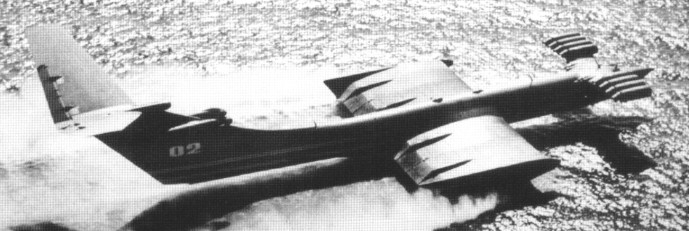
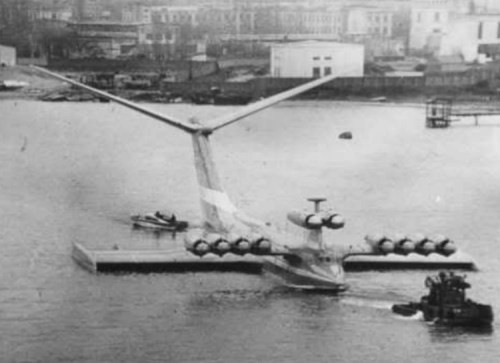
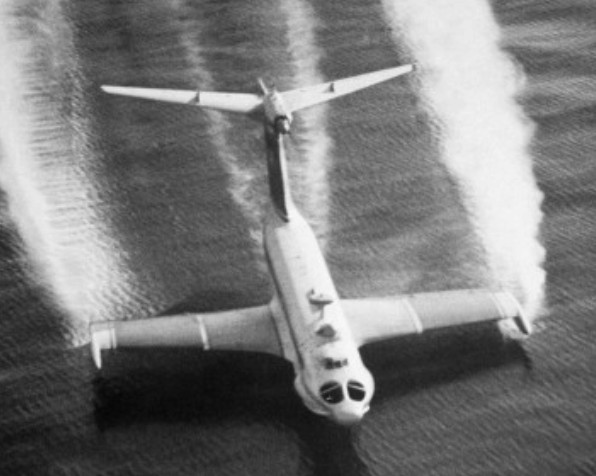
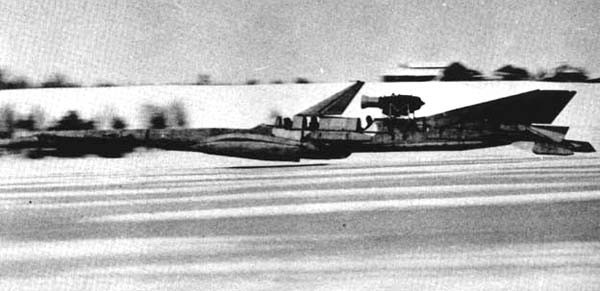
The Monster (its Russian designation was KM, derived from the words Korabl’ Maket or “ship model”) was nothing less than a juggernaut, one of the largest heavier-than-air flying machines ever built. At 500 tonnes it had a 100-tonne MAUW advantage over its fellow winged heavyweight the Boeing 747. No less than ten jet turbines constituted its propulsion system, an array of power used for take-off rather than cruise. Eight turbines were arranged in a shoulder-mounted stub-wing battery just aft of the cockpit. Capable of being deflected under the mainplane where a full-span trailing edge flap would trap their thrust, their combined power could generate an immense lifting force via a hovercraft-like static air cushion to cruise 4 metres above the water
The Lun-class ground effect vehicle (GEV), or sea skimmer, was developed by Russian engineers at the Alexeyev Hydrofoil Design Bureau.
During the Cold War, ekranoplans were sighted for years on the Caspian Sea as huge, fast-moving objects. The name Caspian Sea Monster was given by U.S. intelligence operatives who had discovered the huge vehicle, which looked like an airplane with the outer halves of the wings removed. After the end of the Cold War, the “monster” was revealed to be one of several Russian military designs meant to fly only a few meters above water, saving energy and staying below enemy radar.
The KM, as the Caspian Sea Monster was known in the top secret Soviet military development program, was over 100 m long (330 ft), weighed 540 tonnes fully loaded, and could travel over 400 km/h (250 mi/h), mere meters above the surface of the water.
These craft were originally developed by the Soviet Union as very high-speed (several hundred km/hour) military transports, and were mostly based on the shores of the Caspian Sea and Black Sea. The largest could transport over 100 tonnes of cargo. The only three operational A-90 Orlyonok ekranoplans built (with renewed hull design) and one Lun-class ekranoplan remained at a naval base near Kaspiysk.
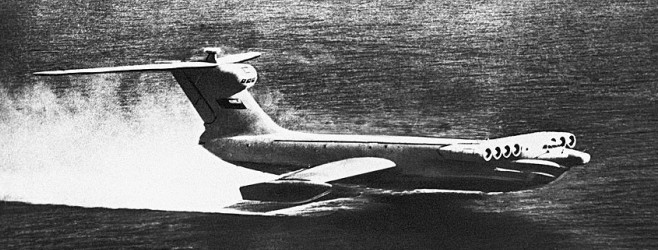
The Lun-class (“Harrier”) Ekranoplan MD-160, dubbed the “Caspian Sea Monster” by US Intelligence services, was one of a kind. It was capable of carrying up to 124 tonnes of troops and equipment, including as many as six nuclear missiles, at speeds up to 560km/h as far as 2000km. Eight Kuznetsov 128.9kN NK-87 turbofans mounted on the front cannards provided the thrust to get the seaplane’s hull up and out of the water and engage the ground effect.
While ground-effect vehicles are a highly efficient way to transport cargo over long distances, the MD-160 had significant drawbacks in its military applications. For one thing, manoeuvrability. Anything resembling a sharp turn was right out, and allowing a wing tip to even sniff the water could result in 500 tonnes of seaplane cartwheeling along the surface of the Caspian. And since the ground effect didn’t actually take effect until the plane was out of the water, the MD-160 had to always take off into the wind.
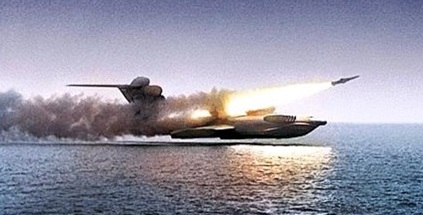
In 1987, the first flight was made by Lun, an ekranoplan-rocket carrier. It was armed with six guided anti-ship missiles “3M-80 Mosquito”.
After the successful completion of state tests “Lun” was in 1990 transferred to trial operation. However, the collapse of the Soviet Union led to the cessation of work in this area and the disbanding of the 11th Air Group of the Black Sea Fleet E-Wing.
So while the MD-160 was thoroughly impervious to subsurface mines and torpedoes, its size and complete lack of manoeuvrability made the planes sitting ducks against Western air forces (hence its NATO designation: Duck), often requiring armed escort and forward scouting boats to avoid obstacles. The Ekranoplan carried anti-ship P-270 Moskit guided missiles in six pairs mounted onto its fuselage as well as a pair of 23mm Pl-23 cannons in a tail turret and forward-facing pair under the forward missile tubes.
Despite the the MD-160’s shortcomings, Soviet high command continued to move forward with the program right up until the Soviet Union fell. A second MD-160, destined to be a mobile field hospital, was 90 per cent complete and another 30 A-90 Orlyonok GEVs, meant to strengthen the Black Sea Fleet, were on order when the program’s funding was cut. The MD-160 currently resides at a naval station in Kaspiysk.
A 125-tonne, 200-knot troop transport and assault wing in surface effect craft for the Soviet forces. The development of ekranoplans was supported by Dmitri Ustinov, Minister of Defence of USSR. About 120 ekranoplans (A-90 Orlyonok class) were initially planned to enter military service in the Soviet Navy.
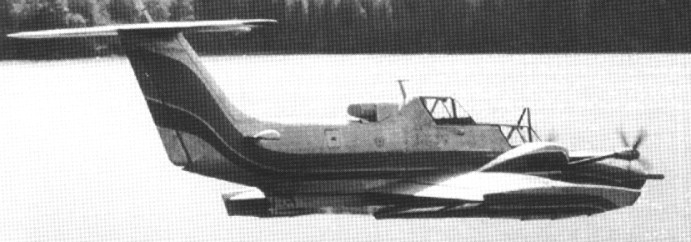
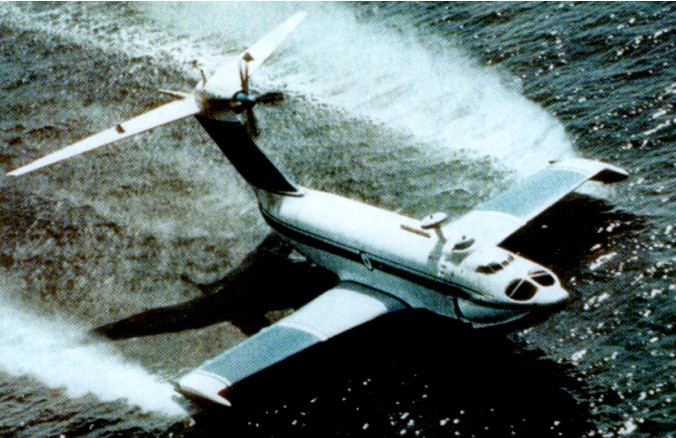
In 1972, the first really working military “Orlyonok” was built, intended for the transfer of amphibious assault forces to a range of up to 1,500 km.
The figure was later reduced to less than thirty vehicles, planned to be deployed mainly for the Black and the Baltic Soviet navies. Marshal Ustinov died in 1985, and the new Minister of Defence Marshal Sokolov effectively ceased the funding for the program. The only three operational A-90 Orlyonok ekranoplans built (with renewed hull design) and one Lun-class ekranoplan remained at a naval base near Kaspiysk.
A-90 “Orlyonok” in the Museum of the Navy in Tushino, Moscow
The Central Design Bureau for Hydrofoil named after R.Ye. Alekseev (Central Design Bureau for SEC) was developing a project for an ekranoplan ocean zone with a take-off weight of about 500 tons. About this on Tuesday at the forum “Marine Industry of Russia” said the director and chief designer of the concern “Morinformsystem-Agat” Georgy Antsev.
The International Forum “Marine Industry of Russia” takes place from May 19 to 21, 2015 in Moscow, in the Gostiny Dvor exhibition complex. The forum presented a project of a coastal zone WIG with a take-off weight of 60 tons.
“We need WIG ocean zone with a take-off weight of 500 tons. Such developments are conducted in the CDB Alekseev. Today there is a reboot of the Soviet period, a search is underway for the customer, certain research and development, modeling, and prototyping, ”said Antsev. – It has a very good direction – it is necessary both for passenger transportation, and for northern tasks, and for tasks of protecting state borders. He can use the airfield infrastructure and be at some point, in essence, an airplane. “
The ekranoplan, or a ship on a dynamic air cushion is a high-speed vehicle flying at a height of up to several meters from the surface of water, land, snow or ice. This is a kind of hybrid between an airplane and a watercraft, with equal mass and speed, the winged surface of an ekranoplan is much smaller than that of an airplane, and according to the international classification it belongs to sea vessels. Ekranoplans capable of tearing themselves off the surface for a long time and moving into “airplane” flight mode are called echo flight.
The very first developments, as well as actually operating samples, were obtained by designers of the USSR. The direction was developed by two independent teams. One, under the leadership of Rostislav Alekseev, who, as early as October 1, 1941, defended his thesis “Hydrofoil Glider”. After that, he devoted his life to the development and creation of ekranoplanes. The CDB for SEC was founded in the early 50s.
СМ-1
In the early 60s, a test base for these devices was built on the Gorky Reservoir. In 1961, the first flight of the SM-1 / CM-1 screening vehicle took place, and the following year, the SM-2 / CM-2.
СМ-2
Developed by the Soviets from the 1960s onwards, particularly by Dr Rostislav Alexeyev’s Central Hydrofoil Design Bureau, the leading exponents in the design and operation of Wing in Surface Effect types are now located in the Russian Federation. Far ahead of the West in terms of construction and flying experience, the Soviets planned a fleet of 120 surface skimming WISE military transports in the 1980s and four prototypes were built. However, with the end of the Cold War the funds and the cause for the manufacture of the planned balance-of-power-altering transport fleet ceased.
Designed by Floyd Copeland, the 1928 Southern Commercial Aircraft Co Sea Hawk was a four-place, open cockpit, biplane flying boat, powered by a Wright J-5 engine.
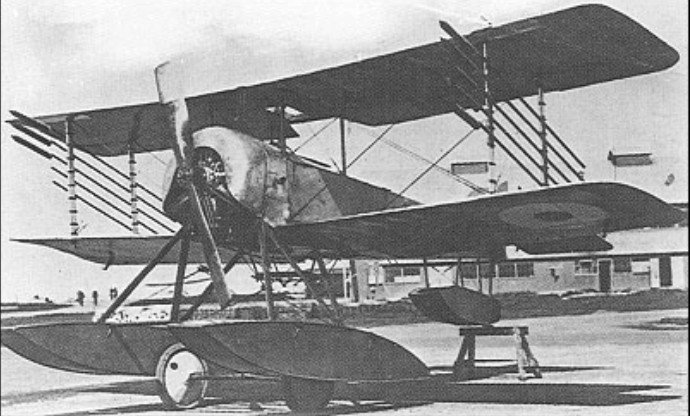
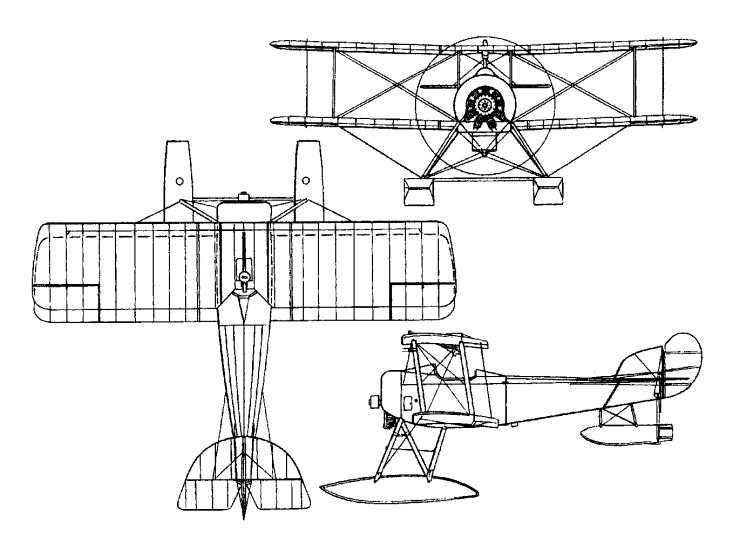
Derived from the Schneider single-seat fighter seaplane, the Baby first appeared in September 1915, and differed from its predecessor primarily in having a 110hp Clerget nine-cylinder rotary in place of the 80 hp Monosoupape Gnome, this being accommodated by a horseshoe-shaped open-fronted cowling.
As on late production Schneiders, ailerons replaced wing warping for lateral control, and armament usually consisted of a single 7.7mm machine gun synchronised to fire through the propeller, although a few Babies retained the arrangement of the Schneider with the gun attached to the centre section and firing upward to clear the propeller.
Several Babies were fitted with two 7.7mm guns side by side over the wing; one batch of Blackburn-built Babies was fitted with Ranken explosive darts as anti-airship weapons, and at least one was fitted with Le Prieur rockets, 10 of these devices being attached to the interplane bracing struts. Two 29.5kg bombs could also be carried.
1916 Sopwith built Baby N2078
The Baby was widely used by the RNAS to provide fighter aircraft for use with patrol.ships, as escorts for two-seaters and for operation from early aircraft carriers.
A total of 286 Babies was built of which 195 were produced by Blackburn at Leeds – and sometimes known as Blackburn Babies – 105 of the latter being fitted with the 130hp Clerget engine, and, of these, 40 were fitted (initially) to carry the Ranken dart and no gun armament. A more extensive modification of the Sopwith float fighter was the Fairey Hamble Baby.
Replica ultralight: Circa Reproductions Sopwith Tabloid / Baby
Engine: Clerget, 130 hp Wingspan: 6.90 m / 23 ft 8 in Length: 7.01 m / 23 ft 0 in Height: 3.05 m / 10 ft 0 in Wing area: 22.30 sq.m / 240.03 sq ft Max take-off weight: 778 kg / 1715 lb Empty weight: 556 kg / 1226 lb Max. speed: 161 km/h / 100 mph







 All Aero