A two-seat open ultralight floatplane (optional wheels or skis).
Amphibian
Stroukoff YC-134 Pantobase
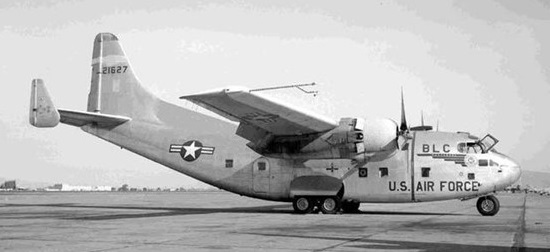
The Stroukoff YC-134, designed in 1956, was based heavily on the Fairchild C-123 Provider. The United States military contracted with Stroukoff Aircraft Corporation to develop an improved version of the aircraft, combining features that the company had developed for the YC-123D and YC-123E.
The product of a US Air Force contract in 1956, a single C-123B from the -CN production block (serial 52-1627) was modified by Stroukoff Aircraft to become the YC-134. This aircraft was heavily modified with the following new features:
New Engines: The YC-134 was equipped with two 3,500 hp (2,600 kW) Wright Turbo Compound R3350-89A radial engines, turning four-blade, thirteen foot Aeroproducts constant-speed fully feathering propellers.
A new thickened wing. In the root of the wing they installed two turbocompressors with 400 hp each
Improved Control Surfaces: The YC-134’s horizontal stabilizers were given endplates to improve directional stability.
Improved landing gear: While the nosewheel from the C-123B was retained, both main gears were given a third wheel to improve weight distribution.
Fuel was no longer housed in the rear of the engine nacelles, but in an expanded center-wing fuel tank. In addition, two plumbed hardpoints for 550-gallon drop tanks were also added to each wing.

Stroukoff’s BLC and Pantobase: the YC-134 was fitted with Stroukoff’s own BLC and all three aircraft had they been delivered were to have been fitted with the Pantobase equipment designed for the YC-123E.
The features gave an empty weight increase over the C-123B from 31,058 lb (14,088 kg) to 37,965 lb (17,221 kg), and a maximum loaded weight increase from 60,000 lb (27,000 kg) to 74,700 lb (33,900 kg). The aircraft’s cruising speed was 219 mph (352 km/h), compared to the C-123B’s 190 mph (310 km/h), and the YC-134 had a 1,600-mile (2,600 km) range with a 24,000 lb (11,000 kg) payload. The BLC allowed the YC-134’s take-off distance to decrease from 1,850 feet (560 m) to 750 feet (230 m), very similar to that of the YC-123D.
The aircraft for the first time rose into air on 19 December, 1956, on the tests were obtained good results, and servicemen ordered two additional machines. On them they installed the modernized boundary-layer control system with one more powerful compressor and “pantobase”. The YC-134 gained the designation “Pantobase” after hydro-skis were added. The YC-134 demonstrated following: takeoff on the earth – 244 m, on the snow and the water – 458 m; path on the earth – 320 m, on the snow – 305 m, on the water – 228 m. In the beginning of 1958 all three YC-134 were transferred to the Air Force.
One conversion to a YC-134 (YC-123D) was made in 1956 (53-8068), powered by two 3500hp Wright R-3350, with similar dimensions to the Fairchild C-123B. Fitted with a boundary layer control system, tailplane endplates, and tandem mainwheels.
The 1958 YC-134A had a sealed and strengthened fuselage and “Pantobase” multi-purpose landing gear fitted with land/water skis and wingtip floats. Began as Chase C-123B 52-1627 rebuild then was modified by Fairchild as YC-123B with wingtip J44 jets, and later reputedly converted by Stroukoff as YC-134A “Pantobase” with R-3350-89A engines and boundary layer control.
The U.S. Air Force, however, deemed that the YC-134 did not offer substantial improvement over the C-123, nor did it have a requirement for a piston-engined amphibious assault transport, and decided to purchase the Lockheed C-130 Hercules.
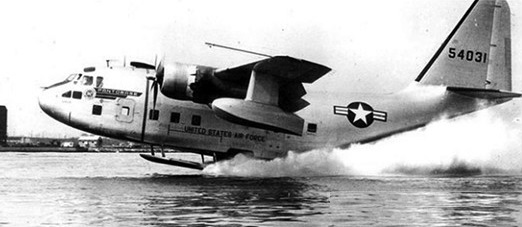
YC-134-SA
Engine: 2 × Wright R-3350-89A, 3,500 hp
Payload: 24,000 lb
Empty weight: 37,965 lb (17,221 kg)
Max. takeoff weight: 74,700 (33,900 kg)
Cruise speed: 219 mph (352 km/h)
Range: 1,600 miles (2,600 km) with 24,000 lb (11,000 kg) payload
Take-off distance: 750 feet (230 m)
Strack Wassereindecker
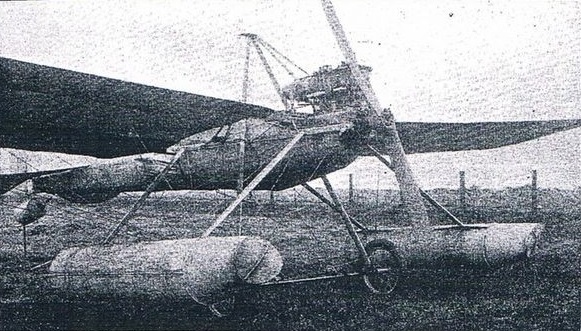
Amphibian monoplane entered by the builder Strack Flugzeugwerke (Duisburg) into the Bodensee-Wasserflug 1913. The machine had a unique amphibian construction which worked such that the land undercarriage was fixed but the floats could be moved up and down. When landing on the water the floats were set in the down position, so that the fixed land undercarriage cleared the water.
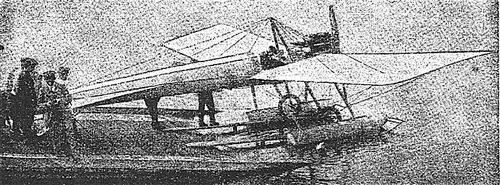
STOL Aircraft Twin Bee / United Consultants Twin Bee
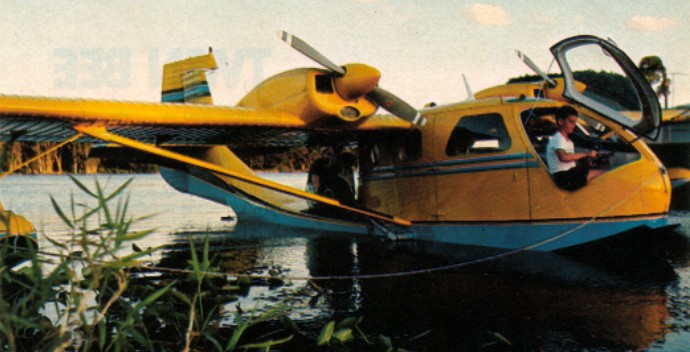
The Seabee inspired a number of follow-on designs, including the “Twin Bee”, a twin-engine conversion implemented by Joseph Gigante and his United Consultants (later STOL Aircraft) firm at Norwood Airport near Boston and sold by Seaplane Services, Meredith.
Designed by Joseph W Gigante, United Consultants added three foot wing root extensions on each side, plus a three foot center fuselage plug. The airframe is zero-¬timed, and all of the hydraulics, cables, instruments and furnish¬ings are new. Capping the makeover are two Lycoming IO-360-B1D 135 kW / 180 hp fuel injected engines driving two-bladed Hartzell variable propellers in tractor configuration on each wing. Two 180hp Lycoming O-360-A1A tractors originally in the 1960 built prototype N87588, IO-360-B1D for production (A6EA).
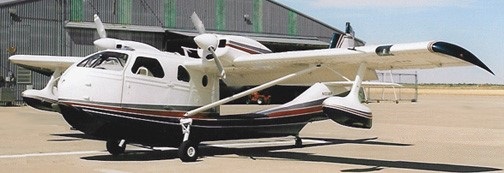
The result had center of gravity problems, which were solved by increasing the size of the fuel tank and installing a new fuel tank in the tailboom, which increased range at the expense of some fiddling with fuel management during a flight.
The Twin Bee is fuelled at the left rear of the cabin wall, direct¬ly above the 85 USG main tank in one of the keel compart¬ments. There’s a 16 USG auxiliary tank in the tail, just below the elevator. While an access panel leads to the auxiliary tank’s fuel cap, you customarily fill it by transferring fuel from the main. A single switch on the panel operates a valve and pump that move fuel in either direction between the two tanks.
The two seats in the second row can be replaced by a bench seat for three, the rearmost solo seat between the two portholes provides a little less space; it’s a nice place for a child to sit.
The doors hinged on the rear instead of the front. Changing the door hinge from front to rear was motivated by the need to keep the occupants from stepping out into the prop arc. The doors were implemented with additional latching and warning lights to indicate if they weren’t locked.
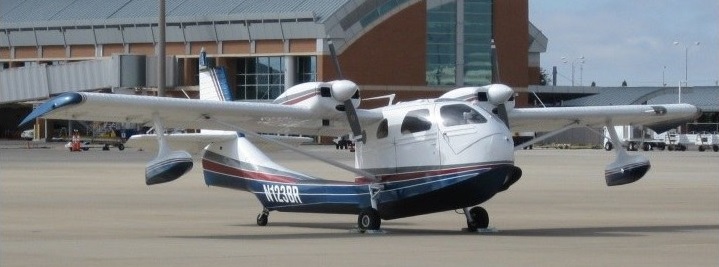
The first conversion was performed in 1960 built in the old hangars of Helio Aircraft at Norwood Airport, MA,
In her original configuration, the prototype had two 180 hp Lycoming O-360-A1A engines, and made her first flight in 1960 with a Helio test pilot at controls. Later most test flights were made by test pilot Peter Annis. During development, engine model was changes to injection type, the cowlings were redesigned and the tail control surface areas were increased.
After extensive flight tests for five years, the UC-1 Twin Bee was awarded the US FAR Aircraft Type Certificate No: A6EA on 25 June 1965. The first production aircraft was delivered one year later.
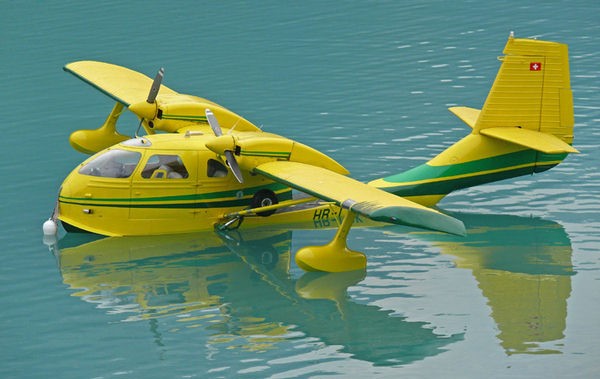
Conversion is accomplished by replacing the Seabee’s original 215 hp Franklin engine by two 180 hp Lycoming IO-360-B1D engines, driving 2-blade CS/feathering tractor propellors. The original wing span is increased by 6 ft, to 43.33 ft, by adding a 3-foot wing-root extension on each side. The hull is stretched 3 ft by inserting a “plug” just aft of cabin, to counter-act shift of CG. Further the rudder/trim-tab area is increased according to the increased power. The fuel capacity is increased from 75 US gal to 101 US gal by the addition of a new 85 US gal main fuel tank above step and 16 US gal fuel tank in the tail boom. The instrument panel, and the seat tracks, are moved forward to allow a fifth seat in the original cargo area.
23 updates sold from 1965 to 1987, the last one in 1987.
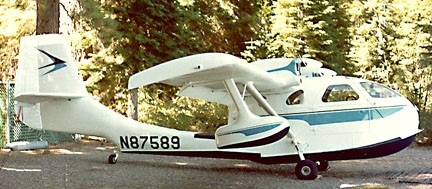
UC-1 Twin Bee
Engines: two Lycoming IO-360-B1D 135 kW / 180 hp
Wingspan: 43’3″
Length: 31’4″
Useful load: 1300 lb
Max speed: 147 mph
Cruise speed: 131 mph
Stall: 38 mph
Range: 900 mi
Ceiling: 19,000 ft
Seats: 5
Stinson Amphibian
The 1931 Stinson Amphibian project, very Sikorsky-like, was abandoned after unsatisfactory testing and a wheels-up landing.
It was a five-place, high wing cabin monoplane, powered by two 215hp Lycoming R-680 engines, and registered NX11117 c/n M-7000.
Stinson SM-9
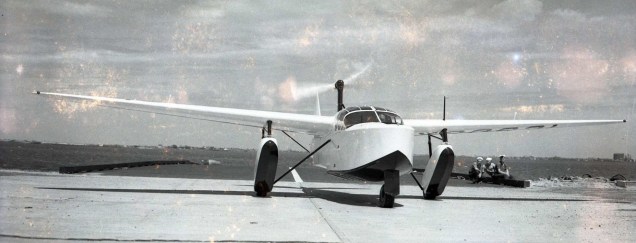
The 1930 SM-9 was four-place cabin, mid-wing monoplane experimental amphibian. Powered by a 215hp Lycoming R-680 engine and registered NX414Y M-9000, it was scrapped after a crash-landing
Stevens & Sons 1915 flying boat
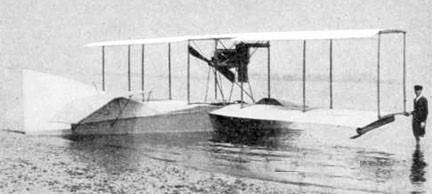
The 1915 B Stevens & Sons flying boat was designed by George Armitage, and constructed by Fred Chanonhouse, production superintendent at Sturtevant Co.
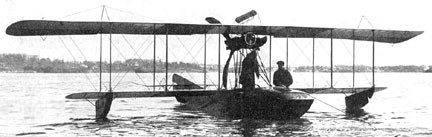
A two-place open cockpit, powered by a 105hp Sturtevant pusher engine, a variation appeared in 1916.
Steco Aerohydroplane
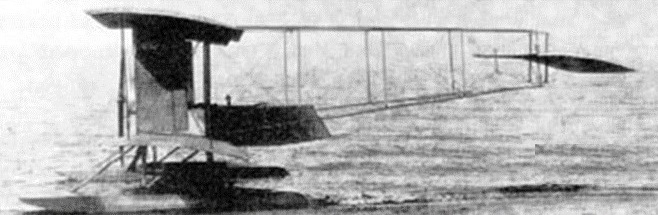
The (James S & Ralph C) Stephens Engineering Co Aerohydroplane of 1911 was designed by James Stephens as an open biplane on wheel or floats. Interplane stabilizer panels were non-controllable—for a right turn, the right panel stayed in place and the left panel swung free, and vice-versa. This prevented the aircraft (wings) from sideslipping or stalling. Turning was accomplished by the empennage flight control steering system (not wing-warp) which gimbaled 360 degrees. These was no elevator, rudder, or ailerons. 1915 US aircraft patent #1,127,105.
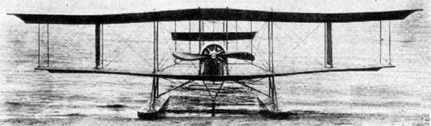
Tricycle gear or all known pictures show two 16′ Burgess pontoons.
Stored in 1914, it was recovered in 1990 to the American Wings Air Museum at Blaine MN, where reassembly began in Feb 2002. It was to be fitted with the tricycle landing gear, which incorporates pneumatic shock absorbers, independent main gear brakes, and has nosewheel steering.
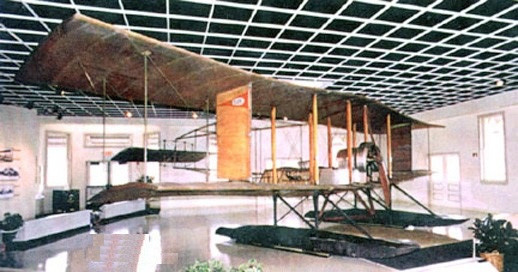
Engine: 50hp Gnôme Omega
Span: (upper) 41’8″
Span: (lower) 36’0″
Length: 31’0″
Speed: 50 mph
Seats: 1
Standard Twin Hydro / TH-D
The 1917 Standard Aircraft Corp Twin Hydro, or TH-D, was a two-place, open cockpit, monoplane with twin floats; serial AS364. Only the one was built.
Engine: 125hp Hall-Scott A-5a
Wingspan: 69’2″
Length: 33’4″
Speed: 78 mph
Seats: 2
Sperry Light Bomber
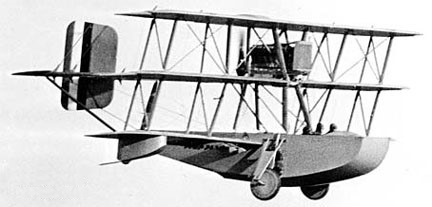
The 1919 Sperry Light Bomber amphibian, possibly A-5243, went to the US Navy. Only the one was built.
Engine: 400hp Liberty 12
Wingspan: 48’0″
Length: 31’6″
Max speed: 90 mph
Cruise: 85 mph
Bombload: 1000 lb
Seats: 3
 All Aero