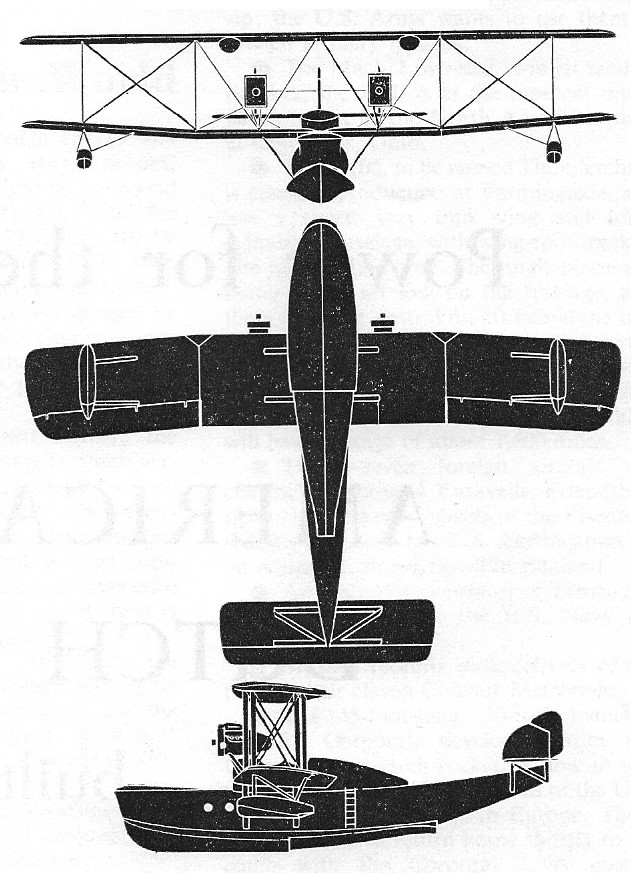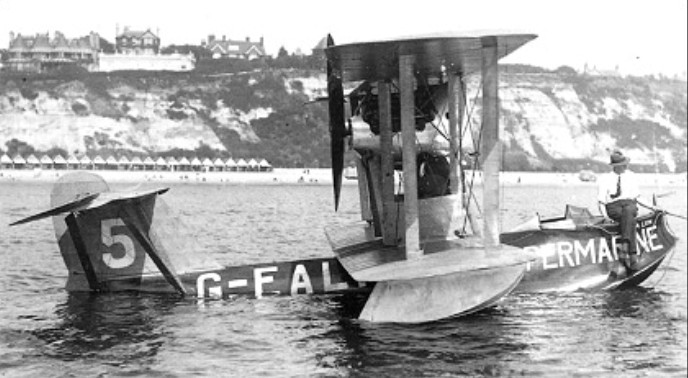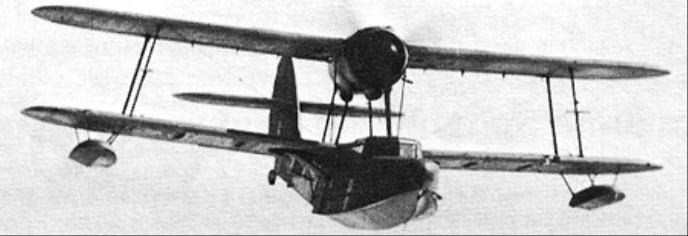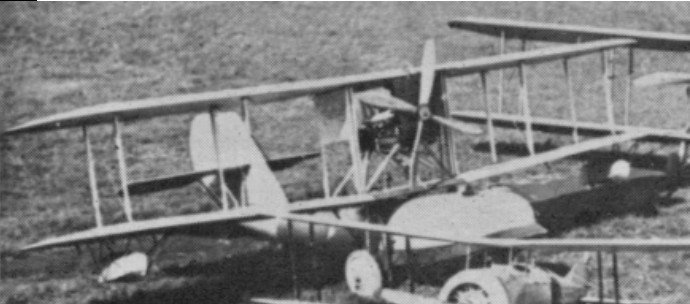
Supermarine Southampton

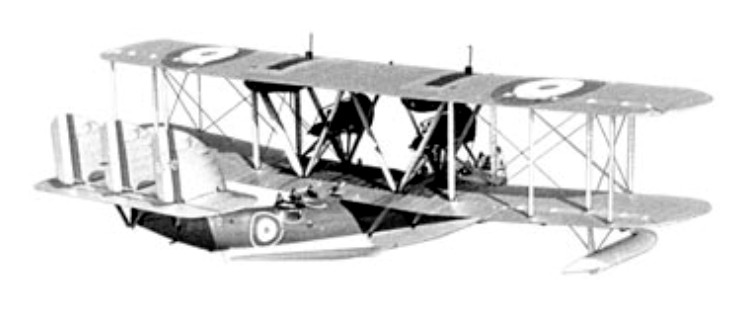
By the mid-twenties the RAF was desperate to replace their First World War vintage Felixstowe flying boats and had almost given up the search when R J Mitchell’s development of his civilian Swan design was offered. It proved an immediate success and established not only the name of the designer but that of the company in military circles.

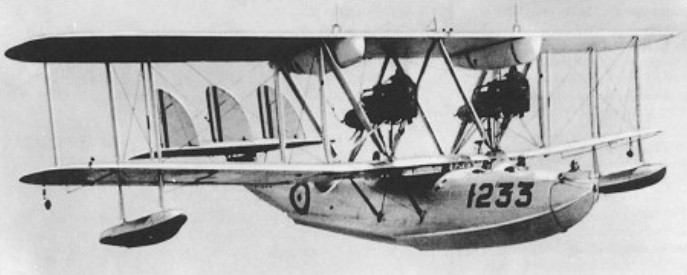
The first eighteen Southamptons delivered were Mk Is with wooden hulls. However a lengthy marine research programme had convinced the Royal Air Force of the superior qualities of metal over wood and so the final forty-eight were delivered as Southampton MkIIs with metal hulls and powered by two 335kW Napier Lion V engines. In a programme begun in 1929 all surviving wooden-hulled Southamptons were re-built with metal hulls.

Southamptons first entered service in August 1925 and quickly became famous for long-distance formation flights, ‘showing the flag’ in many parts of the world. The most notable was a 43500km (27000 mile) cruise of the Far East Flight’s four Southamptons from Felixstowe to Singapore via the Mediterranean and India in 1927 and 1928.

The Southampton flying-boat was one of the most successful ever used by the Royal Air Force. With a reputation for reliability, its service life of eleven years was surpassed only by that of the Sunderland.
Gallery

Southampton Mk II
Engines: 2 x Napier Lion VA W-12, 373kW
Max take-off weight: 6895 kg / 15201 lb
Empty weight: 4082 kg / 8999 lb
Wingspan: 22.86 m / 75 ft 0 in
Length: 15.58 m / 51 ft 1 in
Height: 6.82 m / 22 ft 5 in
Wing area: 134.61 sq.m / 1448.93 sq ft
Max. speed: 174 km/h / 108 mph
Ceiling: 4265 m / 14000 ft
Range: 1500 km / 932 miles
Armament: 3 x 7.7mm machine-guns
Bombload: 500kg
Supermarine Swan

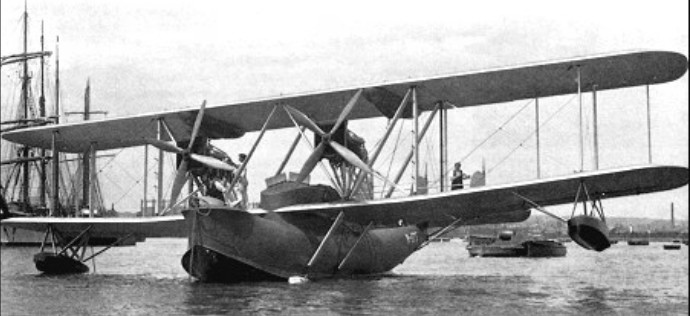
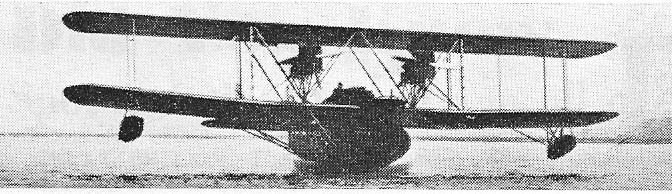
Shortly after World War I, Supermarine received two Air Ministry contracts to Specification 21/22, one in 1921 for a five-seat military seaplane and the other in 1922 for a commercial seaplane, the former named Scylla and the latter Swan.

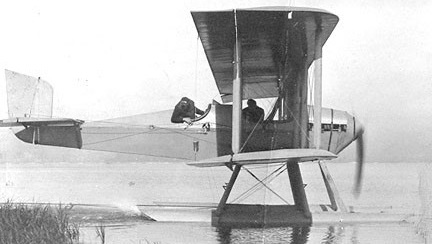
The aircraft were equal-span, two-bay biplanes with monoplane tail units and triple fins and rudders. The raised cockpit seated the two-crew side-by-side.

The Scylla N174 emerged as a monoplane, but was apparently converted to triplane configuration in 1923, when it carried out taxi trials at Felixstowe. There is no evidence that it ever flew.

Swan

The Swan N175 was completed as planned in 1924, but as a maritime reconnaissance flying-boat biplane. After completing its flight trials, it was converted to civilian use. An Air Ministry Specification R18/24 was issued for a development, later built by Supermarine as the first Southampton.

Engine: 2 x 2 x 450hp Napier Lion IIB
Max take-off weight: 5820 kg / 12831 lb
Wingspan: 20.90 m / 69 ft 7 in
Length: 17.06 m / 56 ft 12 in
Height: 7.95 m / 26 ft 1 in
Max. speed: 175 km/h / 109 mph
Ceiling: 3089 m / 10150 ft
Range: 1400 km / 870 miles
Crew: 2
Passengers: 10

Supermarine Sea Lion

R.J. Mitchell joined Supermarine in 1917 and was responsible for a racing design, the Sea Lion was developed from the Baby, an earlier aircraft designed to meet an Admiralty experimental requirement to compete in the 1919 Schneider Trophy race, but was badly damaged by an underwater obstruction.

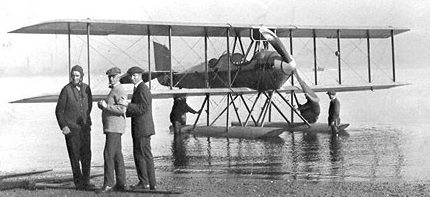
Mitchell went on to redesign the Sea Lion (II) biplane flying boat (itself a derivative of the Sea King fighter), powered by a strut-mounted single pusher engine. The new Sea Lion won the 1922 Schneider race in Naples at 145.62 mph. The Sea Lion (III) was fitted with an uprated engine for the 1923 event at Cowes, but only managed third place. Mitchell was well aware of the need to decrease drag and moved on to design the S.IV.

Sea Lion II
Crew: 1
Engine: 1 x 450hp Napier Lion V12
Max take-off weight: 1425 kg / 3142 lb
Wingspan: 9.75 m / 32 ft 0 in
Length: 7.54 m / 25 ft 9 in
Max. speed: 233 km/h / 145 mph

Supermarine Sea Otter

The Sea Otter amphibious biplane was designed to replace the Walrus on reconnaissance and general duties, including air-sea rescue. It was produced before World War II and went into service with the RAF and FAA during the war. A total of 290 was built. After the war a number were modified for civil use with the normal military equipment removed. Power was provided by one 637kW Bristol Mercury 30 radial, giving a maximum level speed of 241km/h.

Engine: 1 x Bristol Mercury XXX, 638kW / 843 hp
Max take-off weight: 4530 kg / 9987 lb
Empty weight: 3080 kg / 6790 lb
Wing loading: 16.4 lb/sq.ft / 80.0 kg/sq.m
Wingspan: 14.02 m / 46 ft 0 in
Length: 12.01 m / 39 ft 5 in
Height: 4.93 m / 16 ft 2 in
Wing area: 56.67 sq.m / 609.99 sq ft
Max. speed: 130 kt / 241 km/h / 150 mph
Cruise speed: 87 kt / 161 km/h / 100 mph
Ceiling: 4875 m / 16000 ft
Range: 900-1160 km / 559 – 721 miles
Armament: 3 x .303in / 7.7mm machine-gun
Crew: 2
Payload: 2 pax

Supermarine Baby

Towards the end of the first World War, the marauding German Brandenburg fighter seaplanes had become a nuisance to Allied patrol airships and flying boats which were guarding coastal convoys and Naval flotillas from U boats. These were beyond the effective range from shore bases of fighters, and the need for a small fighter flying boat to counter this menace was recognised by Supermarine which built the Baby in 1918 for just this purpose. It had the strength in its hull which twin float seaplanes lacked and it seemed full of promise, particularly in the open waters of the North Sea in times when engines lacked reliability. It was too late to see war service, but the design led to the successful Sea Lion series and, eventually, to the Walrus.

Sun Aerospace Sunray

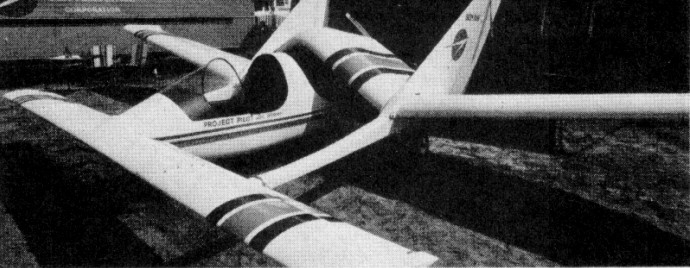
Single seat single engined monoplane with conventional three axis control. Wing has swept back leading and trailing edges, and tapering chord; no tail, canard wing. Pitch control by elevator on canard; yaw control by fin mounted rudders; control inputs through stick for pitch/roll and pedals for yaw. Retractable undercarriage has three wheels in tricycle formation. Ground steering by differential braking; (limited castoring nosewheel optional). Composite construction fuselage, partially enclosed (totally enclosed optional). Engine mounted level with centre part of wing driving pusher propeller.

Russ Mcdonald of Sun Aerospace announced that the test flights on the prototype, which is radical both in terms of its aerodynamics and the technology used, were under way from the end of March 1983 and the aircraft was scheduled to he shown in August at Oshkosh, where the Sun Ray will be in the running for the $10,000 prize offered by DuPont to promote the use of advanced materials and design concepts in lightweight aircraft construction.

The Sun Ray is a conventional control aircraft with a side mounted control stick. Its wing has a laminar profile and is made up of two outer half wings with a large dihedral and a central inverse V wing forming the engine housing and carrying the pusher propeller. Below the joints between the centre section and the outer wings are twin parallel booms, which ensure the structural rigidity of the assembly by running forward to carry a canard at the nose of the fuselage, while above each joint is a fin and rudder assembly, inclined slightly outwards.
The fuselage forms the hull and has a float attached, adding to the buoyancy of the parallel twin booms, which act as under wing floats. The single hull float and the outboard sponsons are detachable to take advantage of US law, which dictates that removable floats are not included in the empty weight of an ultralight. For ease of transportation, the outer wing and canard sections are removable, leaving a structure 8ft (2.4m) wide.

The Sunray makes extensive use of the Dupont fibre Kevlar, which is lighter and stronger than glass fibre and which allows more elaborate shapes while giving an impeccable surface finish.

In 1984 the Sun Ray kits started at $7595.

Engine: Kawasaki TA 440, 30 hp
Power per unit area 0.24hp/sq.ft, 2.6 hp/sq.m
Length overall 13.3 ft, 4.06 m
Height overall 6.0ft, 1.83m
Wing span 32.0ft, 9.75m
Canard span 8.0ft, 2.44 m
Total wing area 126 sq.ft, 11.7 sq.m
Empty weight 250 lb, 113kg
Max take off weight 510 lb, 231kg
Payload 260 lb, 118kg
Max wing loading 4.05 lb/sq.ft, 19.7 kg/sq.m
Max power loading 17.0 lb/hp, 7.7kg/hp
Max level speed 63 mph, 101 kph
Never exceed speed 85 mph, 137 kph
Max cruising speed 56 mph, 90 kph
Economic cruising speed 43 mph, 69 kph
Stalling speed 27 mph, 43 kph
Max climb rate at sea level 600 ft/min, 3.1 m/s
Service ceiling 13,500ft, 4100m
Range at average cruising speed 145 mile, 233 km