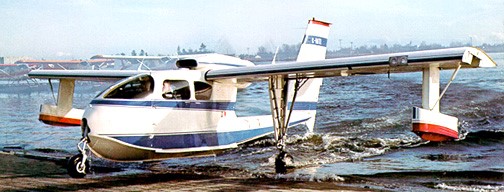
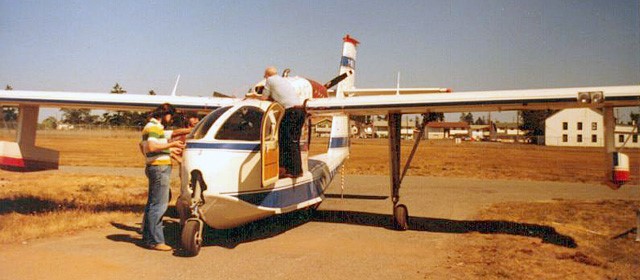
Canadian firm Trident Aircraft Ltd of Vancouver, BC, tried to resurrect the Seabee in the form of the TR-1 Trigull. Trident Aircraft was established in early 1970s to develop Trigull-320 six-seat light amphibian The factory was in Sydney, British Columbia, Canada. The Trigull resembled the Seabee closely enough to be confused with it, Spence Spencer apparently having a hand in the design. The Trigull could be distinguished from the Seabee by the angular swept tailfin, floats that retracted up to the wingtips, and tricycle landing gear, the long main gear hinging to retract outward into the wings, and the nose gear pivoting up to retract into the nose.
Two flight prototypes were built, first flown on 5 August 1973, the second taking to the air in 1973. The aircraft had a price tag of $111,360 in 1979. A Turbo Trigull was offered with turbocharged engines.
third prototype, c.1978, at Victoria, BC.
Production machines were to be powered by a Lycoming IO-540-M1A5 air-cooled flat-six engine, with 255 kW (340 HP), though the prototypes were powered by the less powerful Teledyne Continental Tiara flat-six. The Trigull was about a tenth longer and a tenth heavier than the Seabee, and could have seating for four or six, the rear seat in the six configuration apparently being intended for kids since it would be pretty cramped for adults.
The stop go progress of Trident Aircraft reached its fourth and probably final “stop” in 10 years in November 1980 as costs continued to escalate ahead of the latest funding programme. With $Can10m spent already, the company estimated that another $Can8.5m was needed to establish full production of the Tri Gull amphibian at the new plant set up for the purpose on Vancouver Island. All employees were dismissed and survival of the project appeared unlikely; the two prototypes of the Tri Gull have been put into storage, the company going under in the early 1980s.
Viking Air LTD of Vancouver obtained the rights to the Trigull; Viking, incidentally, also had rights to de Havilland Canada classics like the Beaver, Otter, and Twin Otter, performing turbo conversions of Beavers and Otters, plus building Twin Otters new. Viking has dropped hints of producing the Trigull, presumably to see if there was any interest, and saying that a production machine would have a turboprop powerplant. Apparently there wasn’t any interest, since it never happened.
A 1931 eight-passenger high-wing cantilever monoplane amphibian flying-boat, it was powered by two 225hp radial Packard DR-980 diesel engines mounted on muitistrut pylons on the wing upper surface. The TA-3 received certification ATC 2-291.
The Thurston HRV-1 was a hydro research vehicle developed for the USN from a Colonial C-2 Skimmer. The single HRV-1 was a two-place cabin, mid-wing monoplane amphibian, registered N1001L.
David B. Thurston, veteran amphibian aircraft designer was completing certification requirements for his four-place waterbird, the TA16 Trojan, to be called the Seafire when FAA-certified. This means that home-builders will have a proven, FAA-certi¬fied amphibian structure if they follow the plans with care. The proto-type Seafire is scheduled for flight testing in July 1981, while 45 home-builders already have Trojans under construction. Thurston, designer of the Colonial Skimmer (still produced as the Lake Amphibian) and the Teal Amphibian, estimates that the Tro¬jan/Seafire can be built in 3000 hours by anyone with previous airframe construction experience. This time can be reduced by using subassem¬blies and parts currently available from Underwood Aircraft, 18440 South Broadway, Gardena, CA 90248. The Trojan/Seafire has a radius of ac¬tion in excess of three hours and can operate from water, land, snow or ice.
The prototype N16SA first flew on 10 December 1981 and about 45 were under construction by 1982.
Construction, aluminum alloy with fiberglass bow deck skin and windshield enclosure Power 160 – 250 hp
Thurston Aircraft Corp designed and manufactured the TSC-1A1 Teal two/three-seat light amphibian later acquired by Schweizer and later Teal Aircraft Corporation.
The TSC-1A Teal prototype N1968T first flew in June 1968 and, selling for $17,150, fifteen went to the USN. The improved TSC-1A1 Teal flew in 1972.
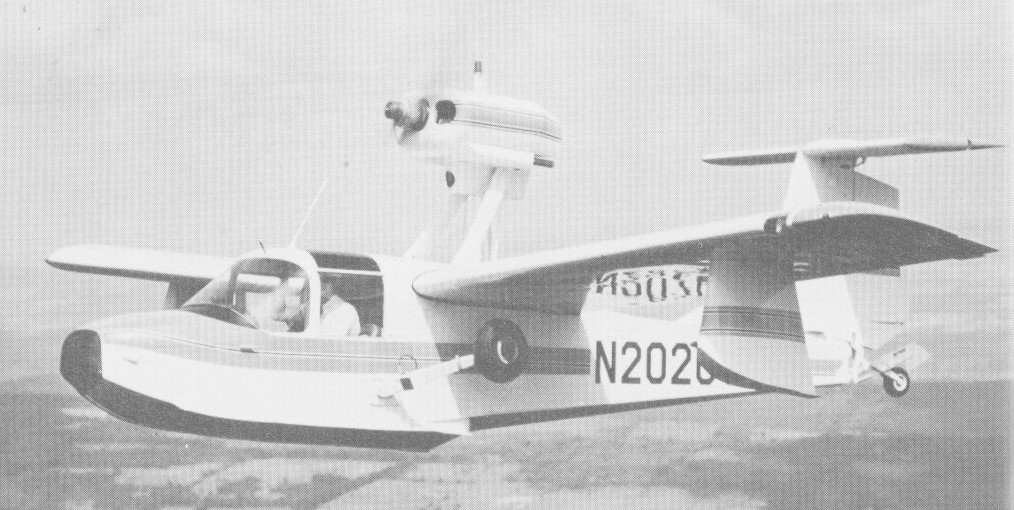
The TSC-1A2 Teal II N2020 first flew in October 1972. The TSC-1A2 Teal II was an improved version featuring slotted trailing-edge flaps, new wing leading-edge fuel tanks, optional hull fuel tank, and independent retraction of the tail wheel.
TSC-1A2 Teal II
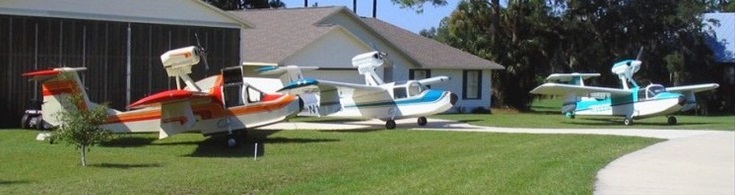
From 1976 Teal Aircraft Corp held manufacturing and tooling rights for the Thurston Teal, which was previously owned by Schweizer Aircraft Corporation. It was being produced by Teal Aircraft in St. Augustine, Florida, at the rate of 24 a year. For about $40,000, they’ll put you into the 150 horsepower Teal II, which cruises at 102 knots and carries a 765 pound equipped useful load. For $2,000 more, they’ll sell you the same airplane with a 180 hp engine the Teal III. The TSC-1A3 Teal III first flying in September 1991.
Thurston Aeromarine Corp superseded International Aeromarine; initially to produce two-seat Teal III amphibian (delivered from 1995), then expected to be followed by Seafire four-seat amphibian.
The 1915 Thomas-Morse SH-4 was a USN float version of the Thomas T-2 with a single main pontoon and wingtip floats, larger tail, three-bay wings, and various engines including the Curtiss OX-5 and Hisso A.
The first design for Thomas-Morse by B D Thomas, it incorporated much of the same look as his Curtiss J, and sold for $7,575.




 All Aero