Siemens-Schuckert Werke GmbH
Began airship construction in 1907. In 1909 manufactured airplanes, but poor results stopped work in 1911. Airplane department reopened 1914. In October started design of four-engined aircraft similar to that of Sikorsky in Russia. As entirely new venture company sponsored designs by two Steffen brothers leading to giants R.I-VII of 1915-1917. R.VIII, which did not fly, was then world’s largest airplane with span of 158 ft (48.16 m), and had experimental rotating gun-turret. Other advanced projects included steam-turbine monoplane and wire-guided flying bombs. Company also made E-l monoplane single-seat fighter and D-l copy of Nieuport. D-III and D-IV also built in quantity. Fighters were technically very advanced.
Airship
Short R31 / R32

The R31 class of British rigid airships was constructed in the closing months of World War I and comprised two aircraft, His Majesty’s Airship R31 and R32. They were designed by the Royal Corps of Naval Constructors – with assistance from a Herr Müller who had defected to Britain and previously worked for the Schütte-Lanz airship company – and built by Short Brothers at the Cardington airship sheds. The airship frame was made from spruce plywood laminated into girder sections, weatherproofed with varnish, and also fireproofed. These enclosed 21 gas bags. R31 was the largest British airship to fly before the end of the war, and the class remains the largest mobile wooden structures ever built.
As the airships were intended for fleet protection operations, they were to be fitted with defensive machine guns on top of the envelope, at the stern and in the gondolas. A 12-pounder gun was to be fitted in a special position centrally below the airship for use against U-boats. In the event, this armament was only fitted to R31, as R32 was only completed after the armistice with Germany. It had also been intended to fit a bomb load of two 520 lb (240 kg) bombs and four 230 lb (100 kg) bombs. but with the end of hostilities these were never installed on either airship.
R31 made its first trial flight, lasting two hours, in July 1918 under the command of Squadron Leader W.C. Hinks. A top speed of 70 mph (110 km/h) was achieved, well above the expected 50–55 mph (80–89 km/h) and faster than any other airship then in service. It was originally powered by six 275 hp (205 kW) Rolls-Royce Eagle engines, but in view of the performance and to reduce fuel consumption one was removed, reducing the maximum speed to a still satisfactory 65 mph (105 km/h); similarly the R32 was built with six engines and later converted to a five-engine configuration.
The airship was finally commissioned on 6 November 1918, just before the armistice with Germany, after having spent four hours in the air. It set off, again under the command of Squadron Leader Hincks, for the airship base at East Fortune in Scotland. On the journey she encountered bad weather and it was feared that some of the plywood girders were failing, so she diverted to the airship base at Howden in the East Riding of Yorkshire for examination and repair. Unfortunately, the sheds had not been repaired since the R27 had caught fire three months earlier and the roof leaked badly. This caused the glue holding the plywood together to deteriorate; as a result the airship became unairworthy and was beyond repair. In February 1919 it was dismantled. The covering was removed and returned to Cardington while the frames were sold for £200; these were broken up and sold for firewood but due to the fireproofing treatment they had received they would not burn.

After being formally accepted by the Royal Navy, R32 made its first trial flight on 3 September 1919 and then on 6 September went to RNAS Pulham, Norfolk, which at the time was a centre for training and experimentation. On 10 September in formation with the R33 she made a flight over the Netherlands, Belgium and Northern France and back to Pulham. In October 1919 the R32 with the rest of the airship fleet was formally handed over to the Royal Air Force. The ship was flown from Cardington on September 16th 1919 with Major Elmsley in charge. George Meager reports that a week later he was on board as navigator when the R32 flew across to Amsterdam – he recalls another crew member named Scroggs on this flight. He took a further two flights a month later naming Flt Lt Ivor Cecil Little as the Captain and Scroggs as First Officer. The airship was used by the National Physical Laboratory for structural testing. On 20 March 1920 it was flown to Howden to be refurbished and used for crew training by the American party who had come to accept the R38 (ZR-2). When the metal-framed R80 became available, the use of the by now obsolete wooden-framed R32 stopped and, to save money, it was decommissioned and used to assess the effect of a gas-bag bursting. Once the covering had been removed and the engines taken away, cell No.18 was overpressurised until the expansion caused the bracing and structure to fail. The frame was subsequently dismantled.

Powerplant: 5 × Rolls-Royce Eagle, 275 hp (205 kW) each
Volume: 1,547,000 cu ft (43,976 m3)
Length: 615 ft 0 in (187.5 m)
Diameter: 65 ft 6 in (19.97 m)
Useful lift: 36,960 lb (16,800 kg)
Maximum speed: 65 mph (104 km/h, 56 kn)
Shaw Aerial Velocipede

California lighthouse keeper Shaw’s “aerial row boat” consisted of two cartridge-shaped balloons of oiled silk, kept in position by ash frames. The buoyant power was barely sufficient to lift the apparatus and one’s weight. The conical ends pointed in opposite directions, and the two balloons were kept a few feet apart by strong connecting pieces of ash. Between the ash pieces was arranged a seat and footrest. This apparatus would support one in the air and locomotion was by oars. It was reportedly successfully tested in New York’s Central Park sometime during the 1860s.
Severo Bartolomeu de Gusmão
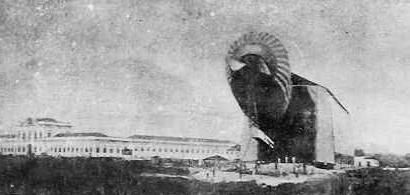
The Augusto Severo designed semi-rigid airship “Bartolomeu de Gusmão” was first flown on February 14, 1894, from the Royal Field at Rio de Janeiro, Brazil.
Severo Pax
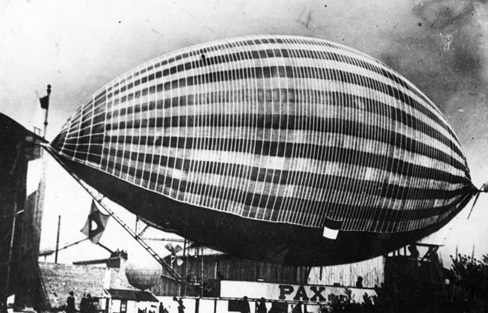
At the end of 1901 Brazilian inventor Augusto Severo de Albuquerque Maranhão travelled to France to build an airship, the semi-rigid “Pax”. It had no directional rudder but seven propellers, one at the stern, one at the bow, another at the nacelle and four at the sides. He had intended to use electric motors, but the lack of resources and time made him opt for two Buchet-type engines, one of 24 hp and the other of 16 hp. The envelope had a capacity of 2,500 cu.m, 30 m long and 12 m at the largest diameter.
Two pusher propellers set at 50 rpm drove the aircraft. The forward and aft propeller diameters were 5 and 6m, respectively. in addition, two other propellers were placed parallel to the machine’s longitudinal axis for lateral control, only. a further propeller was placed below the deck and was employed to control the pitch movement of the 30-m-long aircraft. Maranhão had some insights in designing the Pax, which were not taken into account by his predecessors. one of them was the placement of the traction line coincident with the drag one to better control and handling of the aircraft.
The trials were successfully performed on May 4 and 7, 1902. At 5 am on May 12, 1902, Severo and his mechanic, Georges Saché, set off, intending to fly from Vaugirard in Paris to Issy-les-Moulineaux. It rose quickly, but at about 400 meters’ altitude it exploded, crashing on Avenue du Maine. Both Severo and Saché were killed.
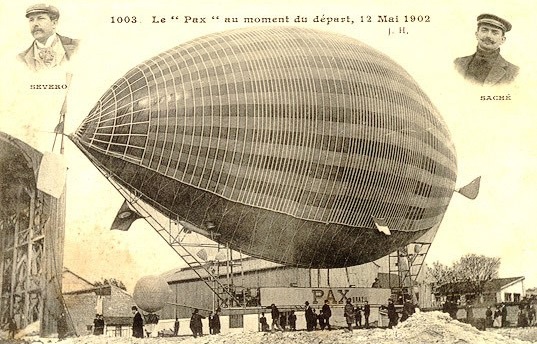
Severo, Augusto
Brazilian, Severo Augusto de Albuquerque Maranhão, born in Macaíba, Rio Grande do Norte State in the northeast of Brazil, designed and flew the dirigible Bartolomeu de Gusmão in Rio de Janeiro in 1894. he also developed and constructed a second machine, the Pax.
Schwarz No.1 / No.2
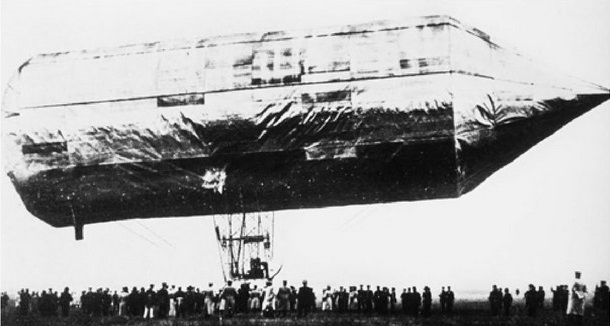
In 1895 Austrian timber merchant David Schwarz produced plans for a rigid-framed airship. It was built in St Petersburg for the Russian government but, although completed, never flew due to political complications; the Russians constantly regarding Schwartz as a spy. Schwartz was forced to leave Russia in secrecy, retuning to Germany where he built a second airship of similar design for the Prussian Airship Division in Berlin.
Schwarz died before the constuction was complete. The work was taken over by his able and practable widow until completed. The airship was a bottle-shaped craft of cylindrical form with a conical nose and shallow rounded stern, an internal framework constructed of tubular aluminium members and girders was covered by a skin of sheet aluminium .008in in thickness. The hull contained a single gas cell.
The filling of the envelope was accomplished by introducing a series of paper bags within the framework to be filled with hydrogen gas, which at the same time expelled an equal volume of air contained within the metal hull. A two-cylinder Daimeter petrol motor of 12 hp provided power, driving three airscrews through fabric transmission belts.
Two wing screws mounted above the car were assigned to drive the craft through the air, while a third larger diameter propeller mounted on the centre line, able to move through 90˚ vertically and horizontally, was supposed to control direction.
Schwarz No.2 crashed on its initial flight at Tempelhof on 4 November 1897. With the engines running, the ground crew released the ropes and the airship rose to approximately 100 ft. Maintaining its position against the breeze for some minutes, the airship was beginning to make headway against the wind when the left-hand driving belt jumped off its sheaves.
The airship continued to rise to 1300 ft as the pilot, a soldier named Ernst Jagels, struggled to maintain control, adjusting the angle of the central propeller to counter the wind. Just as he was turning into wind the right-hand driving belt also slipped off. Jagels valved gas to bring the craft down near the Tempelhof Field but the descent was too rapid, causing it to crash heavily on the ground, completely wrecking the airship. Jagels escaped unharmed but without further funding the project was abandoned.

Envelope capacity: 131,000 cu.ft
Length: 154 ft
Diameter: 46 ft
Height: 60 ft
Engine: Diamler 2 cyl, 12 hp
Speed: 17 mph
Crew: 1
Schütte-Lanz SL
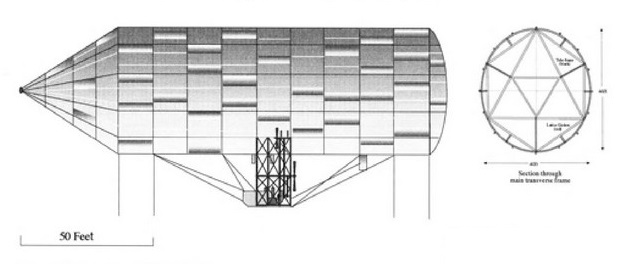
Conceived from the outset with an alternative construction to rival the metal Zeppelins, the SLs with their rigid ply framework were claimed to be lighter and more flexible than met¬al-framed airships, and most of those in German military service were oper¬ated by the army.
The Navy, responsi¬ble for most of the raids against the British Isles, rightly claimed that wooden vessels were incapable of lift¬ing a sufficiently large bomb load as their weight would be increased by moisture absorbed while crossing the sea.
Wire-braced wooden structures had been used by the Schütte-Lanz company since the design stages of their initial SL 1 that had first flown on 17 October 1911.
SL 11 was accepted by the army in June 1916, and after trials was sent to its operational base at Spich in August. Armament was two 7.92-mm (0.312-in) Parabellum machine-guns on free mountings in single gun position above forward hull, plus bombs. At the end of the month its initial oper¬ational sortie proved abortive because of the weather. The attack at the beginning of September was its first and last, such a brief career resulting in the airship having only one com¬mander, Hauptmann Wilhelm Schramm, who had gained experience in charge of three earlier rigids, all of Zeppelin design.
On the night of the SLll’s destruction, when Schramm died with all his crew, both incendiary and explosive bombs were dropped. The airship’s chief claim to fame lies in that it was the first enemy aircraft of any kind to be brought down on British soil. SL11 was brought down by William Leefe Robinson on the night of 3 September 1916. In recog¬nition Robinson was awarded the Victoria Cross.
SL 11
Type: bombing airship
Engines: four l79-kW (240-hp) Maybach HSLu six-cylinder water-cooled piston
Maximum speed 95 kph (59 mph)
Service ceiling 5400 m (17,717 ft)
Range 3700 km (2,299 miles)
Useful lift 21500 kg (47,399 lb)
Diameter 20.09 m (65 ft 10.9 in)
Length 173.98 m (570 ft 9.6 in)
Volume 31900 cu.m (1,126,540 cu ft)
Armament: two 7.92-mm (0.312-in) Parabellum machine-guns
Schütte-Lanz Luftfahrzeugbau
Luftschifflan Schutte-Lanz
Schütte-Lanz Luftfahrzeugbau
In 1909 Luftschifflan Schutte-Lanz was established to build airships. This company’s Luftfahrzeugbau was founded in 1915 at Zeesen, near Konigswusterhausen, Brandenburg, in recognition of the fact that airships must be supplemented by aeroplanes. The C-1 of 1915 had an unconventional engine installation; D-III built in 1916 was a single-seat fighter. Company built the Ago-Flugzeugwerke two-seat C.IV in quantity. Had studied ‘giant’ aircraft and was included in 1916 R-plane ‘giant’ programme. Contract awarded for six Staaken bombers. R.27-29 delivered late 1917 and became operational; three other Staaken machines (R.84- 86) unfinished at Armistice. Company also made special equipment (e.g. bomb gear and engine-room telegraphs) for other builders of giants, but own ambitious twin-boom project of 1917 remained unrealised. After aircraft work ended company remained as plywood manufacturer.
SCA T-34 / Roma
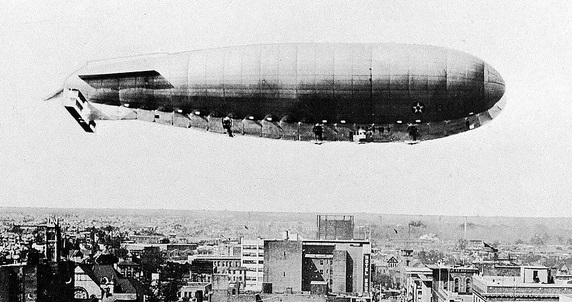
The Italian semi-rigid airship Roma was designed by Celestino Usuelli, the engineers Eugenio Prassone, Umberto Nobile and Colonel Gaetano Arturo Crocco. It was the first project of the Stabilimento Costruzioni Aeronautiche (“Aeronautical Construction Factory”), as the partnership of Umberto Nobile, Usuelli, Giuseppe Valle and Bennetto Croce was known. Originally designated T-34, it was designed for trans-Atlantic crossings and was the largest semi-rigid airship in the world at the tie.
As a semi-rigid design it was built about a rigid keel – though the keel was partially articulated to allow some flexibility. The passenger spaces and control cabin were within the keel. The engines, 400 hp Ansaldos, were mounted outside, angled such that the slipstreams would not interfere with each other. In addition to the 11 cells of hydrogen within its skin, it housed six cells of air, called ballonets, into which additional air could be pumped if the gasbag drooped or flattened.
It first flew in September 1920.
It was purchased by the United States from the Italian government for $250,000 in 1921. After purchase by the US, in March 1921 the Roma flew the 300 miles from Rome to Naples and back carrying the US Ambassador. After transportation to the US, Roma flew on 15 November 1921 with minor problems. When Langley crews unpacked the crated airship that August, they found its fabric skin mildewed and weakened. Six new, American-made Liberty motors, were ordered as replacements for the balky Italian powerplants.
It served in the US Army until February 21, 1922, when it crashed.
The Roma crashed in Norfolk, Virginia on February 22, 1922. The crash was caused by failure of the airship’s box rudder system, which allowed it to maneuver over tight areas. The airship contacted high voltage lines, and burst into flames. A total of 34 were killed, 8 were injured, and 3 escaped unharmed. Among the dead was the airship’s pilot, Captain Dale Mabry.
At 12:45 p.m., the preflight checks complete, 45 souls on the manifest – the crew, a few civilian mechanics, government observers – stepped aboard. The rain had stopped. The temperature had warmed to 46 degrees.
One hundred fifty men gripped lines holding the airship to earth as the Roma’s crew completed last-minute preparations for launch. The Libertys were fired up, then idled. All six worked.
Lines dropped away. The airship swept upward, tail first, then leveled.
At 500 feet, Mabry (the ship’s skipper) ordered cruising speed and, engines roaring, the Roma began making for the Chesapeake Bay. It reached it near the mouth of the Back River. Mabry ordered the ship south along the shoreline, toward Old Point Comfort. The crew waved to people below at Fort Monroe, looked down on the site of the burned Hotel Chamberlin, at crowds on the government pier. The Roma headed out over the water toward Willoughby Spit. The spit was dotted with waving Norfolkians agog at the mammoth craft overhead.
Mabry steered the Roma toward the Navy base.
After passing over the Spit and cruising over the Norfolk Naval Station, crewmembers noticed that the upper curve of the gasbag’s nose was flattening. The Roma, pitched nose-first toward the ground. From far astern came a cry: The keel was slowly buckling. Then another: The tail assembly was coming loose. The Roma began to bullet earthward at a 45-degree angle.
On the ground, sailors and civilian base workers watched the ship’s nose tilt, and warehousemen at the Army’s nearby Quartermaster Depot stepped outside to witness what was, clearly, an airship in trouble.
The skipper could see the greens and fairways of the Norfolk Country Club ahead, beyond the depot and the Lafayette River.
If they could get the Roma that far, they could put it down somewhat safely.
The passengers and crew, meanwhile, began to panic, to toss everything they could get their hands on through the keel’s windows – tools, furniture, spare engine parts. People on the ground watched a shower of equipment fall to earth.
But the Roma’s dive continued. The ground rushing to meet the falling ship was a scrubby field at the depot, split by a small road – and by a high-voltage electric line. The end came in a flash.
The Roma’s nose hit the ground, its massive girth brushed the electric line, and in an instant it was engulfed.
Its gas cells, loaded with more than a million cubic feet of hydrogen, blew to atoms.
The blast set off the ship’s gasoline tanks, creating a pyre of flame and smoke and din that leapt from the field and into the overcast sky.
Depot workers and sailors rushed to the wreckage, but the flames kept them back. Three fire companies spent five hours quelling the blaze, and watched as the Army’s greatest airship shrank to a pile of twisted aluminum that glowed red into the evening.
The event marked the greatest disaster in American aeronautics history at the time. It was the last hydrogen filled airship flown by the US military; all subsequent ships were inflated with helium.
Engines: 6 × Liberty L12, 300 kW (400 hp) each
Length: 125 m (410 ft 0 in)
Diameter: 25 m (82 ft 0 in)
Volume: 33,810 m3 (1,193,000 ft3)
Height: 92 ft
Empty weight: 34,500 kg (76,000 lb)
Useful lift: 19,100 kg (42,000 lb)
Maximum speed: 128 km/h (80 mph)
 All Aero