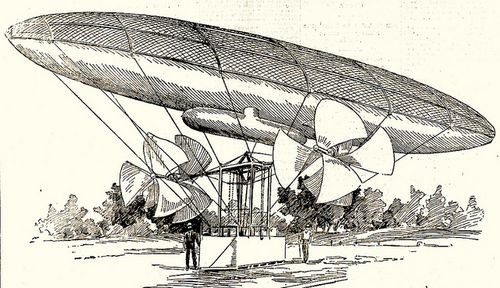
Non-rigid design with an external ballonet, from which was slung a car fitted with two sets of 6-bladed aluminium propellers that were to be driven by a 4 hp gasoline engine. However, the project at Green Island, California was never brought to its final construction. The designers had high hopes for their machine, and talked about making “a transcontinental journey to the national capital.” The envelope was described as circumscribed along its length with bicycle tubing to prevent it from collapsing. This tubing, a part of the suspension band, was probably inflated to pressure and thereby stiffened. This device was similar to an idea developed and demonstrated by the notable aeronaut Louis Capazza using a free balloon in the 1880s; that if the envelope were to suffer a catastrophic loss of lift gas during flight, the suspension band would keep the envelope from folding, or rather collapsing, and thus allow the gas bag to act as a parachute in slowing the descent of the airship.
Inspired by the experiments of Graf von Zeppelin, Heinrich Suter of Arbon, Switzerland, built an airship of 40 metres length. The Paris-made, cigar-shaped, 5-chamber envelope had a reported volume of 1000 m³. The movements of the LTA/HTA craft were carried out by propellers, while the balloon was used only to lift the machine and aeronaut. On a wooden pole under the balloon hung by a ball joint, was the actual flying machine, which enabled a free, independent movement of the two parts. Suter’s connection of a balloon with a flying machine was based on the principles of Ingenieur Kreß of Vienna. In Gustav Adolf Saurer, the founder of the “Ersten Schweizerischen Velociped-Fabrik Arbon”, Suter found the perfect construction partner. Inside the metal structure that connected to the ball joint, he built a velo-drive. Pedals drove outside of the “cage”, mounted and by hand, a pivotable double propeller. In this way, Suter believed to be able to control the occurrence of different air currents, while the position of the steering sail could also be altered manually. On April 19, 1901, from the purpose-built shed at the Hotel “du Lac” the inflated airship was pulled to the shore of Lake Constance. Many curious onlookers as well as journalists were in attendance to witness the spectacular event. At first everything went according to plan – Suter increased the pressure on the pedals and circled the steerable airship over Steinacherbucht bay. Suddenly the wind shifted, and at low altitude drove it into the branches of a tree on the Steinach shore, ending the maiden voyage. As for Suter, he lacked the funds to conduct further tests and the project was terminated shortly thereafter.
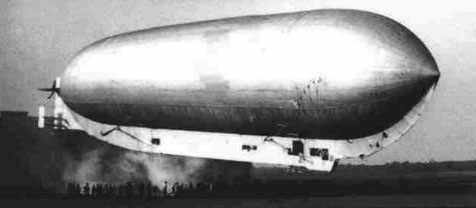
A rigid airship designed by Albert Paul Veeh, who was from Düsseldorf, Germany. It was built by the “Luftschiffbau Veeh GmbH”, a company that Veeh had set up in 1910, and which changed it’s name to “Deutsche Luftschiffwerft GmbH” in 1911. Veeh had patented his ideas for a semi-rigid airship, which featured a solid keel hull structure running the full length of the airship, and which incorporated the passengers, the motors, and fuel. His design allowed easy dis-assembly of the entire airship. Although several test runs were quite promising in nature, later tests proved problematic and Veeh eventually lost interest and financial support for his venture. The first proper test flight took place on 11 July 1912, “Flight” reports further flights during 1913 and 1914. Veeh himself died in 1914, apparently broken by the project.
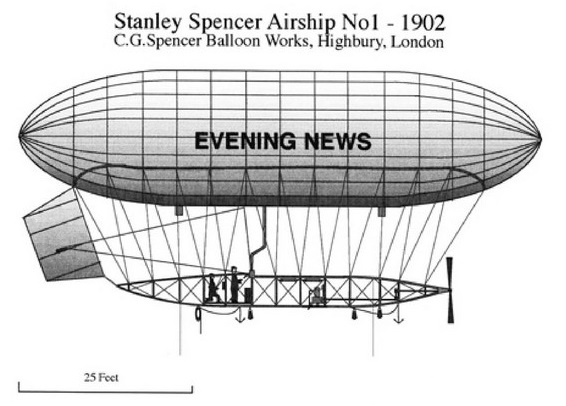
Stanley Spencer, with his brothers, ran a balloon factory at Highbury in North London. In 1902 they built a small 20,000 cu.ft capacity airship constructed along the lines of the Santos-Dumont craft.
The first successful navigable flight in Great Britain of a manned, powered aircraft took place on 22 September 1902, when Stanley Spencer piloting his airship No.1 flew from Crystal Palace via St Pauls to Eastcote Middlesex, a distance of 28 miles, in 94 minutes. It was intended to fly from Crystal Palace, round to St Paul’s and return to the starting point but contrary winds caused the airship to be driven to the north-west.
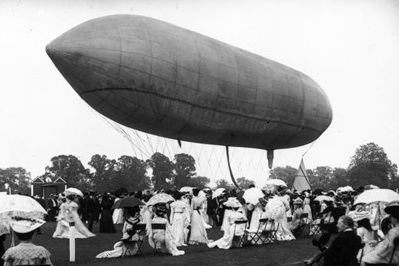
A Spencer Airship ascending at Ranelagh, watched by a fashionable crowd, 1903
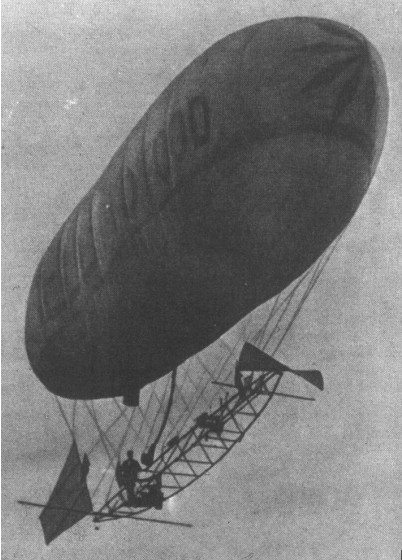
Spencer Airship No.1 1902 Capacity: 20,000 cu.ft Gross lift: 0.580 ton Disposable lift: 600 lb Engine: 1 x JAP water cooled single cylinder, 3 hp Speed: 20 mph Crew: 1-2
Stanley Spencer, with his brothers, ran a balloon factory at Highbury in North London. In 1902 they built a small 20,000 cu.ft capacity airship constructed along the lines of the Santos-Dumont craft.
The first successful navigable flight in Great Britain of a manned, powered aircraft took place on 22 September 1902, when Stanley Spencer piloting his airship No.1 flew from Crystal Palace via St Pauls to Eastcote Middlesex, a distance of 28 miles, in 94 minutes.
Spencer built a series of airships, but more powerful, similar to the No.1, up to the outbreak of the war. Finance was in part by the use of advertising slogans on the envelopes: Boveril being one of the companies that utilised this advertising medium.
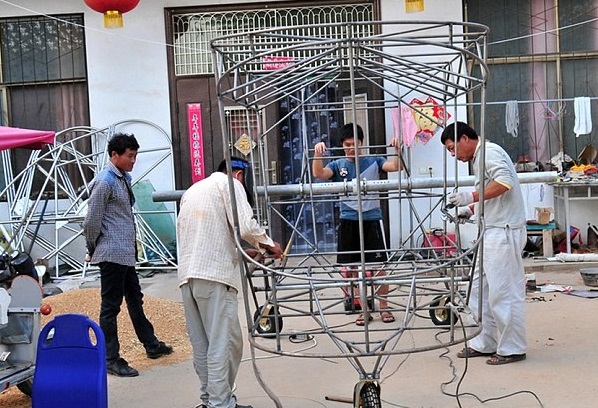
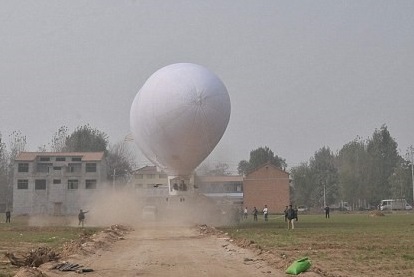
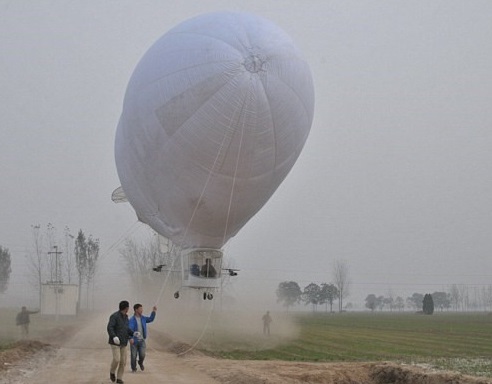
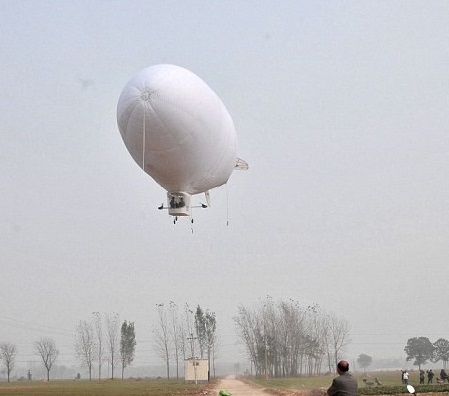
Shi Songbo from Ningling, central China, spent 300,000 Yuan (£30,000) on the Zeppelin, which successfully completed a two-hour test flight near his home in October 2015.
Although his family have been farmers for several generations, his brother attended the Aeronautical Engineering Institute in Xi’an, central China.
As a result of his studies, Shi’s brother always brought home aeronautical engineering magazines and reading material, which got Shi interested in the techniques involved in building an aircraft.
Eventually, Shi would go on to work for an aerial model company as a designer, which gave him greater understanding of the composition of a plane.
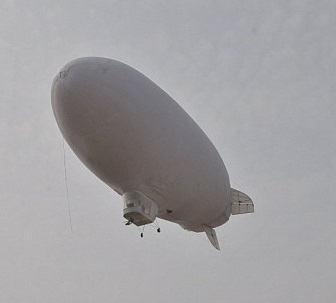
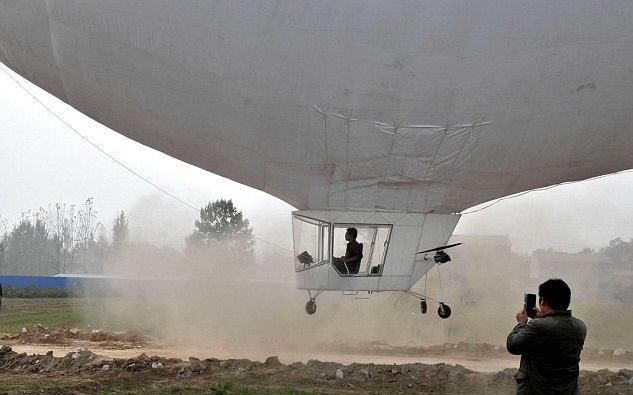
In June 2015, Shi was let go from his job, which prompted him to start building his ‘Songbo’ Zeppelin. Shi Songbo spent four months building a Zeppelin. The Zeppelin is about 33 feet tall and 75 feet long. The top portion is composed of a hydrogen-filled airbag while the bottom is made up of the seat and controls.
Shi spent around four months and 300,000 Yuan (£30,000) on the Zeppelin, with many of the components imported from Germany and the USA.
Shi Songbo conducted his first official flight on October 25 2015 in a field near his home under the direction of friend Shang Jianjun, who acted as a dispatcher.
Along with his co-pilot Li Kai, the inventor made several different maneuvers and successfully took off and landed eight times over the space of two hours split between the morning and afternoon. Speaking of his first aerial experience, Shi said: ‘There were lots of low-hanging electricity cables.” ‘Because I was worried about bumping into the cables, everything had to be under the direction of the dispatcher.’ He added, ‘My co-pilot was my eyes and ears. He helped to monitor my surroundings.’
It is able to travel just over 30 miles per hour at 1,640 feet above the ground while carrying two people. The Zeppelin prototype will need additional testing but Shi hoped that it could be used to distribute pesticide, aerial surveying or tourism in the future.
Built by A.J.F. Smith in the UK, the Santos Dumont non-rigid airship was registered G-BAWL c/n 1. Powered by a Wankel engine if first flew, from Cardington, on 7 May 1974.
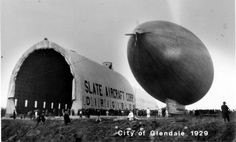
The all-metal dirigible “City of Glendale” was supposed to be able to fly around 100 mph and carry 40 passengers.
On its test run in 1929 the airship was ripped by an explosion. The Slate Aircraft Company, who built the dirigible, claimed that heat from the sun had pressurised the gas chamber to a destructive level.
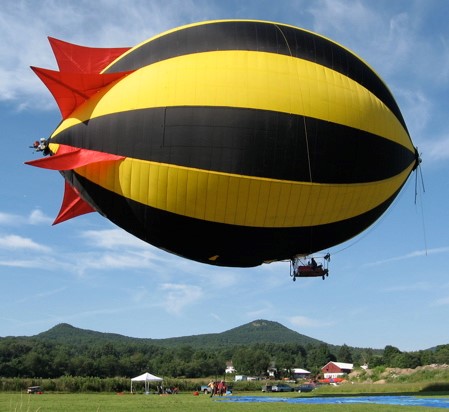
Since 2002 Skyacht Aircraft, Inc. has been developing Personal Blimp. The Personal Blimp uses hot air for lift and silent electric motors for propulsion. Initial flight tests are using a conventional gas-powered motor. Electric motors will be added once these initial tests are complete. Similarly, the initial flight tests are being made with conventional hot air balloon burners. Quiet burners were to be added later. The Personal Blimp flies “low, slow, and smooth.”
The Personal Blimp hull structure has three main components: 1) the fabric envelope, 2) a set of flexible ribs embedded within the fabric, and 3) a tensioning line that runs along the central axis of the hull.
The hull is a “tension structure” wherein the ribs are under compression and the fabric and tensioning line are under opposing tension.
What is new and different about the Personal Blimp hull design is the ease with which one can create a lightweight, sturdy, self-supporting (no fans required) airship envelope.
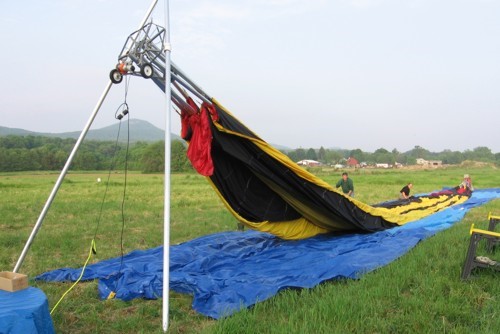
The fabric of the envelope has several continuous, tubular sleeves sewn into it running from nose to tail. The ribs are inserted into the sleeves. The ends of the ribs are held together at each end. The tensioning line is then connected between the two ends and the whole contraption is inflated by pulling on the tensioning line. As the tensioning line is made shorter the ribs are forced to bend or “bow” outward. The envelope continues to expand until eventually the fabric is pulled taut.
Different shapes can be designed by varying the composition and/or cross section of ribs along their length. For instance, making the ribs more flexible towards the nose gives a blunter shape to the front of the ship. Relatively stiffer ribs can also be used to get a longer, skinnier shape.
When not in use, the Personal Blimp can be deflated and folded for storage. The combination of ready buoyancy control and rapid deflation eliminates not only hangars but also the large ground crews.
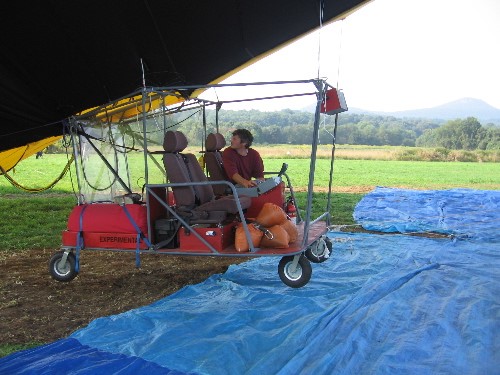
The Personal Blimp has a rigid, but folding, skeleton to allow the envelope to retain its shape without requiring internal air pressurization. Patent (USPTO #6,793,180) for this unique structural design in September of 2004. The Personal Blimp’s rigid but foldable structure provides hardpoints at strategic locations (e.g. on the tail) for mounting systems such as the engine and propeller. With the engine/propeller mounted on the tail, the Personal Blimp can use vectored thrust for steering. This provides far greater maneuverability.
Since its first flight on October 27, 2006, the Alberto has completed more than 50 hours of flight testing. Work focuses on both refining its systems and further expanding its capabilities.

 All Aero