U.S. Army Airship Service C-6

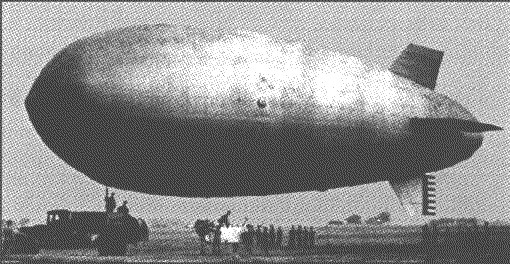
U.S. Army Airship Service C-6 motorized observation balloon at Scott Field, late 1930s. The suspended engine-equipped crew car, not the entire balloon, was made by St. Louis Aircraft

As Congress refused to authorize expenditures for Army airships but did allow funding of observation balloons the army resurrected the “Motorized Observation Balloon” concept abandoned a decade before. The “Motorized Observation Balloon” continued in use for several more years. There were even new ‘pony blimps’ constructed. These were the five C-6, seven C-8 and four C-9 class airships. Two of the TE-3 class were re-designated C-7s. The last US Army airships were the two C-7s which were turned over to the USN in 1943.

Following World War II, the War Assets Administration put up for sale sixteen Motorized Observation Balloons of the C-6, 8 & 9 classes. One was briefly operated by the Douglas Leigh Sky Advertising Company between 1948 and 1950, the C-6-36-11 made its last flight on 14 June 1950.

Tse Tsan-tai Airship

LTA/HTA dirigible designed by Australian-born and raised Chinese revolutionary Tse Tsan-tai – sometimes identified as being the first person of Chinese descent to fly an airship, although it is not clear as to whether the actual craft was ever completed. Even so, had it been, it almost certainly would not have been able to fly. An extract from the July 1907 issue of “Aeronautics” describes the invention thus: “A syndicate is being formed in Hong-kong to build an airship designed in 1894 by a Chinaman, Tse Tsan Tai. It is to be built of aluminum, and will be enclosed in an aluminum shell to protect it from the enemy’s projectiles. The envelope is to be cigar-shaped. Tse Tsan Tai’s principle is that airships should depend upon their fan-propellers for advancing, receding, ascending and descending. The gas-envelope is to be used only as a buoy. For the vertical movement, therefore, there are to be horizontal propellers on the deck regulated by clockwork. The steering will not be by exposed planes and rudders, but by concealed steel wings, which can be thrown out at the stern on the pressure of an electric button.”

Tissandier Airship

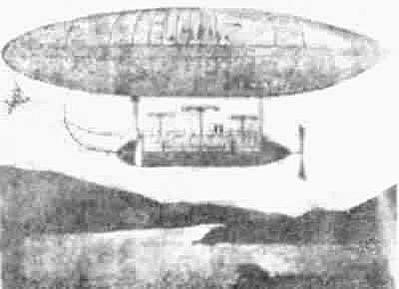
The contemporary engraving shows the Tissandier electric dirigible scale model – similar in appearance to the Giffard airship of 1852 – at the Conservatoire des Arts et Metiers in Paris. Seen at the Exposition d’électricité in 1881, the aérostat électrique was a demonstrative model of the later constructed full-scale Siemens electromotor-driven Tissandier airship. The model’s all important electromotor was designed and built by French inventor Gustave Trouvé.

In 1882 the Tissander brothers built a 92 ft long airship. At 37,000 cu.ft capacity, it was powered by a Siemens electric motor of 1.5 hp driving a primitive two-bladed airscrew, which drew its power from twenty-four bichromate of potash cells weighing 500 lb, contained in the car suspended by netting below the fuselage.

The first trial took place on 8 October 1883 when, despite a fair breeze, a measure of control was achieved with the aid of the sail rudder. A second trial on 26 September produced better results although due to the low power of the engine the craft was unable to make any headway in a wind of any magnitude and the brothers ended their works.

Thunder & Colt GA-42

T&C produced the GA-42 non-rigid helium airship which was capable of carrying two people and featured state of the art fly by wire controls. The rights to the GA-42 design were acquired by the American Blimp Corporation when T&C was acquired by Cameron in 1995.
Thunder & Colt AS 105

A T&C AS 105 Mk II hot air airship at the 1996 Worlds in Italy.

Mk2 Gondola and 105,000 cu.ft. Mk2 envelope

With the thermal airship, the shape is maintained by a small pressurising motor while the heat is supplied in the same manner as a common or garden hot air balloon, via a large twin burner. Fuel for both motors and the heating is supplied from two 100 litre LPG tanks.

All AS-105 are certified under Civil Aviation Authority UK AN 17803

Length: 34 m
Height: 13 m
MAUW: 750 kg
Fuel: LPG
Fuel cap: 2 x 100 lt
Endurance: 2 hr
Envelope capacity. 105,000 cu.ft
Max envelope temp: 120 degC
Max envelope pressure: 14 mm/Hg
Vertical rate of climb: 500 ft/min
Service ceiling. 6000 ft
Normal operational altitude minimum legal
Structural cruise: 12 14 kt
Vne: 15 kt
Forward propulsion: Honda, 600 cc V-twin lquid cooled
Seating capacity: 2 persons

AS-105 MkII
Length overall: 34.0 m (111 ft 6.5 in)
Max. diameter: 13.87 m (45 ft 6 in)
Volume: 2,973.3 cu.m (105,000 cu ft)
Max. speed: 37 km/h (23 mph)
Endurance: 2 h 30 min

Thunder & Colt AS56 Blimp

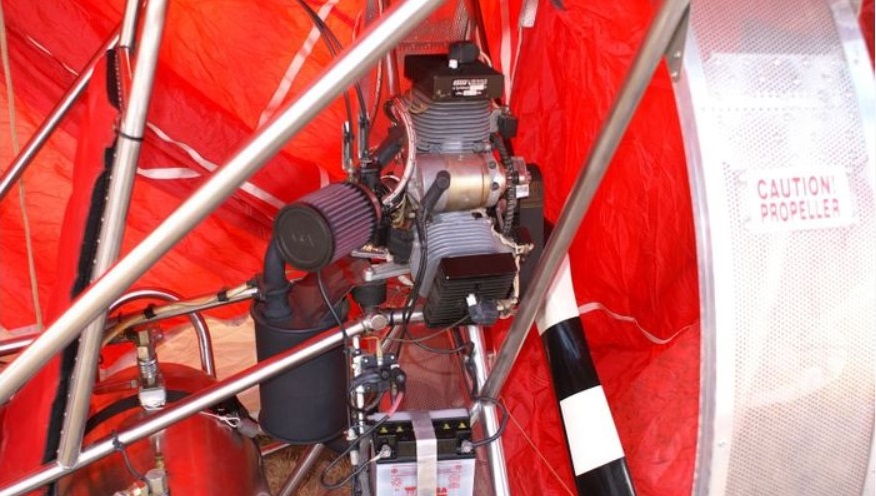
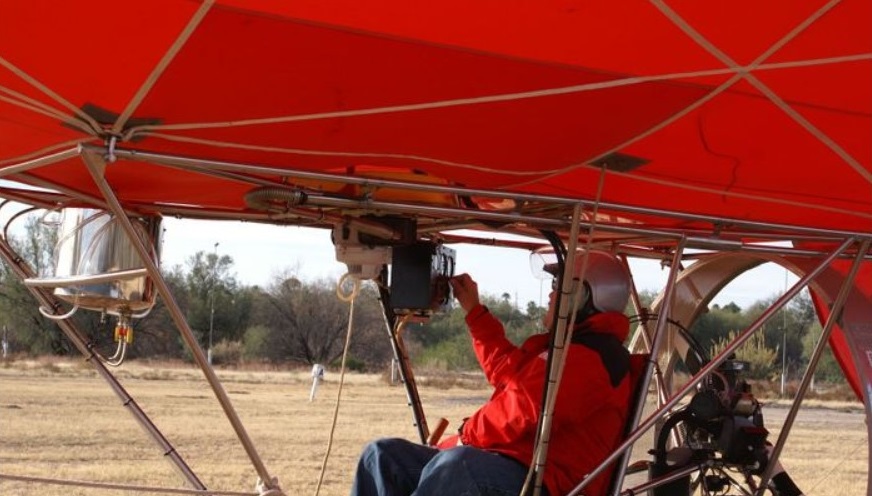
The circa 1885 Thunder and Colt Pressurized Thermal Airship instead of using helium for lift, uses low pressure (3 psi) hot air to provide static lift. The hot air is supplied by a hot air balloon burner located above the pilot’s head inside the hull. Directly beneath the burner is a modified 2 stroke engine that drives a small fan that provides constant pressure in order to provide rigidity to the hull. Behind the pilot is a 24 horsepower 3-cylinder 2 stroke German Konig radial engine that swings a 52″ pusher propeller
A Certified Aircraft

The pilot climbs by raising the temperature inside the hull. He descends by allowing it to cool. There is a small amount (20%) of dynamic lift that increases with speed. Rudder only.

Gallery

Top speed: 23 mph / 20 kt
Cruise: 15 mph
Useful Load: 250 lb
Endurance w/res: 1.5 hr
Seats: 1

Thunder & Colt

Colt made a name as a scrappy player in the industry, not to be underestimated. Perhaps because that image so resembled Thunder’s in the ’70s, the two companies merged in 1980. Thunder & Colt continued production of Colt balloons, bringing the marque’s ultimate output to 99 before production ceased.

Later in 1994, Airborne Group Plc (UK), and its various divisions, including Thunder & Colt Ltd., UK were placed into receivership. The hot air ballooning division, Thunder & Colt Ltd. (UK), was purchased in December 1994 by Cameron Balloons Ltd.

In 2011 T&C Balloons US, Inc. offers a complete line of sporting balloons from the one-man cloudhoppers, to the single and dual chariots, right up to the more traditional 77 and 90,000 cubic foot models. For 1995, the sport models were upgraded to include the Classic basket and the new adjustable Stratus double burners. T&C system prices are based on the following equipment: Series I (12-gore) envelope, Classic basket, adjustable double Stratus burners, two 15-gallon stainless steel tanks with jackets and straps and the Ball M55 instrument package. Our envelopes include a Nomex scoop, full Nomex protection in the throat, LongLife fabric in the parachute and top two panels and two paraclear inserts.

In 2011 T&C Balloons US, Inc. offers a complete range of ride balloons unequaled in their quality of construction and passenger comfort. The following sample system prices are based on the following equipment: A-type envelope (24 or 28-gore) with Nomex scoop and full Nomex throat, LongLife fabric in the parachute and top two panels with two paraclear inserts; double adjustable Status burners, two 15-gallon stainless steel tanks with jackets and straps, Ball M55 instruments and Classic T-partition baskets.

In 2011 Thunder & Colt offer a range of four different hot air airships. A standard two person gondola is suspended beneath either a chubby Mark 2 envelope or a slim line GD envelope. Each envelope design comes in a choice of sizes and has its own unique properties.

All T&C systems include your choice of color patterns, any full panel-any color at no extra charge. Other standard equipment includes a fire extinguisher, accessory bag and two strikers. Improvements to balloon and airship equipment are being made all the time.

Cloudhoppers are non-registered ultralight aircraft. Chariots and hot air airships are not US type-certified, but may be flown on British registration, as is the case with special shapes.

Thunder & Colt was bought by Cameron Balloons in 1995. At that time, the T&C factory in Shropshire was not profitable and production was moved to the Cameron factory in Bristol. T&C now operates as a separate division with its own sales and engineering staff, promotion, and model range. Despite the change in ownership, Thunder & Colt continues to lead a separate existence as an independent balloon manufacturer and has kept producing some of the finest hot air vehicles on the market.

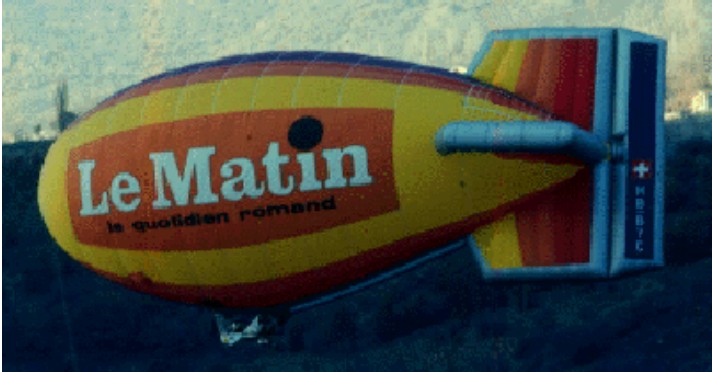
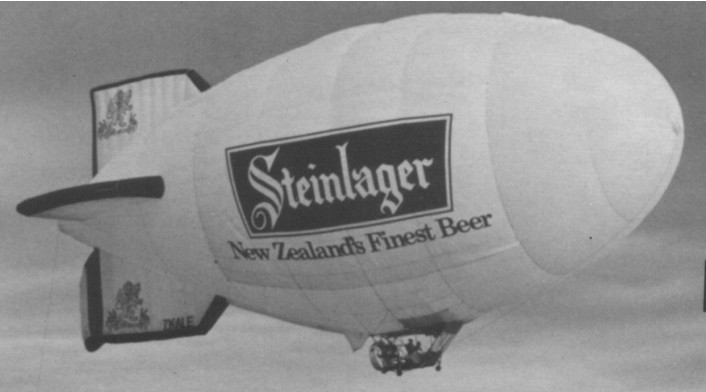
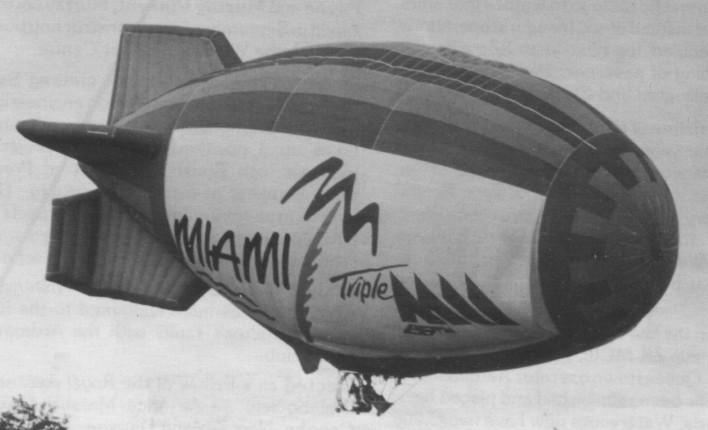
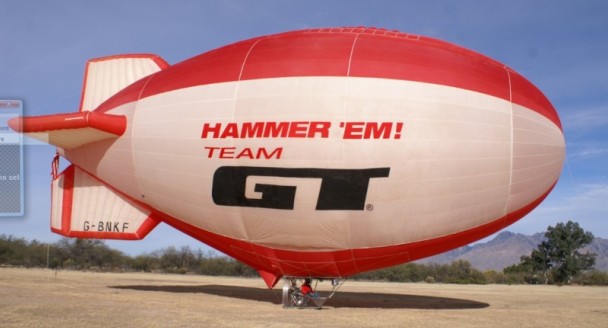
Thunder & Colt was the first company to build a pressurized Hot Air Airship. From the very beginning their designs were well thought out. The four designs currently available are the AS-105 Mk II (105,000 cu. ft.), AS-120 Mk II (120,000 cu. ft.) and the AS-80 GD and AS-105 GD which were developed by GEFA-FLUG in Germany. (“GD” stands for “German Design”.) Thunder & Colt also developed the largest hot air airship in the world, the AS-261, to drop an observation platform in the canopy of tropical rainforests. In 1993 the ship was fitted with a larger replacement envelope manufactured by Lindstrand Balloons and has since been known as the AS-300. The main advantage of Thunder & Colt’s airship line is that all models feature internal catenary curtains for load suspension like real helium airships. This improves the aerodynamic shape and stability of the envelope.

At the 1996 Hot Air Airship World Championships in Aosta, Italy, the first three places were won by Thunder & Colt airships with the fourth place being held by a GEFA-FLUG AS 80 GD which features a standard T&C gondola and is also built at the T&C factory in Bristol, England.

T&C also produced the GA-42 non-rigid helium airship which was capable of carrying two people and featured state of the art fly by wire controls. The rights to the GA-42 design were acquired by the American Blimp Corporation when T&C was acquired by Cameron in 1995.