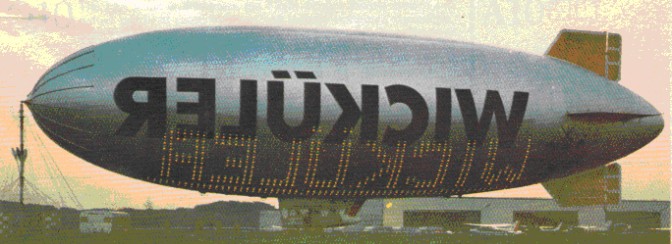
In 1978, a German company, Westdeutsch Luftwerbung, moved its 180 foot long flying machine to the United States, where it was leased by a consortium tentatively known as Skysign. The sides of the blimp are lined with 10,000 colored lightbulbs controlled by onboard computers, creating two 104 foot long flying billboards. The blimp’s powered by two 180hp Rolls Royces, cruises at 30 mph and never stalls. Its 211,888 cubic foot, helium filled envelope could carry it to 8,500 feet, but it’s happiest within a few thousand feet of the ground where its sign is visible to all.
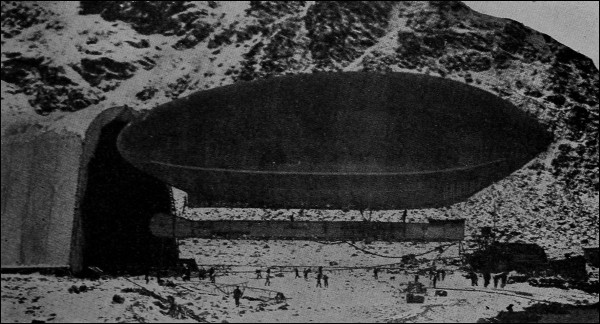
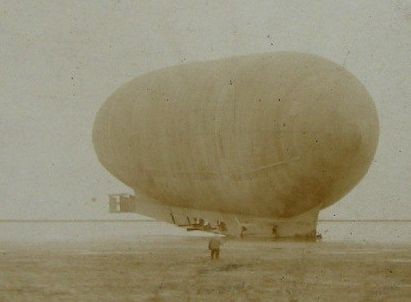
A 108 foot long semi-rigid airship of 200,000 cu.ft was built in 1907 in Paris for journalist-adventurer Walter Wellman and the engineer Melvin Vaniman. This airship, the America, powered by two 50 hp engines, was shipped to Spitsbergen the same year for an attempt on the North Pole, but was forced to return after only a few hours’ flight with engine trouble.
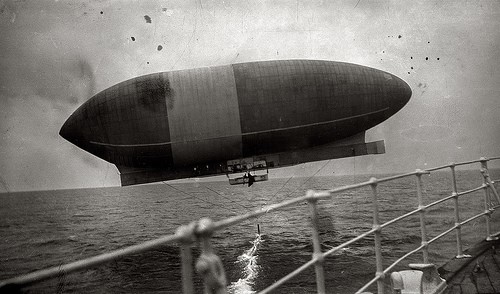
Originally the 1906 Godard-designed, French-built polar exploration airship, the “America” had already been rebuilt and enlarged twice by the time it was lost at sea. It was lost at sea in 1910 due to engine failure during an attempted transatlantic crossing. Walter Wellman, aero-pioneer Melvin Vaniman, four crewmen (and one ship’s cat) were recovered by RMS Trent near Bermuda 72 hours and 1000 miles into the Trans-Atlantic voyage; no losses.
Rescue of the “America” photographed from the SS Trent on October 18, 1910
It was intended to buy three more Parsevals from Germany, PL 20, 21 and 22, but the outbreak of war ended this plan. Instead, three ships HMA No. 5, 6 and 7 were built in England by Vickers based on Parseval designs. These were not delivered until late 1917 and were used for training.
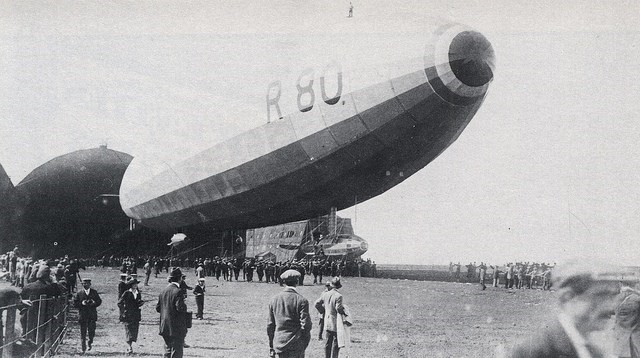
Circa 1921 was the R80; the only example of the Small R33 Class. She was the last rigid to be planned before World War One ended. Measuring 534 ft in length, 70 ft in diameter, with a volume capacity of 1,250,000 cu ft she was fitted with four 250hp Wolsey Maybachs giving a maximum speed of 65mph. R80 was designed by Barnes Wallis and built by Vickers. When at Pulham decisions were reached that she was too small to be a lot of commercial use, and was laid up there after only 73 hours flying time. She was finally broken up in 1924.
R80 Length: 534 ft Diameter: 70 ft. Volume capacity: 1,250,000 cu ft. Engines: four 250hp Wolsey Maybachs. Maximum speed: 65mph.
The “Flying Fish” of 1858, designed by Camille Vert shown here during the presentation of the machine in 1859 at the Palais de l’Industrie in Paris.
A description of the airship was “Two propellers are placed under the balloon, at the extremity of a horizontal axis and the vertical plane passing through the length of the device, that is to say one at the front, the other at the back, and united by a steam engine at the center of the nacelle, are used to direct the Flying Fish. Tractive effort is directed onto the frame solidly fixed around the aerostat.”
Demonstrated in the presence of the French emperor Napoleon III, the airship, which had an ingenious parachute system for the safety of its passengers, functioned satisfactory as it turned at will in all directions when in the air. The inventor, after being praised by His Majesty, was authorized to make a public exhibition in the Palace of Industry.
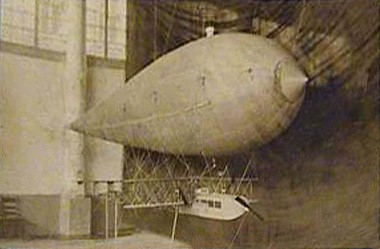
The original Akron was specifically built for the Sieberling-Vaniman trans-Atlantic expedition, undergoing trials at Atlantic City, New Jersey on November 5, 1911. Identified by its semi-rigid keel design, box-tail rudder and placement of the four, 2-bladed propellers.
After making changes and repairs to the airship, it was once again tried on June 1, 1912 with results less than satisfactory due to an accident with the drag rope in which Calvin Vaniman, the younger brother of expedition leader and commander Melvin Vaniman, had to climb out on the propeller struts to save the airship from wrecking.
The final test of the Akron on July 2nd ended in an explosion of the over-pressurized hull 500 feet above Absecon Bay, resulting in the deaths of all five crewmen aboard, including Melvin Vaniman and his brother Calvin.
Born in Virden, Illinois to parents George and Luisa, Vaniman was the oldest of four sons. The short fiery red-head and his siblings were raised within a Christian sect called the Dunkards (via the German Baptist church)… a sect that disagreed with the concepts of modernization and even sad no to instrumental music in the agricultural community they lived in.
They lived on a farm and Vaniman was the kid who learned how to fix all kinds of machinery – even engines on the farm.
Like many kids, Melvin Vaniman wanted to escape the small town and seek his fortune elsewhere… turning his back on farming to study music, initially at Mt. Morris College run by the German Baptist Bretheren, before gaining further study at Valparaiso University in Indiana and later at Dexter College in Iowa, where he stayed on to become a music teacher – guitar and singing – before joining a touring opera company in Louisiana in 1887.
Vaniman built his own aeroplane in 1906… a triplane, in fact… the first ever triplane.
Calvin Vaniman completed a scaled miniature trans-Atlantic passenger airship, “Atlantic No.1”, on June 23, 1912.
Atlantic No.1
It was made for the American inventor-aeronaut-adventurer Melvin Vaniman, who died alongside his younger brother Calvin and three other crew members in the airship “Akron” trial-flight disaster on July 2, 1912 near Atlantic City, New Jersey.
Designed by Professor van der Fleet and Boklevskogo, also an engineer, VF Naydenov with Captain BV Golubova, the Dove was built in 1910 in Russia on Izhorskij, located in Kolpino near Petrograd.
During the First World War, this airship carried out a number of reconnaissance flights over enemy lines. In October 1914 it was evacuated to Lida, where the blimp was dismantled. Unpacked in the summer 1916 in the open, during a storm it was damaged.
Length: 50 m Width: 8 m Envelope volume: 2270 cu.m Max speed: 50 km / h
A 3970 cu.m non-rigid airship designed by Celestino Usuelli, 51 meters long with a maximum diameter of 9.8 meters. Construction of the U.1 was started in 1909 although it probably didn’t make its first flight until 1910 at Turin. Powered by one SPA of 100 hp driving two propellers.







 All Aero