Baldwin California Arrow constructors (left to right): Eugene Godet, Thomas Scott Baldwin, —, Glenn H. Curtiss.
In 1902-1903 Thomas Scott Baldwin supervised the construction of the California Eagle based on the ideas of August Greth and financed by the American Aerial Navigation Company of San Francisco. It incorporated a French DeDion Bouton automotive engine and paddle propeller based on marine technology so prevalent in airship design in the period. After collaborating with Greth and John J. Montgomery in 1903-1904, Baldwin acquired sufficient knowledge to begin his own independent airship project.
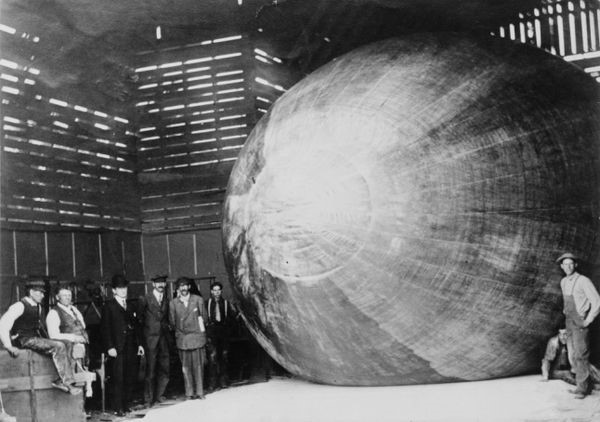
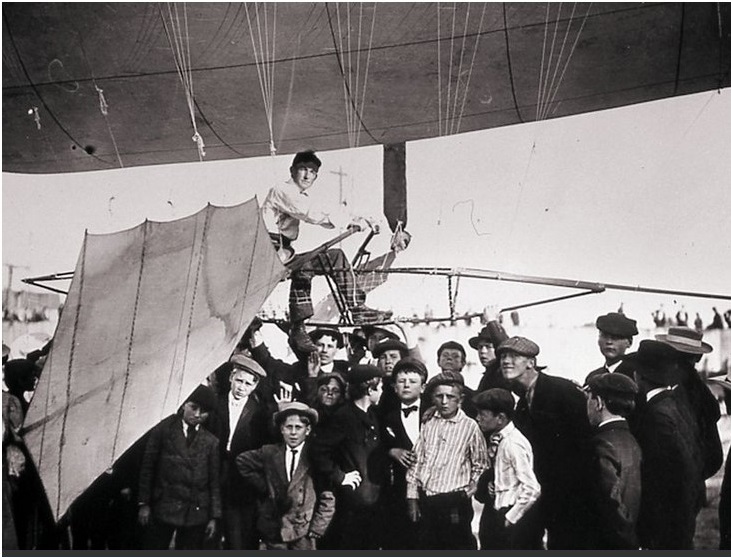
Baldwin, known for his balloons and parachutes and, in 1910, his Red Devil airplanes, was the first to debut an aerial rowboat. Baldwin had already built the California Arrow, the first U.S. airship to make a controlled circular flight, when he won a contract with a Los Angeles amusement park to exhibit a dirigible that could be rowed through the air like a boat. In 1905, Baldwin came up with a 38-foot-long hydrogen-filled gas bag with a kayak-shaped frame underneath. In lieu of an engine were bamboo oars with paddles made of silk. A canvas bag filled with sand maintained neutral buoyancy.
Baldwin’s non-rigid dirigible could do about 4 mph on a calm day, but even a slight headwind would stymie it. Because Baldwin was too heavy to pilot the craft, he hired 23-year-old L. Guy Mecklem. On the craft’s maiden voyage, Mecklem became stranded 2,000 feet above the crowd with a broken oar and a malfunctioning safety valve on the bag. “The sun got hotter and the hydrogen expanded and nothing I could do…would stop it” from rising, he recalled. After the sun set, Mecklem was able to land in an orange grove.
The next day, Baldwin strung a 300-foot-long wire between two poles and attached a guideline to the aerial rowboat so it could slide along the wire. Mecklem spent the next two weeks practicing how to row back and forth.
“We could put on a pretty good show,” Mecklem recalled in his unpublished autobiography. Ascending a few hundred feet, he bombed his audience with bags of peanuts. He’d also throw his handkerchief overboard and paddle down to retrieve it. His favorite stunt was aiming the tip of the gas bag at a girl in the grandstand and rowing away at the last second as she tried to dodge it.
Alva L. Reynolds challenged Baldwin to an airship race in his own version. When Baldwin’s pilot, the balloonist Roy Knabenshue, asked for $20,000 in expense money, Reynolds said Knabenshue was “afraid to race.”
Baldwin’s aerial rowboat proved a remunerative attraction, though a short-lived one: One night its hydrogen inexplicably ignited, destroying the craft.
Thomas Scott Baldwin was born on June 30, 1854 to Jane and Samuel Yates Baldwin in Marion County, Missouri and orphaned as a young teenager. He worked as a brakeman on the Illinois railroad, then joined a circus working as an acrobat. In 1875, he started an act combining trapeze and a hot air balloon. He eventually turned to jumping from a balloon, getting credit for inventing the modern parachute in 1885.
Baldwin, holder of Dirigible Balloon Pilot license #1, is also credited with the invention of the first practical parachute, in 1885, although he never bothered to patent his idea. On January 30, 1885 he made one of the earliest recorded parachute jumps from a balloon. Baldwin repeated the feat on multiple occasions as a paid entertainer, netting $1500 from one dangerous jump over the water from 600 feet at Rockaway Beach in August 1887 marred by parachute difficulties.
c.1887: (Thomas Scott) Baldwin Airship Co (lighter-than-air), Quincy IL; USA
In 1900, Baldwin created a small pedal-motorized powered airship. It never served as anything more than a curiosity. In 1902-1903 he supervised the construction of the California Eagle based on the ideas of August Greth and financed by the American Aerial Navigation Company of San Francisco. It incorporated a French DeDion Bouton automotive engine and paddle propeller based on marine technology so prevalent in airship design in the period.
After collaborating with Greth and John J. Montgomery in 1903-1904, Baldwin acquired sufficient knowledge to begin his own independent airship project.
1902: San Jose CA USA
In June and July, 1904 Baldwin built an aerodynamic cigar-shaped, hydrogen gas filled, balloon. He created the dirigible “California Arrow”, which incorporated a 7-HP Hercules motorcycle engine manufactured by Glenn H. Curtiss of Hammondsport, New York.
The Army bought it and designated its first dirigible “SC-I” (Signal Corps Dirigible Number 1). Baldwin picked up the sobriquet: “Father of the American Dirigible.” He received the Aero Club of America’s first balloon pilot certificate.
1906: Hammondsport NY. USA
1909: Baldwin Aeroplanes (airplanes, and Eastern distributor of Hall-Scott motors).
In 1910 Baldwin designed his own airplane, and it was built by Glenn Hammond Curtiss. On September 10, 1910 Baldwin made history with the first airplane flight over the Mississippi River. The St. Louis flight started just east of Bellefontaine Cemetery. Baldwin and his Red Devil plane took off at 5:11 p.m. 200,000 citizens lined the riverfront on both sides to watch the red biplane fly from the north St. Louis field and land in Illinois across the river from Arsenal Street. On the return flight, the aviator astounded the crowds by flying under both the Eads and McKinley bridges at fifty miles per hour (80.5 km/hr). Baldwin landed at 6:05 back at his starting place.
Baldwin at the wheel of the Red Devil
Baldwin flew it at an air meet in Kansas City, Missouri, on October 7, 1910. He spoke to State University of Iowa engineering students on October 11, 1910 and flew demonstrations at the Iowa City, Iowa fairgrounds on October 12–13, 1910. The flight on October 12 was unsuccessful. On October 13, he flew two flights, one of which was photographed by Julius Robert Hecker. On the second flight he did not gain sufficient altitude and the plane was damaged on a barn but he was uninjured. He then took his airplane to Belmont, New York. He put together a company of aerial performers including J.C. “Bud” Mars and Tod Shriver in December 1910 and toured countries in Asia, making the first airplane flights in many of those locations. The troupe returned to the United States in the spring of 1911.
1911: Contract builders (C and A) Wittemann Aeronautical Engineers Staten Island NY. USA
In 1914 he returned to dirigible design and development, and built the U.S. Navy’s first successful dirigible, the DN-I. He began training airplane pilots and managed the Curtiss School at Newport News, Virginia. One of his students was Billy Mitchell, who would later become an advocate of American military air power.
1914: Merged with Connecticut Aircraft Co (lighter-than-air).
When the United States entered the World War I, Baldwin volunteered his services to the United States Army. He was commissioned a captain in the Aviation Section, U. S. Signal Corps and appointed Chief of Army Balloon Inspection and Production. Consequently, he personally inspected every lighter-than-air craft built for and used by the Army during the war. He was promoted to the rank of major during the war.
After the war, he joined the Goodyear Tire and Rubber Company in Akron, Ohio, as a designer and manufacturer of their airships.
Captain Thos. S. Baldwin, PO Box, 78, Madison Square, N.Y.
1921: T S Baldwin retirement.
1922: Acquired Orenco holdings (pres: William Bennett).
T.S. Baldwin died on May 17, 1923, in Buffalo, New York, at the age of 68. He was married to Cary Poole. He was buried in Arlington National Cemetery in Arlington, Virginia, with full military honors.
He held Aero Club of America licenses: Balloon Pilot Certificate #1 Airship Pilot Certificate #9 Airplane Pilot Certificate #7
Baldwin was inducted into the National Aviation Hall of Fame in 1964.
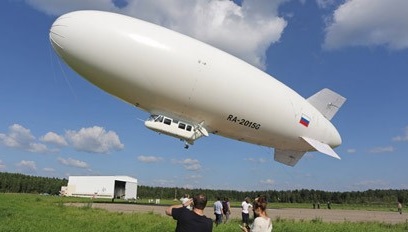
Has developed a range of manned and unmanned airships for various applications as its main business. Is also developing the Krechet as a light VTOL airplane with a thrust/flow vectoring system using ducted propellers under the rearmounted wings and in the nose, with cascade aerofoils to deflect thrust; vectoring system has been tested on Aerostatika airships.
Length: 295.276 ft / 90.0 m Width of hull: 54.134 ft / 16.5 m Contained volume: 572184 cu.ft / 16200 cu.m Max. speed: 50 kts / 93 km/h Engine: 2 x Renault, 247 hp
Length: 223.097 ft / 68.0 m Width of hull: 47.572 ft / 14.5 m Contained volume: 222516 cu.ft / 6300 cu.m Max. speed: 40 kts / 75 km/h Engine: 2 x Renault, 158 hp
Engines: 2 x Brasier, 118 hp Length: 284.449 ft / 86.7 m Width of hull: 45.932 ft / 14.0 m Contained volume: 316114 cu.ft / 8950 cu.m Max. speed: 28 kts / 52 km/h
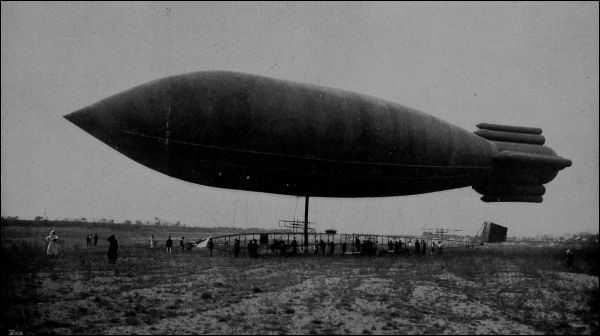
The 1909 Ville de Paris movable rudders may be either hand or motor-operated. The double vertical steering rudder of the Ville de Paris had an area of 150 square feet. The horizontally pivoted rudders for vertical direction had an area of 130 square feet.
The motor in the Ville de Paris was at the front of the car, the operator behind it. This car had the excessive weight of nearly 700 pounds.



 All Aero