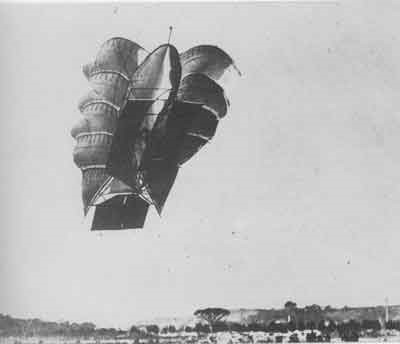
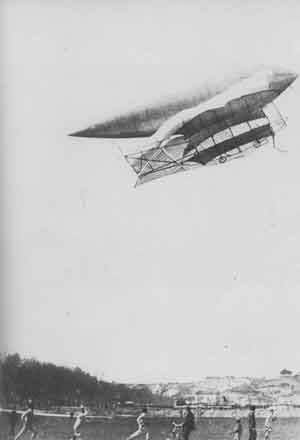
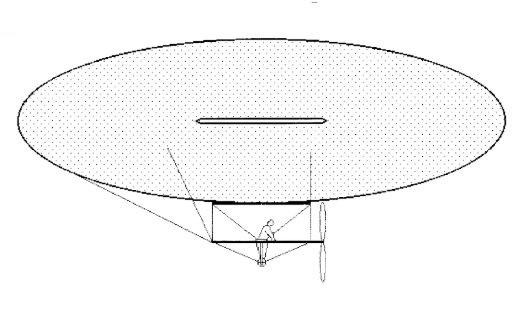
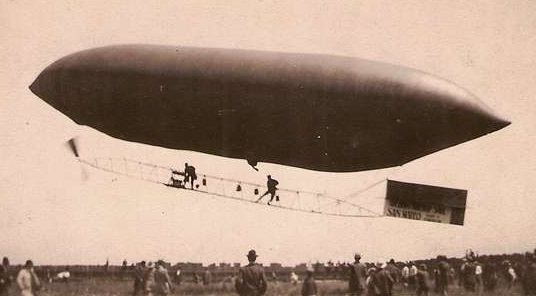
Shown in Rome in 1905, the “Aerostave” was financed by the Italian industrialist Achille Bertèlli (1855-1925). As a consequence the machine is commonly known as the Aerostave Bertèlli. The man who designed the machine was Vittorio Cordero di Montezemolo, who in 1903 published his ideas in a study of aerial navigation. The complex multi-wing structure was eventually built at the Surcouf factory in Paris. There, powered by a Levavasseur engine of 22 hp, trials were performed fitted with a gas bag, thus giving it additional lift in the manner done in 1906 by Santos-Dumont when testing his No. 14-bis.
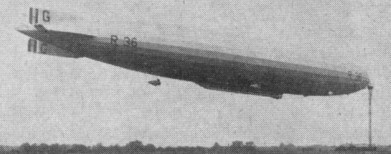
R36 was a British airship designed during World War I by the new Airship Design Department, work commencing in November 1917. She was a lengthened version of the R33 class. These had been influenced by the design of the German Zeppelin LZ 76 that had been forced to land in England. The LZ 96, which was forced down at Bourbonne-les-Bains in June 1917, provided yet more input into the design.
The R36, along with a second ship the R37 were to be a stretched version of the R33, getting more lift by adding another 33 feet (10 m) gas bag. Two of her five engines were German Maybach engines, recovered from the downed LZ 113. Construction began before the end of the war, but the design was altered to include accommodation for 50 passengers.
Unlike the R33 class, the control car was not suspended below the hull but directly attached to it, and formed the forward section of the elongated passenger compartment. The engines were housed in five engine cars, one pair (containing the Maybach engines) either side of the hull forward of the control car, a second pair either side of the passenger compartment and the fifth on the centreline in front of the tail surfaces. Unlike previous British airship designs, the fins and horizontal stabilisers were cantilevered structures, with no external bracing.
R36 was launched for her maiden flight on 1 April 1921 from the Beardmore works at Inchinnan near Glasgow. Late the following day she flew on to RNAS Pulham in Norfolk. When she first flew in 1921, it was not in her originally intended role as a patrol aircraft for the Royal Navy, but as an airliner, the first airship to carry a civil registration (G-FAAF).
On 5 April it left Pulham at 07:25am bound for London. After making its appearance over the city it proceeded to Salisbury Plain, where it climbed to 6,000 ft (1800 m) and began manoeuvring trials. Starting a fast turn of 130 degrees it encountered windshear, which overstressed the rudder, damaging the top rudder and starboard elevator. This made the ship adopt a nose down attitude and rapidly lose height, but it was brought under control at around 3,000 feet. Emergency repairs were made to the damaged control surfaces and the ship limped home on her one remaining rudder and elevator, using differential engine control to help with directional control, reaching Pulham at 9.15pm.
After repairs and strengthening work she re-emerged in June for a successful series of test flights, including an endurance trial starting on 10 June which lasted nearly 30 hours, covering 734 miles (1,174 km) over land and sea. She was also used by the Metropolitan Police for observing traffic congestion caused by the Ascot Races. Journalists and senior police representatives were entertained in great comfort on the day, and the journalists stories were dropped by parachute over Croydon airfield.
On 21 June, returning from another trial flight, she suffered damage during landing. The release of emergency ballast caused a sharp pitching up, straining the ship against the mooring line. The nearest unoccupied sheds were at Howden in Yorkshire since the Pulham sheds were holding German Zeppelins handed over as war reparations. The wind increased and it was decided that the LZ 109 (L 64) would have to be sacrificed to save the R36. Within 4 hours L 64 had been cut into pieces and cleared to give enough room for R36. Even then she was damaged by a gust of wind during the manoeuvre into the shed.
Repairs were delayed while policy on airships was reviewed because of the R38 disaster and economic conditions. In 1925 she was refurbished for an experimental flight to Egypt as part of the Imperial Airship Scheme, but calculations cast doubt on her ability to make the trip and in the light of her age and condition she was scrapped in 1926.
Engines: 3 × Sunbeam Cossack, 350 hp (260 kW) each / 2 × Maybach, 260 hp (190 kW) each Volume: 2,101,000 ft3 (59,500 m3) Length: 675 ft 0 in (206 m) Diameter: 78 ft 6 in (23.9 m) Height: 91 ft 7 in Maximum speed: 65 mph (105 km/h) Range: longest flight, 734 miles (1181 km) Endurance: 29 hours 54 min Service ceiling: highest attained, 6000 ft (1829 m) Crew: 28 Capacity: 50 passengers
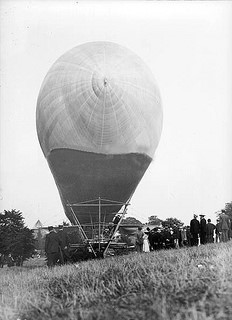
The “Weißen Adler” (“White Eagle”) airship was built in Dresden by Georg Baumgarten in 1879. Baumgarten became acquainted with the wealthy Leipzig bookseller Dr. Friedrich Hermann Wölfert, who liked him for his experiments in airships. Together they built the 26 meters long airship, which had three gondolas and had propellers driven by hand cranks. Their first airship, the “Dreigondelluftschiff” rose on 31 January 1880, the first time in Leipzig-Plagwitz. However, the flight ended with an accident, but with no injuries, but the airship was destroyed.
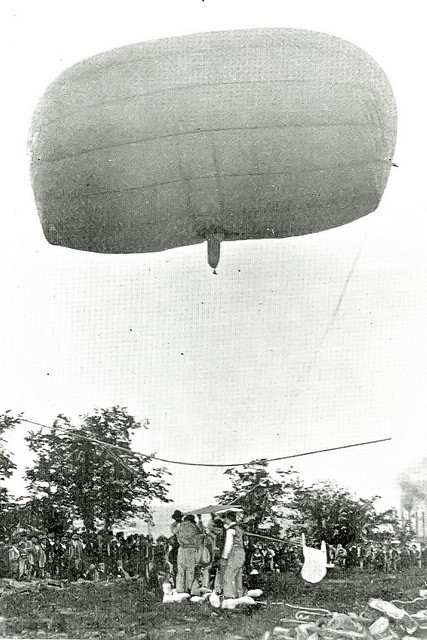
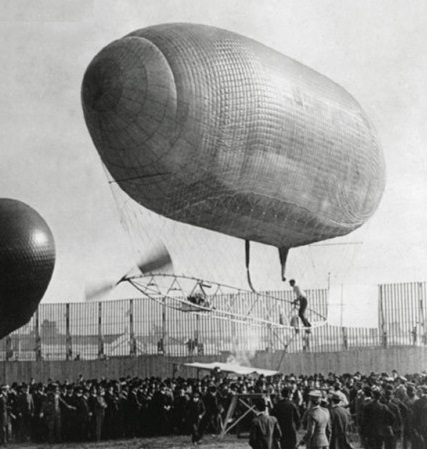
The ascent of the Barton-Rawson airship at the Alexandria Palace, UK, Saturday, July 22nd, 1905. A view taken at the entrance of the shed showing the airship pulled out.
Professor Arthur W. Barnard, Director of Physical Training for the YMCA of Nashville, built this airship, which measured 18 feet in diameter and 46 feet in length. It was filled with hydrogen and used a propeller of 8 feet diameter. Barnard pedalled his Centennial Airship in Nashville at the Tennessee Centennial Exhibition of 1897. He went a distance of some 20 miles with the help of a strong wind, but on the return the spar broke off one of the propellers and he landed twelve miles short of returning to the Exhibition grounds. During another ascension the balloon split at the height of a half mile. It descended with great rapidity, but when some distance from the ground it formed a kind of a parachute and the professor landed safely near the exposition grounds. He received a shaking up, but was not injured.
The DN-1 was the US Navy’s first airship. Captain Mark L. Bristol, the second Director of Naval Aviation, supported the development of the dirigible in the anti-submarine role. Victor Herbster, Holden Richardson and LCDR Frank McCrary drew up the specifications for the DN-1. The contract was awarded on 1 June 1915 to the Connecticut Aircraft Company of New Haven, CT. The U.S. Navy had no experience with airships and it seems neither had any of the principles of Connecticut Aircraft Company. They were a lawyer who was the financial backer, a amusement park owner who acted as manager; the technical staff was an Austrian, Hans Otto Stagel, who claimed to be a dirigible pilot and a German engineer and mechanic, who claimed to be Zeppelin experts. Jerome Clarke Hunsaker of MIT and his assistant Donald Wills Douglas, later founder of the Douglas Aircraft Company, aided the Connecticut Aircraft Company in the design of DN-1. The Chief Engineer was James F. Boyle and the Production Manager was J.J. DeLunay. The civilian inspector and designer was Thomas Scott Baldwin and the resident Navy inspector was Frank M. McCrary.
The DN-1 envelope was made of two layers of cloth, with rubber between them. The outer layer of fabric was yellow to prevent deterioration caused by light. The gondola control car, built by George Lawley & Son of Dorchester, Massachusetts, was a large rectangular box with two four-bladed propellers on outriggers. There were originally two engines, built by the B. F. Sturtevant Company of Hyde Park, MA, were mounted in the open gondola, and the propellers could be swiveled to provide thrust in either the horizontal or vertical planes. A 1-1/2 hp Indian engine was provided to maintain air pressure in the two ballonets when the engine was not running. The gondola was water-tight as the Navy intended to operate the DN-1 off water. The specification for the DN-1 provided for being capable of being moored to a mooring mast which had first been used with HMA No. 1 in 1911. The DN-1 was photographed beside a mooring mast but there appears to be no evidence it was ever moored to it.
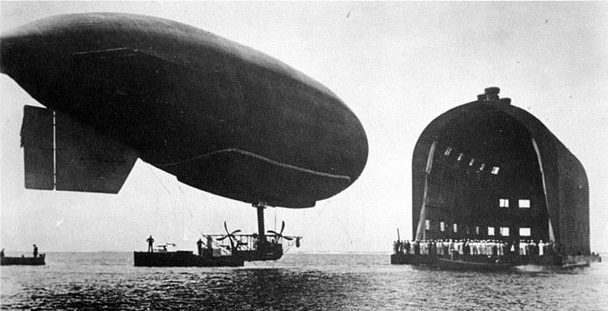
The DN-1 was announced in the press before its flight program. The DN-1 was shipped to Pensacola, Florida, in late 1916 and assembled in a floating hangar constructed for it. The day of the planned first flight, the DN-1 was removed from its hangar, only to lose lift and sink. Crew member Petty Officer James F. Shade, up to his chin in the water, invited spectators to come aboard for “the first submerged flight of the DN-1.” The DN-1 was returned to its hangar and lightened. One step take to lighten the DN-1 was the removal of one engine.
When the test program began on 20 April 1917 the DN-1 was a disappointment. DN-1 lacked lift, barely met the speed requirement of 35 miles per hour (56 km/h) and the transmission overheated, melting the bearings. The DN-1 was piloted for its first flight by LCDR Frank M. McCrary USN, LT Stanley V. Parker assisted by PO Jimmy Shade. It was 27 April before the airship flew again. Two days later the handling party which was attempting to tow the airship across the water damaged the DN-1.The Navy decided that the airship was not worth repairing and the DN-1 was scrapped. The “The Rigid Airship Manual (GPO, 1928) commented upon the DN-1 “was so overweight that it could barely lift itself off the ground. It’s envelope leaked and the power plant functioned badly. It did, it did, however, actually fly and since the firm had built the ship in good faith and at a cost greatly in excess of the contract price[$45,636], it was formally accepted.”
The DN-1 forced the Navy to take a more effective approach to following airship development depending upon more reliable contractors and closer involvement of the Navy in design and management. The subsequent B, C, and D-Class airships were quite successful.
After its demise the DN-1 came to be considered the A class. Such designation was never officially used by the Navy, nor was it used during DN-1’s short life.
Engine: 1 × Sturtevant Model 5, 140 hp (104 kW) Length: 175 ft 0 in (53.51 m) Diameter: 35 ft 0 in (10.67 m) Volume: 115,000 ft3 (3256.4 m3) Maximum speed: 35 mph (56 km/h)
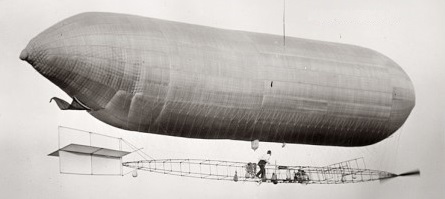
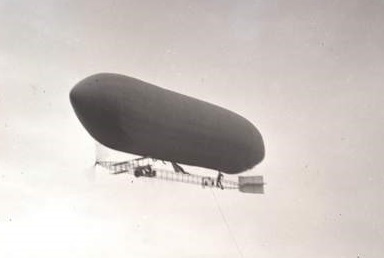
The No. 9, the “Baldwin-9” followed in 1909. Number 9, was an “Exhibition airship”. In the Baldwin design, this girder-gondola framework was made of bamboo, Oregon spruce, and metal. The “square” frames of the skeleton are 1 meter apart and the No 9 has 24.
In 1909, Baldwin built the No. 10 for George L. Tomlinson, a wealthy industrialist and aviator. The d’Orcy Airship Manual says the Tomlinson airship was a “Baldwin-9 type.” According to the d’Orcy Airship Manual, the major difference between the Baldwin-9 and the Tomlinson (Baldwin 10) was a barely perceptible “0.6 m” difference in gas-bag diameter.
The Tomlinson and the Baldwin-9 particiated in the Hudson-Fulton Celebratin of Summer 1909.
Works No: 9 Year: 1909 Length: 58 ft / 26.2 m Diameter: 6.1 m Volume: 530 cu.m Engine: Curtiss, 20 hp Speed: 35 kph
Works No: 10 Name: Tomlinson Year: 1909 Length: 26.2 m Beam: 5.5 m Volume: 500 cu.m Engine: 20 hp Speed: 36 kph
On April 18, 1906, a massive earthquake struck San Fransisco. This was the great quake of 1906. Baldwin had one airship remaining, which he had relocated to Hammondsport, New York, before the earthquake. Baldwin then moved to Hammondsport and, in collaboration with Glenn Curtiss was able to use Curtiss’s facilities for his continued airship work.
Baldwin’s demonstration of the abilities of the “California Arrow near the end of 1904, very much impressed the US Army, and in 1907 announced a request for bids for an airship, the result of urgings by Chief Signal Officer Brigadier General James Allen. Baldwin was awarded a contract to provide the Army with an airship.
The “square” frames of the skeleton are 1 meter apart and the SC-1 has 30. The SC-1 has some tubes near the pilot used for pressure control of the inflated balloon.
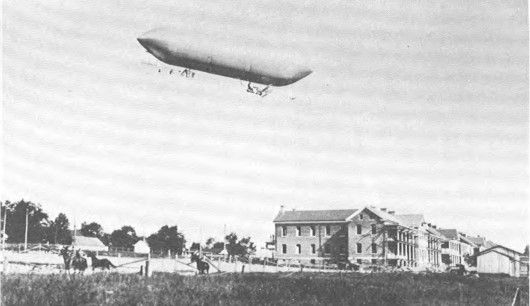
In 1908 he delivered a 95-foot long airship which could be crewed by two, and the Army accepted it, and it entered inventory as “Signal Corps No. 1”. Signal Corps Dirigible No. 1 was the first powered aircraft ordered for the Signal Corps by the Aeronautical Division of the United States Army. The craft fell short of a 2-hour, 20 mph objective to meet a $8,000 per unit award. The Army formally accepted the craft as Signal Corps Dirigible No. 1 paying $5,737.50 on 5 August 1908. The Army tested SC-1 at Fort Myer, Virginia and on 12 August, 1908 the first test flights were made with Thomas Baldwin as pilot, and another aviation pioneer as flight engineer – Glenn Curtiss. On 28 Aug. 1908 Lieutenants Frank Lahm, Thomas Selfridge and Benjamin Foulois were taught to fly the craft. Selfridge, known as being the first fatality from a heavier-than-air craft aboard a Wright Brothers aircraft (the Wright Flyer) flown by Wilbur Wright on September 17, 1908, less than one month after his first training on the SC-1.
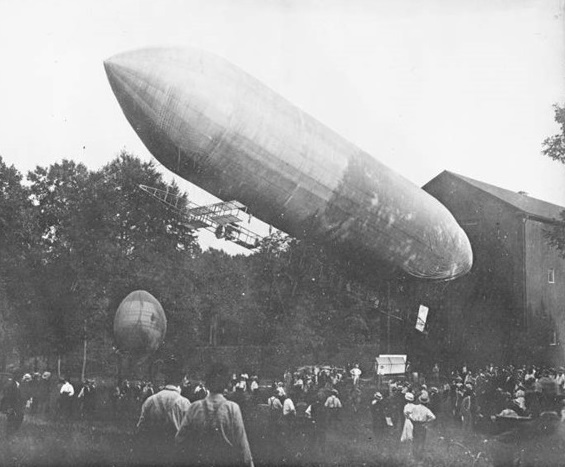
U. S. Army (Baldwin) airship “Signal Corps No. 1” (SC-1) outside old balloon shed at Fort Myer, Virginia, nose pitched upwards, probably on August 3, 1908, prior to the fully inflated and rigged airship being moved to the parade ground. Note not-yet-attached tail rudder section being carried by two men at right background, and “nurse” balloon tethered at left with extra hydrogen for airship.
Lieutenants Lahm and Foulois became the first “US Army Airship Pilots” on May 26th, 1909 when they became the first “airmen” to ascend in the SC-1 without Baldwin. After Second Lieutenant John G Winter Jr of the 6th Cavalry was assigned to duty in the Aeronautical Division, the balloon detachment was transferred to Fort Omaha, Nebraska.
On 26 May, pilot Lieutenant Lahm and Lieutenant Foulois made a flight in SC-1 at Fort Omaha, and manoeuvred the craft at will. SC-1 remained there until scrapped in 1912. The Army did not purchase another dirigible until after World War I.
After working with the Army to train Army Officers to fly the airship, Baldwin built at least another couple of airships in 1909. He then moved into heavier-than-air work, but joined the Army in WW I where he served the Signal Corps as Chief of Balloon Inspection and Production.
Powerplant: 1 × Curtiss, 20 hp (15 kW) Volume: 800 cu.m Length: 36 m Diameter: 18 ft 6 in / 6 m Weight: 1,360 lb Useful lift: 1,360 lb (620 kg) Maximum speed: 17 kn; 32 km/h (19.61 mph) Cruise speed: 12 kn; 22 km/h (13.75 mph) Crew: 2
Works No: 6 ‘City of Portland’ was an exhibition airship designed, built, and owned by T.S.Baldwin.
No.7 was a Baldwin-6 type touring airship of Capt. Hildebrandt, Berlin.
Designed and built by Capt. T.S.Baldwin at the Lewis & Clark Exposition sire aerodrome, ‘City of Portland’ was flown from 19 August until 2 September 1905 by the brothers Lincoln and Hillery Beachey. On 2 September the City of Portland was scheduled to race airship Gelatine, but because of strong winds its pilot, George Tomlinson, withdrew. Lincoln Beachey took off nether the less and was quickly swept across the river into Albina District. There he got caught up in a tree and tore a 10 ft hole in the side of the gasbag.
As a consequence of the catastrophic damage done to the envelope of City of Portland, coupled with the wear and tear from repeated flight to Gelatine’s gondola, the dirigibles were amalgamated; with the gasbag from the Gelatine being fitted onto the gondola of the City of Portland. This remodelled airship continued to carry the Gelatine name and flew for the duration of the fair.
Works No: 6 Name: Baldwin-6 Year: 1908 Length: 29.1 m Beam: 5.8 m Volume: 580 cu.m Engine: Curtiss, 20 hp Speed: 25 kph
Works No: 7 Name: H.1 Year: 1908 Length: 29.1 m Beam: 5.8 m Volume: 580 cu.m Engine: 20 hp Speed: 28 kph
Upon hearing about the first dirigible flights in France in 1898, Thomas Scott Baldwin traveled across the Atlantic to learn more. Unlike a hot-air balloon, which flies, literally, whichever way the wind takes it, a powered dirigible moves under its own power, and can therefore be taken exactly where you want it to go and can also return to where you start. Baldwin also sought the insight of the aviation pioneer and professor at Santa Clara College, John J. Montgomery, whose propeller designs were adopted by Baldwin, and August Greth, a French doctor living in San Francisco who had become fascinated by military observation balloons while serving in the French army in Algeria.
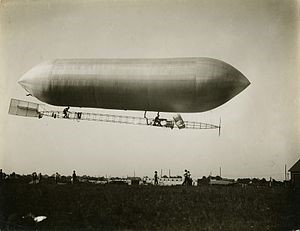
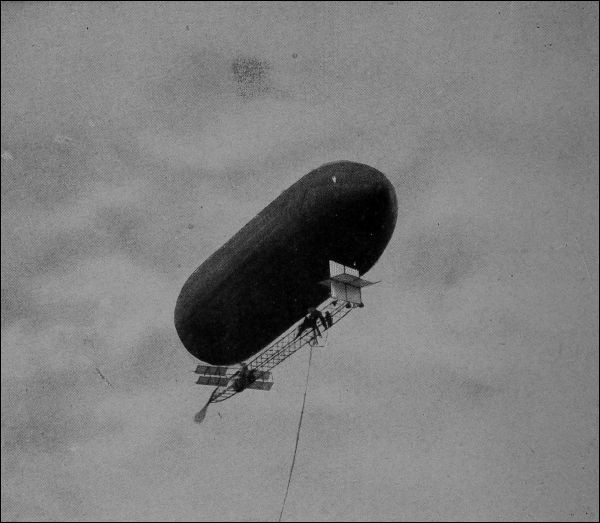
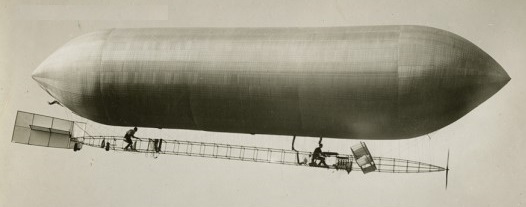
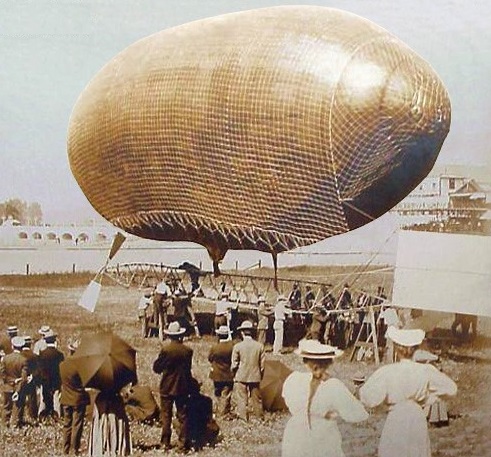
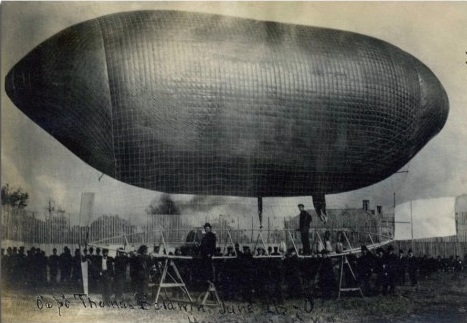
Baldwin began experimenting and ultimately built a non-rigid aircraft featuring a 52-foot-long, 17-foot-diameter gas bag of oiled Japanese silk that tapered to a point at both ends. The silk gas bag contained 8,000 cubic feet of hydrogen to keep the California Arrow aloft. It was a completely “basic” design, a suspended triangular frame catwalk as a “control car” under a set of square-mesh nets of strong cord which, upon inflation of the the gas bag, contain and held the gas bag captive. Baldwin constructed a 30-foot-long, triangulated-framed control car suspended from the gas bag by an extensive rope net. The control car had enough space for one man, the pilot, who could move fore and aft to shift himself as ballast as needed. The rudder was attached to this frame. The Gas-bag envelope was 54 feet long, the control “car” was made up of square cedar struts (painted a silver color resulting in an “aluminum” appearance) and piano wire cross bracing making the entire frame very rigid. The gas bag is cigar-shaped, made of Japanese silk “painted” with linseed oil to seal the silk and make it both impervious to gas, and relatively waterproof, had a capacity of 8,000 cubic feet of hydrogen.
What Baldwin did not have, and what he could not fabricate himself, was the appropriate engine. He found the right powerplant being made by a young motorcycle manufacturer in Hammondsport, New York, by the name of Glenn Hammond Curtiss. The compact and lightweight V-twin “Hercules” made between five and seven horsepower, enough to move the 520-pound dirigible under its own power, the output shaft of which was connected to a rudimentary propeller. The Curtiss engine weighed only 60 pound, and was located in the control car frame just forward of the center of gravity, and so geared as to generate 150 revolutions per minute at the propeller shaft. Though this was Curtiss’s first brush with the aviation industry, it would not be his last, as he would go on to found the very successful Curtiss Aeroplane and Motor Company, a leading U.S. aircraft manufacturer in the 1920s and early 1930s. The total weight of the airship was only 520 pounds, and had an estimated life capacity of about 500 pounds over the airship’s weight.
The altitude of Baldwin’s early airships was not regulated by means of a gas valve attached to the balloon. They had no valve. When the gas-bag is filled with hydrogen the neck of the gas inlet was simply tied-off with a piece of rubber. Elevation was provided by the volume of gas in the gas-bag, and the payload weight. Then after rising to a certain height the gas, which expanded due to the decrease in atmospheric pressure, would exert pressure against the constraint of the rubber tie around neck of the gas inlet. Overcoming the tie-off, some gas volume would be release allowing the machine to settle and stabilize at altitude. Of course, as the sun further heated the gas, the whole process would repeat, limiting the vehicle’s altitude and endurance.
Ascent and descent was affected by a weight which could be shifted from bow to stern, or vice-versa and permits the nose of the airship to be raised or lowered. The pilot could also scramble forward or aft on the gondola’s framework, thus subtracting of adding to the tilt of the nose. Using the thrust of the propeller alone, the airship was then “pulled” in the desired direction, though the pilot also had the luxury of reversing the rotation of the propeller if need. Directional turns were provided by a 5 by 3.5 foot rudder, which could be activated by the pilot from anywhere along the frame. Only about 20 pounds of ballast was carried for emergencies.
Constructors (left to right): Eugene Godet, Thomas Scott Baldwin, —, Glenn H. Curtiss.
Baldwin first flew the California Arrow in August of 1904, successfully completing a 20-block round trip in Oakland, California. With Lincoln Beachey as his pilot, the Arrow underwent the first controlled circular flight in America on August 3, 1904 at Idora Park in Oakland, California. But the real goal was to bring it to St. Louis for the Louisiana Exposition World’s Fair held that year. Organizers had secured sponsors for a $100,000 prize to be given to the first aircraft that could successfully navigate a predefined course and return to the start. A now overweight Baldwin hired another aviation pioneer, the much thinner and lighter Augustus Roy Knabenshue, to pilot the Arrow. Knabenshue won the prize for Baldwin, who garnered instant acclaim for creating the first successful self-propelled dirigible in the U.S. A 1905 Pope-Toledo touring car was the object of a “race” between the car and the airship.
First flown at Hammondsport, N.Y. on June 28, 1907 by Glenn Curtiss, Capt. Baldwin’s Curtiss-powered machine was driven by an a 4-bladed propeller and sported a rudder emblazoned with the “Stars and Stripes”. Often referred to as Baldwin Airship No.4, the dirigible was entered in the St. Louis airship races in October and finished a distant third behind the Strobel airships of Lincoln Beachey and Jack Dallas.
Baldwin and Knabenshue crisscrossed the country demonstrating the California Arrow, including racing Barney Oldfield across Los Angeles, with Oldfield confined to the ground in an automobile. Not long after, Baldwin secured contracts from both the Army and Navy to build their first dirigibles, based on what he had learned building the California Arrow.
Eventually, Baldwin and the crowds grew tired of this act as well, though Baldwin continued to work with hot-air balloons, even fabricating them in San Francisco.
On April 18, 1906, a massive earthquake struck San Fransisco. This was the great quake of 1906, and Thomas Baldwin’s manufacturing facility on Market Street was destroyed. He lost five airships including the California Arrow.

 All Aero