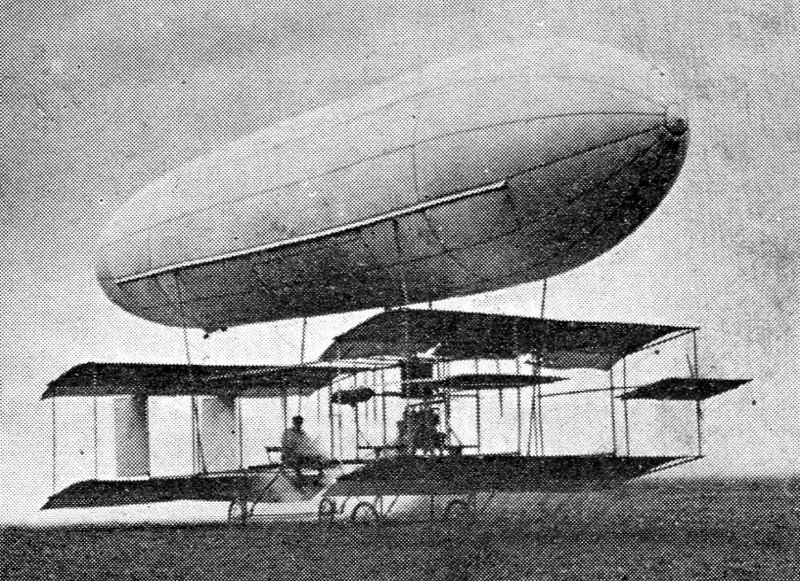
This tandem biplane design of central pusher configuration is attributed to Léopold César, but was a modification of a 1909 design of Eugène Boutaric. The Boutaric design had the same construction, but used a 25 hp Anzani which drove two propellers via chains. The propellers were placed just behind the front biplane wing in tractor configuration. There are no reports that the César tandem-wing machine left the ground, not even when fitted with a balloon on struts above it. Wing span was only six metres. It had a 50 hp Prini-Berthaud engine, mounted quite some way behind the front biplane wings on the connecting structure between the wing cells.
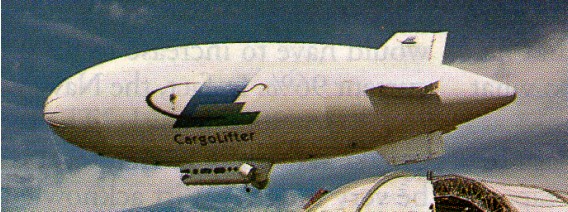
The 1999 CargoLifter Joey Prototype is the one person prototype for the giant CargoLifter semi-rigid cargo transport airship. It was registered D-LJOE to Mats Backlin, CargoLifter, Brand, Germany.
German airship manufacturer. CargoLifter AG had completed in 2000, work on a giant hangar for assembly of prototypes and series variants of its CL 160 beavy-lift dirigible. Work on the first full-scale prototype is expected to begin at year’s end, 2000.
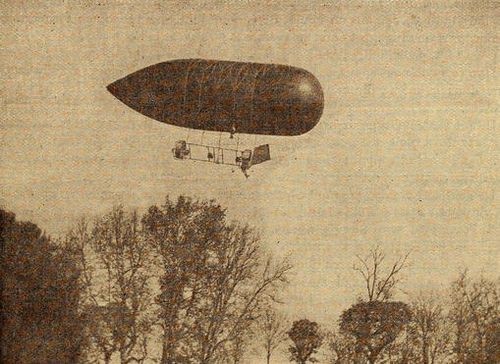
Arguably the first navigable airship system invented in Italy. Designed by Comte Jules Carelli and realized by Evaristo Vialardi. Tethered ascension using spring-wound motors were made in November 1899; possibly followed by later trials.
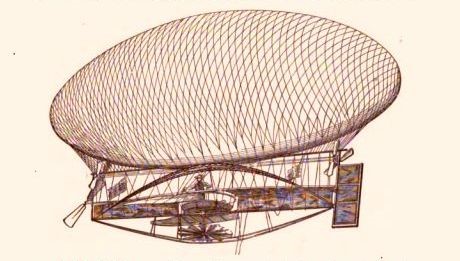
Powered by an Edison electric motor, its 18,000 cu. ft. envelope supplied by Carl E. Meyers, and built a cost of $2500 by the Novelty Air Ship Company of Brooklyn, N.Y., for Professor Peter C. Campbell; the first flight of which was made December 8, 1888 from Coney Island to Sheepshead Bay, piloted by Carlotta the aeronaut – the wife of Carl Meyers. At this time the motive of power is reported to have been bicycle pedals and multiplying gears. The Campbell Air Ship was lost at sea July 16, 1889 while being flown by Professor E. D. Hogan, a Canadian professional aerobat/parachutist, during an exhibition flight originating from the Nassau Gas Works. Intending to make a trip around New York, then to pass over to New Jersey and into the country, five minutes into the flight the 8 foot diameter lower propeller, with which Hogan was to raise and lower the Air Ship gave way and fell to the ground. To make matters worse, it was observed that the steering propellers did not seem to work as no revolutions were discernible, leaving Hogan at the complete mercy of the wind.
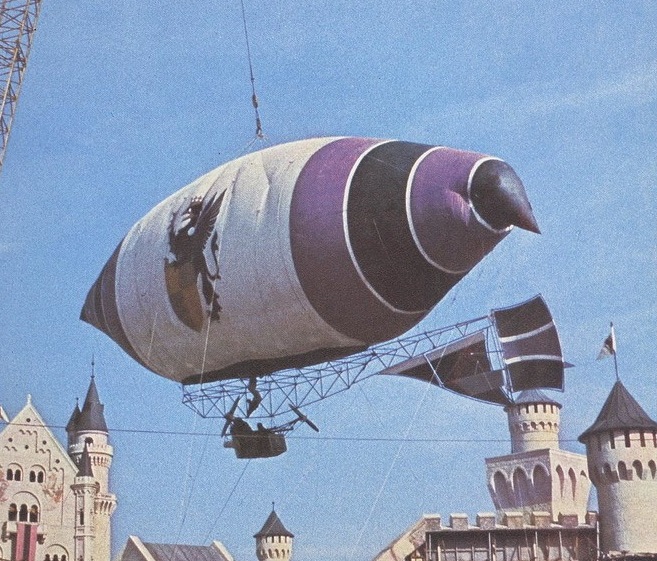
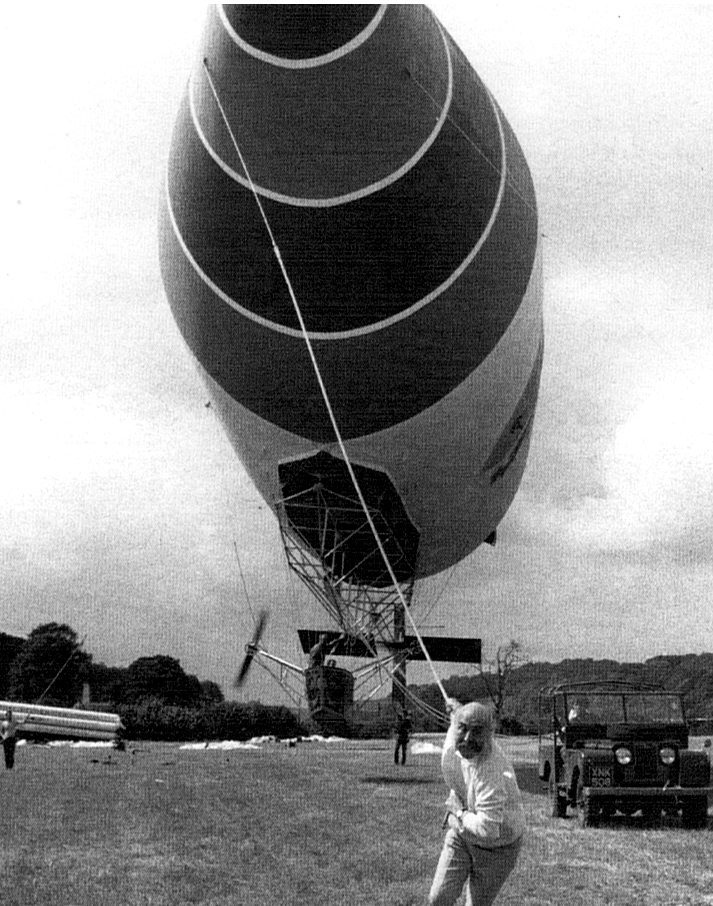
The semi-rigid airship, whose appearance was designed by Ken Adam, was an approximate replica of a 1904 Lebaudy airship for the film Chitty Chitty Bang Bang. It was intended to represent the airship of Baron Bomburst of Vulgaria. Although fictional in inspiration, it was a fully functional flying airship.
Vulgaria, and the airship, is drawn from Roald Dahl’s screenplay for the film, rather than Ian Fleming’s original book.
The airship was built in 1967 by Malcolm Brighton, at Cardington, Bedford. It was only the second British airship to be built post-war, the first being the Airship Club’s 1951 Bournemouth. It was also the first British airship to be mainly filled with helium rather than hydrogen, though it was topped up with hydrogen.
The envelope was symmetrical fore-and-aft and short and deep compared to typical rigid airships, with pointed ends above the centre of the envelope that gave it the distinctive Lebaudy “hooked” appearance. The gondola was a long open truss structure beneath this and a crew basket beneath, with the typical Lebaudy feature of cruciform control surfaces at the rear of the gondola.
The ends of the airship envelope were coloured with bands of the Vulgarian tricolor: black and purple on white. The flanks were adorned with a large black griffin, the arms of Vulgaria.
The envelope was 112 feet long, with a width of 30 feet and height of 44 feet, giving a volume of 37,000 cubic feet (1,000 m3). A single Volkswagen Beetle engine of 40 hp drove two two-bladed propellers. First flying in 1967, the small Lebaudy control surfaces made the airship difficult to control in pitch.
Only the one was ever built. It first flew, from a farm at Turville Heath, Buckinghamshire, on 9 August 1967.
Lionel Jefferies, one of the films stars.
On one flight by Malcolm Brighton and Derek Piggott the airship collided with two sets of high-voltage power wires, causing much damage. Soon after it was repaired, a freak storm tore the point of attachment of the mooring ropes, destroyed it totally.
 All Aero