First flew on 31 July 1913.
Length: 73.5 m
Width: 12.2 m
Capacity: 6,500 cu.m
Engines: 2 x Clément Bayard 90 cv
Top speed: 60 km/h.
First flew on 31 July 1913.
Length: 73.5 m
Width: 12.2 m
Capacity: 6,500 cu.m
Engines: 2 x Clément Bayard 90 cv
Top speed: 60 km/h.
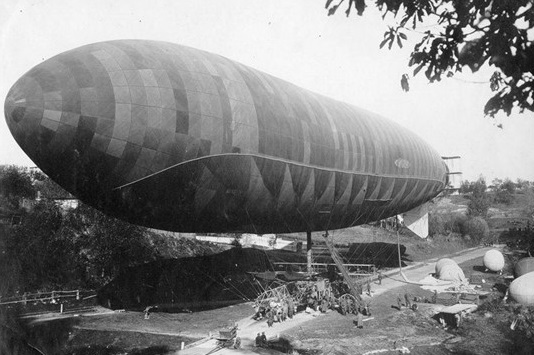
A non-rigid dirigible first flown on 9 February 1913. Acquired in 1913 from France by Russia, the airship was named “Condor”.
To the beginning of the WWI in Russia there were 14 dirigible. Condor was not used owing to the slow speed of flight.
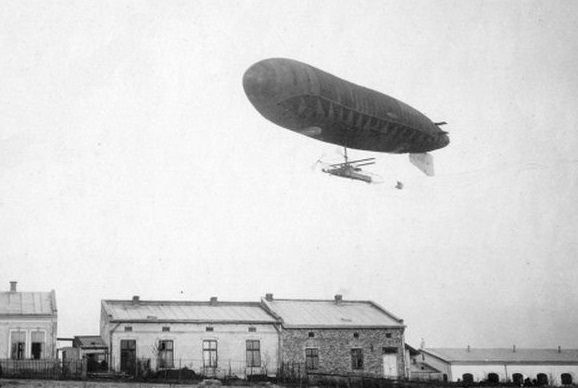
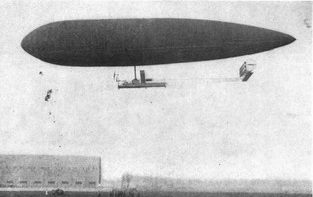
In the spring of 1915, the airship was dismantled.
Length: 86 m
Width: 13.5 m
Capacity: 9,600 cu.m
Engines: 2 x Clément Bayard 130 cv
Maximum speed: 55 kph
The N° 4 / Adjudant Vincenot first flew in 1911.
The modified Adj Vincenot first flew on 13 August 1913.
N° 4 / Adjudant Vincenot
Length: 88.5 m
Width: 13.5 m
Capacity: 9,800 cu.m
Engines: 2 x Clément Bayard 120 cv
Top speed: 49 km/h.
Adj Vincenot modified
Length: 87.3 m
Width: 13.5 m
Capacity: 9,800 cu.m
Engines: 2 x Clément Bayard 120 cv
Top speed: 53 km/h.
First flew on 1 May 1912.
Length: 89 m
Width: 13.5 m
Capacity: 9,000 cu.m
Engines: 2 x Clément Bayard 120 cv
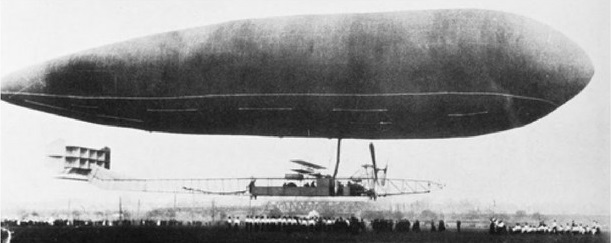
Two large dirigibles were ordered from France. The purchase of the first of these, the Clement-Bayard, was the result of agitation by factions within Parliament who were concerned by the lack of positive action to provide for aerial defence of the nation and had persaded the War Office to purchase an existing military dirigible, which had already seen service with the French Army.
The Treasury put up the bulk of the £18,000 purchase price and several patriotic MPs supplied the remainder with the assistance of the Daily Mail, which paid for the construction of a 365 foot long by 75 foot wide shed to be erected at Wormwood Scrubs to house the craft.
The 310 foot long airship was flown from its base at Compiegne on 16 October 1911, making the first journey of its kind between France and Great Britain in 6 hours and 30 minutes, flying at an average speed of 38mph. The airship flew over central London landing safely at Wormwood Scrubs, to be housed in the new shed where it was the subject of much attention by the populace and a source of satisfaction to those who had put so much effort into acquiring it.
The wisdom of buying a second-hand airship that had already seen a year’s usage with the French army was questioned when subsequent inspectin showed the envelope to be in a much deteriorated condition. The leakage of gas was so severe as to require replacement of the entire envelope.
The airship was deflated and taken by road to Farnborough where it was stored in the old balloon shen. After further inspectins of the structure, the War Office decided not to attempt to recondition the airship on the grounds of expense, and the remains were subsequently scrapped.
Engines: 2 x Clément Bayard 120 cv
Length: 76.50 m / 310 ft
Width: 13.22 m / 40 ft
Height: 62 ft
Volume: 7,000 cu.m / 227,500 cu.ft
Gross lift: 6.7 ton
Useful lift: 1.3 ton
Top speed: 54 km/h
Range: 500 mi
Crew: 7
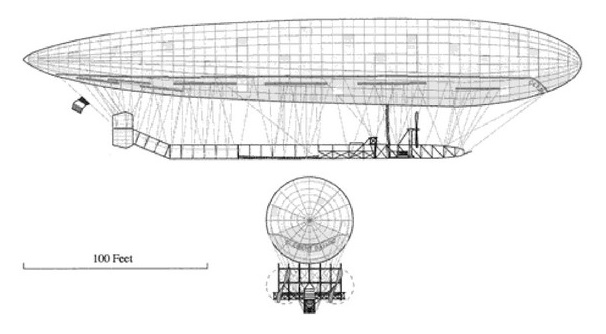
Airship, France, 1915
Length: 492.126 ft / 150.0 m
Width of hull: 51.837 ft / 15.8 m
Contained volume: 812360 cu.ft / 23000 cu.m
Engine: 4 x Clément-Bayard, 247 hp
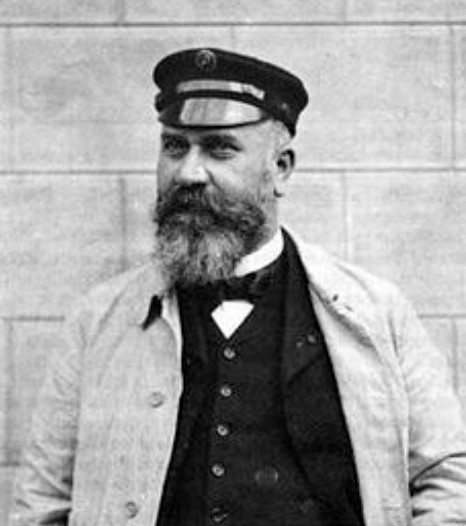
Clément-Bayard was a French manufacturer of automobiles, aeroplanes and airships founded in 1903 by the entrepreneur Adolphe Clément-Bayard (née Adolphe Clément). The name celebrated the Chevalier Pierre Terrail, seigneur de Bayard who saved the town of Mézières in 1521. A statue of the Chevalier stood in front of the Mézières factory, and the image was incorporated into the company logo.
In 1894 he started construction work on a former military site in the Faubourg Saint-Julian at Mézières, to build a new factory, which would become known as La Macérienne. Clément personally supervised the work remotely using photographs taken every day and visiting the site once a week. By 1897 it was producing components and spokes for the Gladiator Cycle Company. It covered 15,000 sq.m and using a hydraulic turbine power plant, a steam room, large machine hall, a foundry, a workshop for the nickel processing, the operation with the manufacturing of nuts and spokes on a bike. The factory building still exists but in the spring of 2006 it was transformed into a cultural center.
From 1903 Clément-Bayard automobiles were built in a ‘state of the art’ factory at Mézières, known as La Macérienne, which Clément had designed in 1894 mainly for building bicycles.
In 1908 ‘Astra Clément-Bayard’ began manufacturing airships at a new factory in La Motte-Breuil in response to a French Army decision to commence airship operations. Seven Clément-Bayard airships were completed.
Aircraft test flights began in 1908 and Louis Capazza’s ‘planeur (glider) Clément-Bayard’ was unveiled in L’Aérophile on 15 May 1908. Clement-Bayard was pioneer of welded steel tube airframe construction. Clément-Bayard also built Alberto Santos-Dumont’s Demoiselle No 19 monoplane that he had designed to compete for the Coupe d’Aviation Ernest Archdeacon prize from the Aéro-Club de France. The plane was small and stable, but they planned a production run of 100 units, built 50 and sold only 15 for 7,500 francs for each airframe. It was the world’s first series production aircraft. By 1909 it was offered with a choice of 3 engines, Clement 20 hp; Wright 4-cyl 30 hp (Clement-Bayard had the license to manufacture Wright engines); and Clement-Bayard 40 hp designed by Pierre Clerget. It achieved 120 km/h.
Pierre Clerget designed a range of Clement-Bayard aircraft engines including a 7-cylinder supercharged radial, the 4-cyl 40 hp used on the Demoiselle, a 4-cyl 100 hp used on ‘Hanriot Etrich’ monoplanes, and a V8 200 hp airship engine. By 1909 Clement-Bayard had the license to manufacture Wright engines alongside their own design.
Circa 1909 Adolphe Clément received permission from the Conseil d’État to change his name to Adolphe Clément-Bayard.
In 1910 the Clement-Bayard Monoplane No. 1 was introduced at the Paris show.
By 1912 Clément-Bayard built a biplane plus three different models of horizontally opposed aircraft engines.
In November 1912 the Clement-Bayard Monoplane No. 5 was introduced. It was powered by a Gnome 7-cylinder rotary engine producing 70 hp (52 kW). The pilot sat in an aluminium-and-leather tub.
Gnome-engined Clement-Bayard two-seat monoplane set world distance record of 255 miles (410 km) February 1913. Same year other Gnome-engined civil/military monoplanes appeared.
In 1913 a three-seater biplane was introduced as part of the military project, the Clement-Bayard No. 6. It was configured for two observers in front of the pilot, and was powered by either a 4-cyl 100 hp (75 kW) Clement-Bayard or 4-cylinder Gnome engine.
At Olympia Aero Show, London, March 1914, exhibited an all-steel armored monoplane. Clément-Bayard produced a steel scouting monoplane powered by either an 80 hp (60 kW) motor or a 100 hp (75 kW) Gnome et Rhône engine. The nickel steel armour was designed for protection against rifle fire.
Adolphe Clément ceded control of Clément-Bayard to his son Maurice in early 1914, but the consequences of World War I for the company were disastrous. The La Macérienne factory at Mézières was lost to the Germans, the machinery was shipped back to Germany, and the forges, foundries and smelter were destroyed. The gutted building was used as an indoor riding school for German officers.
Automobile production in Levallois-Perret, Paris, was suspended as the factory was turned over to war production, military equipment and military vehicles, aero engines, airships and planes.
In 1922 the Clément-Bayard automobile company was sold to André Citroën, in whom Adolphe Clément also invested financially, and the factory at Levallois-Perret became the centre of 2CV manufacturing for the next 40 years.
In 1922 the company was broken up and the factory in Paris was taken over by Citroën. In 1928 Clement-Bayard sold his factory to Citroen.
Airship, France, 1915
Length : 305.118 ft / 93.0 m
Width of hull : 45.276 ft / 13.8 m
Contained volume : 370860 cu.ft / 10500 cu.m
Max. speed : 38 kts / 70 km/h
Engine : 2 x Clément-Bayard, 197 hp
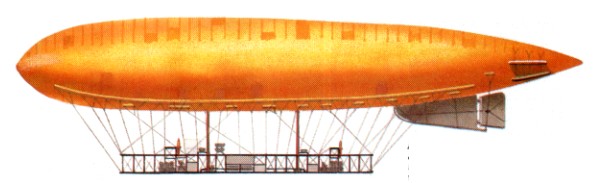
When war broke out in 1914, French airship equipment was entirely of the non-rigid pattern, and it was one of these that became the first Allied airship to carry out an air raid. This was the Fleurus, which had been built (like all French army craft of the lighter-than-air type) in the workshops at Chalais¬Meudon two years earlier, being re¬garded as a smaller sister ship to L’Ad¬jutant Vincenot (C.B.IV).
The Fleurus (or C.B.V. as it was officially known), had for the period a good aerodynamically efficient shape as it had been de¬signed as a result of wind tunnel tests conducted at the Eiffel laboratory. While these results were applied to the contours of the envelope, Clement¬Bayard was responsible for the design of the motor and the gondola, hence the initials of the alternative designa¬tion.
During the last year of peace, great use was made of the vessel, which par¬ticipated in the army manoeuvres of that summer. It also left its base at Pau on 23 September at the beginning of a flight to Saint-Cyr, a journey which it completed in 16 hours, averaging a speed of 54 km/h (33.7 mph), rather less than its maximum, for the distance of 680 km (423 miles) at an altitude nev¬er more than 1000 m (3,281 ft).
When making its historic raid from Verdun, the F]eurus was officially an army airship, there being no equiva¬lent naval air arm; but with effect from 1 January 1917 this was rectified and the army vessels were handed over to establish the new branch of the navy. Of the six non-rigids involved, four were at once deployed for sea patrol in much the same manner as the British ‘North Sea’ and similar types, but by now the C.B.V was five years old and obsolescent, so that with another airship it was relegated to training duties. The base for this work was far from the area where the newer airships operated — North Africa’s Mediterranean coast — being instead no further afield than Rochefort. It was here the Fleurus ended its days, destroyed in a fire as a result of an air raid in June 1918.
National insignia had not been adopted at the time of the first flight to be made by Fleurus, but when it was introduced this vessel was one of the earliest in France to be thus marked.
Chalais-Meudon Fleurus I
Engines: two 59. 7-kW (80-hp Clement-Bayard four-cylinder water-cooled piston
Diameter 12 40 m (40ft 8.2 in)
Length 77.0m (252 ft 7.5in)
Contained volume : 229580 cu.ft / 6500 cu.m
Max. speed : 32 kts / 59 km/h
Service ceiling 1005 m (3,281 ft)
Range 680 km (423 miles)
Useful lift 5200 kg (11.464 lb).
Airship, France, 1917
Length : 272.310 ft / 83.000 m
Width of hull : 45.276 ft / 13.800 m
Contained volume : 323178 cu.ft / 9150 cu.m
Max. speed : 46 kts / 86 km/h
Engine : 2 x Salmson, 237 hp
 All Aero