In 1875, Júlio Cesar Ribeiro de Souza, born in Belém, a city located in northern Brazil, started some research in aeronautics because he was impressed with the flight of certain native birds of the Amazon rain forest. he moved to Rio de Janeiro, where he published works on air navigation and presented talks on this subject to the Instituto Politécnico, an engineering faculty. he designed a dirigible, which was christened Victória after his wife. after obtaining part of the funding in Brazil, the device was constructed in Paris. attempts to place the device airborne failed both in France and in Brazil.
Airship
de Marcay-Kluytmans Airship
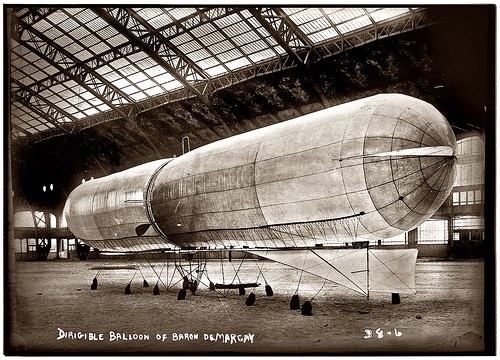
The “Dirigeable” was an unmanned proof-of-concept airship financed by Baron Edmond de Marçay together and designed by Dutchman Johan Kluytmans. It had its propeller positioned amidships and around the circumference of the two-part envelope, driven by an engine that was slung below the envelope. It was tested held by ropes, but was no success. Both de Marçay and Kluytmans went on to design more conventional aircraft.
da Schio Italia
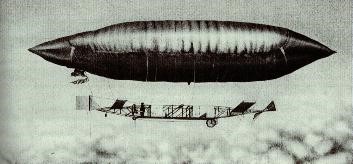
Designed and built by Count Almerico da Schio, the 1905 airship “Italia” was the first Italian dirigible.
The “Italia” had an envelope without a rigid internal structure, a little less than 38 meters long, and containing 1208 cubic meters of hydrogen. It featured many technological innovations patented by A. da Schio, such as an elastic rubber band to allow for additional volume of the envelope rendering it deformable at different altitudes and temperatures. The “aeropiani” (also called rudders) situated at the bow and stern of the gondola, consisting of curved profile surfaces variable in inclination to the line of flight, allowing more stability and governance to the airship.
Danilewsky Pilstrem
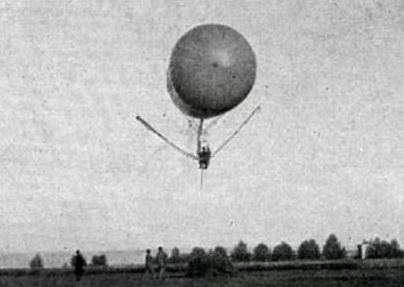
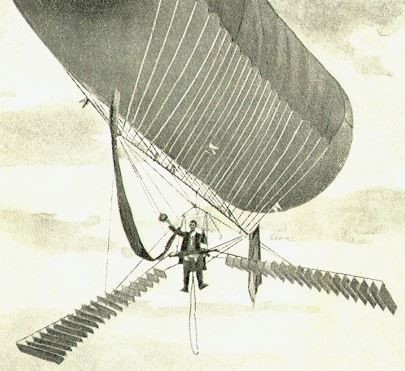
The second man-powered airship constructed by Dr. Konstantin I. Danilewsky of Charkov, Russia (now Ukraine). Supported by industrialist A. A. Pilstrem, and flown by the 20-year old engineer-aeronaut Peter Koziakov it made its first ascent on 18 June 1898. It was controlled by fans, or wings, up to 16′ 4″ long, which could be opened over an arc of 90 degrees. It was trial-flown with some success, making several ascents in alternate configurations, and demonstrated before a Russian board of inspection on 15 August 1898.
Custead Airship Co Airship
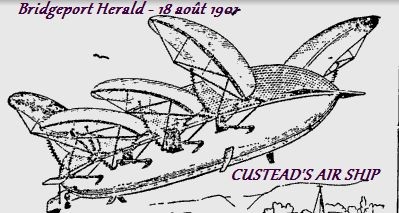
Approximately 30 feet long and originally built of bamboo framework. Exactly when Custead started work on it is unclear, but it is known that by the mid-to-late 1890s it was being tested and was, supposedly, making numerous tethered flights inside of a tent that Custead had erected next to his home in Elm Mott, Texas, a small hamlet located just north of Waco.
In 1900, backed by a number of Texas and Southern capitalists, Custead formed the Custead Airship Company, and with a capital share stock of $100,000 forged a partnership with Gustav Whitehead of Bridgeport, Conn., later the same year.

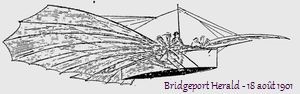
Custead Airship Co
Custead formed the Custead Airship Company, and with a capital share stock of $100,000 forged a partnership with Gustav Whitehead of Bridgeport, Conn., later the same year.
Curtiss H.8 America
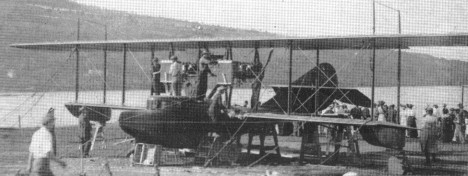
The two-engine Curtiss flying boat America was built in 1914 for an attempted flight across the North Atlantic. Before it could be completed Britain was at war with Germany. John Porte, the intended pilot, returned to the Navy, closely followed by the America, which became the forerunner of all the large Curtiss flying boats.
By July 1916 first examples of a larger Curtiss flying boat design began arriving in England. Designated H.8, these were quickly modified to accept more powerful twin 250 hp Rolls Royce engines, and redesignated Curtiss H.12s, or ‘Large Americas’.
20 similar models that were either modified or manufactured in England, marking the beginning of England’s flying-boat industry. The aircraft were used extensively for antisubmarine patrol.
Cornu Aîné Ballon Remorqueur
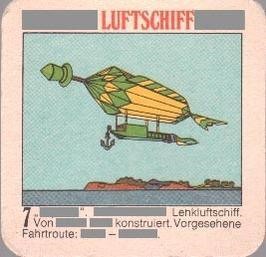
The ballon remorqueur, or balloon tug, was a patented dirigible airship conceived and drafted by Cornu Aîné of Nuits, Cote D’Or, France, during the years 1852–1854, with the intention of using compressed steam as its system of propulsion to tow a train of balloon carriages as a proposed aerial express running between Paris and London. The steam reactor system employed a pivoting “point d’appui aerien” (aerial fulcrum) in the shape of a bell set three meters ahead of the nose of the dirigible express. By injecting steam into the bell and deflecting the steam rearward, M. Cornu planned to steer the craft by articulating this hinged fulcrum device.
Cornu Aîné
Cornu Aîné of Nuits, Cote D’Or, France, drafted and patented a dirigible airship conceived during 1852–1854, with the intention of using compressed steam as its system of propulsion.
Clement-Bayard 1909
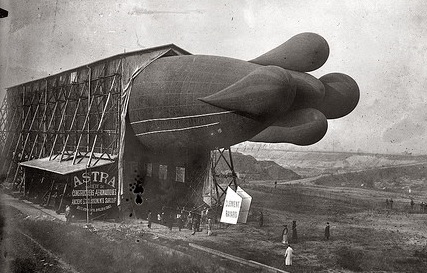
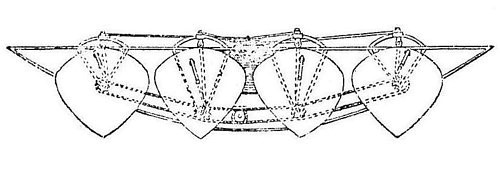
A c1909 Clément-Bayard, French experimental non-rigid airship had four lobes rather than fins for stability. The lobes retarded the maximum forward velocity of the airship.
 All Aero