Formed 1940 to take over the Goodyear Zeppelin Corporation. Served as aircraft manufacturer and subcontractor to numerous companies during Second World War, including complete construction of the FG-1 Corsair, a Chance Vought design. Reverted to lighter-than-air craft postwar, but built a few GA-2 Duck three-seat experimental amphibians in 1947-8. GA-400R light single-seat helicopter flown in May 1954. Produced the Goodyear Inflatable Aircraft with an inflatable wing in mid-1950s.
Airship
Gilbert Aérocycle-Rotateur / Gladiator
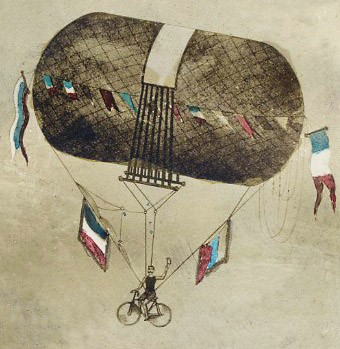
A combination gas balloon/parachute of 300 m³ volume employed by French aéronaute-constructeur Charles Gilbert, exhibited primarily throughout France, then in Russia, during the 1890s.
During these performances a bicyclette – likely a model built by the Paris firm of “Gladiator” – was suspended by ropes from the balloon in place of a basket, and while pedaling in the void, Gilbert naturally had to deal with the manoeuvring of his apparatus.
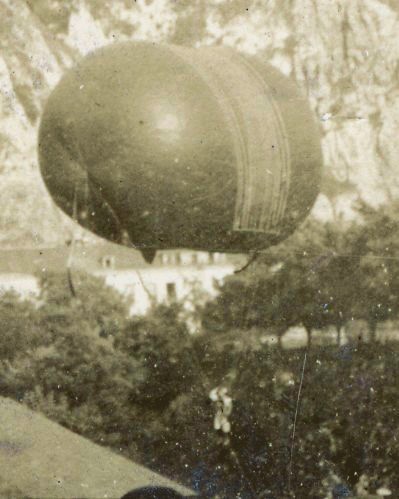
With his “rotateur” system enabling him to land at his discretion, at a given point, a kind of “rallye-ballon”, or balloon rally was organized. Velocemen who set off in pursuit of the balloon, joined the descent, and with folded balloon bagged, the aerocyclist returned with them on his bicyclette, to the place he had ascended from.
Giffard Airship
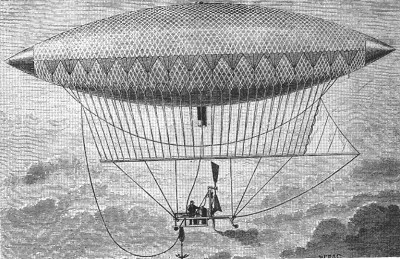
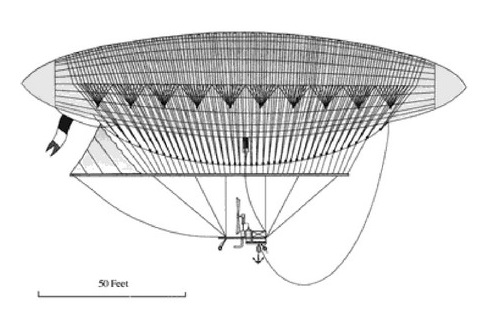
The first practical airship was the work of Frenchman Henri Gifard who in 1852 constructed a 143 ft long craft. Pointed at both ends and driven by a 3 hp steam engine; weighing, with its boiler, 350 lb and suspended 20 ft below the envelope, driving an 1 ft diameter propeller at 110 rpm to give it a still air speed of 6 mph.
On 14 September 1852 Giffard lifted off from the Hippodrome in Paris and, in near perfect weather conditions, flew 17 miles to Trappes, south of Paris in around 3 hours.
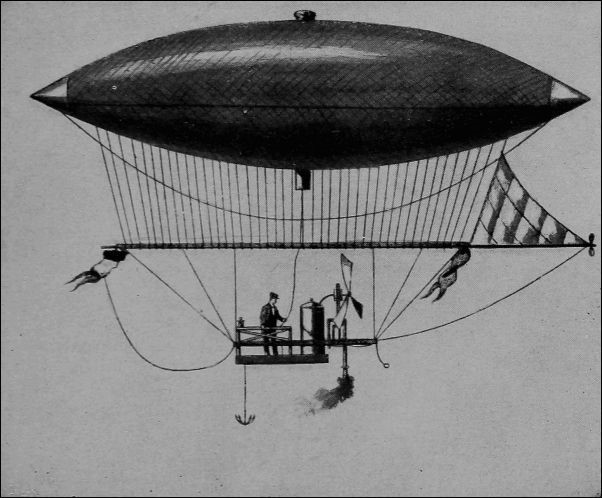
Whilst Giffard was able to effect a degree of control with the triangular sail that performed the function of a rudder in directing his flight, he was unable on this or later flights to either navigate in a circle or return to his starting point due to the low power of the engine.
Engine: 3 hp
Length: 144.357 ft / 44.0 m
Width of hull: 39.37 ft / 12.0 m
Contained volume: 88300 cu.ft / 2500 cu.m
Max. speed: 5 kts / 10 kph
Gross lift: 2500 kg
Giffard, Jules Henri

1825 – 1882
Airship builder
GEFA-FLUG AS 80 GD
At the 1996 Hot Air Airship World Championships in Aosta, Italy, the first three places were won by Thunder & Colt airships with the fourth place being held by a GEFA-FLUG AS 80 GD which features a standard T&C gondola and is also built at the T&C factory in Bristol, England.
Volume: 80,000 cu. ft
Forssman Lenkballon
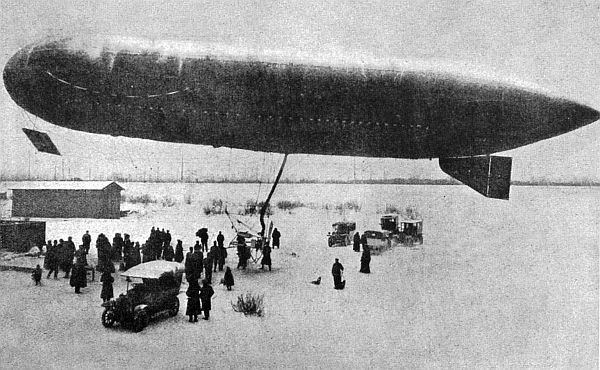
In 1910, Villehad Henrik Forssman (1884–1944) had graduated from the Riga Polytechnic Institute as a mechanical engineer and then moved to Germany that same year. Thereabouts, the Swede had been contracted by the Russian army to deliver a dirigible and was there to be used for intelligence services, which was constructed at “August Riedinger Ballonfabrik” in Augsburg. It is not known whether or not the Russian military ever took delivery of the airship. The dirigible was only 35 meters long with a maximum diameter of 6 meters, and held 800 cubic meters of hydrogen gas. It could be dismantled very quickly and just as fast, later be ready to fly. Because of lift-force limitations a gondola was not available, only a single bench seat with the engine, where the pilot and a mechanic had a place to sit. The 28 hp motor, which was also built by Forssman, weighed only 38 kg, and the cooling 4 1/2 kg. Reportedly the entire craft weighed 450 kg and capable of attaining a maximum speed of 43 km/h.
Forlanini Omnia Dir
Built in 1931, the Omnia Dir was only completed after Forlaninis death. It used two groups of five jets of compressed air for maneuvering, one at each end.
Propulsion: One Isotta Fraschini, 150 hp
Volume: 4,000 cubic metres
Forlanini F.6
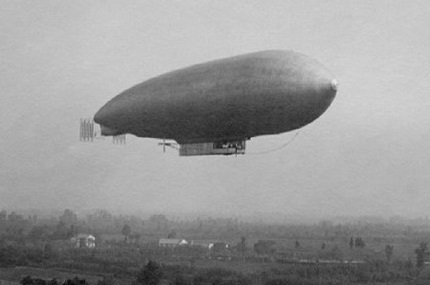
Built in 1918 for the Royal Italian Army (Regio Esercito), the F.6 made one single military mission before the armistice.
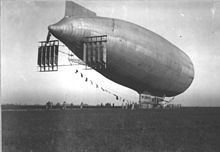
Propulsion: Four Isotta Fraschini IV-B, 180 hp
Volume: 15,000 cu.m
Forlanini F.5
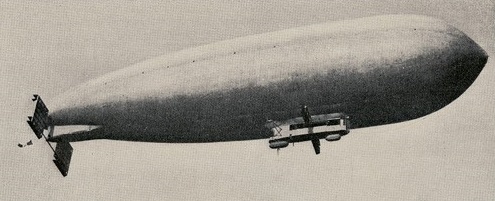
The F.5, ordered by the Army and arriving in 1917, carried a crew of five, full defensive armament, a quantity of bombs, and travelled at an altitude of 6100m (20,000ft).
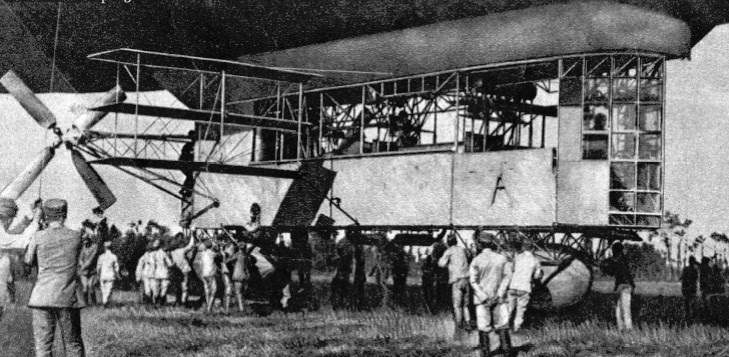
Of light construction in proportion to its size, the envelope was divided into several compartments with a strong, yet flexible internal keel, which allowed the nacelle to be frmly attached to the hull of the airship.
The F.5 was decommissioned on 6 February 1918, then at Baggio, on the western outskirts of Milan, the F.5 met a firey end when it burnt in is hanger on 25 March 1919.
Propulsion: Two FIAT S.76-A, 250 hp
Props: 4 blade
Volume: 17,783 cu.m / 628,000 cu.ft
Length: 300 feet (91 m)
Maximum width: 66 feet (20 m)
Gas cells: 12
Max speed: 75 kph / 46.6 mph
Diameter: 20m / 65.6 ft
Flight ceiling: 20,000 feet (6,100 m)
Payload: 20,227 lb (9175 kg)
Crew: 5: commander, two officers, two mechanics
Forlanini F.4
Built in 1915, the Forlanini F.4 was owned by Marina Italiana.
Volume: 15,000 cu.m
 All Aero