The Type AA were followed by the larger Type AB of 43,000 cu ft (Navy H Class & Army No. 121), and the even larger Type AC of 185,000 cu ft (Army AC 1) delivered in 1922.
Airship
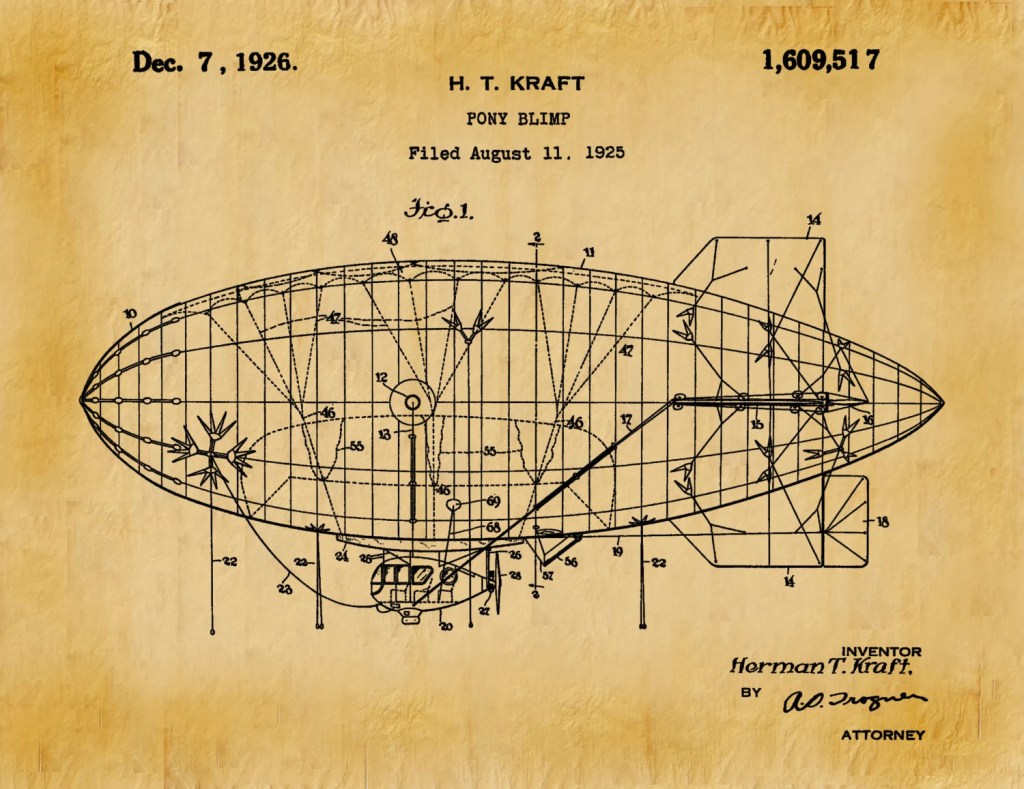
Goodyear Pony Blimp / Type A / Type AA
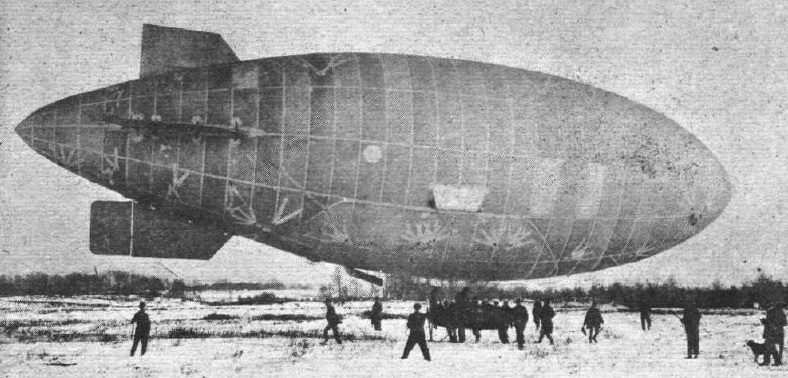
Although short lived, the FD was soon to be followed by three much smaller craft of 35,500 cu ft which were known as “Pony Blimps”. These were described as aerial runabouts, but their high initial cost and expense of operation precluded their large scale adoption by private owners.
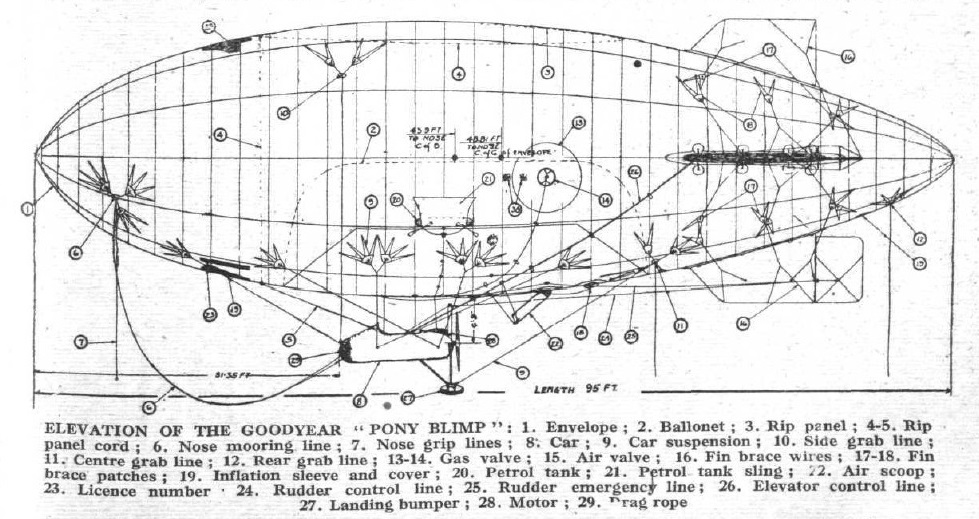
The first example was the Type A with a pusher engine built in December, 1919, the second and third being tractor engined Type AA, completed in April and June, 1920. No more of this type were built for civil use but the design attracted the interest of the military, with the result that the Army bought four Type AA in 1920 21, numbering them OA 1 to 4.
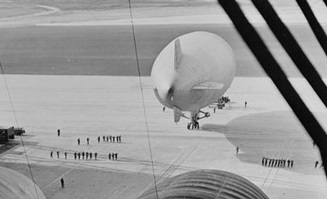
Engine: Water cooled, 40 hp
Length: 95 ft
Capaciy: 35,000 cu.ft
Ballonet capacity: 7000 cu.ft
Useful lift: 935 lb
Goodyear Type FD
The lack of military contracts caused Goodyear to look at the possibility of building commercial airships, and this led to a series of designs which were to become world famous. The first of these was the Type FD “Wingfoot Express”, of 95,000 cu ft, which first flew in June, 1919. Just over 160 feet long and capable of carrying five people, it was powered by two Gnome Le Rhone rotary engines which were suspended from the envelope above and behind the car. Although short lived, it was soon to be followed by three much smaller craft of 35,500 cu ft which were known as “Pony Blimps”.
Goodyear Type FC / ‘F’ Class / A-4
With the end of the war, large contracts for naval airships were cancelled but work continued on various military designs such as the Type FB (U.S. Navy E Class) and Type FC (Navy F Class and Army A-4), both of 95,000 cu ft capacity.
Goodyear Type FB / ‘E’ Class
With the end of the war, large contracts for naval airships were cancelled but work continued on various military designs such as the Type FB (U.S. Navy E Class) and Type FC (Navy F Class and Army A-4), both of 95,000 cu ft capacity.
Goodyear ‘D’ Class
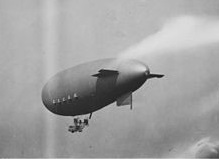
The BA contract was followed by others for C and D Class ships, each slightly larger and more improved than the preceding type. The D class blimp was a patrol airship used by the US Navy in the early 1920s. The D-type blimps were slightly larger than the C-type and had many detail improvements. The Navy continued the practice of dividing the envelope production between Goodyear and Goodrich. The control cars were manufactured by the Naval Aircraft Factory. The major improvements over the C-type blimps were a better control car design and easier, more reliable controls and instrumentation. The engines were moved to the rear to reduce noise and allow better communications between crew members. The fuel tanks were suspended from the sides of the envelope. The envelope was identical to the C-type, except an additional six-foot panel was inserted for a total length of 198 feet (60 m) and a volume of 190,000 cubic feet (5,400 m3). The last of the D-Class, D-6, had a different control car designed by Leroy Grumman who later founded the Grumman Aircraft Engineering Corporation.
The D-1 burned the day of its first flight, 13 July 1920, in the Goodyear hangar at Wingfoot Lake, Ohio. The D-2, D-3, D-4 and D-5 were transferred to the United States Army which the Air Ship Board had given the primary role of operating non-rigid airships after World War I. D-3 participated as an observation and photography aircraft at the famed “Mitchell” bombing test of 1921. D-3 also participated in the Mitchell bombing trials and tested experimental mooring masts. D-3 also participated in early “hook-on” experiments to see if it was possible for an airplane to fly up to and hook onto a trapeze hanging from an airship. No actual hook-ons were achieved, but approaches were practiced. D-4 also participated in the Mitchell trials, for observation and photography. The D-5 was never operated by the Army with that designation. After the loss of D-2, the D-5 was erected with more powerful 180 hp Wright V engines and flown as the D-2 (no. 2) D-2 (no 2 is a designation created by historian James Shock, never used by the Army). There is no evidence the airship flew for the Army with the designation “D-5”. D-5 is believed to have been renumbered “D-2” after the loss of that airship.
The Navy retained one additional D-type, the D-6. The D-6 was built by the Naval Aircraft Factory, Philadelphia, Pennsylvania, but her design was sufficiently different that she was distinct from the other five D-class airships. It featured a further improved control car (the “D-1 Enclosed Cabin Car” which had a water tight bottom for landings on water and internal fuel tanks. The D-6 was burned in the Naval Air Station Rockaway hangar fire of 31 August 1921 along with two small dirigibles, the C-10 and the H-1 and the kite balloon A-P.
The last operational D-type, the D-3 was decommissioned by the Army sometime in 1924.
Typical Specifications
Length: 198 ft 0 in (60.37 m)
Diameter: 42 ft 0 in (12.80 m)
Height: 58 ft 0 in (17.68 m)
Volume: 190,000 cu.ft (5,380 cu.m)
Useful lift: 4,340 lb (1,969 kg)
Powerplant: 2 × Union, 125 hp (93 kW) each
Maximum speed: 58 mph (93 km/h)
Cruise speed: 40 mph (64 km/h)
Range: 1,480 miles (2,380 km)
Endurance: 37 hours
Crew: Four
Armament: 1 × .303 Lewis gun
Bombload: 4 × 270 lb (122 kg) bombs
Goodyear ‘C’ Class
The BA contract was followed by others for C and D Class ships, each slightly larger and more improved than the preceding type.
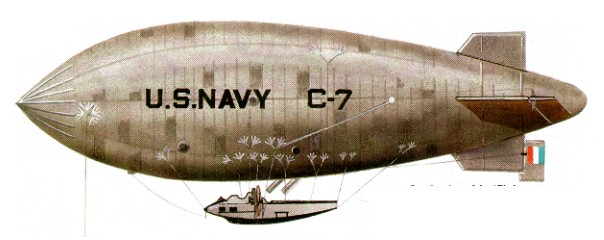
The Goodyear ‘C’ class airship was a type which must be counted the most successful design ever produced for the type of work envisaged: the C-7 became part of technical history and the type as a whole, although of non-rigid pattern, influenced the next generation of rigid vessels.
The first flight of a ‘C’ class airship took place on 30 September 1918, this and the subsequent five airships being produced by the Goodyear Tire & Rubber Company of Akron, Ohio, where a training establishment and a hydrogen plant had already been set up under contract with the US Navy on 29 May 1917; the 20 trainees in each intake had the advantages of permanent barracks.
The six vessels produced were numbered C-1 to C-8, the omitted designations C-2 and C-6 being used for some reason with C-9 and C- 10 for the quartet of airships of the type ordered from the Goodrich company.
Although the work performed by the ‘C’ class units proved it an outstanding airship design, the type came into use at a time when World War I was nearing its end, so it is to the design features of the class that one must look for interest. Most obvious of these was the four-crew streamlined car with an engine and pusher propeller mounted at each side. The C-7’s claim to history rests on a single incident when, on 1 December 1921, it became the first airship in the world to fly with helium substituted for the normal hydrogen lifting gas. The test was so successful that it was decided that henceforth all US airships would use this inert gas as a fire precaution despite the small loss of lift in comparison with that provided by lighter but inflammable hydrogen.
Other records held by the ‘C’ class include its use for the first successful release of an aeroplane from a non¬rigid airship, and by becoming the first airship to make a coast-to-coast US crossing, this being achieved by one of the pair that were given over to US Army control in 1921. On the other hand the C-5, earmarked for a projected transatlantic crossing attempt, was lost in a storm when it was ripped from its moorings.
With the end of the war, large contracts for naval airships were cancelled but work continued on various military designs.
Goodyear C-7
Type: coastal patrol and convoy escort airship.
Powerplant: two 149. 1-kW (200-hp) Hall-Scott L-6 eight-cylinder water-cooled piston engines; reports also mention the 11 1.9-kW (150 hp) Wright Hispano
Maximum speed 97 kph (60 mph)
Service ceiling 2438 m (8,000 ft)
Range about 4828 km (3,000 miles).
Useful lift about 2,404 kg (5,300 lb).
Diameter 12.80 m (42 ft 0 in)
Length 58.52 m (192 ft 0 in)
Volume 5125.3 cu.m (181,000 cu ft)
Armament: one 7.62-mm (0.30-in) Lewis machine-gun.
Goodyear Type F / ‘B’ Class
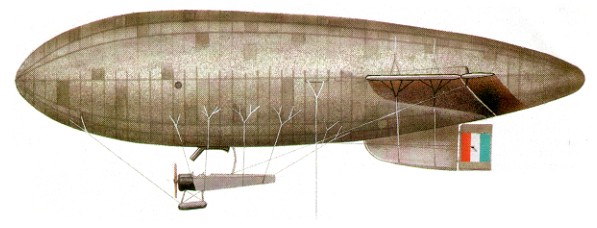
It was in 1915 that the US Navy took on charge its first non-rigid coastal patrol airship, a type that was based on the information coming out of Germany and built by the Connecticut Aircraft Company as the DN-1. The ‘B’ class which followed the failure of this first design was more closely based on that of British airships used for similar work, the first orders going to Goodyear on 14 March 1917 for 9 B Class airships of 77,000 cu ft (Goodyear Type F and FA). However in all fairness it should be said that the ‘B’ class was in no way conceived as a replacement for the earlier type, which had in fact not flown when de-sign work had begun on the Goodyear.
Although the ‘B’ class shared some of the British features, such as the use of an aeroplane fuselage as its car, there were differences such as the absence of an upper fin, though some ‘B’ class vessels did have this feature. There were several other differences be¬tween individual airships within the same class. The company’s first complete airship, BA, was delivered on July 19, 1917. This contract was followed by others for C and D Class ships.
Further variations took place after the first nine examples (B-1 to B-9) had been built by Goodyear, production then being undertaken by the B. F. Goodrich Co. The earlier airships had employed the finger-patch method of fastening the car lines to the envelope, which measured 9.60 m (31 ft 6 in) in diameter, and 48.77 m (160 ft 0 in) in length, but the ‘B’ class from B-10 to B-14 were longer and of greater girth.
It is interesting to note that the later variants (of which two only were built by Connecticut) were the shortest of all but with a greater-diameter envelope, and that the belly-bands which had replaced the finger-patches on the Goodrich were retained.
The B-10, in common with others of its class, proved a sound and reliable vessel; the two-man crew were fairly comfortably accommodated in the individual cockpits of the suspended fuselage, on which the landing gear had been replaced by rigidly-mounted air-filled flotation bags.
The B-10 was among the first batch of Goodyear/Goodrich vessels which were delivered between June 1917 and July of the following year, the former date marking something of a record since the first of the ‘B’ class had made its maiden flight at the end of May, only two weeks after the declaration of war on Germany by the United States. The total number of vessels of this type delivered was only 16, but three were later reconstructed and given new numbers B-17 to B-19. The final B-20 was sufficiently different, with increased gas capacity and an OXX-3 motor, to be considered a new design.
The Goodyear B-20 had an increased cubic capacity, and the rope lines of earlier models were replaced by cable. Three fins were fitted instead of the five of the early variants, although the car with its typical Avro 504-type lines was unchanged.
Goodrich B-10
Type: coastal patrol airship
Powerplant: one 74. 6-kW (100-hp) Curtiss OXX-2 eight-cylinder water-C cooled piston engine
Maximum speed 80 kph (50 mph)
Service ceiling 2134 m (7,000 ft)
Endurance about 16 hours.
Useful lift about 2268 kg 1 (5,000 lb)
Diameter 10.06 m (33 ft 0 in)
Length 50.90 m (167 ft 0 in)
Volume 2265.3 cu.m (80,000 cu ft)
Armament: one or two 7.62-mm (0.30-in) Lewis machine-guns.
Goodyear Akron
After visiting Europe to see the latest airships flying at the time, P. W. Litchfield returned to America to start the construction of the company’s first envelope, which was completed in July 1911. With a total capacity of 375,000 cu ft, it was made for Melvin Vaniman’s ill fated airship “Akron” which attempted to fly across the Atlantic in July 1912. Vaniman was one time engineer to Walter Wellman, whose airship “America” had attempted a similar crossing in 1910. “Akron” was assembled in Wellman’s old airship shed at Atlantic City and test flown towards the end of the year. On July 2, 1912, the airship took off with Vaniman and four crew on board to cross the Atlantic. Only fifteen minutes later the ship was seen to burst into flames and fall into the sea, killing all on board.
Goodyear Tyre & Rubber Co.
Airship work started at the Akron, Ohio, plant of the company in 1910, when engineer P. W. Litchfield began developing the specialised techniques required for the manufacture of rubberised fabric. After visiting Europe to see the latest airships flying at the time, he returned to America to start the construction of the company’s first envelope, which was completed in July 1911. With a total capacity of 375,000 cu ft, it was made for Melvin Vaniman’s ill fated airship “Akron” which attempted to fly across the Atlantic in July 1912.
As a result of negotiations, which began in 1922 between Goodyear and Luftschiffbau Zeppelin, the Goodyear-Zeppelin Corporation was formed on December 14, 1923. From then on, Goodyear’s major effort was directed towards the design of rigid airships for naval and commercial use, but it was to be several years before an airship of this type was laid down by the, new company.
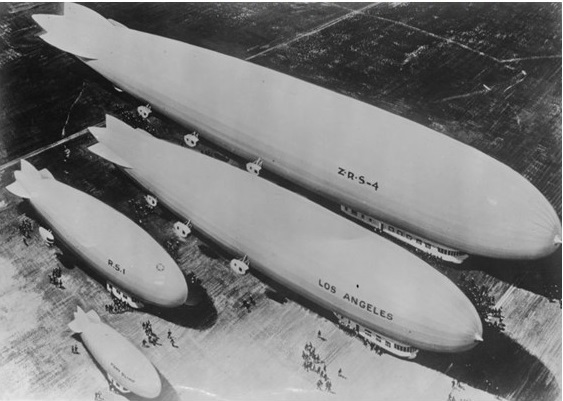
“GZ” stands for Goodyear-Zeppelin, stemming from the partnership Goodyear had with the German company when both were building airships together. However these models came many years after this partnership had dissolved during the start of World War II. The GZ-1 was the USS Akron (ZRS-4), the U.S. Navy’s fourth rigid airship used for several tests including as a flying “aircraft carrier”.
Total airship production by the company up to 1923 was 37, of which 26 were for the U.S. Navy, 7 for the U.S. Army, and 4 commercial.
On December 5, 1939, to reflect the company’s growing interest in other fields of aeronautical work, the corporate name was changed again, this time to the Goodyear Air¬craft Corporation. With America’s entry into WW II, a great expansion began of the U.S. Navy’s airship service, with 200 airships being authorised in June, 1942. Between September, 1941 and April, 1944, Goodyear delivered 130 K Class, 10 L Class, 7 G Class, and 4 M Class airships to the Navy. These joined 4 K, 3 L, 1 G, and two ex Army ships already in service, plus five Goodyear fleet ships, to make the largest airship fleet ever assembled by any nation. They were used extensively along the eastern and western seaboards of the United States, in Central and South American waters, and from 1944 in the Mediterranean area. The ZP squadrons, the first being commissioned at Lakehurst on January 2, 1942, (ZP 12), were organised into Fleet Airship Wings, of which there were five.
As recently as 1967, Goodyear carried out an evaluation programme for the U.S. Naval Air Development Center in which a series of rigid and non rigid designs were examined for operational cost and performance potential. Amongst the designs considered were 45 million cubic feet rigids operating at speeds up to 210 m.p.h., which were found to be totally practical from a technical point of view.
As a further reflection of Goodyear’s expanding interest in aeronautics and space research, the company name was changed once more on July 1, 1963, to become the Goodyear Aerospace Corporation. With this change, airship operations were transferred to Goodyear Tire & Rubber public relations, with Aerospace being responsible for engineering, maintenance and development of the fleet. During this period the company were operating two airships, namely, the Type GZ 19As “Mayflower”, based at Miami, Florida, and “Columbia” at Los Angeles, California, during the winter months, both airships going on nationwide tour each summer. These ships were of 147,000 cu.ft. capacity and powered by two 175 h.p. Continental engines.
 All Aero