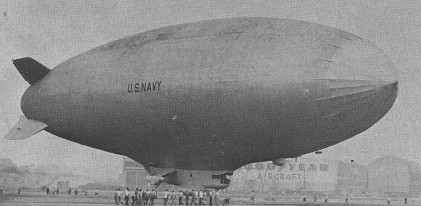
The 2PG-2 patrol airship of 1953 was equipped with an autopilot, and had a single control column to operate all control surfaces.
The 2PG-2 patrol airship of 1953 was equipped with an autopilot, and had a single control column to operate all control surfaces.
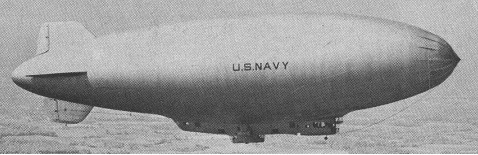
In order to improve range, endurance, and war load still further, Goodyear designed the M Class, the last of the wartime designs to be built. Of 625,000 cu.ft. capacity and powered by two Pratt & Whitney Wasps of 600 h.p., twenty two were originally ordered. First flight of M 1 was on 27 October, 1943, but with the improving anti¬submarine situation after 1944 only three more were completed (M 2 to 4). They were used after the war on airship research and development work and XM 2 was flown with a retractable tricycle landing gear which was used on later naval airships.
M-1
Volume: 625,000 cu ft.
GZ 5
Volume: 647,000 cu ft.
Length: 310ft.
Max Dia: 73ft.
Engines: 2 x 600 h.p. Pratt & Whitney R 1340 AN 2 Wasp.
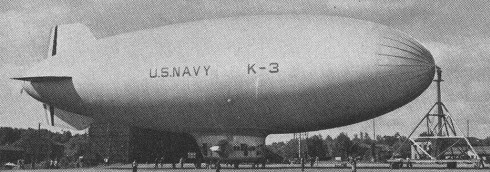
The “K” class are the standard U.S. Navy patrol airships and 130 were built during war. Most were modified by 1955 into ZP2K and ZP3K, with the latest radar search equipment and increased capacity envelope.
The L 1 was followed by the prototype of a new class of naval airship which was destined to be built in larger numbers than any other single airship type, either rigid or non rigid; the K Class. K 1 was a one off experimental ship built by the Naval Aircraft Factory in 1931, using a Goodyear envelope of 319,900 cu.ft. and was remarkable mainly in being the first U.S. Navy blimp to have the car attached flush to the underside of the envelope. At that time the Navy was primarily interested in the new rigid airships then being built, but with the disbandment of the Army L.T.A. Section the Navy became responsible for coastal patrol work as, well as long range scouting. As a result there began, with the aid of Goodyear, the serious development of the patrol type airship, and K 2 was the result. Powered by two 550 h.p. Pratt & Whitney Wasp engines, she was the largest non rigid of her day, with an envelope of 404,000 cu.ft. capacity. First flight took place on December 8, 1938, and she was soon to be followed by many more of her kind.
ZP 14 squadron was formed in 1944 to operate from Port Lyautey, French Morocco, the airships being flown across the Atlantic via the Azores, the first non rigids ever to make the crossing. First across were K 123 and K 130, both ships completing the 3,145 mile journey between May 29, and June 1, 1944, in a flying time of 58 hours. In the following months, K ships were based in southern France (Cuers), Sardinia, Italy (Pisa and Venice), and at a temporary mooring mast at Gibraltar. Primary mission in the area was anti submarine work in the Straits of Gibraltar, but they also completed many hours of mine sweeping operations in conjunction with surface vessels of the Royal Navy. Using magnetic airborne detection gear, flying mainly at night or in bad weather when other types of aircraft could not be used due to the low flight altitudes required on this work, they were able to maintain round-the clock patrols. After the arrival of the airships in the area no, more U boats were able to enter or leave the Med. without detection and eventual destruction.
Larger numbers were built of K Class airships than of any other single type.
After 1948, the K Class became known as the ZPK Class and many of these were modified with larger envelopes and improved electronic detection gear to become ZP2K (456,000 cu.ft.), and ZP3K (527,000 cu.ft.). These were followed in 1954 by the new ZP4K and ZP5K which later became designated the ZSG 4 and ZS2G-1 respectively.
The “K” class are the standard U.S. Navy patrol airships and 130 were built during war. Most were modified by 1955 into ZP2K and ZP3K, with the latest radar search equipment and increased capacity envelope.
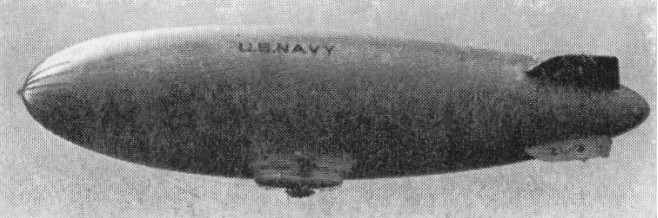
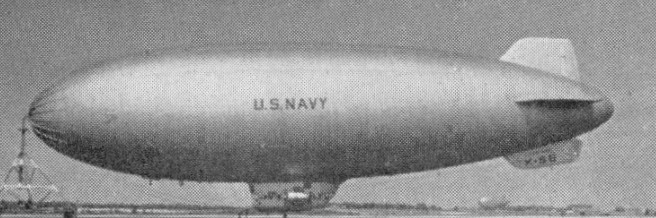
The ZSG 4 was a new development of K Class. 15 built 1953¬-1955, and in service to 1961.
There were 18 ZS2G-1 built 1954 56 and they remained in service to 1961.
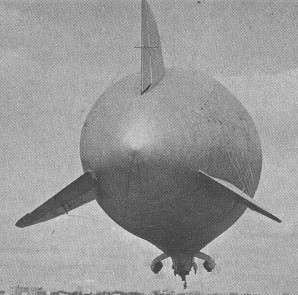
While the ZSG 4 was essentially a modified K Class, the ZS2G-4 was an entirely new design with an envelope of 650,000 cu.ft. and a unique inverted Y tail configuration. Carrying a crew of eight and equipped with the latest in anti submarine devices, these ships could be refuelled from surface craft at sea and re ballasted by a water pick up system. The prototype flew on July 22, 1954, and the type remained in service until 1961.
Immediately after the war, Goodyear bought back from the Navy four complete L ships and one K ship to form the basis of a new commercial fleet. Goodyear were not the only company to be interested in the airship, however.
The Douglas Leigh advertising company purchased no less than 29 surplus L and K ships in February, 1946.
In September 1946, the actress Elizabeth Taylor christened the first Leigh airship at ceremonies in the Lakehutst hanger. The next day, the “MGM Aiship” inaugurated aerial operations. A second ship promoting the Ford Motor Company was launched, and a third, the “Tydol Airship” (ex-K-76), was pressed into service early in 1947.
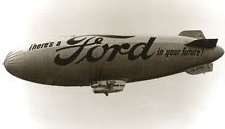
East Coast operations were promising, so similar enterprise was organised in California, with headquarters at Moffat Field. Flights using an L-ship for promotion commenced in spring 1947.
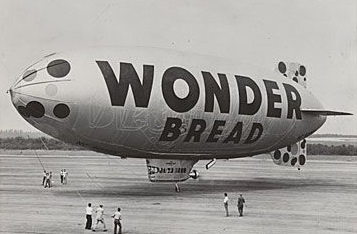
The coming of television advertising and the high cost of replacing the war¬ surplus ships soon began to tell, and by the early 1950s Goodyear were alone as commercial airship operators in America.
The later K ships of 425,000 cu. ft. with a crew of three officers and nine men, had a range of 2,000 miles at 45 m.p.h. with a normal fuel load, and a top speed of 75 m.p.h. Total orders for the K Class amounted to 138 (K 2 to K 139), but the last four were cancelled before completion. Total production was 134 ships, K 2 to K 135. Post war many modified as ZP2 K and ZP3 K.
Thirteen naval airships were deflated and placed in long-¬term storage in case of future need, while two ZPG 2s were retained for experimental work with the Airship Test and Development Department at Lakehurst. In addition, one ZS2GA was made available to Mississippi State University for a programme of boundary layer control research on airship envelopes. When these ships, too, were deflated at the end of 1962, forty five years of U.S. Naval airship operations came to an end.
The ZP3M long endurance patrol airship, with a volume of 725,000 cu. ft. and length of 310 ft. One ZP3M has remained airborne for more than a week. Early ZPM-1 aircraft have two 550 h.p. Wasps; later ZP3Ms have two 700 h.p. Wright Cyclones. The ZP2M is a modernised ZPM-1, with revised electronics.
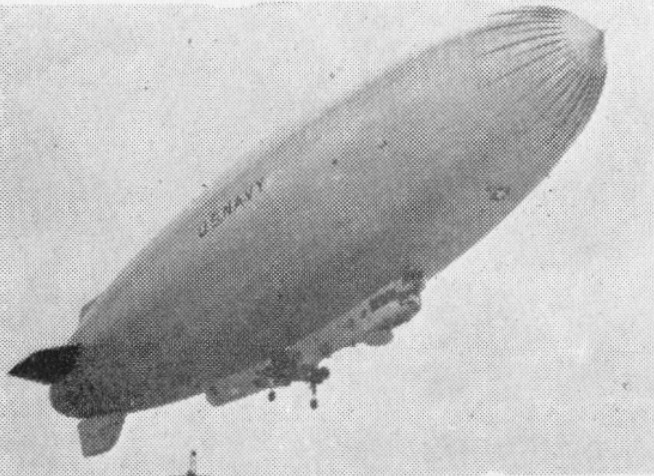
Goodyear ZPG2 / ZP-3
Variant: Piasecki Heli-Stat
GZ 6
Volume: 404,000 cu ft to 425,000 cu ft.
Length: 251.7ft.
Max Dia: 62.5ft.
Engines: 2 x 420 h.p. Wright R 975 28 Whirlwind 9 or Pratt & Whitney R 1340 AN 2 Wasp.
ZSG 2 & ZSG 3 (GZ 10)
Volume: 456,000 cu ft and 527,000 cu ft.
Length: 267ft.
Max Dia: 70ft.
Engines: 2 x 550 h.p. Pratt & Whitney R 1340 Wasp.
ZSG 4 (GZ 12)
Volume: 527,000 cu ft.
Length: 267ft.
Max Dia: 70ft.
Engines: 2 x 550 h.p. Pratt & Whitney R 1340 Wasp.
ZS2G-1 (GZ 15)
Volume: 650,000 cu ft.
Length: 285ft.
Max Dia: 68ft.
Engines: 2 x 800 h.p. Wright R 1300 4 Cyclone 7.
ZP2K
Volume: 456,000 cu. ft.
ZP3K
Engines: 2 x 550 h.p. Pratt & Whitney Wasp
Volume: 527,000 cu. ft.
Length: 253 ft
Speed: over 75 m.p.h.
ZP3M
Engines: 2 x 700 h.p. Wright Cyclones
Volume: 725,000 cu. ft.
Length: 310 ft
ZPM-1
Engines: 2 x 550 h.p. Wasps.
Goodyear had supplied the Navy with J 1 in 1922 and G 1 in 1935.
In the period 1925 to 1937, Goodyear not only became the sole supplier of airships in production quantities to the Navy, but also built 14 non rigid airships and one semi¬rigid airship for the U.S. Army. However, from June 30. 1937, the Army ceased all airship operations and handed over their remaining ships to the Navy, including the Goodyear built TC 13 of 360,000 cu.ft., built in 1933. Thus, from the summer of 1937 onwards, the U.S. Navy became the only military force in the world to employ dirigibles on an operational scale, although even these operations were severely limited by the small number of airships in commission.
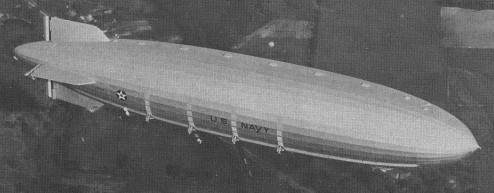
As an extension of the Type ZR programme, the Navy was granted authority in 1926 to procure two large American-built rigid airships for long range scouting purposes. A design competition was announced which was subsequently won by Goodyear Zeppelin. In 1928 the company began the construction of the first ship, the ZRS 4, U.S.S. “Akron”, of 612 million cubic feet capacity. It was an advanced airship design in many ways, being conceived from the start to make use of safe non inflammable helium gas as the lifting agent. This made it possible to contain, within its length of 785ft, a hangar, 60ft by 75ft, capable of housing four small scout or fighter type aircraft. These could be launched and recovered in flight by means of a retractable trapeze device beneath the airship that was engaged by a hook on the aeroplane. The airship was powered by eight German built 560 h.p. Maybach engines which were mounted within the hull and drove their propellers through shaft drives and gearing. These propellers could he used not only to provide normal longitudinal thrust,’ forward and reverse, but could also be swivelled vertically upwards or downwards to give greater control of the ship during take off and landing.
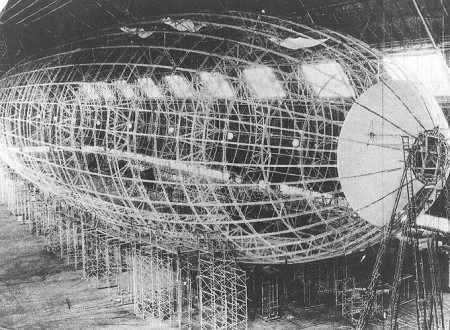
“Akron” was commissioned on October 27, 1931, and made numerous long flights, experimenting with her unique aircraft squadron carried on board, and engaging in exercises with surface vessels of the U.S. Navy. Her range of over 5,000 miles and her complement of four Curtiss F9C 2 “Sparrowhawks” added a new dimension to naval air operations; the flying aircraft carrier. But the success was to be short lived. Stationed at Lakehurst, “Akron” made 73 flights before being lost at sea in a violent storm on the night of April 34, 1933, with the loss of all but three of her crew. She had completed 1,695 flying hours.

Just two months later, on June 23, 1933, her sister ship, the ZRS 5 U.S.S. “Macon”, was commissioned and went into service at Naval Air Station Sunnyvale, California. (Moffett Field). Apart from some minor modifications, she was a copy of ZRS-4, and carried the same number of Curtiss F9C 2 fighters. The experiments and the development of new operational techniques were resumed with good results and the future looked bright for the naval rigid airship.
While engaged on a naval exercise off the coast of California on February 12, 1935, “Macon” suffered a structural failure of the dorsal fin which resulted in the rupture of several gas cells in the stern of the ship. The airship began to descend, and despite all the efforts of the crew to regain control, she hit the sea and sank forty minutes later. Thanks to the safety precautions taken after the loss of “Akron”, adequate survival equipment was on board, and of the 83 crew only two were lost.
This second major accident did not immediately bring to an end the U.S. Navy’s rigid airship programme. A new training rigid of 3 million cubic feet (ZRN) was planned for service in 1938 40, and a giant 912 million cubic feet design, (ZRCV), capable of carrying nine Douglas Northrop BT 1 dive bombers, was projected in 1937. In the event no funds were made available to build these ships, but as late as 1940 Goodyear were proposing 10 million cubic feet ships for use by the Navy. These were to be built in three forms; a hospital version (G.A.C. 1940 project number GZ 1); a carrier version (GZ 2); and a cargo version (GZ 3). Political and military considerations ruled against such projects being proceeded with, although some interest was shown in a revival of the ZRCV strike aircraft carrier concept in 1942.
XRS 5 U.S.S. “Macon”
Engine: 8 x 560 h.p. Maybach VL II.
Length: 785ft.
Maximum Diameter: 133ft.
Volume: 6,500,000 cu ft (95% full).
Maximum speed: 87 mph.
Cruising speed: 63 mph.
Range: 5,940 miles at 63 m.p.h. / 7,268 miles at 53 m.p.h.
Endurance: 108 hours at 63 m.p.h. / 158 hours at 53 m.p.h.
Fuel: 16,000 Imp.Gal.
Useful load: 160,644 lb.
Total number of flights: 54.
Total flight hours: 1,798.2.
In order to train pilots and other personnel, Goodyear decided to build and operate a fleet of small non rigid airships. These would not only prove useful as training craft, but also as experimental ships to test new materials and techniques required for the rigid airship programme.
Between July 1928 and August 1940, twelve commercial airships were built by Goodyear, eleven of the Type TZ, which was an enlarged and improved version of “Pilgrim”, and one larger Type PA. The one off Type PA named “Defender”, largest of the fleet, began life in 1929 with an envelope of 178,000 cut ft. In September 1935, this was replaced with one of 183,000 cu ft when the ship was sold to the U.S. Navy as the first of the G Class.
The “Defender”, the Flag Ship of the fleet, was powered by two 165 h.p. Wright Whirlwind engines and could take eight passengers plus pilot.
Operations were based on five airships during the summer months, With “Defender” based at Akron until retirement in 1934.
Goodyear had supplied the Navy with J 1 in 1922 and G 1 in 1935. G 1 was ex-¬Goodyear DEFENDER,1935, Vol 183,000 cu ft. G 2 to G 8 were ordered June, 1942.

In order to train pilots and other personnel, Goodyear decided to build and operate a fleet of small non rigid airships. These would not only prove useful as training craft, but also as experimental ships to test new materials and techniques required for the rigid airship programme.
Between July 1928 and August 1940, twelve commercial airships were built by Goodyear, eleven of the Type TZ, which was an enlarged and improved version of “Pilgrim”, and one larger Type PA. Various sizes of envelope were used, but finally a standard size of 123,000 cu ft was employed on all of the TZ type in service after 1932.
First of the fleet was “Puritan” of 86,000 cu ft, which flew on July 2, 1928. For the next ten years, “Puritan” was in more or less continuous service until completely wrecked in a hurricane on September 21, 1938, at Springfield, Mass. Next to fly was “Volunteer” in April, 1929, to be followed by “Mayflower”, “Vigilant” and “Defender”, all named after winners of the America’s Cup yacht races.
These TZ ships could accommodate four to six passengers and the pilot in their totally enclosed cars, and were powered in their final form by two 145 h.p. Warner Scarab engines.
Operations were based on five airships during the summer months, With “Defender” based at Akron until retirement in 1934, “Volunteer” at Los Angeles, and the remainder either touring or operating at one or other of the two main bases. As ships were lost or retired they were replaced by new or rebuilt ships. When “Vigilant” was wrecked at Piedmont in November 1930, the car and fins were fitted with a new envelope to become “Columbia” re entering service in July, 1931. The new “Reliance” first flew in November, 1931, and she was followed by “Resolute” in 1932, “Enterprise” in 1934, “Rainbow” in 1939, and “Ranger” in 1940.
The outbreak of war curtailed the commercial fleet’s operations until the summer of 1946, when a new fleet was established to continue the tradition. The fleet, however, did not go into retirement. All the ships then in commission, plus a replacement car for “Ranger”, saw service with the U.S. Navy as training L Class ships throughout the war period.
Goodyear had supplied the Navy with J 1 in 1922 and G 1 in 1935, but it was not until 1937 that an order was placed for the first of the L Class (L 1) which was based on the TZ type commercial ship of 123,000 cu.ft. In 1940, L 2 (ex RANGER) and L 3 were ordered and these were followed by the five former Goodyear fleet ships (L 4 to L 8) and 14 production models of which Goodyear built ten (L 13 to L 22). Over twenty of the type were used for wartime training.
The L 1 was followed by the prototype of a new class of naval airship which was destined to be built in larger numbers than any other single airship type, either rigid or non rigid; the K Class.
The second “Ranger” was a replacement for the first. Completed after outbreak of war and delivered direct to U.S.N. as L 8 at Moffett Field, 26 2 42. The car returned to Goodyear in 1946 and was stored. Rebuilt as GZ 20 type for AMERICA, 1968 69.
Immediately after the war, Goodyear bought back from the Navy four complete L ships and one K ship to form the basis of a new commercial fleet. Goodyear were not the only company to be interested in the airship, however.
The Douglas Leigh advertising company purchased no less than 29 surplus L and K ships in February, 1946, and began operating some of them in various parts of the United States with advertising for Ford, M.G.M., Mobilgas, and many other sponsors. However, the coming of television advertising and the high cost of replacing the war surplus ships soon began to tell, and by the early 1950s Goodyear were alone as commercial airship operators in America.
Total production: 18.
The only other Goodyear built airship to be used commercially, other than those of the Goodyear fleet, was the ex Navy L 19, N65N. Originally built in 1944, the airship was delivered to a German company and made its first flight at Stuttgart on March 16, 1956. It became D LAVO, later D LISA, and was used for aerial advertising in Germany until sold to Japan in 1968.
The post war Goodyear fleet, which began operations in May, 1946, were given names used before by the pre war ships, although there was no connection between them and the previous ships of the same name. Navy L-14 became “Mayflower”, L-16 became “Enterprise”, L 17 “Volunteer”, and L 18 “Ranger”, all in service by May, 1947. The single K ship (K 28) became “Puritan” and was the largest commercial airship ever operated by Goodyear, with an envelope of 425,000 cu.ft. She entered service in March, 1947, but due to the high operating cost was withdrawn just over a year later in April, 1948.
Cars from three of the pre war fleet (L-4, L 5, and L 8) were also acquired in 1946 and placed in storage as spares. The car of L 8 has since been used in a modified and improved form for the “America” in 1968. As with the pre war fleet, several rebuilds took place during the 1950s and 1960s to keep one or two ships always in commission up to 1968 when a major expansion programme got under way.
In 1964 Goodyear blimp Mayflower cruised over New York City with two chemists and 250 lb of air sniffing equipment to detect sulpherdioxide gases expelled from industry.
Type TZ (NAVY L CLASS) 1938
Engines: 2 x 145 hp Warner Scarab.
Length: 149ft.
Maximum diameter: 39ft 6in.
Volume: 123,000 cu ft.
Maximum speed: 60 m.p.h.
Cruising speed: 45 m.p.h.
Range: 335 miles.
Endurance: 61 hours.
Useful load: 2,150 lb.
GZ 7
Engines: 2 x145 h.p. Warner R 500 2/6.
Volume: 123,000 cu ft.
Length: 149ft.
Max Dia: 39ft.
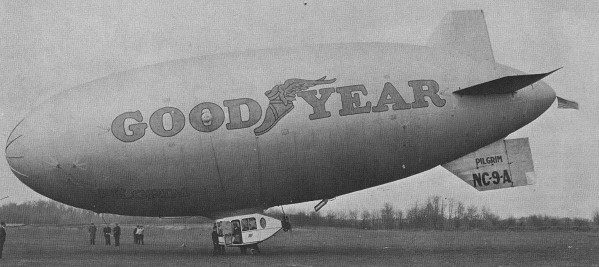
Non rigid airship construction continued with the revolutionary Goodyear Type AD “Pilgrim”, which first flew on June 3, 1925 with a capacity of 123,000 cu ft. With this airship a new system of internal rigging was used for the first time which enabled the control car to be rigged flush with the underside of the envelope, thereby reducing the aerodynamic drag and the overall height of the ship. The envelope volume was 50,000 cu ft and the ship was powered by a 60 h.p. Lawrence engine which gave a speed of 50 m.p.h. at full power. The interior of the enclosed cabin was luxuriously appointed with blue mohair velour upholstery and mahogany finished veneer below the window lines. Seating was for a pilot and two passengers, with a rear cockpit for an engine mechanic.
The first flight was made with the envelope inflated with hydrogen, but a month later it was re inflated with helium and flew for the first time with this gas on July 17, 1925. Since then all Goodyear airships have employed helium as the lifting agent. “Pilgrim”, registered NC 9A in 1927, remained in service until December, 1931, completing 2,880 hours and carrying 5,355 people. before honourable retirement. It is now preserved by the Smithsonian Institution, Washington, D.C. Its design formed the basis of all subsequent non rigid airships built by Goodyear and was the prototype for all modern pressure airships.
Goodyear Type AD (Pilgrim) 1925
Engine: 1 x 60 hp Lawrence air cooled radial.
Length: 105ft 6in.
Maximum diameter: 31 ft.
Volume: 50,068 cu ft (before stretch).
Maximum Speed: 50 m.p.h.
Cruising Speed: 40 m.p.h.
Range: 330 miles at full power, 525 miles at half power.
Endurance: 61 hours at full power, 13 hours at half power.
Fuel: 32 Imp.Gal.
Useful load: 921 lb.
The Type AA were followed by the larger Type AB of 43,000 cu ft (Navy H Class & Army No. 121), and the even larger Type AC of 185,000 cu ft (Army AC 1) delivered in 1922.
 All Aero