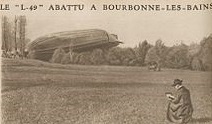
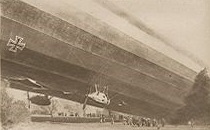
The L-49 was one of the lightened Type U “height climbers” designed by the Germans late in World War I, when improvements in Allied fighter aircraft and anti-aircraft artillery made it necessary for Zeppelins to climb to great altitudes to avoid being shot down. For the Zepeplins to rise to greater heights on a fixed volume of lifting gas, however, the weight and strength of their structures were dramatically reduced. This decrease in strength was accepted as a wartime necessity, since a structurally weaker Zeppelin flying above the reach of enemy aircraft and artillery was safer than a stronger Zeppelin that could be easily attacked.
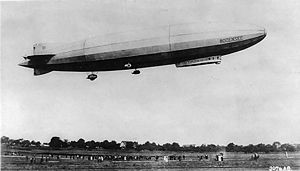
LZ 120 Bodensee was a passenger-carrying airship built by Zeppelin Luftschiffbau in 1919 to operate a passenger service between Berlin and Friedrichshafen. It was later handed over to the Italian Navy as war reparations in place of airships that had been sabotaged by their crews and renamed Esperia. A sister-ship, LZ 121 Nordstern, was built in 1920: it was handed over to France and renamed Méditerranée.
The Bodensee, designed by Paul Jaray, had an innovative hull shape of relatively low fineness ratio, (ratio of length to diameter). This was arrived at after wind-tunnel tests conducted at the University of Göttingen had shown that this would significantly reduce drag.
The framework consisted of eleven 17-sided main transverse frames with a secondary ring frame in each bay, connected by longitudinal girders with a stiffening keel. The forward-mounted control car was combined with the passenger accommodation and was constructed as an integral part of the hull structure rather than being suspended beneath it. Passenger accommodation consisted of five compartments seating four people and a VIP cabin for one. An additional six passengers could be carried on wicker chairs in the gangway between the compartments. A galley and toilets were also fitted.
It was powered by four 190 kW (260 hp) Maybach Mb.IVa engines, two in a centrally mounted aft gondola driving a single 5.2 m (17 ft 1 in) diameter two-bladed pusher propeller, the other two in a pair of amidships engine cars mounted either side of the hull. These drove 3.2 m (10 ft 6 in) two-bladed propellers via a reversing gearbox to enable reverse thrust for manoeuvering when landing.
A sister-ship LZ 121 Nordstern, similar to the lengthened Bodensee but with modified passenger accommodation, was completed in 1920.
Bodensee was first flown on 20 August 1919 piloted by Captain Bernhard Lau. The first passenger-carrying flight was made on 24 August, with Hugo Eckener in command. It made over 100 flights for DELAG, carrying 2,322 passengers over a total distance of 50,000 km (31,000 mi) These flights included a 17-hour voyage between Berlin and Stockholm.
On 3 November 1919 Bodensee suffered a partial engine failure, leading to an accident at Staaken when attempting to land. One of the ground handling crew was killed and several injured, and the airship, lightened after five passengers had jumped out, was then carried off by the wind and eventually brought down near Magdeburg.
Bodensee had suffered some damage in the accident, and while being repaired was also modified: the controls had proved oversensitive, so the control surfaces were cut down and it was lengthened by 10 m (32 ft 10 in). In July 1921 Bodensee was handed over to the Italian government as compensation for the Zeppelins which were to have been handed over as war reparations but had been sabotaged by their crews. Two stowaways accompanied the flight to Rome: a German bank clerk and an American cinematographer. In Italian service, renamed Esperia it made at least one long flight in Italian service, a 2,400 km (1,500 mi) voyage lasting 25 hours from Rome to Barcelona and Toulon before being broken up for scrap in July 1928.
The Bodensees sister-ship, LZ 121 Nordstern, was also covered by the reparations decided as part of the peace treaty of June 1919 and was confiscated by the Allies, Nordstern was delivered to France as a war reparation on 13 June 1921 and renamed Méditerranée.
LZ 120 Bodensee / Esperia (after enlarging) Engines: 4 × Maybach Mb.IVa Length: 120.8 m (396 ft 4 in) Diameter: 18.71 m (61 ft 5 in) Volume: 20,000 m3 (710,000 cu ft) Empty weight: 13,646 kg (30,084 lb) Useful lift: 9,593 kg (21,149 lb) Maximum speed: 132.5 km/h (82 mph; 72 kn) Range: 1,700 km (1,056 mi; 918 nmi) Crew: 12 Passengers: 27
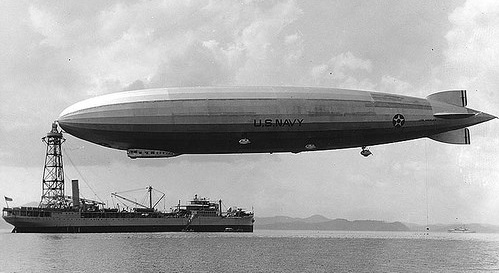
Built by Luftschiffbau Zeppelin GmbH as LZ 126 in 1923-1924 and handed over to the United States as a part of war reparations as the US Navy rigid airship ZR-3 USS Los Angeles. LZ126 has a distinction of being the first German-built dirigible to cross the Atlantic.
USS Los Angeles, upside down after a turbulent wind from the Atlantic, Lakehurst, New Jersey, 1926
Four airships on the ground (USS Akron, USS Los Angeles, Goodyear RS-1, Pony Blimp)
The Los Angeles (ZR-3) served with the U.S. Navy until decommissioned in 1932, and dismantled in 1939. The longest-serving US military airship.
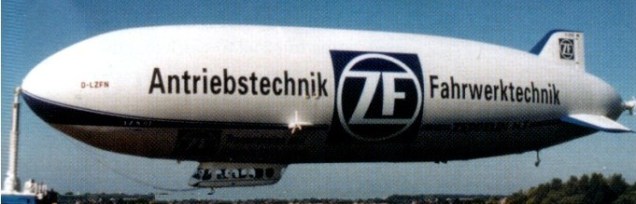
The 75m prototype Zeppelin NT LZ07 first flew in 1997. A semi-rigid airship, the LZ07 received type certification in the commuter category for up to 19 passengers.
In May 2011, Goodyear announced it will be replacing its fleet of three blimps with three semi-rigid airships built by Luftschiffbau Zeppelin.
The new airships are faster, quieter, larger, easier to fly and more manoeuvrable than the blimps it introduced more than 90 years ago. Still, the company plans to keep calling the new models blimps “Because a Goodyear Semi-rigid Dirigible doesn’t roll off the tongue”.
The switch to dirigibles offers a similar-looking, cigar-shaped flying machine but one that’s nearly the length of a football field and about 15 metres longer than the old blimps. With room for three engines instead of two, it will be able to hit speeds of over 110 kilometres per hour.
The quieter engines also will provide an advantage in covering golf tournaments. The ability to hover will allow a pilot to better position the aircraft to capture NASCAR race finishes and key moments in a baseball game.
Construction began in 2012 on the first of three new semi-rigid airships; the first completed in March 2014.
Assembly of Wingfoot One began in March 2013 at Goodyear’s Wingfoot Lake hangar. An international team of engineers and technicians from Goodyear and Germany’s ZLT Zeppelin Luftschifftechnik worked side by side to complete the build project. Parts such as the tail fins and gondola were built in Germany and shipped to the U.S. for assembly. The balloon-like body of the airship – the “envelope” – is made of polyester with an innovative film from DuPont™ called Tedlar®, surrounding a semi-rigid internal structure, which differentiates this airship from previous Goodyear blimps.
Spirit of Innovation, a model GZ-20A blimp (non-rigid airship), was retired on March 14, 2017, and Wingfoot One (N1A), the first such model in Goodyear’s U.S. fleet, was christened on August 23, 2014, by Good Morning America anchor Robin Roberts, near the company’s world headquarters in Akron, Ohio. Wingfoot Two, the name of Goodyear’s second semi-rigid airship, was unveiled in April 2016.
Wingfoot One (N1A (model LZ N07-101), based in Pompano Beach, Florida
Wingfoot One N1A
Wingfoot Two (N2A) (model LZ N07-101), based in Suffield Township, Ohio
Wingfoot Two N2A
All three craft will be outfitted with LED sign technology Goodyear calls “Eaglevision.” This allows the aircraft to display bright, multi-colored, animated words and images. Goodyear also has blimps operating in other parts of the world. These airships are built and operated by Van Wagner of Orlando, Florida.
The new airships are 246 feet long, 52 feet longer than Goodyear’s old model, the GZ-20. The Zeppelin NT model is also slimmer, has a top speed of 70 miles per hour (versus 50 for the blimp), and has a passenger gondola that seats 12 (compared to seven in the blimp). The gondola even has a bathroom.
The blimps are filled with helium. The helium is maintained under low pressure, so small punctures do not pose serious consequences for the blimp. One inspection element of the blimps is to look into the envelope for pinpoints of light which are indicative of small holes.
Goodyear decided a celebration for its centennial year the main event was giving the iconic airship a retro makeover with a black-and-silver color scheme, complete with a vintage Goodyear logo and a reappearance of the blue-and-yellow Goodyear “house flag” that donned the side of the company’s earliest blimps. The retro design is intended to replicate the look of the first Goodyear blimp, dubbed “Pilgrim,” that appeared 100 years ago. It’s important to know that only one Goodyear blimp, Wingfoot One, gets the special treatment. There were currently four Goodyear blimps wafting overhead in 2025: Wingfoot One, Wingfoot Two, Wingfoot Three, and a fourth airship based in Germany, Europe Blimp. It is operated by noted blimp company Zeppelin. These three blimps will maintain their current blue-and-yellow design.
The L70 (company designation LZ112) represented the final type of military Zeppelin (Zeppelin Typ X), and was conceived around the importance of making an entry to the Atlantic round the north of Scotland and having swift climb characteristics, the emphasis therefore being put on fuel capacity and a lightened structure.
Four airships of this type were planned, of which L70 was the prototype, and the only one to be powered by seven engines, unique among naval lighter-than-air craft. It was work over the Dogger Bank that found L70 on its first operation, a routine patrol during which units of the British fleet were reported. Despite the heavy cloud, course was altered and the targets identified, 10 bombs being dropped on the ships despite concentrated anti-aircraft fire, an example of the type of action in which lighter-borne interceptors would have been of use.
Zeppelins of this type were not planned for patrol work alone however, and despite the fact that by 1918 aeroplanes were exhibiting much greater usufulness for attacks on targets in the British Isles, the day of the airship was not completely over. Thus the L70 was committed to a raid on 5 August, an attack that some thought foolhardy since it was planned to take place before it had grown completely dark. This is the action which cost the lives of not only the entire crew, including the commander Kapitänleutnant von Lossnitzer who had been responsible for the attack on the naval vessels, but also Peter Strasser.
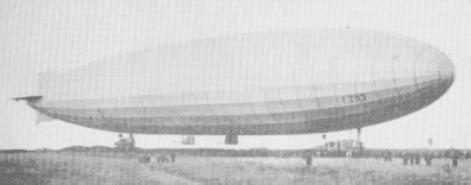
Of the planned four units of the Typ X variants, only two others were built, though only one was commissioned into the Germany navy. This was the L71 (LZ113) later handed over to the UK. The L72 (LZ114) was completed after the Armistice as the Dixmude and was delivered to France as part of war reparations. These vessels differed from the L70 in having six Mb IVa engines and a volume of 68500 m3 (2,419,059 cu ft) in a hull lengthened to 226.5 m (743 ft 1.3 in).
LZ113
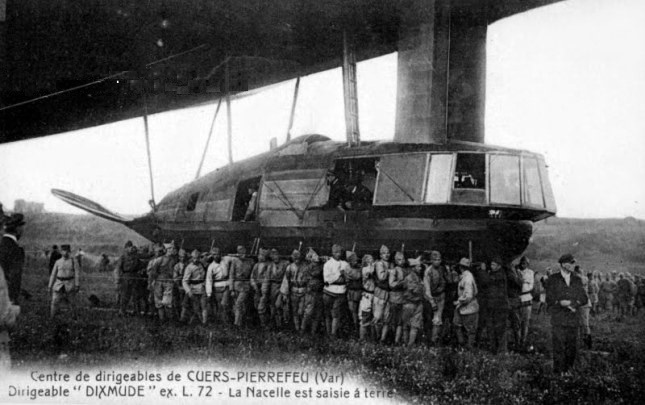
The French ex-German LZ114/L 72, renamed Dixmude, was lost with all hands (44-man crew) between Sicily and Tunisia on December 21, 1923.
French Navy airship Dixmude
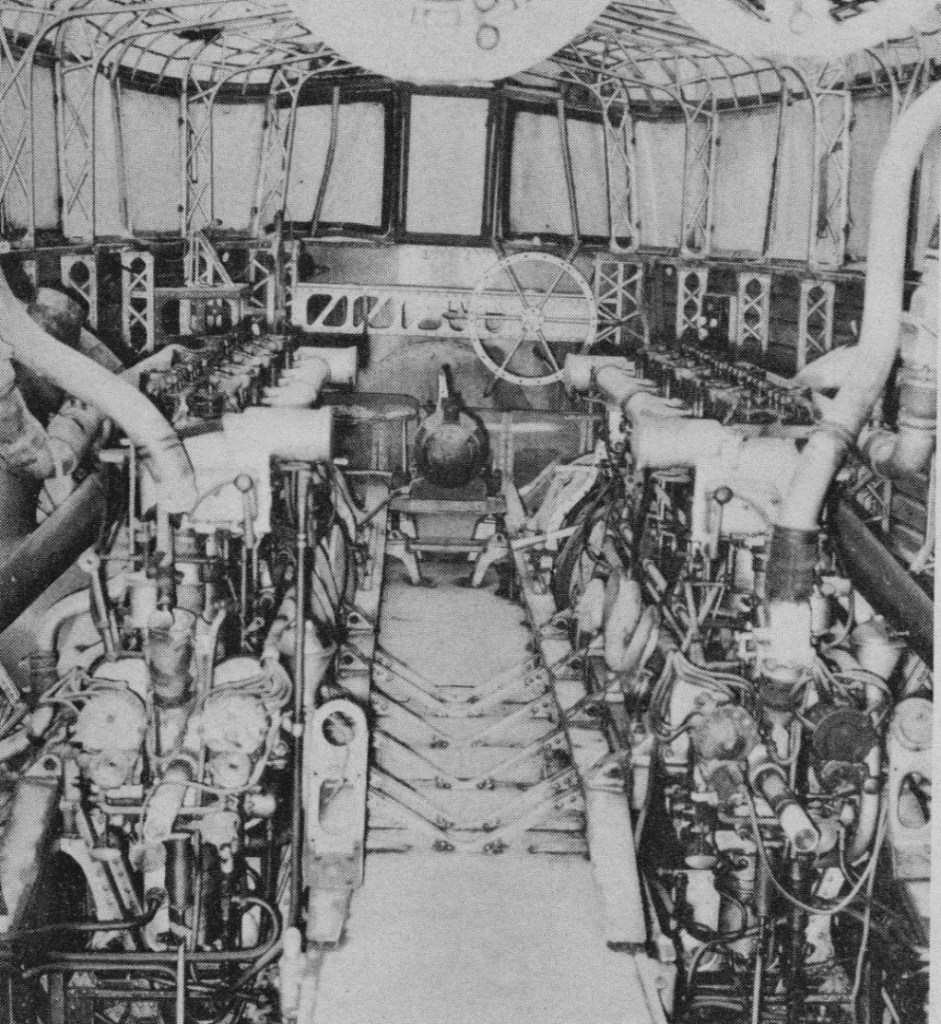
The rear nacelle of the L- 71 (LZ 113) “X” Class Super Zeppelin was given the France in 1920 and located at the Musee de L’Air,
L- 71 (LZ 113)
L70 (Zeppelin LZ112) Type: strategic bomber and patrol airship Powerplant: seven 193.9-kW (260-hp) Maybach Mb IVa six-cylinder water¬cooled piston Maximum speed 130 km/h (81 mph) Service ceiling 7000 m (22,9660 ft) Range 6000 km (3728 miles) Empty weight 28260 kg (62,303 lb) Useful lift 43500 kg (95,901 lb) Diameter 23.95 m (78 ft 6.9 in) Length 211.50 m (693 ft 10.8 in) Volume 62200 cu.m (2,196,576 cu ft) Armament: up to 10 7.92-mm (0.312-in) Maxim machine-guns on free mountings above hull, plus bombs
L- 71 / LZ 113 Engines: 7 x H.S.L.U. Maybach, 240 hp Length: 693 ft Diameter: 79 ft
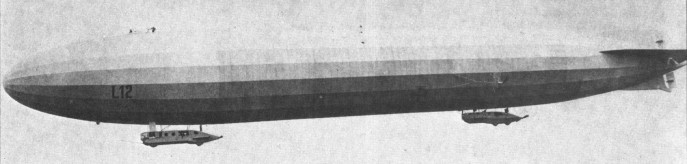
While being built as a Zeppelin Typ V, the L59 (LZ 104) was hurriedly leng¬thened as the second Zeppelin Typ W. This was to replace the L57 which had been chosen for a special mission in November 1917 and, as the LZ102, con¬verted from a Typ V to the first Typ W before being damaged in a storm in October. L57 was intended to fly to German East Africa to aid General von Lettow-Vorbecks forces in the theatre by flying out a sizeable quantity of sup¬plies; the vessel was thereafter to be used as a bomber. Together with the best men of his crew (the cream of each usually moved with the commander) Kapitän¬leutnant Ludwig Bockholt from L57 took charge of L59 without delay, and such was the urgency of the mission that when a member of the crew was discovered to have sold a large part of the rations and made up the cases with the equivalent weight, there was no time to re-provision and the deficit had to be made up with emergency self-heating foods. Although crews for bombing mis¬sions were sometimes reduced to 15 to allow an enlarged offensive load, the full complement of 21 was carried when the vessel set out in November. However, the airship was forced to turn back twice, on the second occa¬sion as a result of damage caused by rifle fire from Turkish railway guards, so that a 32-hour return journey re¬sulted in the next attempt being de¬layed until suitable weather on 20 November. In point of fact a large portion of von Lettow-Vorbecks forces had been forced to surrender on the same day, the commander escaping with a small party to continue the fight after captur¬ing Portuguese supplies, but the recall by radio failed to be picked up in L59. Instead course was set across the Libyan desert where the heat made the vessel difficult to control after gas had been lost through the automatic valves; soon after this one engine began to give trouble. The vessel was beyond the Nile when one of the recall signals was finally heard and the long return trip began. The tropically-kitted crewmen were by now not only exhausted but suffering from the cold at the height where the flight was taking place, but the finaf leg of the journey was suc¬cessfully completed and rightly hailed as a triumph by the German Naval Airship Service, which was still re¬garded as experimental with the officers and men undergoing ‘on the ]job’ training. The problem remained what to do with the vessel and after a lengthy dis¬cussion it was decided to rebuild her for attacks against targets in the Mid¬dle East and Italy, and for these she was back at Jamboli (from which the African trips had begun) in February 1918. It was flying from here on 7 April 1918 that L59 mysteriously blew up not far from the heel of Italy.
L59 (Zeppelin LZ104) Type: strategic bomber and patrol airship Powerplant: five l79-kW (240-hp) Maybach HSLu six-cylinder water¬cooled piston Maximum speed 108 km/h (67 mph) Service ceiling 8200 m (26,903 ft) Range 8000 km (4,971 miles) Empty weight 27625 kg (60,903 lb) Useful lift 52100 kg (114,861 lb) Diameter 23.95 m (78 ft 6.9 in) Length 226.50 m (743 ft 1.3 in) Volume 68500 cu.m (2,419,059 cu ft) Armament: provision for up to 107.92-mm (0.312-in) Maxim machine-guns above hull, plus bombs
Apart from the historical factors surrounding the last operation carried out by L53, this Zeppelin Type V airship was also of some technical prominence. This lay in the fact that her construction embodied an increased spacing of her main frames, which were now 15 in (49 ft 2.5 in) apart compared with the previous norm of 10 in (32 ft 9.7 in). Measures such as these served to lighten the L53, contributing to the fact that her useful lift was some 62.7 per cent of the total, so that on her maiden raid an altitude of 6300 in (20,670 ft) was attained. Alternatively known by the works designation LZ100, this airship made its first flight on 18 August 1917 from Friedrichshafen where she had been built, and became the command of one of Peter Strasser’s most senior officers, Kapitanleutnant der Reserve Eduard Proelss. He first brought his new charge over the British Isles on the night of 24/25 September 1917 when raids were directed against targets in the Midlands and north east, 17 months after his first bombing sortie in L13, his previous command. However, it would be wrong to give the impression that Zeppelins were entirely directed to bombing missions against land targets. L53 is an illustra¬tion of this fact since of the 23 operational sorties made by this vessel be¬tween her commissioning date on 21 August 1917 and her fiery end on 11 August of the following year, only four were bombing attacks. The remainder were scouting missions over the North Sea where the endurance of lighter-than-air craft made them superior to any conventional aeroplane of the day Small wonder therefore that L53 and her nine sister craft (L55/LZ101, L56/ LZ103, L58/LZ105, L60/LZ108, L61/ LZ 106, L62/LZ 107, L63/LZ 110, L64/ LZ109 and L65/LZ111) were regarded as a standard scout type. All after L56 were fitted with Maybach motors of the supercharged Mb IVa type.
On 21 June 1921, returning from another trial flight, Beadmore R36 suffered damage during landing. The release of emergency ballast caused a sharp pitching up, straining the ship against the mooring line. The nearest unoccupied sheds were at Howden in Yorkshire since the Pulham sheds were holding German Zeppelins handed over as war reparations. The wind increased and it was decided that the LZ 109 (L 64) would have to be sacrificed to save the R36. Within 4 hours L 64 had been cut into pieces and cleared to give enough room for R36. Even then she was damaged by a gust of wind during the manoeuvre into the shed.
L53 (Zeppelin LZ100) Type: strategic bomber and patrol airship Powerplant: five 179-kW (240-hp) Maybach HSLu six-cylinder water-cooled piston Maximum speed 106 km/h (66 mph) Service ceiling 6400 m (20997 ft) Range 4680 km (2908 miles) Empty weight 24500 kg (54013 lb) Useful lift 40460 kg (89,199 lb) Diameter 2390 m (78 ft 4.9 in) Length 196.495 m (644 ft8 in) Volume 55990 cu.m (1,977,271 cu ft) Armament: two 7.92-mm (0.312-in) Maxim machine-guns on free mountings in single position above forward hull, plus bombs
January 1915 was the date set for the introduction of a new type of German bomber airship, the Zeppelin Typ P. In point of fact the first of the new vessels was four months late in making its appearance, the lead ship L10 (buil¬der’s designation LZ40) being deli¬vered in mid-May. Armament was two 7.92-mm (0.312-in) Maxim machine-guns on free mountings in single gun position above the forward hull. The ship was sent on its attack against targets in England in the following month with a raid on London, it being believed at all levels and on both sides of the North Sea that the selection of individual targets was possible. In point of fact, the weather took a hand, and L10 was able to get only as far as Gravesend, where its bombs chanced to set light to a military hospital with a consequent reaction against such ‘frightfulness’. Another attack was mounted 11 days later when Jarrow and South Shields were the targets, despite heavy fire from the defence batteries on the coast. Three other occasions found the new Zeppelin over the British Isles from a total of 28 military excursions from Nordholz. The German system of organization meant that the flights were usually carried out by the same crews, so that some became more ex¬perienced than others, but mindful of the dangers the men tended to live only for the day and to endure bomb¬ing trips under thousands of cubic metres of explosive gas and in numb¬ing cold as best they could. Strangely, it was on what should have been an uneventful flight, a mari¬time reconnaisance on the afternoon of 3 September 1915, exactly a year be¬fore SL11 was destroyed, that the L10’s career ended. While the airship was making ready to land back at Nordholz near Cuxhaven, the order to valve off gas was given as a normal preliminary to making landfall. Unfortunately a thunderstorm happened to be raging and the naval airship was struck by lightning. There was a violent explo¬sion before the vessel plunged into the shallow waters below, where it burned for several hours. All aboard perished, Kapithnleutnant Hirsch the comman¬der and his crew of 18. Total produc¬tion of the Type P was 10 units, L10 to L19 (builder’s designations LZ40, LZ41, LZ43, LZ45, LZ46, LZ48, LZ50, LZS3, LZ52 and LZ54 respectively).
L10 (Zeppelin LZ40) Type: strategic bomber airship Powerplant: four 156.6-kW (210-hp) Maybach CX six-cylinder water-cooled piston Maximum speed 95 kph (59 mph) Service ceiling 3900 m (12,795 ft) Range 2150 km (1,336 miles) Empty weight 21100 kg (46,518 lb) Useful lift 26200 kg (57,760 lb) Diameter 18.70 m (61 ft 4.2 in) Length 163.50 m (536 ft 5 in) Volume 31900 c.m (1,126,540 cu ft) Armament: two 7.92-mm (0.312-in) Maxim machine-guns
The 1916 L.30 Class were about 643 feet long, with a capacity of 1,907,000 cubic feet, and were powered by six 240-h.p. engines driving two blade props and used a considerably modified girder construction in the hull. Maximum speed was 60 m.p.h., carry¬ing a 22-ton load. They carried incendiary and high -explosive bombs from 110 to 660 lb. in weight.
With a volume of 55,000 cubic metres and a length of 198 metres, the L30 had a top speed of 100 kilometres per hour.
In 1916 new airship was in the process of being designed when a stroke of luck, caused the latest German airship technology to be handed to the British on a plate. On the night of 23rd/24th September 1916, the German Zeppelin L-33 was brought down at Great Wigborough, Essex. The L-33’s commander had been participating in an air raid on London when it was damaged by antiaircraft fire, and then intercepted and brought down by a night fighter who’s fire failed to ignite the hydrogen. However so much damage was done to the gasbags and fuel tanks that the ship was forced to descend. The German crew attempted to destroy the ship instead of it falling in to enemy hands but so little hydrogen was left that only the doped fabric lit when they fired signal flares in to the hull. The L-33 was virtually intact and her motors were undamaged. In one stroke the British had been handed a near perfect ship full of the latest German technology.
Immediately a crew of investigators recorded every feature of the ship in detail. This top-secret record took five months to complete. The designs for the R34 and R34 were put on hold whilst this was being undertaken. It was with this information that the British designers could adapt the plans to include what the Germans had done so successfully, and this enabled the design teams to produce near copy designs for the R 33 and R 34. The R33 was allocated to Armstrong and Whitworth at their Barlow works just some 3 miles south of Selby, Yorkshire.
DELAG, the Deutsche Luftschiffahrts-Aktiengessellscaft, was funded in part by the Hamburg-Amerika Shipping Company and from money raised by those cities involved in the undertaking. Each city, in addition, provided ‘aerial harbours’; erecting airship sheds at their own expense to house the fleet of airships. Although no scheduled passenger services ensured, excursion flights of several hours’ duration at 100 Marks per head proved popular to Germans and foreigners alike over the four years of operation.
The first airship destined for service was the LZ-7 Deutschland. Following this in the years preceding the war came the airships LZ-10 Schwaben, Sachsen, Viktoria Luise and the Hansa, which between them carried over 35,000 fare-paying passengers in 1588 flights, covering 170,000 miles without serious mishap.








 All Aero