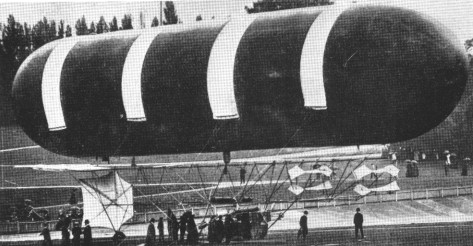
H.M. Balloon Factory Nulli Secundus

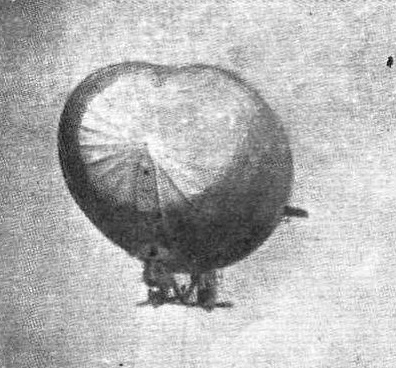
Nulli Secundus

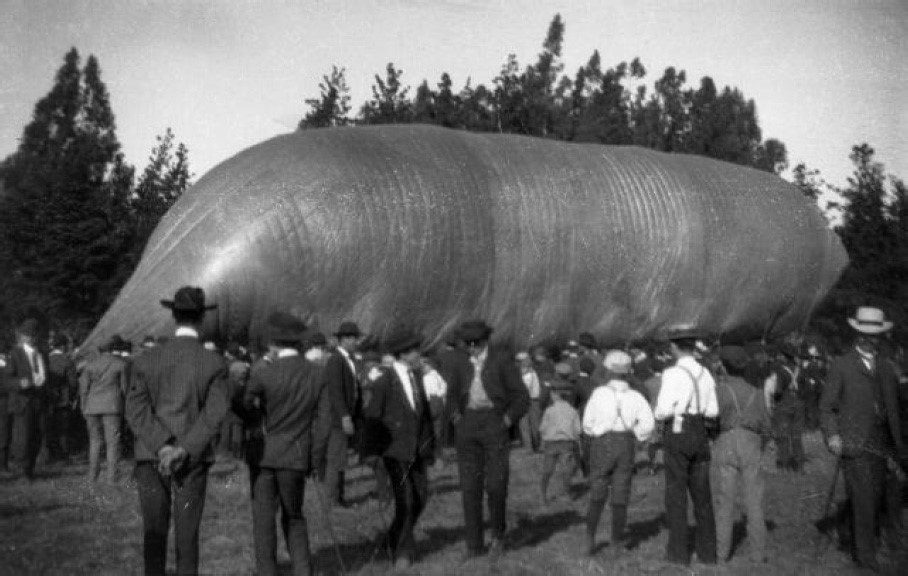
The first official government interest began in 1907 at Farnborough where, after receiving a small grant from the War Office of £2000, Colonels Capper and S.F.Cody wre able to start work on the first of the army airships, the Nulli Secundus.

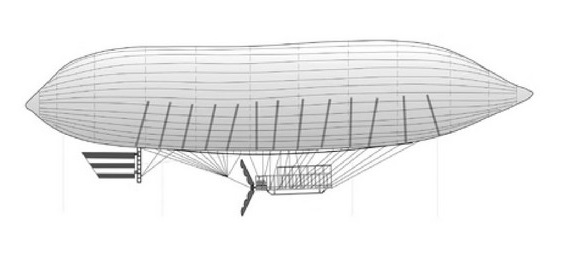
The airship was designed as a semi-rigid and was to be built under conditios of the greatest secrecy. A noticeable feature of the completed craft was the long, uncovered square section metal keel suspended 12 feet below a cylindrical goldbeaters’ skin envelope of 56,000 cu.ft capacity. With a length of 120 ft, power was provided by a 50 hp Antoinette petrol motor, which doubled as the power unit for Cody’s Army Aeroplane No.1, and which drove two aluminium paddle propellers on each side of a small car suspended below the keel containing the crew of three.

An advanced feature of the propellers was that they represented the first use of a variable pitch mechanism in any aircraft, so that the blades coulb be set at an optimum angle of attack. The envelope lacked an internal balloonet compensating for the expansion of gas as the airship rose to a moderate altitude. They did include an automatic gas valve and two hand-operated manoeuvring valves.

The envelope was attached to the keel framework by four circumferential cloth bands and covered with cord netting. The netting bands being made necessary despite the extra weight due to the extreme difficulty of attaching suspension wires or other attachments to the goldbeaters’ skin fabric. Twin rudders were fitted aft, while the elevating plane was situated at the bow in the hope of providing vertical control.

On September 10th, 1907, Nulli Secundus made her maiden flight. A series of short, local flights were made at Farnborough where a speed of 16 mph was obtained.
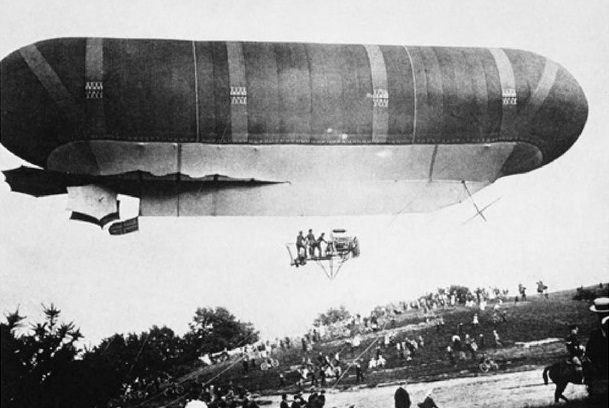
Following these tests Nulli Secundus departed on 5 October to fly to London, landing after a three and a half hour flight at Crystal Palace. Piloted by Capper and Cody, she set up an endurance record for non rigids by staying in the air for 3.5 hours on the journey from Farnborough to London. The achievement was unfortunately crowned by anti-climax, for excessive headwinds forced the airship down at Crystal Palace on the way back. Strengthening winds threatened to damage the moored ship and the sargent in charge instead ordered the ship to be inflated and it was returned to its base by road.

In December 1907, Cody began to build his first biplane at Farnborough, and Nulli Secundus was being rebuilt to emerge as Nulli Secundus II the following summer.

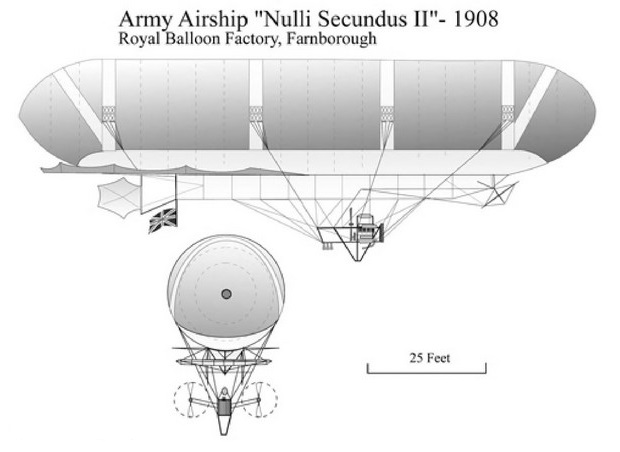
During the winter month the airship was rebuilt, emerging as Nulli Secundus II of a slightly increased capacity with a new, streamlined silk-covered deep keel that was attached directly to, and faired into, the underside of the envelope. Nulli Secundus II had made its first flight on July 24th, 1908. Several local flights were made during July and August, where a speed of 22 mph was recorded however both vertical and horizontal control was deemed to be inadequate and the airship was dismantled at the end of 1908.

In May 1909, after withdrawing its support for aeroplane experiments, the War Office reorganized the Factory for the primary task of producing airships.

Nulli Secundus II 1908
Capacity: 56,000 cu.ft
Length: 120 ft
Diameter: 26 ft
Height: 44 ft
Gross lift: 1.0 ton
Disposable lift: 0.20 ton
Engine: 1 x Antoinette, 50 hp
Speed: 12 mph
Endurance: 4 hr
Crew: 3
H.M. Balloon Factory

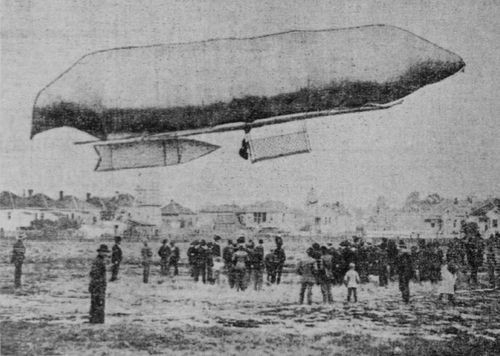
It was in the early 1860s that a Royal Engineer officer, Lieutenant George Edward Grover, first began to investigate the use of balloons for military purposes. It took Grover some fifteen years before he persuaded the War Office to carry out trials with free and tethered observation balloons, but in 1878 such a series of tests was carried out at Woolwich Arsenal, introducing aeronautics for the first time to the British Army. These experiments resulted in the first ever Air Estimate, when the War Office voted £150 to build a balloon designed by Captain J.L.B. Templer of the 2nd Middlesex Militia; the Pioneer.
Templer was, though unofficially, designated as instructor to the Corps of Royal Engineers in the art of ballooning, which duty he carried out with Pioneer and another balloon of his own. At Woolwich, a Balloon Equipment Store was set up under Captain R. P. Lee, R.E., beginning the RAF.
From these foundations there was formed, in 1890, a Balloon Section of the R.Es., now trans¬ferred to new quarters at Aldershot; the Air Estimate had risen from the initial £150 to a figure of £4,300; and Major Templer was now ‘Officer in Charge of Balloons’. In 1894, when the establishment’s title was once again changed, he became the Balloon Factory’s first superintendent. The Superintendent of the Balloon Factory at Aldershot, Lt. Col. J. L. B. Templer, went to Paris to find out all about Santos Dumont’s airships. On his return, he extracted £6,000 from the Treasury to conduct, similar experiments in Britain. This covered the cost of the envelopes for two airships, but no engines, so work came to a temporary halt in 1904.
The outbreak of the Boer War in 1899 meant considerably increased production at the Factory.
The Man lifting Kite Section had been formed in 1894 under Capt. B. F. S. Baden Powell, but it did not come into prominence until 1906, when “Colonel” S. F. Cody was appointed Chief Instructor in Kiting. Until his death in an aircraft accident seven years later, this colourful figure with the goatee beard, and long hair sprouting from under an enormous Stetson hat, remained a dominant figure in British aviation, combining rare skill and courage with a flair for showmanship that was displayed not only in his personal appearance but in stunts such as crossing the’ Channel in a small boat towed by several of his kites. Although unrelated, he traded on the publicity value 6f his famous namesake and fellow American, Col. “Buffalo Bill” Cody, and was to be seen astride a richly saddled white horse almost as often as on the pilot’s seat of an aircraft.
In 1905 the Balloon Factory, together with the Balloon Section, R.E., was moved to South Farnborough
In April 1911 the Factory changed its title again it was now the Army Aircraft Factory, a shift of emphasis reflected in the year’s Air Estimate of £85,000 for dirigibles and aeroplanes and the R.E. Balloon Section closed down.
On April 11, 1912, the Army Aircraft Factory became the Royal Aircraft Factory.

Heaton California Messenger

George E. Heaton’s 1904/05 Oakland/Bay-area airship, the California Messenger, making its first trial on December 2, 1904, at a field in East Oakland (north of the Tidal Canal, east of 23rd Ave.). At Idora Park during the following February it was on the California Messenger which world-renowned birdman Lincoln Beachey made his first powered-flight.

Haenlein Airship

In 1860 Belgian Etienne Lenoir patented a gas engine fuelled by coal gas. Paul Haenlein employed a four-cylinder Lenoir engine producing 5 hp in his airship at Brunn in 1872.

The airship’s varnished silk envelope was filled with coal gas, which supplied the engine at a rate of 250 cu.ft of gas per hour, turning a large propeller at 40 rpm. Internal pressure was maintained by a ballonet supplied with air rom a mechanical pump, fitted to compnsate for the coal gas burned in flight. During the first trial at Brunn in December 1872, perceptible control and a degree of acceleration were evident, with the craft achieving 11 mph.

Despite the initial success of this and further trials, the early Lenoir engines suffered from a poor power-to-weight ratio and low power. Haenlein eventually abandoned his work, frustrated by the lack of suitable engine.

Envelope capacity: 72,000 ft
Length: 150 ft
Diameter: 30 ft
Height: 44 ft
Gross lift: 2.1 ton
Disposable load: 0.30 ton
Engine: 1 x Lenoir 4 cyl gass, 5 hp
Speed: 11 mph
Range: 10 mi
Crew: 1

Gross I / II / IV

The Gross I of 1908 was superior in every way to the contemporary British Nulli Secundus, with the British airship being capable of only 13 mph and only able to stay aloft for four hours.

Conversly, the efficient Gross II made a record flight of 13 hours in September 1908, and later the larger Gross IV of 1913 was accepted for service by the navy for use in the Baltic where it performed useful work during the war. The Gross II was frequently moored out to sea anchors, demonstrating its handiness to be speedily dispatched on patrol, and was one of the few airships to successfully make an attack on a British submarine in 1915.

The earlier Gross airships, although used by the army air battalion in a ground support role with the army, were not possessed of any distinctive transferable constructional features and contributed little to the development of the airship itself.

Gross

The German government ordered Major von Gross, the officer commanding the army balloon establishment outside Berlin, to commence the design of a large semi-rigid to match French efforts. Work began in 1906 under conditions of the greatest secrecy, and was to result in the construction of a series of airships distinguished by an envelope of elipsoidal form with a triangular-section, articulated tubular steel keel.

The structure evenly distributed the shear and compressive stresses that resulted from the weight of the cars and other loads, whilst allowing the envelope to retain its shape to the best aerodynamic advantage. The Gross airships were shown to be sturdy and well-engineered craft, the development of which benefited from the availability of almost unlimited resources provided by the German government.

Goodyear RS-1

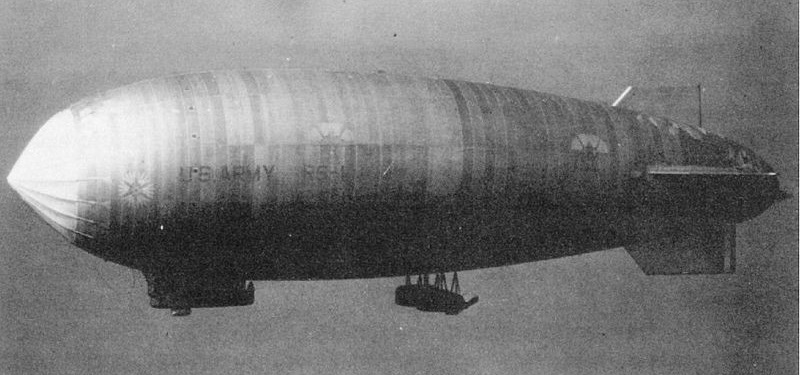
The first semi-rigid airship designed and built in the United States, the RS-1 project was initiated in 1922 and became a joint effort of the Air Service and the Goodyear Tire and Rubber Company of Akron. Ohio. It was designed by Goodyear engineer and inventor, Herman Theodore Kraft. A contract was signed with Goodyear on 13 October 1922 and actual construction was started at the Goodyear facility in Ohio in 1923.

The ship used helium as a lifting medium and power was by four 300 hp Liberty 12 engine. There were two power cars, each having a pair of engines driving a single 17 ft 6 in propeller through a transmission designed and built specifically for the RS-1. The contract to build the transmission was given to Goodyear along with one to built the airship itself. Goodyear subcontracted the transmission to the Twin Disc Clutch Co of Racine, Wisconsin. The design work was done by Thomas Farwick. Three units were built, one for testing and use for any refinements required, and two for installation in the RS-1. The first unit was delivered to McCook Field and passed is 50 hr test in the Summer of 1925. The remaining two units were delivered directly to Goodyear.

The design provided 12 to 5 reduction gearing to a single 17 ft 6 in propeller being driven by either two 300 hp Liberties or by a single one. The transmission could reverse the direction of the propeller but one engine had to be disengaged during the operation. Either or both engines could be disengaged by its own disk clutch.

The engines were mounted in staggered form. Each had its own disengaging clutch. One drove a transmission input through a short shaft and the ther through one long enough to clear its adjacent engine.

The ship was delivered to Scott Field in early 1925 where it was erected. A 35 ft (10.7 m) enclosed control car is suspended from the keel at the nose. Equipment included a bombing cockpit and the ability to carry 3,500 lb (1,588 kg) of bombs, as well as mounts for machine guns on each side at the forward end of the car.

Along the belly of the envelope is an enclosed aluminium alloy keel, suspended by catenary cables, which attach to the three points of the keel at 10-ft. intervals. The load coming on the centre catenary gives the envelope a heartshape transverse cross-section, of which the greatest dimensions are 66.5 ft by 73 ft high. The envelope is divided into four compartments by transverse diaphragms. The centre diaphragm is a solid wall, while the end ones have surge holes near the bottom in the gas and air compartments.

It was inflated and subjected to numerous tests and was taken on its maiden flight. The first flight was delayed due to a mistake made by a rigger during erection and eventually took place on 8 January 1926, lasting just over an hour with a crew of eight men.

On its initial trial flight, on January 8, it made a successful trip of over an hour’s duration in a mild snowstorm, carrying a crew of eight men and with Lieut. Orval Anderson in charge. During a subsequent test flight the RS-1 encountered extremely bumpy flying conditions and winds that at times exceeded 50 mph. After a flight of 19 hours’ duration, however, the RS-1 was landed at its home base in a high ground wind without mishap, the personnel rendering a favourable report of the ship’s entire performance.

13 May 1926

In 1927 the Liberty engines were replaced by 2A-1500 Packard engines. The Packards were lighter by about 150 lbs. The normal rating of the Packards was 500 hp at 2000 rpm and 600 hp at 2500 rpm. The props were replaced with 16 ft diameter.

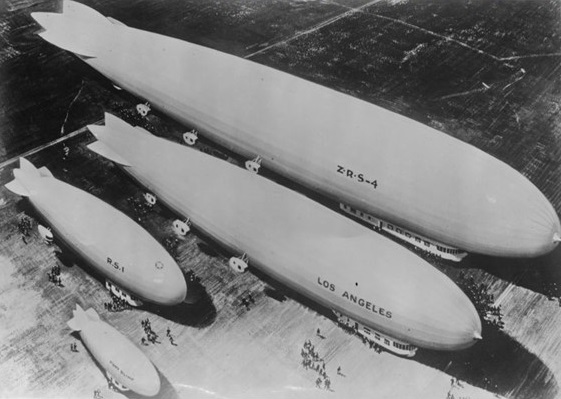
Four airships on the ground (USS Akron, USS Los Angeles, Goodyear RS-1, Pony Blimp)

The airship was taken out of service in November 1928 because of envelope porosity pending its replacement, but because of economic conditions, a new envelope was never installed and the airship was eventually scrapped.

Engines: 4 x Liberty 12, 300 hp / 220 kW
Capacity: 719,500 cu.ft / 20,000 m3
Length: 282 ft / 85.95 m
Diameter: 70 ft 6 in / 21.49 m
Width: 74 ft 6 in
Height: 66 ft
Max speed: 75 mph+ / 121 km/h / 65 kn
Cruise speed: 45 mph / 72 km/h / 39 kn
Useful load: 12,138 lb

Goodyear GZ-20

GZ-20A

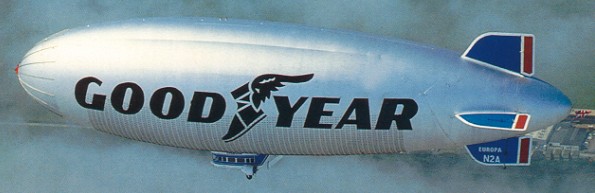
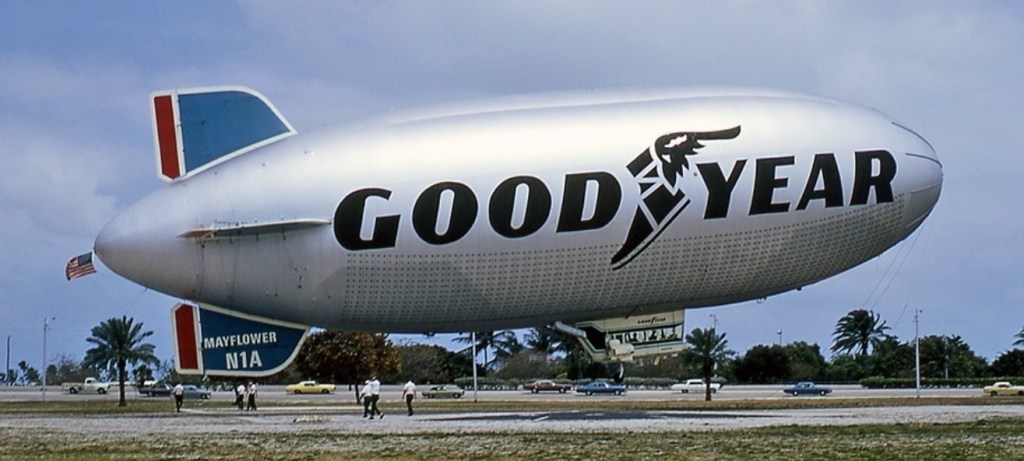
The GZ-20 class was introduced in 1969, with America (N10A) and Columbia (N3A) being the first two. The Europa (N2A) followed in 1972 and was based in Italy, the first Goodyear blimp operated outside of the United States. These blimps are slightly longer than the GZ-19. Beginning in 2014, Goodyear began retiring the GZ-20 and replacing them with the Zeppelin NT. On February 23, 2014, Spirit of Goodyear was retired in Pompano Beach after the 2014 Daytona 500. On August 10, 2015, the California-based GZ-20, the Spirit of America, was decommissioned. The Spirit of Innovation, took over California operations in September 2015 until its retirement in March 2017 as the last remaining GZ-20. In fall of 2017, Wingfoot Two will be relocated to California.

The interest shown by the general public in the Goodyear airships led in 1968 to a major expansion pro¬gramme involving the construction of a new “Mayflower” (GZ 19A) for Miami, a new “Columbia” (GZ 20) for Los Angeles, and a third ship “America” (GZ 20) for a new base near Houston, Texas. The GZ 20 type has an envelope of 202,700 cu.ft. and is powered by two 210 h.p. Continental engines. These ships became operational during 1969 and were joined in 1972 by “Europa” (GZ 20A), a brand new ship based at Rome as part of a new European venture. A completely new ship built at Akron (car) and Litchfield Park, Arizona (Envelope). Assembled and first flown at Cardington, Beds, 10 71 to 3 72.

The GZ 20 commercial airship America first flew in 1969, and was previously Ranger II and L 8. The second “Ranger” was a replacement for the first. Completed after outbreak of war and delivered direct to U.S.N. as L 8 at Moffett Field, 26 2 42. The car returned to Goodyear in 1946 and was stored. Rebuilt as GZ 20 type for AMERICA, 1968 69.

Goodyear operated four helium non-rigid airships, made of neoprene-coated dacron, for publicity and rides.
The Los Angeles based airship Columbia, owned and operated by the Goodyear Tire and Rubber Company, was scheduled to be retired in late July 1975. During six years of operation the Columbia has flown more than 10,200 hours, covering more than 306,000 miles at an average speed of 30 miles per hour.

The blimp will be replaced by another airship bearing the same name, and of the same dimensions: 192 feet long, 59 feet high, and 50 feet wide. The new Columbia will be the 301st airship constructed by Goodyear since 1917, and will join three other Goodyear blimps based in Miami, Houston, and Rome in 1975.

Gallery

GZ 20 AMERICA
Ex RANGER II and Navy L 8.
Registration: N10A.
First Flight: 25 4 69.

GZ 20 COLUMBIA (III)
Ex ENTERPRISE II and Navy L 16.
Registration: N3A.
First Flight: 18 8 69.

GZ 20A EUROPA
Registration: N2A.
First Flight: 8 3 72.
Engines: 2 x Continental IO 360 D, 210 hp.
Length: 192ft 6in.
Maximum Diameter: 46ft.
Volume: 202,700 cu ft.
Max speed: 50 mph.
Cruising speed: 35 40 mph.
Max ROC: 2,400ft/min.
Endurance: 10 hours (with normal tanks), 23 hours (with auxiliary tanks).
Fuel: 138 Imp Gal (normal tanks), 158 Imp Gal (auxiliary tanks).
Max Gross Wt: 12,840 lb.
Empty Wt: 9,375 lb.
Useful load: 3,475 lb.

Goodyear GZ-19

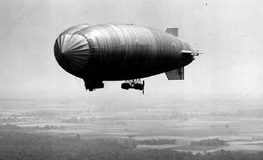
Introduced in 1963 and discontinued in 1978 after the Mayflower (N38A) was destroyed by a tornado, the GZ-19 design for this class resembles the U.S. Navy’s L class blimp.

The interest shown by the general public in the Goodyear airships led in 1968 to a major expansion pro-gramme involving the construction of a new “Mayflower” (GZ 19A) for Miami, a new “Columbia” (GZ 20) for Los Angeles, and a third ship “America” (GZ 20) for a new base near Houston, Texas.

Flying the Goodyear Columbia

Four American completed training for blimps when Columbia was christened in August 1963. Ray Belotti, Oxnad, Calif.; D.E.Swanson, Orange County, Fla; M.R.Johnson, St.Petersburg, Fla, and L.M.Cermak, Akron, Oh, completed 150 hrs of flight instruction including 20 hrs instrument.

The GZ 20 type has an envelope of 202,700 cu.ft. and is powered by two 210 h.p. Continental engines.

These ships became operational during 1969 and were joined in 1972 by “Europa” (GZ 20A), a brand new ship based at Rome as part of a new European venture.

The Goodyear post-war fleet was;
RANGER (III) Registration: N1A. First Flight: 28 5 46.
Ex U.S.N. L 18. To Goodyear 1946. Retired, 30 5 49. Flew again, 24 5 51. Wrecked, Fort Lauderdale, Fla., 26 1 58. Car stored. Rebuilt as GZ 19A type MAYFLOWER IV, 1968.
VOLUNTEER (II) Registration: N2A. First Flight: 26-9 46.
Ex U.S.N. L 17. To Goodyear 1946. Retired, 30 10 49. Car rebuilt as GZ 19A type for COLUMBIA II 1963.
ENTERPRISE (II) Registration: N3A. First Flight: 9 10 46.
Ex U.S.N. L 16. To Goodyear 1946. Retired, 10 12 59. Car rebuilt as GZ 20 type for COLUMBIA III 1969.
MAYFLOWER (II) Registration: N4A. First Flight: 12 5 47.
Ex U.S.N. L 14. To Goodyear 1946. Retired, 24 11 49. Car rebuilt as GZ 19 type for MAYFLOWER III 1958 59.
PURITAN (II) Registration: N10A. First Flight: 27-3 47.
Ex .U.S.N. K 28. To Goodyear 1946. Retired 7 4 48. Reg. transferred to AMERICA 1969.
MAYFLOWER (III) Registration: N4A. First Flight: 25 2 59
Car rebuilt as GZ 19A, 1963. Retired from fleet service, 9 68. Used for R & D work and experimental military duties, 10 68 to 10 69. First airship to fly powered by stern mounted propeller system. Retired, 24 10 69.
COLUMBIA (II) Registration: N2A
First Flight: 23 7 63
GZ 19A type. Retired, 10 69. Ex VOLUNTEER 11 and Navy L 17.

GZ 19A
Capacity: 147,000 cu.ft.
Engines: 2 x 175 h.p. Continental.

GZ 19A MAYFLOWER (IV)
Ex RANGER III and Navy L 18. Registration: N1A. First Flight: 4 9 68.

Goodyear ZPN / ZPG / ZP2N / ‘N’ Class

ZPG-3W

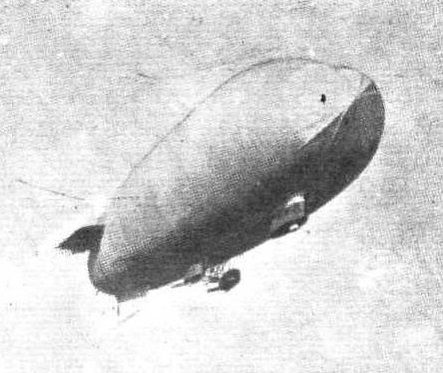
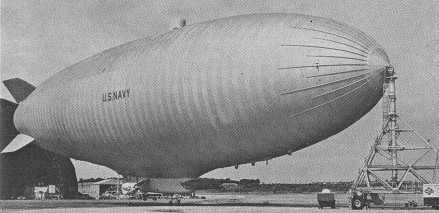
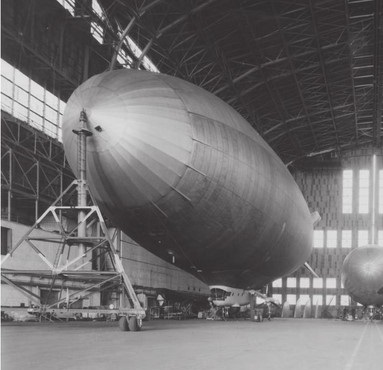
With the end of WW II, the U.S. Navy’s airship service was reduced in size, but new types were developed by Goodyear and brought into service with the Navy. First of these was the N Class of 875,000 cu.ft. flown in prototype form on June 18, 1951. Preliminary ground and flight tests for the prototype were disappointing, mandating further evaluation to explore improvements. The Board of Inspection and Survey trials for N-1 persisted into 1953.

N-1 at Lakehurst, 18 Nov 1952

Under the post war naval airship designation system NA became ZPN 1, and with a further change in 1954 became ZPG 1. This greatly improved, long range patrol ship was 334ft long and powered by, two 800 h.p. Wright Cyclone 7 engines mounted inside the car. A crew of 14 was carried in the double decked car which gave much improved messing and sleeping arrangements compared with those of the wartime ships. One of the most notable external features of the design was the angled position of the tail surfaces, so arranged to, help keep the overall height of the ship (96ft) within the limits of existing sheds. Only one example of this type was built, (GZ 9) but it served as the basis of the later ZPG 2 and ZPG 3 ships.
After extensive evaluation trials with the prototype ZPN 1, an improved and slightly larger version, the ZP2N4, was completed and flown on March 20, 1953. This type was put into production in two forms known as the ZPG 2 patrol version and the ZPG 2W Airborne Early Warning version. The ZPG 2 of 975,000 cu.ft. was powered by two 800 h.p. Wright Cyclone 7 engines driving Curtiss Electric three blade, variable pitch, reversible propellers on out riggers projecting from each side of the car.
The control car accommodated the fourteen crew on two decks, with all operational stations on the lower deck and crew’s quarters on the upper deck. All control surfaces were operated by a single control column, duplicated for the pilot and co pilot; a major departure from the previous normal airship practice of separated elevator and rudder control wheels. The ship was also equipped with an autopilot which was of immense value in reducing crew fatigue on patrols lasting two or more days.
Twelve were 12 built 1953-1955 and were in service to 1961.
The ZPG-2W version was essentially the same except that it carried large quantities of sensitive, long range, radar equipment for aircraft detection, and a large radome on top of the envelope. This could be reached from the control car by way of a 75ft vertical tunnel inside the envelope. The, ZPG 2s made many long flights, setting up World endurance records in May, 1954, of 200.4 hours continuous flight, and in March, 1957, of 264.2 hours (11 days), both flights without refuelling. The second flight took the airship from its base at Weymouth, Mass., to Key West, Florida, by way of Portugal and North Africa, 8,216 miles in all.
Five were built 1957 1958 and were in service to 1961.
As a further development of the ZPG type, the ZPG-3W appeared in July, 1958. The largest non rigid airship ever built, it was 404ft long with an envelope capacity of 112 million cubic feet. Power was provided by two specially developed Wright Cyclone 9 engines of 1,525 h.p., driving 18ft diameter propellers. Twenty four crew were carried in a car 83ft long, with extensive crew quarters on the upper deck. The envelope itself served as a radome for a 40ft internally mounted radar antenna which rotated within the helium gas. Four were built 1958 1960.
Total post war naval airship production accounted for 55 of the 200 new airships built by Goodyear between December 1939, and July 1963. The last for the U.S. Navy was a ZPG3W delivered on April 4, 1960. At that time the Navy still had 27 airships in commission. However, changes in naval policy and the need for budget savings in the light of the costly new Polaris submarine programme, forced a re think of naval air requirements. On June 26, 1961, the Navy announced that the airship service was to be closed down, a decision which took effect during the following year.
Thirteen naval airships were deflated and placed in long-¬term storage in case of future need, while two ZPG 2s were retained for experimental work with the Airship Test and Development Department at Lakehurst. In addition, one ZS2GA was made available to Mississippi State University for a programme of boundary layer control research on airship envelopes. When these ships, too, were deflated at the end of 1962, forty five years of U.S. Naval airship operations came to an end.
The last Goodyear airship for the American Navy was the ZPG 3W of 1958, the largest non rigid ever built. A 40ft radar antenna rotated inside the envelope. These served until the closure of the airship service in 1962.

Goodyear ZPN

ZPG 1 (GZ 9)
Volume: 875,000 cu ft.
Length: 324ft.
Max Dia: 74ft.
Engines: 2 x 800 h.p. Wright R 1300 3A Cyclone 7.

ZPG 2 (GZ 11)
Volume: 975,000 cu ft.
Length: 343ft.
Max Dia: 76ft.
Engines: 2 x 800 h.p. Wright R 1300 3A Cyclone 7.

ZPG 2W (GZ 14)
Volume: 975,000 cu ft.
Length: 343ft.
Max Dia: 76ft.
Engines: 2 x 800 h.p. Wright R 1300 3A Cyclone 7.

Type GZ 17 (Navy ZPG 3W) 1958
Engines: 2 x 1,525 h.p. Wright R 1820 88 Cyclone 9.
Length: 403ft 6in.
Maximum Diameter: 85ft.
Volume: 1,465,000 cu ft (before stretch).
Maximum Speed: 90 m.p.h.
Cruising Speed: 50 60 m.p.h.
Maximum rate of climb: 2,400ft/min.
Range: in excess of 5,000 miles.
Endurance: 80 hours plus.
Fuel: 4,375 gallons.
Maximum Gross Weight: 93,496 lb.
Empty Weight: 71,130 lb.
Useful Load: 22,366 lb (including dynamic lift).

ZPG 3W (GZ 17)
Volume: 1,490,000 cu ft.
Length: 404ft.
Max Dia: 85ft.
Engines: 2 x l,525 h.p. Wright R 1820 88 Cyclone 9.

ZPN-1
Volume: 875,000 cu. ft.
Length: 324.4 ft.
Engines: two 800 h.p. Wright R1300
Top speed: 85 m.p.h.

ZPG-2
Volume: 975,000 cu. ft