The Kubíček BB Series were originally type certificated in the Czech Republic under CZ TC No. 93-01. (Kubíček Balloons was formed in 1989. Prior to that Mr Kubíček worked under the supervision of Aerotechnik, which was owned by the state military organization.)
The model designation reflects the size of the envelope in cu.m x 102 and the cutting style.
Note the latter was originally missing from the model designation of N-type balloons, but has been added at Change 5 of the TCDS. (Only O-type now have no suffix letter.)
The balloons are natural shaped polyester with either vertical gore or horizontal form (Z-type), and have a range of optional deflation systems. The Flight Manual Limitations Section 2 and the TCDS specifies approved envelope/burner/basket/fuel cylinder combinations. The Kubíček BB have traditional canework basket certified under EASA BA.003..
In 2005 Petr Kubiček, encouraged by aerospace engineering students at Brno University, began to design a modernised Mráz M-2 Skaut with the hope of production.
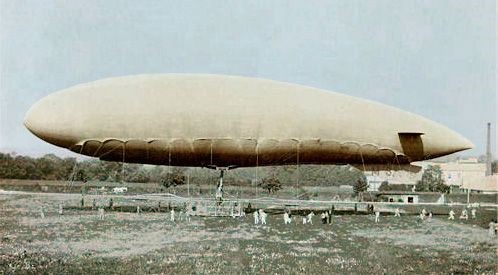
The Körting / Militärluftschiff M.III non-rigid military dirigible was constructed by the firms of Körting and Wimpassing (K-W 1) based on the Parseval-type. It first ascended on January 1, 1911. The “Körting” was Austria’s most successful airship before being lost on a routine aerophotogrammetric mission at Fischamend near Vienna. On June 20, 1914, moments after suffering a glancing mid-air collision with a Farman HF20 – a pusher biplane newly acquired by the military – the hydrogen-filled airship burst into a ball of fire and was dashed to earth. Nine men died including the pilot and observer of the Farman.
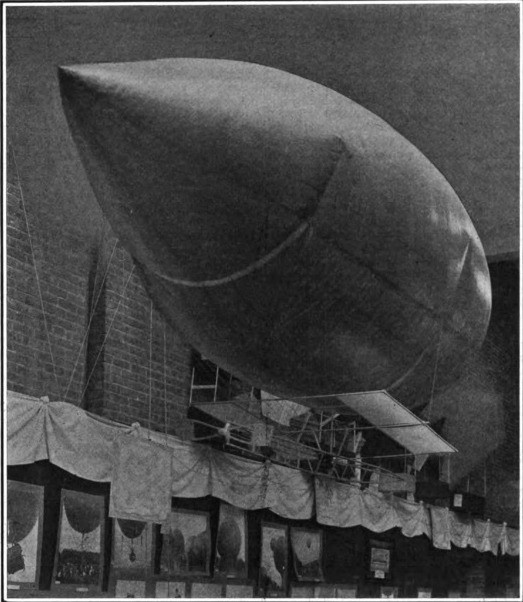
An electrically-propelled dirigible balloon combined with lifting aeroplanes. Its envelope constructed by Carl E. Myers at his balloon farm at Frankfort, N.Y. for Mr. W. M. Keil of Tuxedo Park, N.Y., this Keil-Myers HTA/LTA airship was presented the week of January 13, 1906 at the 69th Regiment Armoury Auto Show in Manhattan, of which the aviation exhibition element was put on by the Aero Club of America. Nothing is known of its existence afterwards.
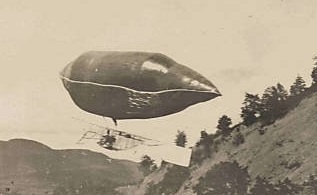
After Charles Oliver Jones aeroplane failed to fly, he turned his attentions to aerial exhibitionism, first building and flying a unique dirigible named the “Boomerang”, then modifying the apparatus in the style of Capt. Baldwin, on which he lost his life when it caught fire during a flight at Waterville, Maine on September 2, 1908.
This is an original Real Photo Post Card of Charles Oliver Jones taking off in his airship “Boomerang”. The site of this photo is near Hammondsport, NY. Jones originally came to Hammondsport,NY where he was apparently influenced by Thomas Scott Baldwin, the famous balloonist, who was working with Glenn Curtiss putting a Motorcycle engine in an aerostat (airship) and built the “Boomerang”. The photo was taken by Sitterly of nearby Bath,NY. Jones died not too long later when the Boomerang caught fire in the air at Waterville.
Charles Oliver Jones in 1905 built the first heavier-than-air craft to be fitted with a Curtiss engine.
Jones was quite active as a socialist lecturer and also an early aeronaut.
He turned his attentions to aerial exhibitionism, first building and flying a unique dirigible named the “Boomerang”, then modifying the apparatus in the style of Capt. Baldwin, on which he lost his life when it caught fire during a flight at Waterville, Maine on September 2, 1908.
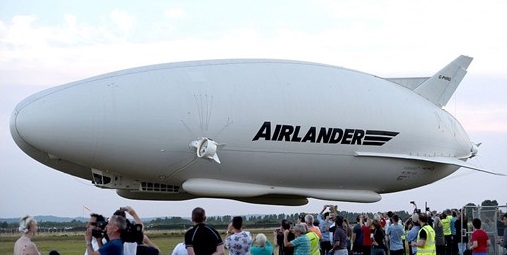
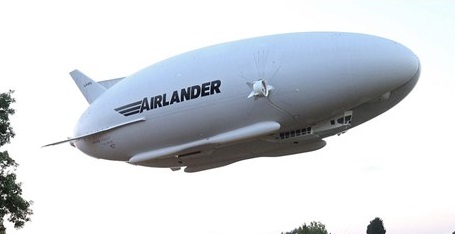
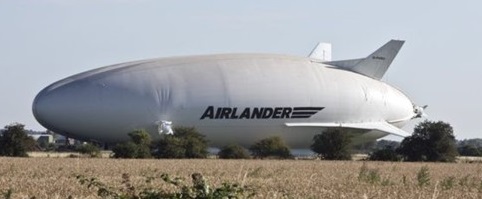
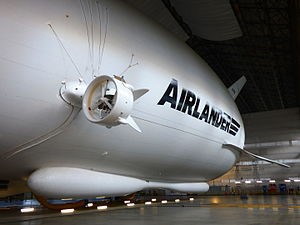
The Hybrid Air Vehicles HAV 304 Airlander 10 is a hybrid airship made by Hybrid Air Vehicles in the UK. It was originally built for the US Army’s Long Endurance Multi-intelligence Vehicle (LEMV) project.
Following the successful demonstration of the HAV-3 small-scale demonstrator, and with Northrop Grumman as the prime bidder, the hybrid airship concept was accepted for the US Long Endurance Multi-intelligence Vehicle (LEMV) project, in preference to the Lockheed Martin P-791 also submitted.
Requirements included the capability to operate at 6 km (20,000 feet) above mean sea level, a 3000 km (2,000 mile) radius of action, and a 21-day on-station availability, provide up to 16 kilowatts of electrical power for payload, be runway independent and carry several different sensors at the same time. According to the U.S. Army, the LEMV was to have been a recoverable and reusable multi-mission platform. It could be forward located to support extended geostationary operations from austere locations and capable of beyond-line-of-sight command and control. Northrop said the LEMV could be used as a cargo aircraft, claiming that it had enough buoyancy to haul seven tons of cargo 2,400 miles at 30 miles per hour.
The HAV 304 was selected by the United States Army for its LEMV programme in which Northrop Grumman was to have been the prime contractor.
The agreement to develop the project was signed on June 14, 2010, between the U.S. Army Space and Missile Defense Command/Army Forces Strategic Command and Northrop Grumman. The agreement also included options for procuring two additional airships.
Northrop Grumman’s subcontractors included: Hybrid Air Vehicles Ltd. in Cranfield, UK (HAV304 platform) Warwick Mills in New Ipswich, USA (fabrics engineering) ILC Dover in Kent County, USA (airship manufacturer and designer) Textron subsidiary AAI Corp. in Hunt Valley, USA (makes the US Army’s OneSystem UAV/surveillance aircraft control & information distribution stations); and SAIC in McLean, USA.
The developmental prototype emerged as the HAV 304, having an internal capacity of 38,000 cubic metres. This compares mid-20th Century airships such as the German Hindenburg-class airships which were 245 m (803 ft 10 in) long.
The airship was a hybrid aircraft and uses aerodynamic lift like a conventional aeroplane to take off before using helium to keep it in the sky once it is airborne. Engines on board are then used to move while it monitors events on the ground. The LEMV’s skin—a blend of Vectran, Kevlar, and Mylar—would have been able to cope with a “reasonable amount of small arms fire.” Northrop estimated that the biggest threat to the craft was weather, where high winds or thunderstorms could buffet the craft.
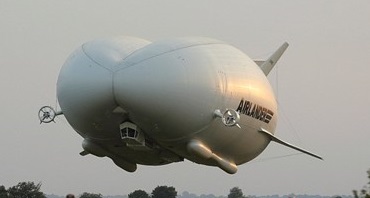
The Airlander, made by British company Hybrid Air Vehicles, has four engines and no internal structure. It maintains its shape thanks to the pressure of the 38,000 cubic meters of helium inside its hull, which is made from ultralight carbon fiber. Together with the aerodynamic shape of its hull, the lighter-than-air helium gas provides most of the lift. The aircraft’s odd shape has led some observers to describe it as a “flying bum.”
The project cost between $154 million and $517 million, dependent on all options. The cost included the design, development, and testing of the airship system within an 18-month time period, followed by transportation to Afghanistan for military assessment.
The timeline for LEMV was an 18-month schedule starting in June 2010 that included vehicle inflation at about month 10. Additional operational characterization would have occurred at Yuma Proving Ground, Arizona, in month 16.
The overall concept struggled with constant time delays and technological challenges. In October 2011 Flight International reported that the LEMV was scheduled to make its first flight in November 2011. According to media reports the LEMV was then set up for its first flight in early June 2012. However, unspecified problems delayed the flight even further. The first flight of the LEMV took place on August 7, 2012 over Joint Base McGuire-Dix-Lakehurst, New Jersey. The flight lasted for 90 minutes and was performed with a crew on board. The first flight primary objective was to perform a safe launch and recovery with a secondary objective to verify the flight control system operation. Additional first flight objectives included airworthiness testing and demonstration, and system level performance verification. All objectives were met during the first flight. That put the combat deployment of the LEMV to Afghanistan in early 2013. However, two months after the test flight, the Army said it had concerns about sending the airship abroad. These included safety, transportation to the theatre of operations, and the timeline of deployment.
The Army was slated to demonstrate the first LEMV in Afghanistan 18 months after June 2010, with proposed plans to build five others following mission completion.
On 7 August 2012 the first test flight of an LEMV was completed at Joint Base McGuire–Dix–Lakehurst, New Jersey. The vehicle tested was one of three planned for the US Army.
The US Army cancelled the LEMV project for cost reasons in February 2013. HAV bought back the airship in September 2013 for $301,000. The cameras, sensors, and communications equipment were removed and the helium was drained before the sale. In 2014—named Airlander—it was reassembled at RAF Cardington in England and re-designated the Airlander 10, to be test-flown in 2016. Hybrid Air Vehicles then managed to raise over 3.4 million pounds ($4.4 million) through two crowd funding campaigns. It also received a grant from the European Union and funding from the U.K. government. The first flight took place on 17 August 2016.
HAV 304 design Length: 91 m (298 ft 7 in) Width: 34 m (111 ft 7 in) Height: 26 m (85 ft 4 in) Envelope: 38,000 cubic metres Engines: four x 350 hp, 4 litre supercharged V8 diesel
Airlander 10 Capacity: 10,000 kg (22,050 lb) Length: 92 m (301 ft 10 in) Wingspan: 43.5 m (142 ft 9 in) Height: 26 m (85 ft 4 in) Volume: 38,000 m3 (1,300,000 cu ft) Gross weight: 20,000 kg (44,092 lb) Powerplant: 4 × 4 litre V8 turbocharged diesel engines, 242 kW (325 hp) each Cruising speed: 148 km/h (92 mph; 80 kn) Endurance: 5 days manned Service ceiling: 6,100 m (20,013 ft) Loiter speed 20 knots (37 km/h)
The British Government formulated plans for the construction of two new airships, the R100 to be built by private enterprise and the R101 to be constructed by the Government Airship Works at Cardington.
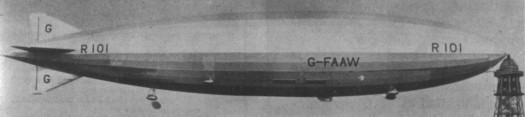
R101 G-FAAW, powered by 650 hp Beardmore Diesel engines, was launched and moored to its mast for the first time on 12 October 1929.
Both airships had their maiden flights in 1929 with R100 being the more successful of the two to the extent that R101 was returned to the Cardington hangar for extensive modification including the insertion of another section into the ship to accommodate an additional gas cell in order to increase her lifting capacity. This added another 55 feet to the length of the ship and further delayed her flight trials.
In the meantime R100 completed a successful trial flight to Canada and back before the modified R101 had begun its trials following the modifications.
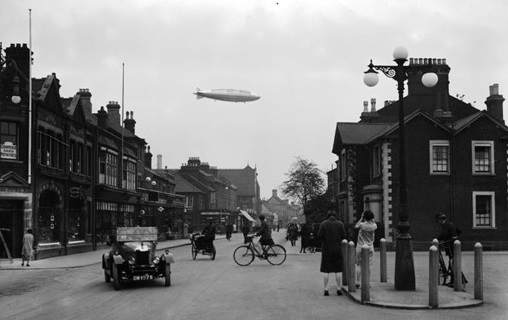
Over Bedford on its first flight
In spite of reservations, held by many technical personnel, as to the airworthiness of the modified ship, pressure brought to bear by Air Ministry Officials and the Secretary of State for Air saw the untried R101 hastily prepared for the inaugural flight to India where a mooring mast and facilities had already been prepared at Karachi.
Upon the successful completion of this flight to India and back hinged the approval of the British Government for an airship service linking the outposts of Empire including a future service to Australia and New Zealand. Sadly, political jealousies between the Government backed faction supporting the R101 and the private enterprise airship, plus the insistence of Lord Thomson, Secretary of State for Air that the India Flight begin without delay saw the R101 lift off from Cardington on 4 October 1930 without having completed its speed trials and with a Certificate of Airworthiness issued without an inspector’s report. R101’s departure was into overcast, wet and stormy weather. Over France worsening conditions were encountered which highlighted the airship’s deficiencies in performance and construction to the extent it became almost impossible to control. Shortly after 2 am on 5 October, almost uncontrollable, the ship made contact with the ground, burst into flames, killing all but six of the 54 persons on board. Among those killed was the Secretary of State for Air on whose insistence the airship began its ill-fated flight long before its airworthiness had been proven. The loss of the R101 heralded the end of the British dream for an airship service linking the outposts of Empire.
Substantially larger than the preceding R31 class, the R33 class was in the design stage in 1916 when the German Zeppelin L 33 was brought down on English soil. Despite the efforts of the crew to set it on fire, it was captured nearly intact, with engines in working order. For five months, the LZ 76 was carefully examined in order to discover the Germans’ secrets.
The existing design was adapted to produce a new airship based on the German craft and two examples were ordered, one (R33) to be constructed by Armstrong-Whitworth at Barlow, North Yorkshire and the other (R34) by William Beardmore and Company in Inchinnan, Renfrewshire, Scotland.
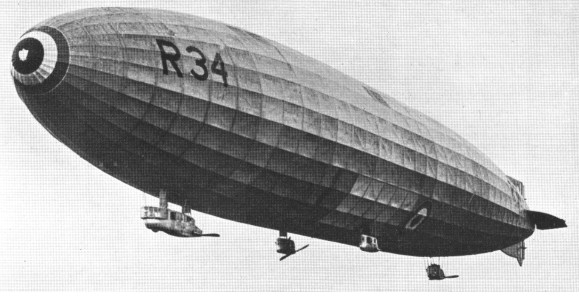
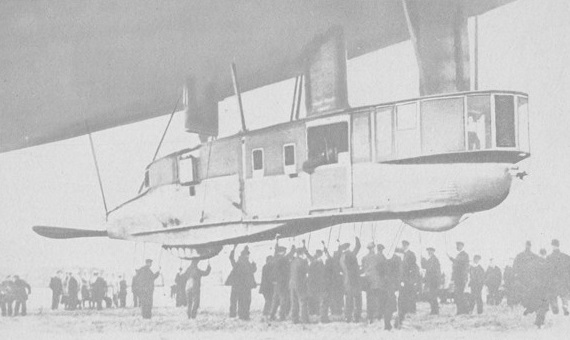
The manufacture of the components for the R33 and her sister ship R34 had begun in the summer of 1917, but the actual construction of the ship in the shed did not commence until the summer of 1918. The ship design was semi-streamlined fore and aft, with a parallel mid-ships section. The main control car was positioned well forward on the ship, and on closer inspection was separated from the engine in the rear of the car by a small gap. The small gap was faired over, so the gondola seemed to be a single structure. This was designed to stop vibrations from the engine car being transmitted down to the forward control car, with its radio detection finding and wireless instruments. Hence, the forward control car and engine car looks as if it is one combined piece, but serviced by two ladders into the hull above.
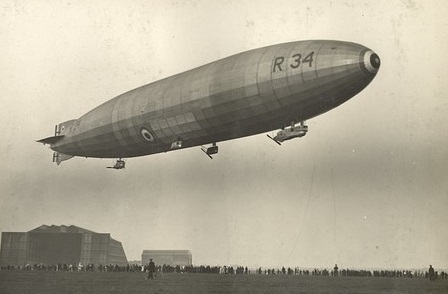
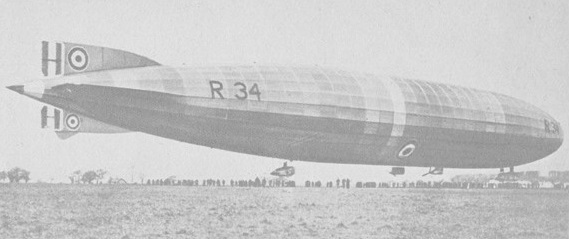
R34
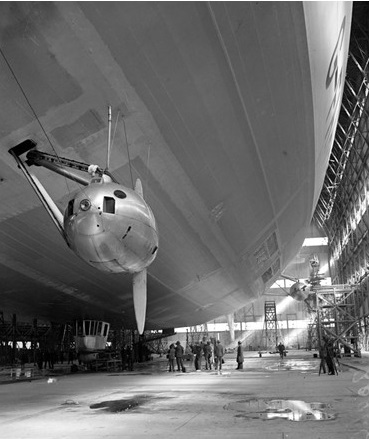
Two more power cars were suspended in the wing positions further aft along the hull and a single engine aft car was positioned amidships at the rear of the craft. All five engines were 275 hp (205 kW), Sunbeam Maori water-cooled petrol units, with one in the aft section of the control car, two more in a pair of power cars amidships each driving a pusher propeller via a reversing gearbox for manoeuvering, and the remaining two in a centrally mounted aft car, geared together to drive a single pusher propeller. The power cars included two gearboxes for each engine, enabling the engines to be started up and running without the propellers rotating. The ship carried enough fuel for 48 hours engine running, but to increase range it was possible to fly the ship on only 3 engines, giving the ship a speed of some 40 knots with petrol consumption of one mile a gallon. The petrol was held inside the hull and fuel flowed from them by gravity to header tanks in the engine gondolas. The reasoning behind this change of arrangement was to feed a smoother and more precise fuel supply than the older arrangements in earlier ships of direct gravity feed.
The radiators in the forward engine gondolas had the flow of air regulated by the use of movable shutters, however the rear gondolas had the old type of traditional “elevated” radiator. Twenty main frames and thirteen longitudinals made the main structure of the ship. There were 19 gasbags within the hull giving a capacity of 1,950,000 cubic feet of hydrogen giving a disposable lift of almost 26 tons. The total construction of the R33 came to £350,000.
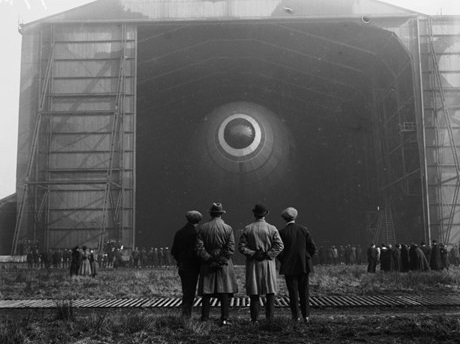
R33 in its hangar before its first flight in Barlow, Yorkshire, March 1919
R33 first flew on 6 March 1919, and was sent to RAF Pulham in Norfolk. Between then and October 14, R33 made 23 flights totalling 337 hours flying time. One of these, a flight promoting “Victory Bonds” even included a brass band playing in the top machine gun post.
In 1920 she was “demilitarised” and given over to civilian work with the civil registration G-FAAG. This work consisted of trials of new mast mooring techniques using the mast erected at Pulham. On one occasion winds of 80 mph (130 km/h) were successfully withstood while moored. Another experiment was an ascent carrying a pilotless Sopwith Camel which was successfully launched over the Yorkshire Moors. After an overhaul, R33 was based at Croydon Airport, moored to a portable mast. In June 1921 it was used by the Metropolitan Police to observe traffic at the Epsom Derby, and in July she appeared in the Hendon Air Pageant before flying to Cardington, Bedfordshire, where she was laid up for three years.
On 31 May 1921 the British government cancelled all airship development for financial reasons. Military airships were scrapped, but as a civilian airship R33 was mothballed instead. In 1925, after being inactive for nearly four years, the reconditioned R33 emerged from her shed at Cardington.
At 09:50 on 16 April 1925 the R33 was torn from the mast at Pulham during a gale, and was carried away with only a partial crew of 20 men on board. Her nose partially collapsed and the first gas cell deflated leaving her low in the bow. The crew on board started the engines, gaining some height, and rigged a cover for the bow section, but the R33 was blown out over the North Sea. A Royal Navy vessel was readied and left the nearby port of Lowestoft in case the R33 came down in the sea. The local lifeboat was launched, but was driven back by the weather conditions.
Some five hours after the initial break from the mast, R33 was under control but still being blown towards the Continent. As she approached the Dutch coast R33 was given the option of landing at De Kooy, where a party of 300 men was standing by. Late in the evening R33 was able to hold her position over the Dutch coast, hovering there until 5 o’clock the next morning. She was then able to slowly make her way back home, arriving at the Suffolk coast eight hours later and reaching Pulham at 13:50 hrs, where she was put into the shed alongside the R36.
For their actions the airships first officer, who had been in command, Lieutenant Ralph Booth was awarded the Air Force Cross, the coxswain, Flight-Sergeant “Sky” Hunt, was awarded the Air Force Medal, four other crew members were awarded the Meritorious Service Medal and the other crew members were presented with inscribed watches.
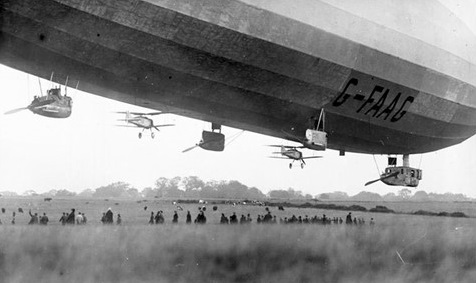
In October 1925, following repairs, she was used for experiments to provide data for the construction of the R101 airship. Once these were finished, in mid-October, she was used for trials launching a parasite fighter, using a DH 53 Hummingbird light aircraft. After some near misses, a successful launch and recapture was achieved in December that year. The following year she launched a pair of Gloster Grebes weighing about a ton apiece, the first of which was flown by Flying Officer Campbell MacKenzie-Richards. She was then sent to the sheds at Pulham where she was finally broken up in 1928, after “severe” metal fatigue was found in her frame. The forward portion of R33’s control car is on display at the RAF Museum at Hendon.
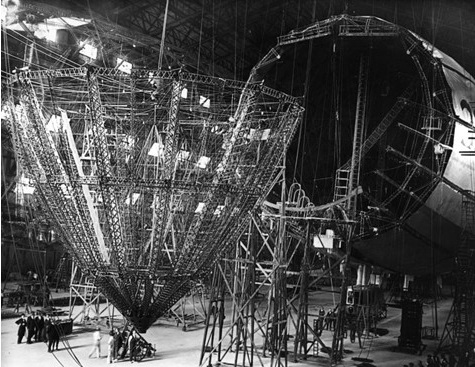
Construction of a new nose for the R33, 1925
The R33 class of British rigid airships were built for the Royal Naval Air Service during the First World War, but were not completed until after the end of hostilities, by which time the RNAS had become part of the Royal Air Force. The lead ship, R33, went on to serve successfully for ten years and survived one of the most alarming and heroic incidents in airship history when she was torn from her mooring mast in a gale. She was called a “Pulham Pig” by the locals, as the blimps based there had been, and is immortalised in the village sign for Pulham St Mary. The only other airship in the class, R34, became the first aircraft to make an east to west transatlantic flight in July 1919 and by the return flight, completed successfully the first two-way crossing, and was decommissioned two years later after being damaged during a storm. The crew nicknamed her “Tiny”.
Gloster Grebe fighter planes, tethered to the underside of the British Royal Navy airship R33, October 1926
R34 made her first flight on 14 March 1919 and was delivered to her service base at East Fortune on 29 May after a 21-hour flight from Inchinnan: having set out the previous evening, thick fog made navigation difficult, and after spending the night over the North Sea the fog made mooring impossible in the morning, and after cruising as far south as Yorkshire she returned to East Fortune to dock at about 3 pm R34 made her first endurance trip of 56 hours over the Baltic from 17 to 20 June.
R34
It was then decided to attempt the first return Atlantic crossing, under the command of Major George Scott. R34 had never been intended as a passenger carrier and extra accommodation was arranged by slinging hammocks in the keel walkway. Hot food was prepared using a plate welded to an engine exhaust pipe.
The crew included Brigadier-General Edward Maitland and Zachary Lansdowne as the representative of the US Navy. William Ballantyne, one of the crew members scheduled to stay behind to save weight, stowed away with the crew’s mascot, a small tabby kitten called “Whoopsie”; they emerged at 2.00 p.m. on the first day, too late to be dropped off.
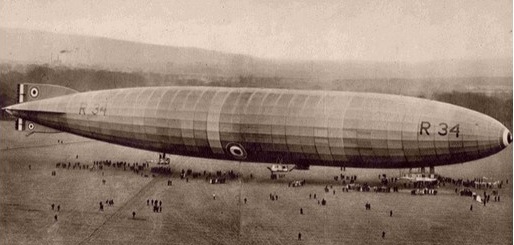
R34
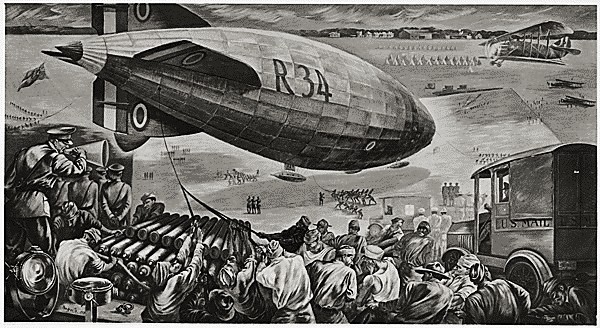
R34 left Britain on 2 July 1919 and arrived at Mineola, Long Island, United States on 6 July after a flight of 108 hours with virtually no fuel left. As the landing party had no experience of handling large rigid airships, Major E. M. Pritchard jumped by parachute and so became the first person to reach American soil by air from Europe. This was the first East-West crossing of the Atlantic and was achieved weeks after the first transatlantic aeroplane flight. The return journey to RNAS Pulham took place from 10 to 13 July and took 75 hours. Returned to East Fortune for a refit, R34 then flew to Howden, East Yorkshire, for crew training.
On 27 January 1921 R34 set off on what should have been a routine exercise. Over the North Sea the weather worsened and a recall signal sent by radio was not received. Following a navigational error the craft flew into a hillside on the North Yorkshire Moors during the night, and lost two propellers. She went back out to sea using the two remaining engines and in daylight followed the Humber estuary back to Howden. Strong winds made it impossible to get her back into the shed and she was tied down outside for the night. By the morning further damage had occurred and R34 was written off and scrapped.
R34, the first airship to make a round-trip flight across the Atlantic.
R34 Engines: 5 × Sunbeam Maori, 275 hp (205 kW) Length: 643 ft 0 in (196 m) Diameter: 79 ft 0 in (24 m) Volume: 1,950,000 cu.ft (55,000 cu.m) Useful lift: 58,240 lb (26,470 kg) Maximum speed: 62 mph (99 km/h) Crew: 26
 All Aero