Parseval PL 17 went to Italy
Airship
Parseval PL-14 / Puffin / Burevestnik / Petrel / Parseval II
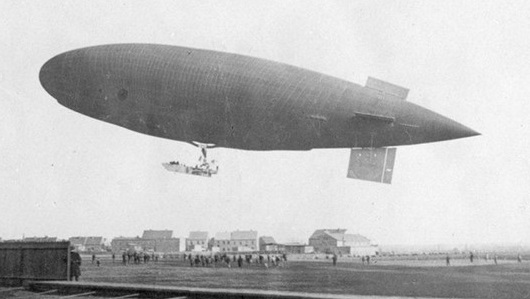
Built in 1913 by Luft-Fahrzeug-Gesellschaft, the non-rigid Parseval PL-14 Burewestnik was purchased in Germany by the Russian Federation and called “Parseval-II” (maybe was called “Puffin” or “Burevestnik / Petrel”).
Burevestnik was filled with gas in the first half of November, 1914 and executed some flights before it was recognized as unsuitable in fighting conditions. It was armed with machine guns and had bombs. It was not used in combat. It flew with the Russian Federation until disassembled in Spring 1915.
Engines: 2 x 177 h.p
Envelope volume: 9600 cu.m
Length: 86 m
Width: 16 m
Maximum speed: 67 kph
Endurance: 20 hr
Parseval PL 13
Parseval PL 13 went went to Japan
Parseval PL 9
Parseval PL 9 went to Turkey
Parseval PL-7 / Grief / Vulture
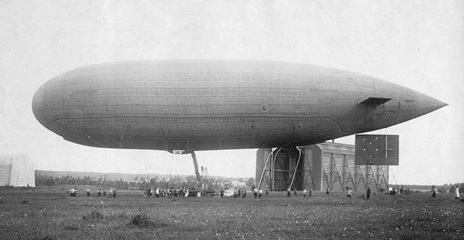
The non-rigid Parseval PL-7 was built by Luftfahrzeug-GmbH in 1910 for the Russian military and was purchased new from Germany by Russia, and named “Grief”.
Parseval V Sportsluftschiff / P.L.5
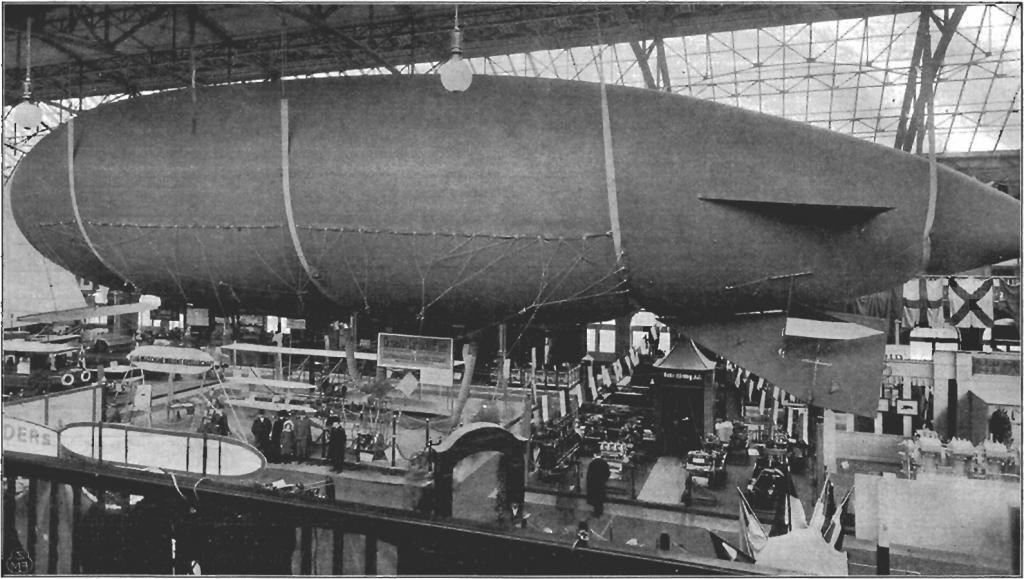
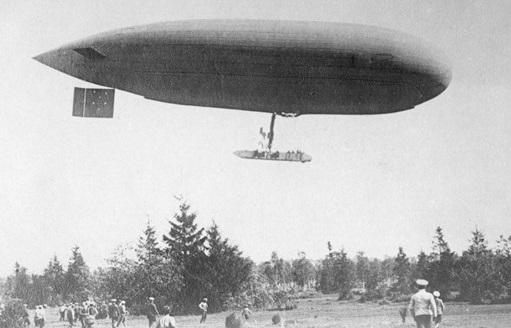
The Parseval V Sportsluftschiff, the smallest Parseval airship was built specifically for sports purposes, the gas cover contained 1200 cu.m within a length of 30 m. It was equipped with a mechanical elevator, consisting of an adjustable horizontal surface. It was exposed at the Internationale Motorboot- und Motorenausstellung in Berlin which was held from March 19th till April 3rd 1910 and was destroyed by fire on June 16th, 1911.
Parseval PL 4
Parseval PL 4 went to Austria (Had also one Lebaudy)
Parseval PL-1
At the instigation of the Kaiser a committee was formed, the Moorluftschiff-Studien-Geselechaft, to investigate the work of promising experimental airship proposals. One of the designs selected by this committee as being worthy of further encouragement was that of Major August von Parseval. His first ship, built during 1906, was of 88,000 cu.ft capacity, powered by two 50 hp Mercedes motors and of an advanced aerodynamic form that contributed to its relatively high speed.
Control in the vertical plane was effected by the provision of two internal balloonets forward and aft, which allowed the nose to be depressed or elevated by filling or emptying one or the other. Simple control surfaces were also fitted to the tail section of the envelope, while and automatically compensating suspension system working on rollers allowed the car to move forwards or backwards whilst maintaining a horizontal axis irrespective of the attitude of the envelope.
Parseval
At the instigation of the Kaiser a committee was formed, the Moorluftschiff-Studien-Geselechaft, to investigate the work of promising experimental airship proposals. One of the designs selected by thic committee as being worthy of further encouragement was that of Major August von Parseval.
Between 1906 and 1923 the Parseval concern built 27 pressure airships, the last of which was of 1 million cu.ft in capacity.
At the time, the Parseval airships impressed the British Committee of Imperial Defence by their performance and potential and an example was purchased for the Royal Navy, with orders placed for three others.
Nobile USSR-V5 / Russian Empire Airship USSR-V5

The Russian “Dirizhablestroem” was staged with developing the production of semi-rigid airship types. In order to speed up the execution of the tasks, in 1932 in the Soviet Union invited Italian Umberto Nobile, who was to head the technical management of the project.
In 1931 Umberto Nobile left Italy to work for the next four years in the Soviet Union where he helped with the Soviet semi-rigid airship programme. There is an obvious Nobile influence in the design of the airships USSR-V5, and SSSR-V6 OSOAVIAKhIM.
By the end of February 1933 USSR-V5 was prepared as the first semi-rigid airship in the. On April 27, 1933 Nobile first took to the air. This airship was of small size, its volume was only 2,340 cubic meters. It was explained that the USSR B-5 was conceived as a semi-rigid airship, established to give Russian designers practical experience with Italian semi-rigid systems, and identifying those problems that might face in the USSR in the production of airships larger volume. In addition to the B-5 was planned to conduct training of ground staff and pilots.
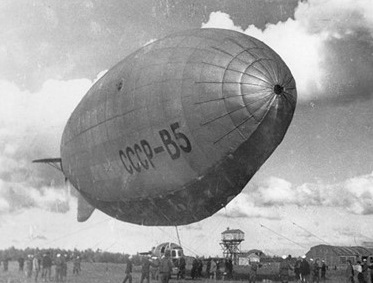
In May 1933, after passing a series of municipal acceptance tests, B-5, was admitted to the civilian air fleet. In 1933, Nobile made over a hundred flights. The experience gained during its construction, and operation was the basis for the construction of the largest airship in the USSR-6 “Osoaviakhim.”
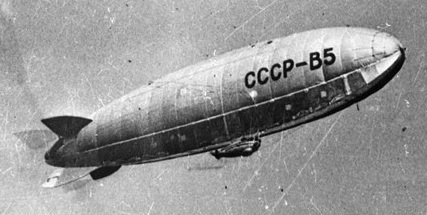
The CCCP B-5 (USSR V5) was dismantled in 1934 – her ‘envelope’ was leaking and generally unreliable. While a new ‘envelope’ development has been in progress, lightning struck the hangar near Moscow where parts of the dirigible were stored. Everything went down to ashes, not only cases with B-5 parts, but her sistership B-4 (also dismantled) and a brand-new B-7 as well.
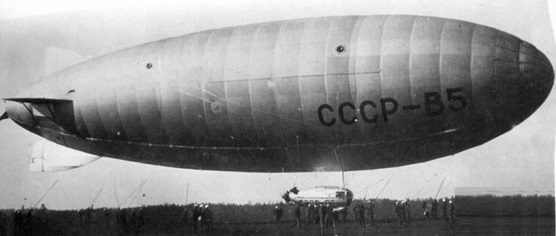
Engines: 3 × Piston engines, 140 kW (190 hp) each
Volume: 19,400 cu.m (685,000 cu.ft)
Length: 104.5 m (344 ft 6 in)
Diameter: 18.8 m (65 ft 7 in)
Gross weight: 12,000 kg (26,400 lb)
Useful lift: 9,300 kg (20,460 lb)
Maximum speed: 93 km/h (58 mph)
Range: 2000 mi
Range 1937: 3107 mi
Endurance: 130 hr 30 min
Crew: 15
 All Aero