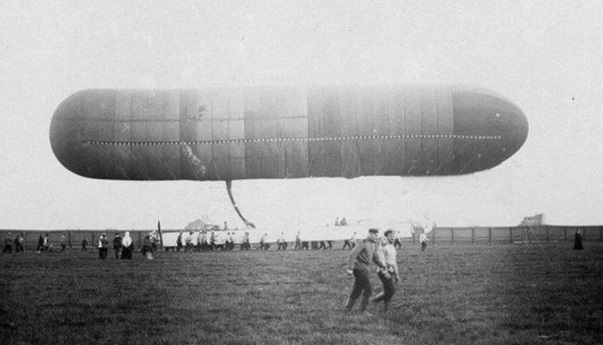
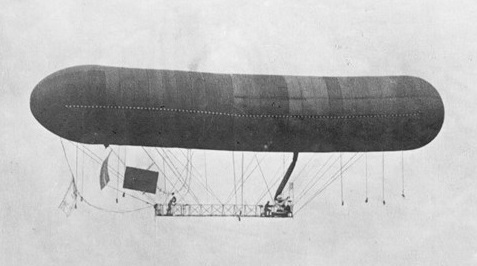
Built in 1908 in Russia the very first Russian airship titled “Training.” The shell was made from two old “Parseval” airships.
This machine was a test board for airship design and operation. “Training” had a solid rate of climb, overtaking the characteristics of the “Zeppelin” and very often used for training crews.
The non-rigid airship was demolished in 1909 due to the dilapidated shell.
Length: 60 m Width: 6.55 m Envelope volume: 1200 cu.m (later 1500 cu.m) Maximum speed: 21 km / h Engine: 1 x 16 hp (later 25 hp)
In 1906 the Chief Engineer’s Office Russian Empire was specially seconded to France, with a delegation of engineers and professionals for the development of on-site experience of the most advanced airship.
In 1923, the Society for the Friends of the Air Fleet of the USSR was created special Vozduhtsentr with tasks which included the promotion of Russian airship in Russia. After a while Vozduhtsentr was renamed vozduhsektsiyu Osoaviahima USSR and in the autumn of 1924 completed the construction of another Myagenko airship under the title “Moscow chemist rezinschik” (MHR). This title pointed to the fact that it was made by means of chemical industry workers in and around Moscow. The designer of this project was N. Fomin.
At the end of 1931 at CAB CAF was created under the title “Dirizhablestroy.” This organization was to unite the efforts of various groups of professionals working in the field, as do the planned deployment of the work in designing and building the next Russian airships. Also, the organization should take the time to research on the topic of aeronautic and improve methods of exploitation airships.
Nobile worked in the USSR from 1931 until 1935. He is believed to have been responsible for the design of nine semi-rigid airships.
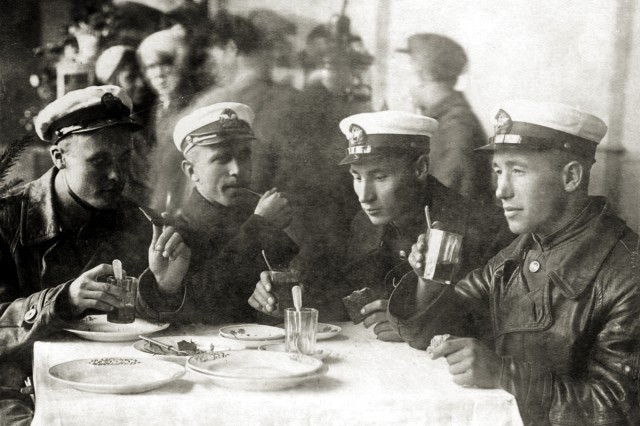
Russian airship crewmen (left to right) – Nikolai Gudovantsev, Ivan Obodzinsky, Ivan Pan’kov and Vladimir Ustinovich. 1933
The rationale for the Soviet program was to provide transport to distant rugged regions, notably Siberia, as well as such utility functions as surveying.
There were works at Leningrad, and Zagi near Moscow, the latter also the center of Tsiolkovski’s metalclad efforts. The plan was to make 92 ships but it is unknown how many were actually made.
There were also some non-rigids built in 1937 at Zagi.
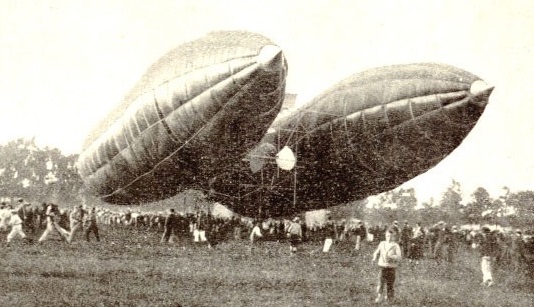
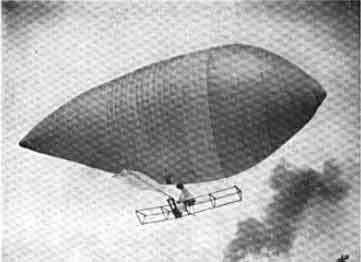
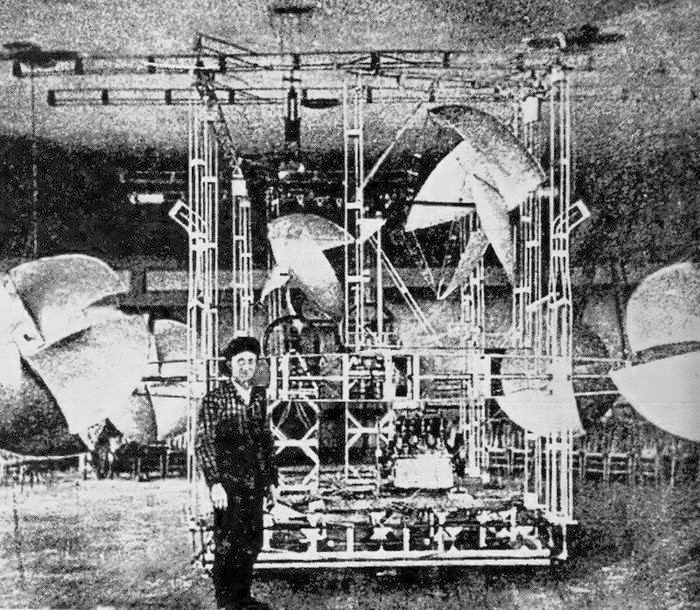
The “Aviateur”, as designed and built by Louis-Étienne Roze. Recognizable due to the catamaran configuration of the rigid airship hulls. The Aviateur was a putative challenger for the Deutsch de la Meurthe prize, eventually won by Santos-Dumont using his No. 6 dirigible – but when tested in 1901, it failed to fly.
Trials took place on the 5th and 6th of September 1901. Miscalculations by M.Roze meant the airship was too heavy and managed to lift only fifteen feet, then coming down and landing softly. At 10 hp each, the two Santos-Dumont (Buchet) motors were too weak. The inherent problem with the motors was that they served the lifting propellors, which in turn had to be switched over to the propulsion/push propellors to move forward. Thus , no forward flight and the silk “wings” remained vertical, not closing to the horizontal.
As Roze had no further financial means to build the Aviateur larger nothing was ever heard of his airship again.
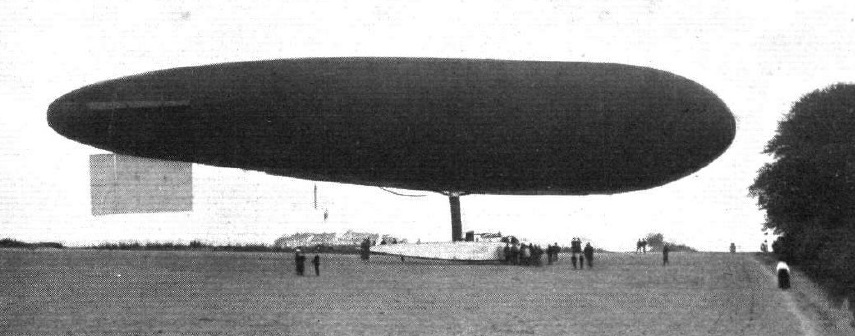
The “Eta” which in a progressive series of small experimental airships built at the Royal Aircraft Factory. The small airships that have been built there were quite inadequate from the standpoint of national requirements.
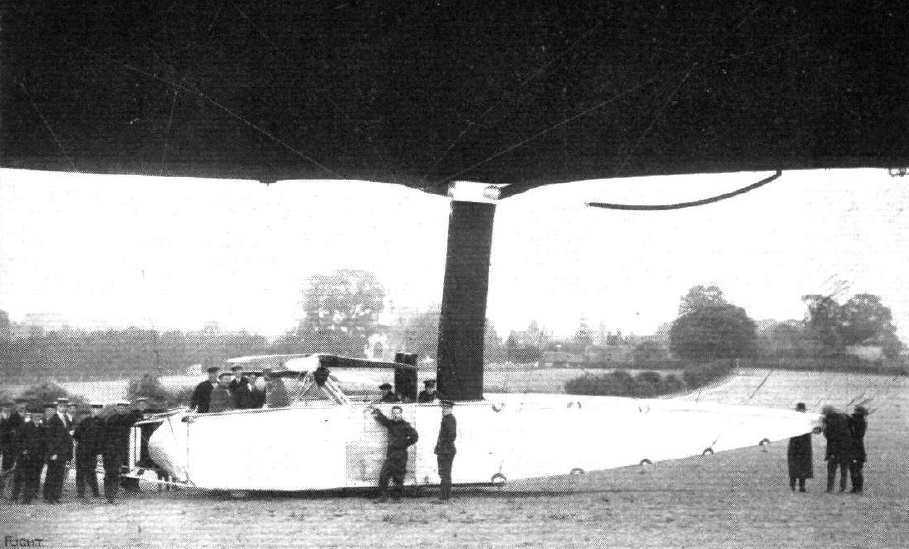
The capacity of the 1913 “Eta” is 100,000 cubic ft, and.it carried 160 hp in two radial stationary Canton-Unne engines, set on opposite sides of the car with their axes placed transversely. Oblique shafts transmit the power to gearing, supported by an overhead framework, which also carries the swivelling propellers. As the airship ascends, these propellers are swivelled round, so that ultimately their axes are horizontal for full speed ahead. In order to stop the airship they can be turned completely round so as to thrust backwards, and they can similarly be used for lowering the airship for the purposes of descent.
Launched in August 1913, the Eta was a non-rigid of 118,000 cu.ft incorporating twin ballonets and capable of 46 mph. The Eta introduced the ‘Eta patch’ in its design as an improved anchorage system for car suspension that greatly reduced drag. The Eta patch allowed the car to be made smaller and attached nearer to the envelope, providing a better streamlined form and reducing drag. The patch consisted of a steel ring through which several layer of overlapping material were rove, forming a fan-shaped patch with the ring positioned at the lower apex. The overlapping layers of fabric were glued and stitched to each other and to the envelope, forming a strong attachment position allowing fr better distribution of load.
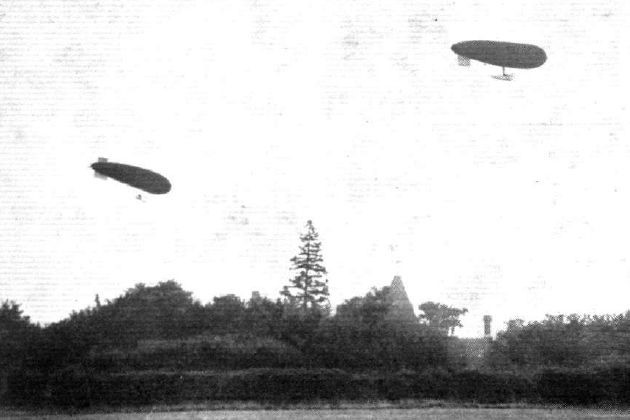
On August 19, 1913, “Naval Airship No.2” (the re-constructed “Willows No.4” – under the command of Lieut. Neville Usborne, R.N.) experienced engine failure due to a broken crankshaft near Odiham in Hampshire. In order to save the hydrogen in the disabled airship, it was decided to try and tow it home employing the airship “Eta” – newly-constructed by the Royal Aircraft Factory and currently undergoing its acceptance trials. Accordingly, a tow-line was attached and the two airships ascended, the “Eta” keeping about 600 feet above the towed ship so as to avoid all chances of fouling the rudder gear. The approximate 8-mile trip back to the airfield at Farnborough was made at a groundspeed of 25 mph against a 5 mph headwind. The “Eta” was in all probability skippered by Army Capt. Waterlow at the time.
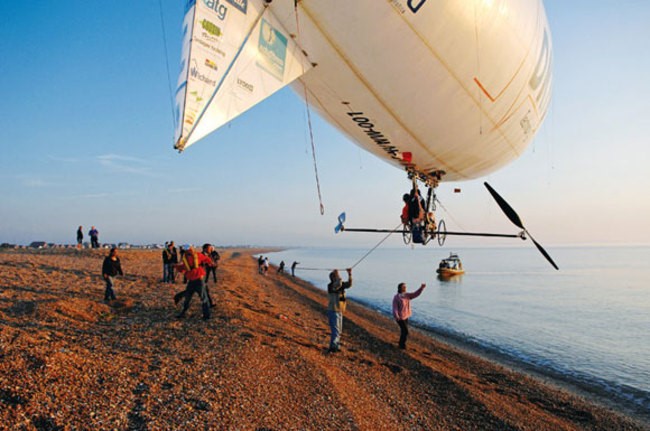
Rousson’s blimp, a crank-driven zeppelin known as Zeppy, is 16-meters-long with a 5-meter diameter, and a maximum speed of 20 kph. The craft’s forward momentum and steering come from a pair of 10-foot movable propellers turned by a recumbent bike hanging from the ship’s belly and pedalled.
Rousson, a 39-year-old Frenchman, attempted to cross The English Channel in a pedal-powered airship on 28 September 2008. He was forced to deflate his blimp and continue to France in a boat after a shift in winds made it impossible for him to progress, no matter how hard he pedalled.
“We were about three-quarters of the way across but the wind was flowing in the wrong direction for me to make it across,” he said. “I’m not disappointed. I feel happy because it had nothing to do with any technical failure, it was purely the wind that got in the way of this achievement.”
The failure is strike two for Rousson, whose June attempt to cross the Channel was also foiled by winds. This time around, he waited more than a week for the right conditions, but was doomed by a light breeze that picked up while he was in flight. “What feels breathlessly still to most people feels like a storm when you’re trying to fly a pedal-powered airship,” he says.
Rousson’s singular focus on flight also seems to be taking over his life. “All of my money has gone into this,” he says. I’m in quite a bit of debt.” He was also dumped by his girlfriend; presumably he loves his blimp more than he loves her.
Connecticut inventor Charles F. Ritchel made his mark in aviation history—and the cover of Harper’s Weekly magazine—by building a dirigible of his own and sponsoring the first controlled flight of a dirigible in America in Hartford in 1878.
Having been first flown outdoors less than two weeks before by Mark Quinlan in Bridgeport, Connecticut; Charles F. Ritchel began exhibiting his flying machine – also known as the Dirigicyle, or Flying Car – at Boston’s Tremont Temple on June 24, 1878. The demonstration, arranged by William McMahon, who played a major role in introducing Edison’s phonograph to the public, was a complete success. In addition to the indoor flights, Quinlan made an exciting ascension from Boston Common. Once in the air, the propeller gears jammed, allowing the balloon to rise dangerously high. Without a valve to relieve the increased pressure of the expanding lift gas, the envelope swelled, breaking several of the bands from which the frame was suspended. Quinlan could not slit his envelope, for there was no netting in which the fabric could gather to form a parachute. He had little choice but to tie one hand and ankle to the frame, then drop beneath the craft to make repairs with a jackknife as his only tool. He finally descended at Farnumsville, 44 miles from the Common, after a flight of one hour and twenty minutes.
Baldwin’s Aerial Rowboat proved a remunerative attraction, though a short-lived one: One night its hydrogen inexplicably ignited, destroying the craft.
That didn’t deter Alva L. Reynolds from launching his own version at nearby Fiesta Park the same year. Thirty-four feet long and 14 feet in diameter, Man Angel had a four- by 10-foot wooden gondola, a 3,000-cubic-foot gas envelope, and a weight of only 18 pounds. Like Baldwin’s craft, it was propelled by oars.
The earliest of six neutral-buoyancy man-powered dirigibles designed and built by Alva L. Reynolds of Los Angeles, California, trials performed above Fiesta Park, Los Angeles, where the aerial rowboat was first flown by Herbert Burke on July 27, 1905.
Reynolds claimed that just about anyone could operate Man Angel. To prove it, he allowed 17-year-old Hazel Odell to take the helm. According to a reporter at the Los Angeles Herald Examiner:
“Miss Odell entered the car and…raised herself to 100 feet. After slight effort she was able to propel the airship in any direction and control its ascent and descent at will. When asked for her motive for performing the feat Miss Odell said: ‘Why should I not? Other people have done it and I was not afraid.’ ”
Reynolds built six Man Angels and leased them to fairs in Kansas, Arizona, and Texas. He also opened a flying school, where he gave twice-daily demonstrations.
Man Angel No.2
The 1905 “Man Angel” hydrogen-filled balloon was 34 feet long and carried an 18 pound frame in which a man sat using ten foot long oars to row across the sky.
Man Angel No.2
The U.S. government investigated purchasing one.
That October, Reynolds challenged Baldwin to an airship race. When Baldwin’s pilot, the balloonist Roy Knabenshue, asked for $20,000 in expense money, Reynolds said Knabenshue was “afraid to race.” In 1906, to keep up interest (and revenue), Reynolds challenged an automobile to a 30-mile race from Chutes Park to Pomona. So confident was Reynolds that Man Angel No. 6 would win, he gave the Herald Examiner $1,000 to hold as prize money. On the day of the race, Man Angel faced such strong head winds it was handily beaten. In a subsequent race, the airship got caught on a telephone wire and crashed into a treetop.
Reynolds never raced Man Angel again. He returned to inventing, and found a method for generating electricity from ocean waves.
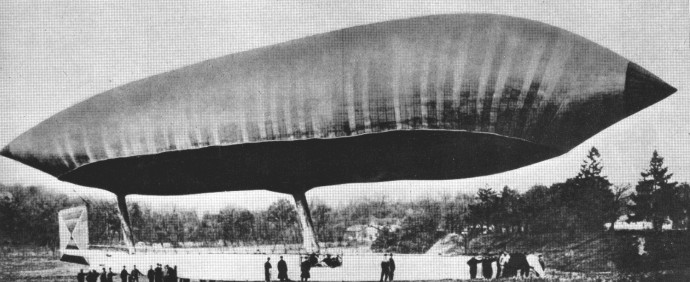
In 1884, under the direction of Renard and Krebs of the French army aeronautical establishment at Chalais Meudon, successful experiments were made employing electrical power with the airship La France.
At the French military balloon establishment at Chalais Meudon, in 1884, engineers Charles Renard and Captain A.C.Krebs designed and constructed the airship La France which was to prove capable of steady, navigable flight, and eas able to describe circular flights against the wind and return to its departure point.
La France, with a capacity of 66,000 cu.ft, was 165 ft long with a diameter of 28 ft, the envelope being made from Chinese varnished silk and of streamlined form. Below the envelope an enclosed car, 108 ft in length, contained a Gramme electric motor, developing 8.5-9 hp for a weight of 210 lb, together with the chromium-chloride batteries that drives a cloth covered tractor airscrew of 23 ft diameter. The battery weighed 435 kg.
The France was thirty-two feet in maximum diameter and nearly 200 feet long, the empennage planes aggregating about 400 square feet were placed forward of the stern.
Steering in the horizontal plane was effected by a large rectangular rudder at the stern, while vertical movement and attitude were controlled by a sliding weight mounted within the body of a car assistd by an ‘elevating rudder’.
In a series of trials the airship demonstrated controlled flight, achieved a speed of 14 mph and made several flights over Paris. The weight of the batteries, limited range and carrying capacity prevented further development.
The first trial of La France took place on 9 April 1884. The flight proving a limited success: making a circular flight of 5 miles in twenty-three minutes at a speed of around 12.5 mph in still air, then returning to its starting point, Chalais-Meudon – the first time this had ever been done. Six other flights were made during 1884-85, including two over Paris.
Chalais-Meudon Renard-Krebs “La France” Engine: 1 x Elektromoteur Gramme electric: 9 hp Batteries: Chromium chloride Contained volume: 65,695 cu.ft / 1860 cu.m Length: 165 ft / 50.0 m Width of hull: 27.887 ft / 8.5 m Height: 60 ft Gross lift: 2.0 ton Useful lift: 0.1 ton Max. speed: 13 mph / 11 kt / 20 km/h Crew: 3
In 1884, Charles Renard and Arthur Krebs, achieve the first closed circuit flight aboard the airship « La France » starting from Meudon, depot Y
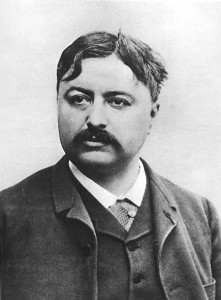
Charles Renard
Charles Renard was born at Damblain, Viosges, France, 23 November 1847. In 1873, he had developed an unmanned glider which was controlled by a pendulum device linked to its control surfaces. The glider was flown from a tower at Arras.
Renard also developed the powered Renard Road Train, in which the trailers were powered by drive shafts from the forward power car, and each car was steered through a system of linkages attached to the car ahead of it. He also developed the concept of preferred numbers.
Charles Renard remained in charge of the aeronautical establishment at Chalais-Meudon until his death. He committed suicide, 13 April 1905.
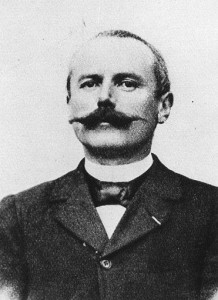
Arthur Constantin Krebs was born 16 November 1850 at Vesoul, France.
Arthur Constantin Krebs
Krebs was a prolific inventor. Following his work with La France, he completed the development of Gymnote (Q1), the world’s first all-electric submarine. His work on automobiles was extensive. He developed the concept of the front engine/rear wheel drive (Systeme Panhard); engine balancing; caster in the steering and suspension system, which allowed the steering wheels to self-center; the steering wheel; shock absorbers; four-wheel drive and four-wheel steering, etc. He invented the electric brake dynomometer which is used to measure power output of engines.
A contrivance consisting of two major parts, a cigar-shaped balloon, to which was attached a frame, on which were six propellers. Four propellers were used for ascending and two for steering. The power was supplied by a gasoline engine. The Streator, Illinois inventor declared that his ship could be driven from Chicago to New York at the rate of 100 miles an hour, and that it could be sailed around a tower with its side touching the structure at all times. It was planned to construct the machine at an expense of $ 10,000.







 All Aero