
On 24 October 2024, Google co-founder Sergey Brin’s airship company LTA Research announced Pathfinder 1’s first if brief untethered flight at Nasa’s Moffett Field in California, part of the space agency’s Ames Research Center.
Pathfinder 1 is a fully rigid airship. This was the first flight of the first airship built by the Google cofounder’s company, the first time a classic rigid airship of this size had flown since the 1930s, and the first of a new generation of airships.
Pathfinder 1 is not a historical replica. It is a proof-of-concept airship designed to see if a rigid design can be updated with new materials. In particular, LTA Research wants to solve the problem of how to mass produce aircraft of this size.
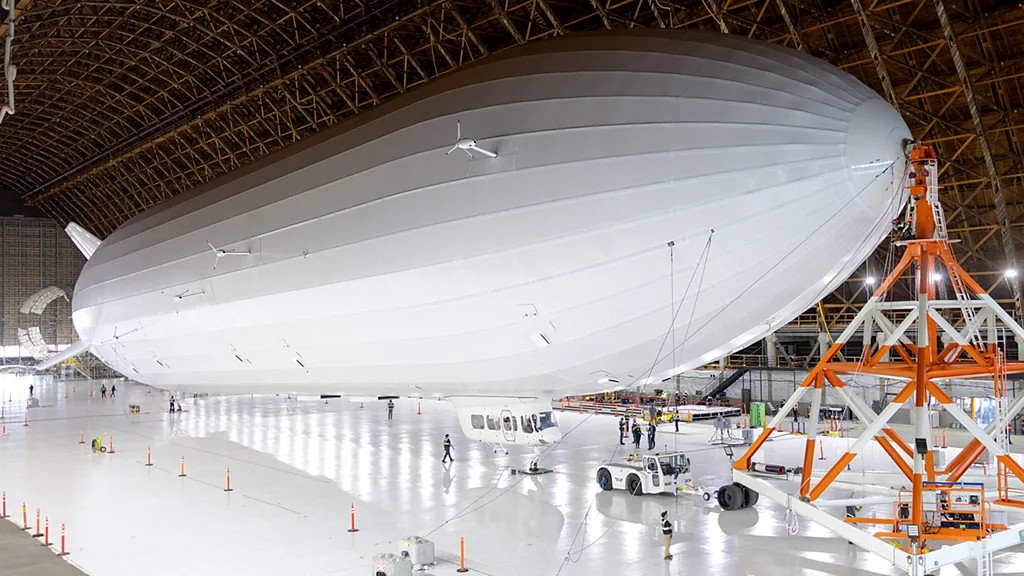
The fact that the giant rigid airship does not have tail fins in the traditional cross shape, but at an angle, is an example of such learning, because airships float up and down on a mooring mast and the bottom tail fin used to get damaged. Likewise, the airship’s engines are no longer inline but staggered along its length to reduce the wind, drag and vibration that they used to cause. It uses helium as a lifting gas.
The first flight of Pathfinder 1 has been at least 12 years in the making. Brin’s interest in airships seems to have begun in 2012 around the same time as a modern semi-rigid Zeppelin NT (New Technology) airship began tourist flights from Moffett Field.
The following year he founded LTA Research Ltd and in 2017 his airship company began to lease space at Moffett Field and research began at the Akron Airdock. There they built a 12-engine, 50ft-long (15m) electric “baby airship” to test their technology.
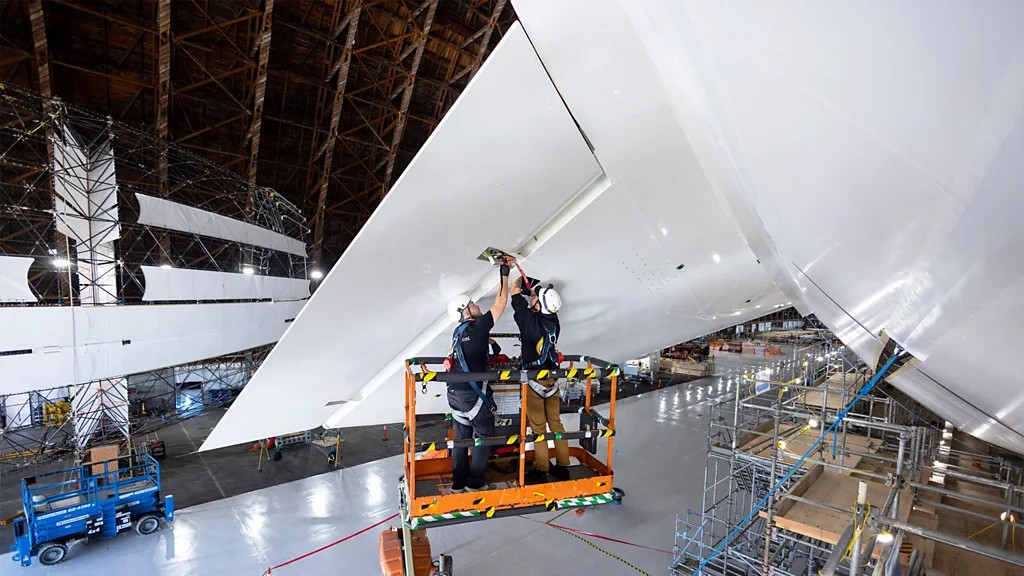
The use of computerised controls, new and much stronger lightweight materials like carbon fibre and titanium to construct the complex skeleton of the rigid airship are just some of the ways the giant rigid airship has been brought into the 21st Century. So too are the use of flame-retardant synthetic materials for the envelope of the airship, sensors to monitor the helium and engines that can be rotated to provide vectored thrust.
In 2017 work started at Moffett Field on LTA’s smallest airship Pathfinder 1, and planning began in Akron on the Pathfinder 3, its successor which is planned to be one-third-larger. (There is no Pathfinder 2.)





 All Aero